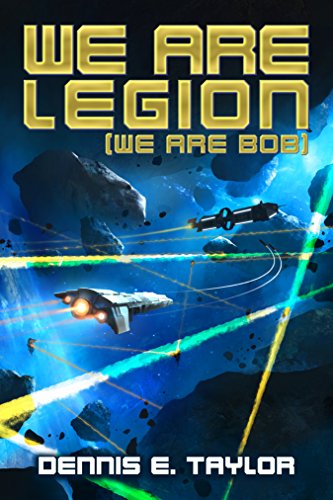
We are Legion (We are Bob)
by Dennis E. Taylor
- Author:
- Dennis E. Taylor
- Status:
- Done
- Format:
- eBook
- Genres:
- Science Fiction , Fiction , Fantasy , Space Opera , Humor , Space
- Pages:
- 299
- Highlights:
- 20
Highlights
Page 38
‘Stereotypes are valid first-order approximations.’ The man was the cliché of the old-time, bible-thumping, fire-breathing preacher: tall and thin, with cheekbones and teeth that seemed to protrude from his face. Even when he smiled, he glowered.
Page 68
She spoke with the standard 22nd century accent, so I was using my translation routine. I’d integrated it to the point where I didn’t even notice the different speech patterns. I knew that Dr. Landers was specially trained to deal with replicants, and had studied my era. Which included getting his patois under control. Dr. Doucette either had skipped that class, or wasn’t normally supposed to be talking to me.
Note: Not Impressed with the author. He doesn’t know the difference between an accent and a dialect.
Page 85
Jeeves came in with fresh coffee. Another example of my lack of maturity, Jeeves was the image of John Cleese, complete with tuxedo and tails.
Note: Should be Stephen Fry
Page 103
playing possum
Page 108
puta merde.”
Page 204
I sat back and massaged my eyes. Well, I’ve always wanted a challenge. When I left the solar system—okay, when Bob-1 left the solar system, but it felt like my own memory—I thought I was done with humanity, except for the occasional radio message. Now, I was not only back to dealing with people, but I had thousands if not millions of lives riding on my actions. The old Pacino-ism really nailed it: Just when I thought I was out, they pull me back in!
Note: The writing is a bit shit.
Page 213
“As if I needed more motivation. Riker out.” I shut down the channel, sat back, and stared into space. I liked the colonel. Really. But dealing with him often felt a lot like dealing with, um, me. He was stubborn, opinionated, and able to support his stance with good, solid arguments. Which just made my job more difficult.
Note: Tells, doesn’t show.
Page 216
play. Let’s hope not this time.” I nodded. “Yeppers. You know, it’s funny. When I left Earth, I just wanted to get away from humanity. Now I find myself acting like some kind of, I dunno, shepherd or something.” “How does the old joke go? I like people in the abstract but not in the concrete?” “Hmm, well, we’ll know in a few years. Meanwhile, how’s the Kuiper mapping going?”
Note: The dialogue is insipid. How is that a joke.
Page 234
Finally, things calmed down. Deltans stood around eyeing each other while another individual was fetched. I could see that he was older—it looked like age was age, whatever planet you lived on. His fur was going gray, and he was stooped. His muscle tone was poor, so he moved slowly.
Note: Just no imagination. A completely alien species is exactly like humans. Sigh.
Page 240
The Deltans followed them to the edge of the camp, screaming and yelling. Again, I made careful note of the verbalizations. Pretty sure there were variations of “your mamma” in there. The first official English/Deltan dictionary would not be suitable for all ages if I had a say in it.
Note: Just no talent at all. These “jokes” fall flat
Page 240
The Deltan defense force fell silent, and I discovered that slack-jawed amazement was probably a universal expression.
Note: Nah mate you just lack imagination
Page 247
“Minister Cranston?” “Yes, replicant?” “Go fuck yourself.” I terminated the call, and examined the next in queue. * * *
Note: Man can’t write dialogue to save his life
Page 260
Julia and I looked at each other in shock for a moment, then we both started to speak at the same time. The log says we talked for three hours, but it felt like no time at all.
Note: It’s such a step down to go from Madeleines Miller to this. I’m reminded of her love for Daedalus, and how that was expressed.
Page 263
I’d finally gotten to see how the Deltans handled their dead. They did indeed have a ceremony, and they buried their dead. They also mourned them, every bit as heart-wrenchingly as any human. I’d had to turn away from the video for most of that.
Note: Wow precisely like humans. What a coincidence.
Page 279
I gave him my best glare and materialized another ball. “I might build a bunch of Bobs and field a team or two…” “Oh jeez no. Half of them will turn Canadian and want to play hockey instead, eh.” I laughed and tossed the new ball.
Note: Not funny
Page 288
Archimedes was no dummy. The sight of the whole village staring at a spot over his head had only one possible explanation. In an impressive display of natural showmanship, Archimedes didn’t look up or directly acknowledge the probe. He simply crossed his arms and looked smug.
Note: Impressive lack of imagination
Page 338
The android was currently powered down and draped on the support rack. Bullwinkle was a quadruped design, about the size of a moose, and every bit as pretty. The external comms array on its head was strangely reminiscent of a famous pair of antlers. Probably not coincidence. Did I mention I’m not very mature?
Note: You don’t need to mention it every time though.
Page 346
“And firewall our device comms. I doubt those things had time to finagle the encryption keys from the roamers, but why take chances?”
Note: Even for a software engineer this doesn’t make sense
Page 362
That left just Elmer and me. I had to give him credit. Now that things had hit the fan, he was no longer whining about the danger. I mentally upgraded him to Michael Biehn.
Note: His humour is entirely just references.
Page 367
“Welcome to the home of Spock, boys.” I popped into the common VR and grinned at them. They were grinning back, of course. After all, Bob. Bert and Ernie had adopted Battlestar Galactica-style uniforms and command deck VRs. I was a little surprised by that, as it hadn’t been one of my favorite shows. Although the Cylons were definitely bad-ass. “I was seriously considering putting up a couple of Vulcan cruisers to escort us in,” Ernie said. I felt my face turn red, and Bert started laughing so hard he almost lost his seat. We took a minute to enjoy the joke—belly laughs are one of the best things about being sentient, and you should never miss a chance for one. We wiped the tears from our eyes, and I pulled up a holo of the system, with Vulcan and Romulus showing in an inset window.
Note: What’s the joke