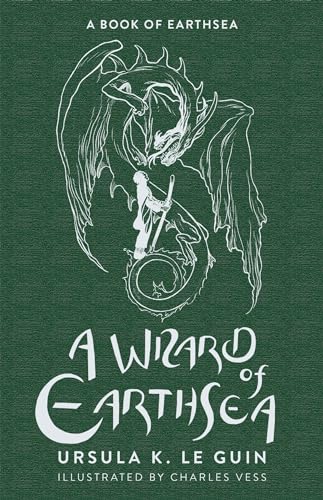
The Wizard Of Earthsea
by Ursula K. Le Guin
- Author:
- Ursula K. Le Guin
- Status:
- Done
- Format:
- eBook
- Reading Time:
- 4:41
- Genres:
- Fantasy , Fiction , Young Adult , Classics , Science Fiction Fantasy , Magic
- Pages:
- 251
- Highlights:
- 12
Highlights
Page 42
Of these some say the greatest, and surely the greatest voyager, was the man called Sparrowhawk, who in his day became both Dragonlord and Archmage. His life is told of in the Deed of Ged and in many songs, but this is a tale of the time before his fame, before the songs were made.
Note: sets the tone nicely
Page 142
It rankled at his heart that he should die, spitted on a Kargish lance, while still a boy; that he should go into the dark land without ever having known his own name, his true name as a man. He looked down at his thin arms, wet with cold fog dew, and raged at his weakness, for he knew his strength. There was power in him, if he knew how to use it, and he sought among all the spells he knew for some device that might give him and his companions an advantage, or at least a chance. But need alone is not enough to set power free: there must be knowledge.
Page 250
‘You want to work spells,’ Ogion said presently, striding along. ‘You’ve drawn too much water from that well. Wait. Manhood is patience. Mastery is nine times patience. What is that herb by the path?’ ‘Strawflower.’ ‘And that?’ ‘I don’t know.’ ‘Fourfoil, they call it.’ Ogion had halted, the copper-shod foot of his staff near the little weed, so Ged looked closely at the plant, and plucked a dry seedpod from it, and finally asked, since Ogion said nothing more, ‘What is its use, Master?’ ‘None I know of.’ Ged kept the seedpod a while as they went on, then tossed it away. ‘When you know the fourfoil in all its seasons root and leaf and flower, by sight and scent and seed, then you may learn its true name, knowing its being: which is more than its use. What, after all, is the use of you? or of myself? Is Gont Mountain useful, or the Open Sea?’ Ogion went on a half-mile or so, and said at last, ‘To hear, one must be silent.’
Page 467
To Ged, however, it seemed a city, and not knowing where to go he asked the first townsman of Thwil he met where he would find the Warder of the School on Roke. The man looked at him sidelong a while, and said, ‘The wise don’t need to ask, the fool asks in vain,’
Note: chutiya
Page 471
Ged asked his question of an old woman with a basket of mussels, and she replied, ‘You cannot always find the Warder where he is, but sometimes you find him where he is not,’ and went on crying her mussels to sell.
Note: facepalm
Page 021
‘You thought, as a boy, that a mage is one who can do anything. So I thought, once. So did we all. And the truth is that as a man’s real power grows and his knowledge widens, ever the way he can follow grows narrower; until at last he chooses nothing, but does only and wholly what he must do …’
Page 051
‘Master,’ said Ged, ‘I cannot take your name from you, not being strong enough, and I cannot trick your name from you, not being wise enough. So I am content to stay here, and learn or serve, whatever you will: unless by chance you will answer a question I have.’ ‘Ask it.’ ‘What is your name?’ The Doorkeeper smiled, and said his name; and Ged, repeating it, entered for the last time into that House.
Note: i like it when the narrator tells us something will happen for the last time. feels momentlus
Page 166
From that time forth he believed that the wise man is one who never sets himself apart from other living things, whether they have speech or not, and in later years he strove long to learn what can be learned, in silence, from the eyes of animals, the flight of birds, the great slow gestures of trees.
Page 325
The next day he met with Pechvarry, who said, ‘I did not know you were so mighty, my lord.’ There was fear in that because he had dared make Ged his friend, but there was reproach in it also. Ged had not saved a little child, though he had slain dragons. After that, Ged felt afresh the unease and impatience that had driven him to Pendor, and drove him now from Low Torning. The next day, though they would have kept him gladly the rest of his life to praise and boast of, he left the house on the hill, with no baggage but his books, his staff, and the otak riding on his shoulder.
Page 675
If he had once touched the Stone, or spoken to it, he would have been utterly lost. Yet, even as the shadow had not quite been able to catch up with him and seize him, so the Stone had not been able to use him – not quite. He had almost yielded, but not quite. He had not consented. It is very hard for evil to take hold of the unconsenting soul.
Page 253
Ged watched him with wonder and some envy, and exactly so he watched Ged: to each it seemed very queer that the other, so different, yet was his own age, nineteen years. Ged marvelled how one who had lived nineteen years could be so carefree. Admiring Murre’s comely, cheerful face he felt himself to be all lank and harsh, never guessing that Murre envied him even the scars that scored his face, and thought them the track of a dragon’s claws and the very rune and sign of a hero.
Page 536
And he began to see the truth, that Ged had neither lost nor won but, naming the shadow of his death with his own name, had made himself whole: a man: who, knowing his whole true self, cannot be used or possessed by any power other than himself, and whose life therefore is lived for life’s sake and never in the service of ruin, or pain, or hatred, or the dark.