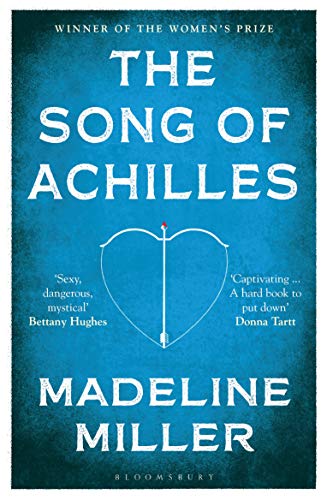
The Song of Achilles
by Madeleine Miller
- Author:
- Madeleine Miller
- Status:
- Done
- Format:
- eBook
- Reading Time:
- 6:43
- Pages:
- 352
- Highlights:
- 35
Highlights
Page 105
my mother on the beach, her eyes turned towards the Aegean. In this last memory, I am skipping stones for her, plink, plink, plink, across the skin of the sea. She seems to like the way the ripples look, dispersing back to glass. Or perhaps it is the sea itself she likes. At her temple a starburst of white gleams like bone, the scar from the time her father hit her with the hilt of a sword. Her toes poke up from the sand where she has buried them, and I am careful not to disturb them as I search for rocks. I choose one and fling it out, glad to be good at this. It is the only memory I have of my mother and so golden that I am almost sure I have made it up. After all, it was unlikely for my father to have allowed us to be alone together, his simple son and simpler wife. And where are we? I do not recognize the beach, the view of coastline. So much has passed since then.
Note: heartbreaking. “almost sure i made it up”
Page 8
‘True. But now I offer you a solution.’ He held up his hands, empty. ‘I have brought no gift, and do not seek to woo Helen. I am a king, as has been said, of rocks and goats. In return for my solution I seek from you the prize that I have already named.’ ‘Give me your solution and you shall have it.’ Again, that slight movement, from the dais. One woman’s hand had twitched against her companion’s dress. ‘Then here it is. I believe that we should let Helen choose.’ Odysseus paused, to allow for the murmurs of disbelief; women did not have a say in such things. ‘No one may fault you, then. But she must choose now, at this very moment, so she will not be said to have taken council or instruction from you. And.’ He held up a finger. ‘Before she chooses every man here must swear an oath: to uphold Helen’s choice, and to defend her husband against all who would take her from him.’
Page 14
The boy’s family demanded immediate exile or death. They were powerful, and this was their eldest son. They might permit a king to burn their fields, or rape their daughters, as long as payment was made. But you did not touch a man’s sons. For this, the nobles would riot. We all knew the rules; we clung to them to avoid the anarchy that was always a hair’s breadth away. Blood feud. The servants made the sign against evil. My father had spent his life scrabbling to keep his kingdom, and would not risk losing it over such a son as me, when heirs and the wombs that bore them were so easy to come by. So, he agreed: I would be exiled, and fostered in another man’s kingdom. In exchange for my weight in gold, they would rear me to manhood. I would have no parents, no family name, no inheritance. In our day, death was preferable. But my father was a practical man. My weight in gold was less than the expense of the lavish funeral my death would have demanded. This was how I came to be ten, and an orphan. This is how I came to Phthia.
Page 15
Peleus was a pious and obedient man and did all that the gods had instructed him to do. He waited for her to emerge from the slate-coloured waves, hair black and long as a horse’s tail. Then he seized her, holding on despite her violent struggles, squeezing until they were both exhausted, breathless and sand-scraped. The blood from the wounds she had given him mixed with the smears of lost maidenhead on her thighs. Her resistance mattered no longer: a deflowering was as binding as marriage vows.
Note: wtf
Page 17
‘Patroclus.’ It was the name my father had given me, hopefully but injudiciously, at my birth, and it tasted of bitterness on my tongue. ‘Honour of the father,’ it meant.
Page 20
Afterwards we were led into the dusty sun of the practice yards for training in spear and sword. Here is where I tasted the full truth of Peleus’ kindness: well-trained and indebted, we would one day make him a fine army.
Note: myrmidons! also i love the phrase tasted the full truth
Page 22
The keen edge of my envy was like flint, a spark away from fire.
Note: lovely
Page 25
‘You are here because you killed a boy. You understand this?’ This was the cruelty of adults. Do you understand?
Page 31
‘I have taken Patroclus from his drills.’ My name sounded strange on his lips; I almost did not recognize it. The old king’s brows drew together. ‘Who?’ ‘Menoitiades,’ Achilles said. Menoitius’ son. ‘Ah.’ Peleus’ gaze followed the carpet back to where I stood, trying not to fidget. ‘Yes, the boy the arms-master wants to whip.’ ‘Yes. But it is not his fault. I forgot to say I wished him for a companion.’ Therapon, was the word he used. A brother-in-arms sworn to a prince by blood oaths and love. In war these men were his honour guard, in peace his closest advisors. It was a place of highest esteem, another reason the boys swarmed Peleus’ son, showing off; they hoped to be chosen.
Page 43
And as we swam, or played, or talked, a feeling would come. It was almost like fear, in the way it filled me, rising in my chest. It was almost like tears, in how swiftly it came. But it was neither of those, buoyant where they were heavy, bright where they were dull.
Page 45
After the men were gone we would sit with him by the fire to hear the stories of his youth. The old man, now grey and faded, told us that he had once fought beside Heracles. When I said that I had seen Philoctetes, he smiled. ‘Yes, the bearer of Heracles’ great bow. Back then he was a spearman, and much the bravest of us.’ This was like him too, these sorts of compliments. I understood, now, how his treasury had come to be so full of the gifts of treaty and alliance. Among our bragging, ranting heroes, Peleus was the exception: a man of modesty.
Page 49
And she wished him to be a god. She had spoken it so simply, as if it were obvious. A god. I could not imagine him so. Gods were cold and distant, far off as the moon, nothing like his bright eyes, the warm mischief of his smiles. Her desire was ambitious. It was a difficult thing, to make even a half-god immortal. True, it had happened before, to Heracles and Orpheus and Orion. They sat in the sky now, presiding as constellations, feasting with the gods on ambrosia. But these men had been the sons of Zeus, their sinews strong with the purest ichor that flowed. Thetis was a lesser of the lesser gods, a sea-nymph only. In our stories these divinities had to work by wheedling and flattery, by favours won from stronger gods. They could not do much themselves. Except live, for ever.
Page 52
The boys too were growing older. Regularly now we heard moans behind closed doors, and saw shadows returning to their beds before dawn. In our countries, a man often took a wife before his beard was fully fledged. How much earlier then, did he take a serving girl? It was expected; very few men came to their marriage beds without having done so. Those who did were unlucky indeed: too weak to compel, too ugly to charm, and too poor to pay.
Page 68
‘Surgery?’ It was not a word I knew. ‘Healing. I forget the barbarities of the low countries.’ His voice was neutral and calm, factual. ‘Sometimes a limb must go. Those are for cutting, those for suturing. Often by removing some, we may save the rest.’ He watched me staring at them, taking in the sharp, saw-toothed edges. ‘Do you wish to learn medicine?’ I flushed. ‘I don’t know anything about it.’ ‘You answer a different question than the one I asked.’ ‘I’m sorry, Master Chiron.’ I did not want to anger him. He will send me back. ‘There is no need to be sorry. Simply answer.’ I stammered a little. ‘Yes. I would like to learn. It seems useful, does it not?’
Note: lovely dialogue. so natural
Page 76
He told us too of Heracles, his labours, and the madness that took him. In its grip he had not recognized his wife and children, and had killed them for enemies. Achilles asked, ‘How could he not recognize his wife?’ ‘That is the nature of madness,’ Chiron said. His voice sounded deeper than usual. He had known this man, I remembered. Had known the wife. ‘But why did the madness come?’ ‘The gods wished to punish him,’ Chiron answered. Achilles shook his head, impatiently. ‘But this was a greater punishment for her. It was not fair of them.’ ‘There is no law that gods must be fair, Achilles,’ Chiron said. ‘And perhaps it is the greater grief, after all, to be left on earth, when another is gone. Do you think?’ ‘Perhaps,’ Achilles admitted. I listened, and did not speak.
Page 78
I turned. Thetis stood at the edge of the clearing, her bone-white skin and black hair bright as slashes of lightning. The dress she wore clung close to her body and shimmered like fish-scale. My breath died in my throat. ‘You were not to be here,’ she said. The scrape of jagged rocks against a ship’s hull.
Note: beautiful analogy
Page 103
A rumble of outrage. Only an Easterner would so dishonour the kindness of his host. Everyone knew how they dripped with perfume, were corrupt from soft living. A real hero would have taken her outright, with the strength of his sword.
Note: We are better than them
Page 158
My hand closed over his. ‘You must not kill Hector,’ I said. He looked up, his beautiful face framed by the gold of his hair. ‘My mother told you the rest of the prophecy.’ ‘She did.’ ‘And you think that no one but me can kill Hector.’ ‘Yes,’ I said. ‘And you think to steal time from the Fates?’ ‘Yes.’ ‘Ah.’ A sly smile spread across his face; he had always loved defiance. ‘Well, why should I kill him? He’s done nothing to me.’ For the first time then, I felt a kind of hope.
Note: biblethump
Page 165
Odysseus chuckled, as if a joke had been made. ‘If every soldier killed only those who’d personally offended him, Pelides, we’d have no wars at all.’ He lifted an eyebrow. ‘Though maybe it’s not such a bad idea. In that world, perhaps I’d be Aristos Achaion, instead of you.’
Page 172
Through every window came the constant clatter of soldiers, bragging and drilling and sharpening their spears. The Myrmidons, they had begun calling themselves, ant-men, an old nickname of honour. Another thing Achilles had had to explain to me: the legend of Zeus creating the first Phthians from ants. I watched them marching, rank on cheerful rank. I saw them dreaming of the plunder they would bring home, and the triumph. There was no such dream for us.
Page 174
From Chiron, Peleus said, handing it to his son. We bent over it, our fingers trailing its surface as if to catch the centaur’s lingering presence. Such a fine gift would have taken weeks of Chiron’s deft shaping; he must have begun it almost the day that we left. Did he know, or only guess at Achilles’ destiny? As he lay alone in his rose-coloured cave, had some glimmer of prophecy come to him? Perhaps he simply assumed: a bitterness of habit, of boy after boy trained for music and medicine, and unleashed for murder.
Page 230
His breath blew out; not quite a sigh. ‘She is worried about me,’ he said. ‘Why?’ I bristled at the thought of her fretting over him; that was mine to do. ‘She says that there is strangeness among the gods, that they are fighting with each other, taking sides in the war. She fears that the gods have promised me fame, but not how much.’ This was a new worry I had not considered. But of course: our stories had many characters. Great Perseus, or modest Peleus. Heracles or almost-forgotten Hylas. Some had a whole epic, others just a verse. He sat up, wrapping his arms around his knees. ‘I think she is afraid that someone else is going to kill Hector. Before me.’ Another new fear. Achilles’ life suddenly cut shorter than it already was. ‘Who does she mean?’ ‘I don’t know. Ajax has tried, and failed. Diomedes too. They are the best after me. There is no one else I can think of.’ ‘What about Menelaus?’ Achilles shook his head. ‘Never. He is brave, and strong, but that is all. He would break against Hector like water on a rock. So. It is me, or no one.’ ‘You will not do it.’ I tried not to let it sound like begging. ‘No.’ He was quiet a moment. ‘But I can see it. That’s the strange thing. Like in a dream. I can see myself throwing the spear, see him fall. I walk up to the body and stand over it.’ Dread rose in my chest. I took a breath, forced it away. ‘And then what?’ ‘That’s the strangest of all. I look down at his blood and know my death is coming. But in the dream I do not mind. What I feel, most of all, is relief.’ ‘Do you think it can be prophecy?’ The question seemed to make him self-conscious. He shook his head. ‘No. I think it is nothing at all. A daydream.’ I forced my voice to match his in lightness. ‘I’m sure you’re right. After all, Hector hasn’t done anything to you.’ He smiled, then, as I had hoped he would. ‘Yes,’ he said. ‘I’ve heard that.’
Page 237
His voice broke the silence of my thoughts. ‘I left one son alive,’ he said. ‘The eighth son. So that their line would not die.’ Strange that such a small kindness felt like grace. And yet, what other warrior would have done as much? Killing a whole family was something to boast of, a glorious deed that proved you powerful enough to wipe a name from the earth. This surviving son would have children; he would give them his family’s name, and tell their story. They would be preserved, in memory, if not in life. ‘I am glad,’ I said, my heart full. The logs in the fire grew white with ash. ‘It is strange,’ he said. ‘I have always said that Hector’s done nothing to offend me. But he cannot say the same, now.’
Page 243
The men too became less like dozens of different armies, and more like countrymen. These men, who had left Aulis as Cretans and Cypriots and Argives, now were simply Greeks – cast into the same pot by the otherness of the Trojans, sharing food and women and clothing and battle stories, their distinctions blurred away. Agamemnon’s boast of uniting Greece was not so idle after all. Even years later this camaraderie would remain, a fellow feeling so uncharacteristic of our fiercely warring kingdoms. For a generation, there would be no wars among those of us who had fought at Troy.
Page 249
Apollo is angry, she had said. One of our most powerful gods, with his arrows that could stop a man’s heart, swift as rays of sun. I was not known for my piety, but that day I praised Apollo with an intensity that could have rivalled Peleus himself.
Note: haha
Page 252
‘Do you like Briseis?’ He frowned, his eyes still closed. ‘Like her?’ ‘Enjoy her,’ I said. ‘You know.’ His eyes opened, more alert than I had expected. ‘What does this have to do with children?’ ‘Nothing.’ But I was obviously lying. ‘Does she wish to have a child?’ ‘Maybe,’ I said. ‘With me?’ he said. ‘No,’ I said. ‘That is good,’ he said, eyelids drooping once more. Moments passed, and I was sure he was asleep. But then he said, ‘With you. She wants to have a child with you.’ My silence was his answer. He sat up, the blanket falling from his chest. ‘Is she pregnant?’ he asked. There was a tautness to his voice I had not heard before. ‘No,’ I said. His eyes dug into mine, sifting them for answers. ‘Do you want to?’ he asked. I saw the struggle on his face. Jealousy was strange to him; a foreign thing. He was hurt, but did not know how to speak of it. I felt cruel, suddenly, for bringing it up. ‘No,’ I said. ‘I don’t think so. No.’ ‘If you wanted it, it would be all right.’ Each word was carefully placed; he was trying to be fair. I thought of the dark-haired child again. I thought of Achilles. ‘It is all right now,’ I said. The relief on his face filled me with sweetness.
Page 266
‘We must do something,’ I said. ‘We can hide her. In the woods or—’ ‘He will pay, now,’ Achilles said. There was fierce triumph in his voice. ‘Let him come for her. He has doomed himself.’ ‘What do you mean?’ ‘I must speak to my mother.’ He started from the tent. I seized his arm. ‘We don’t have time. They will have taken her by the time you are back. We must do something now!’ He turned. His eyes looked strange; the pupils huge and dark, swallowing his face. He seemed to be looking a long way off. ‘What are you talking about?’ I stared at him. ‘Briseis.’ He stared back. I could not follow the flicker of emotion in his eyes. ‘I can do nothing for her,’ he said at last. ‘If Agamemnon chooses this path, he must bear the consequences.’ A feeling, as if I were falling into ocean depths, weighted with stones. ‘You are not going to let him take her.’ He turned away; he would not look at me. ‘It is his choice. I told him what would happen if he did.’ ‘You know what he will do to her.’ ‘It is his choice,’ he repeated. ‘He would deprive me of my honour? He would punish me? I will let him.’ His eyes were lit with an inner fire. ‘You will not help her?’ ‘There is nothing I can do,’ he said with finality.
Note: what the fuck
Page 270
Achilles answers them – cold and bitter, but wryly so, his anger banked and shielded. He is giving a show, I know, of grace, of tolerance, and my teeth clench at the calmness in his tone. He likes this image of himself, the wronged young man, stoically accepting the theft of his prize, a martyrdom for the whole camp to see. I hear my name and see them looking at me. I am to get Briseis.
Note: fuck this dude
Page 273
‘I swear that the news I bring is truth,’ I say. ‘I swear it on my blood.’ Agamemnon is taken aback. The blood and the oath stay his hand; he has always been superstitious. ‘Well,’ he says curtly, trying for dignity, ‘speak your news then.’ I can feel the blood draining down my wrist, but I do not move to staunch it. ‘You are in the gravest danger,’ I say. He sneers. ‘Are you threatening me? Is this why he has sent you?’ ‘No. He has not sent me at all.’ His eyes narrow, and I see his mind working, fitting tiles into the picture. ‘Surely you come with his blessing.’ ‘No,’ I say. He is listening, now. ‘He knows what you intend towards the girl,’ I say. Out of the corner of my eye I can see Briseis following our conversation, but I do not dare to look at her directly. My wrist throbs dully, and I can feel the warm blood filling my hand, then emptying again. I drop the knife and press my thumb on to the vein to slow the steady draining of my heart. ‘And?’ ‘Do you not wonder why he did not prevent you from taking her?’ My voice is disdainful. ‘He could have killed your men, and all your army. Do you not think he could have held you off ?’ Agamemnon’s face is red. But I do not allow him to speak. ‘He let you take her. He knows you will not resist bedding her, and this will be your downfall. She is his, won through fair service. The men will turn on you if you violate her, and the gods as well.’ I speak slowly, deliberately, and the words land like arrows, each in its target. It is true what I say, though he has been too blinded by pride and lust to see it. She is in Agamemnon’s custody, but she is Achilles’ prize still. To violate her is a violation of Achilles himself, the gravest insult to his honour. Achilles could kill him for it, and even Menelaus would call it fair. ‘You are at your power’s limit even in taking her. The men allowed it because he was too proud, but they will not allow more.’ We obey our kings, but only within reason. If Aristos Achaion’s prize is not safe, none of ours are. Such a king will not be allowed to rule for long. Agamemnon has not thought of any of this. The realizations come like waves, drowning him. Desperate, he says, ‘My counsellors have said nothing of this.’ ‘Perhaps they do not know what you intend. Or perhaps it serves their own purposes.’ I pause to let him consider this. ‘Who will rule if you fall?’ He knows the answer. Odysseus, and Diomedes, together, with Menelaus as figurehead. He begins to understand, at last, the size of the gift I have brought him. He has not come so far by being a fool. ‘You betray him by warning me.’ It is true. Achilles has given Agamemnon a sword to fall upon, and I have stayed his hand. The words are thick and bitter. ‘I do.’ ‘Why?’ he asks. ‘Because he is wrong,’ I say. My throat feels raw and broken, as though I have drunk sand and salt. Agamemnon considers me. I am known for my honesty, for my kind-heartedness. There is no reason to disbelieve me. He smiles. ‘You have done well,…
Page 280
‘Did you hear what I said?’ ‘I heard,’ I say. ‘Greeks will die.’ Chiron had said once that nations were the most foolish of mortal inventions. ‘No man is worth more than another, wherever he is from.’ ‘But what if he is your friend?’ Achilles had asked him, feet kicked up on the wall of the rose cave. ‘Or your brother? Should you treat him the same as a stranger?’ ‘You ask a question that philosophers argue over,’ Chiron had said. ‘He is worth more to you, perhaps. But the stranger is someone else’s friend, and brother. So which life is more important?’ We had been silent. We were fourteen, and these things were too hard for us. At twenty-eight, they still feel too hard.
Page 288
It is Odysseus, of course, who begins. He talks first of things, casual words that he drops into our laps, one at a time. A list really. Twelve swift horses, and seven bronze tripods, and seven pretty girls, ten bars of gold, twenty cauldrons, and more – bowls, and goblets, and armour, and at last, the final gem held before us: Briseis’ return. He smiles, and spreads his hands with a guileless shrug I recognize from Scyros, from Aulis, and now, from Troy. Then a second list, almost as long as the first: the endless names of Greek dead. Achilles’ jaw grows hard as Odysseus draws forth tablet after tablet, crammed to the margin with marks. Ajax looks down at his hands, scabbed from the splintering of shields and spears. Then Odysseus tells us news that we do not know yet, that the Trojans are less than a thousand paces from our wall, encamped on newly won plain we could not take back before dusk. Would we like proof? We can probably see their watch-fires from the hill just beyond our camp. They will attack at dawn. There is silence, a long moment of it, before Achilles speaks. ‘No,’ he says, shoving back treasure and guilt. His honour is not such a trifle that it can be returned in a night embassy, in a handful huddled around a campfire. It was taken before the entire host, witnessed by every last man.
Page 290
‘In the days of your father’s father, there was a young hero, Meleager, whose town of Calydon was besieged by a fierce people called the Curetes.’ I know this story, I think. I heard Peleus tell it, long ago, while Achilles grinned at me from the shadows. There was no blood on his hands then, and no death sentence on his head. Another life. ‘In the beginning the Curetes were losing, worn down by Meleager’s skill in war,’ Phoinix continues. ‘Then one day there was an insult, a slight to his honour by his own people, and Meleager refused to fight any further on his city’s behalf. The people offered him gifts and apologies, but he would not hear them. He stormed off to his room to lie with his wife, Cleopatra, and be comforted.’ When he speaks her name, Phoinix’s eyes flicker to me. ‘At last, when her city was falling and her friends dying, Cleopatra could bear it no longer. She went to beg her husband to fight again. He loved her above all things and so agreed, and won a mighty victory for his people. But though he had saved them, he came too late. Too many lives had been lost to his pride. And so they gave him no gratitude, no gifts. Only their hatred for not having spared them sooner.’ In the silence, I can hear Phoinix’s breaths, laboured with the exertion of speaking so long. I do not dare to speak, or move; I am afraid that someone will see the thought that is plain on my face. It was not honour that made Meleager fight, or his friends, or victory, or revenge, or even his own life. It was Cleopatra, on her knees before him, her face streaked with tears. Here is Phoinix’s craft: Cleopatra, Patroclus. Her name built from the same pieces as mine, only reversed.
Page 320
Briseis is kneeling by my body. She has brought water, and cloth, and washes the blood and dirt from my skin. Her hands are gentle, as though she washes a baby, not a dead thing. Achilles opens the tent, and their eyes meet over my body. ‘Get away from him,’ he says. ‘I am almost finished. He does not deserve to lie in filth.’ ‘I would not have your hands on him.’ Her eyes are sharp with tears. ‘Do you think you are the only one who loved him?’ ‘Get out. Get out!’ ‘You care more for him in death than in life,’ her voice is bitter with grief. ‘How could you have let him go? You knew he could not fight!’ Achilles screams, and shatters a serving bowl. ‘Get out!’ Briseis does not flinch. ‘Kill me. It will not bring him back. He was worth ten of you. Ten! And you sent him to his death!’ The sound that comes from him is hardly human. ‘I tried to stop him! I told him not to leave the beach!’ ‘You are the one who made him go.’ Briseis steps towards him. ‘He fought to save you, and your darling reputation. Because he could not bear to see you suffer!’ Achilles buries his face in his hands. But she does not relent. ‘You have never deserved him. I do not know why he ever loved you. You care only for yourself !’ Achilles’ gaze lifts to meet hers. She is afraid, but does not draw back. ‘I hope that Hector kills you.’ The breath rasps in his throat. ‘Do you think I do not hope the same?’ he asks.
Page 348
The sun is setting over the sea, spilling its colours on the water’s surface. She is beside me, silent in the blurry, creeping dusk. Her face is as unmarked as the first day I saw her. Her arms are crossed over her chest, as if to hold some thought to herself. I have told her all. I have spared nothing, of any of us. We watch the light sink into the grave of the western sky. ‘I could not make him a god,’ she says. Her jagged voice, rich with grief. But you made him. She does not answer me for a long time, only sits, eyes shining with the last of the dying light. ‘I have done it,’ she says. At first I do not understand. But then I see the tomb, and the marks she has made on the stone. ACHILLES, it reads. And beside it, PATROCLUS. ‘Go,’ she says. ‘He waits for you.’
Page 351
In the darkness, two shadows, reaching through the hopeless, heavy dusk. Their hands meet, and light spills in a flood, like a hundred golden urns pouring out the sun.