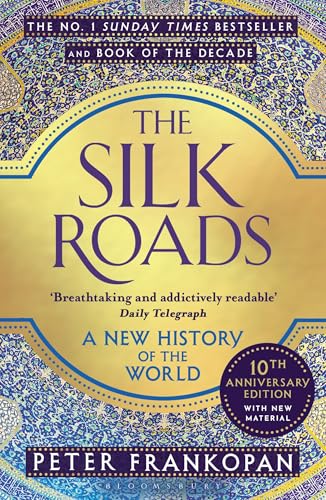
The Silk Roads
by Peter Frankopan
- Author:
- Peter Frankopan
- Status:
- Done
- Format:
- eBook
- Reading Time:
- 20:22
- Genres:
- History , Nonfiction , Politics , World History , Asia , Historical
- Pages:
- 636
- Highlights:
- 188
Highlights
Page 93
a book by the anthropologist Eric Wolf, which really lit the tinder. The accepted and lazy history of civilisation, wrote Wolf, is one where ‘Ancient Greece begat Rome, Rome begat Christian Europe, Christian Europe begat the Renaissance, the Renaissance the Enlightenment, the Enlightenment political democracy and the industrial revolution. Industry crossed with democracy in turn yielded the United States, embodying the rights to life, liberty and the pursuit of happiness.’ 1 I immediately recognised that this was exactly the story that I had been told: the mantra of the political, cultural and moral triumph of the west. But this account was flawed; there were alternative ways of looking at history – ones that did not involve looking at the past from the perspective of the winners of recent history.
Page 184
‘A talent for following the ways of yesterday’, declared King Wu-ling in 307 BC, ‘is not sufficient to improve the world of today.’
Page 197
History was twisted and manipulated to create an insistent narrative where the rise of the west was not only natural and inevitable, but a continuation of what had gone before.
Page 295
Alexander was also able to draw more and more territory under his sway because he was willing to rely on local elites. ‘If we wish not just to pass through Asia but to hold it,’ he is purported to have said, ‘we must show clemency to these people; it is their loyalty which will make our empire stable and permanent.’ 17 Local officials and old elites were left in place to administer towns and territories that were conquered. Alexander himself took to adopting traditional titles and wearing Persian clothing to underline his acceptance of local customs. He was keen to portray himself not so much as an invading conqueror, but as the latest heir of an ancient realm – despite howls of derision from those who told all who would listen that he had brought misery and soaked the land with blood. 18
Page 406
So in due course the Han rulers of China resolved to deal with the Xiongnu once and for all. First, a concerted effort was made to take control of the agriculturally rich western regions of Xiyu; the nomads were driven back as the Chinese took control of the Gansu corridor in a decade-long series of campaigns that ended in 119 BC. To the west lay the Pamir mountains and, beyond them, a new world. China had opened a door leading on to a trans-continental network; it was the moment of the birth of the Silk Roads.
Page 443
The sophistication of the techniques and their early implementation reveal how the imperial courts at the capital in Chang’an (modern Xi’an) and from the first century ad at Luoyang dealt with a world that seemed to be shrinking before their eyes. 49 We think of globalisation as a uniquely modern phenomenon; yet 2,000 years ago too, it was a fact of life, one that presented opportunities, created problems and prompted technological advance.
Page 545
This is captured perfectly in Petronius’ Satyricon, whose most famous scene is the dinner party of Trimalchio, a former slave who had gained his freedom and amassed a fortune. The satire is acidic in its portrayal of the tastes of the new super-rich. Trimalchio wanted only the best that money could buy:
Note: I’ve heard this before
Page 551
New wealth brought Rome and its inhabitants into contact with new worlds and new tastes. The poet Martial typifies the internationalism and expanded knowledge of this period in a poem mourning a young slave girl, comparing her to an untouched lily, to polished Indian ivory, to a Red Sea pearl, with hair finer than Spanish wool or blonde locks from the Rhine.
Page 560
For some conservative observers, it was the appearance of one commodity in particular that appalled: Chinese silk. 81 The increasing volume of this fabric available in the Mediterranean caused consternation among traditionalists. Seneca for one was horrified by the popularity of the thin flowing material, declaring that silk garments could barely be called clothing given they hid neither the curves nor the decency of the ladies of Rome. The very foundation of marital relations was being undermined, he said, as men found they could see through the light fabric that clung to the female form and left little to the imagination. For Seneca, silk was simply a cipher for exoticism and eroticism. A woman could not honestly say she was not naked when she was wearing silk. 82 Others felt the same, for repeated efforts were made to prohibit men from wearing the fabric, including edicts passed by law. Some put it simply: it was disgraceful, two leading citizens agreed, that Roman men should think it acceptable to sport silken clothing from the east. 83
Note: Lmfao. Folks are always going to be upset
Page 583
Whatever form it took, the outflow of capital on this scale had far-reaching consequences. One was a strengthening of local economies along the trade routes. Villages turned into towns and towns turned into cities as business flourished and communication and commercial networks extended and became ever more connected. Increasingly impressive architectural monuments were erected in places like Palmyra, on the edge of the Syrian desert, which did well as a trading centre linking east with west. Not for nothing has Palmyra been called the Venice of the sands. 89 Cities on the north–south axis likewise were transformed, with the most dazzling example at Petra, which became one of the wonders of antiquity thanks to its position on the route between the cities of Arabia and the Mediterranean.
Page 647
Ironically, it was precisely the growth and ambition of Rome that helped galvanise Persia itself. For one thing, the latter benefited greatly from the long-distance traffic between east and west, which also served to effect a shift in Persia’s political and economic centre of gravity away from the north. Previously, the priority had been to be located close to the steppes in order to negotiate with the nomad tribes for livestock and horses, and to supervise the diplomatic contacts necessary to avoid unwelcome attention and demands from the fearsome peoples on the steppes. This was why oasis towns like Nisa, Abivard and Dara had become important, home to magnificent royal palaces. 105
Page 739
It was not only goods that flowed along the arteries that linked the Pacific, Central Asia, India, the Persian Gulf and the Mediterranean in antiquity; so did ideas. And among the most powerful ideas were those that concerned the divine. Intellectual and religious exchange had always been animated across this region; now it became more complex and more competitive. Local cults and belief systems came into contact with well-established cosmologies. It made for a rich melting pot where ideas were borrowed, refined and repackaged.
Page 764
There were strong incentives, therefore, for rulers to invest in the right spiritual infrastructure, such as the building of lavish places of worship. This offered a lever over internal control, allowing leaders to form a mutually strengthening relationship with the priesthood who, across all the principal religions, wielded substantial moral authority and political power. This did not mean that rulers were passive, responding to doctrines laid out by an independent class (or in some cases caste). On the contrary, determined rulers could reinforce their authority and dominance by introducing new religious practices.
Page 777
The Kushans went further, establishing a leadership cult that claimed a direct relation to the divine, and created distance between ruler and subject.
Note: Every fucking time. Rulers be like “bruh, divine sanction”
Page 782
In their most basic, traditional form, the teachings of the Buddha were straightforward, advocating finding a path from suffering (Sanskrit: duḥkha) that led to a state of peace (nirvāna), by means of following eight ‘noble paths’. The route to enlightenment did not involve third parties, nor did it involve the material or physical world in any meaningful way. The journey was one that was spiritual, metaphysical and individual. This was to change dramatically as new ways of reaching a higher state of consciousness emerged. What had been an intense internal journey, devoid of outside trappings and influences, was now supplemented by advice, help and locations designed to make the path to enlightenment and Buddhism itself more compelling. Stupas or shrines ostensibly linked to the Buddha were built, becoming points of pilgrimage, while texts setting out how to behave at such sites made the ideals behind Buddhism more real and more tangible. Bringing flowers or perfumes as an offering to a shrine would help achieve salvation, advised the Saddharmapundarīka, often known as the Lotus Sutra, that dates to this period. So too would hiring musicians to ‘beat drums, blow horns and conches, pan-pipes and flutes, play lutes and harps, gongs, guitars and cymbals’: this would enable the devotee to attain ‘buddhahood’. 7 These were deliberate efforts to make Buddhism more visible – and audible – and to enable it to compete better in an increasingly noisy religious environment.
Page 827
As with the Kushan before them, the Northern Wei had much to gain by promoting the new at the expense of the old, and championing concepts that underlined their legitimacy. Huge statues of the Buddha were erected at Pingcheng and Luoyang, far into the east of the country, together with lavishly endowed monasteries and shrines. There was no mistaking the message: the Northern Wei had triumphed and they had done so because they were part of a divine cycle, not merely brute victors on the battlefield.
Page 885
The promotion of Zoroastrianism was accompanied by the suppression of local cults and rival cosmologies, which were dismissed as evil doctrines. Jews, Buddhists, Hindus, Manichaeans and others were persecuted; places of worship were ransacked, with ‘idols destroyed, the sanctuaries of demons demolished and transformed into temples for the gods’. 34 The expansion of the Persian state was accompanied by a stern enforcement of values and beliefs that were presented as both traditional and essential for political and military success. Those who offered different explanations or competing values were hunted down and in many cases killed – such as Mani, a charismatic third-century prophet whose blend of ideas, drawing on a pot-pourri of sources from east and west, had once been championed by Shāpūr I; his teachings were now condemned as subversive, intoxicating and dangerous and his followers were mercilessly hunted down. 35
Page 905
every aspect of early Christianity was Asian. Its geographic focal point, of course, was Jerusalem, together with the other sites related to Jesus’ birth, life and crucifixion; its original language was Aramaic, a member of the Semitic group of tongues native to the Near East; its theological backdrop and spiritual canvas was Judaism, formed in Israel and during the exile in Egypt and Babylon; its stories were shaped by the deserts, floods, droughts and famines that were unfamiliar in Europe.
Page 916
the Emperor advised tolerance: do not search for Christians, he said, but if they are denounced, deal with them on a case-by-case basis, ‘for it is not possible to set out a set rule that would apply regardless of circumstance’. But on no account act on rumour or anonymous accusation; to do otherwise, he wrote loftily, would be ‘out of keeping with the spirit of our age’. 41
Page 925
Early Christians had to battle against prejudice, bringing anguished cries from writers such as Tertullian (c. 160–225 AD), whose appeals have been compared by one distinguished scholar to Shakespeare’s Shylock: we Christians ‘live beside you, share your food, your dress, your customs, the same necessities of life as you do’, he implored. 44 Just because we do not attend Roman religious ceremonies, he wrote, does not mean that we are not human beings.
Page 984
Another writer states that famous centres for cults were shut down by the Emperor, while oracles and divination, staple features of Roman theology, were banned. The customary sacrifice made before official business could take place was likewise outlawed, while pagan statues were pulled down and legislated against. 60 There was little room for equivocation in the story told by authors with vested interests to show Constantine as single-minded promoter of his new beliefs.
Note: The persecutees become the persecutors
Page 037
As the Persians prepared to mount fierce resistance, they had a huge stroke of luck: before the expedition could get going, Constantine fell ill and died. Shāpūr II proceeded to unleash hell on the local Christian population in Persia as a reprisal for Constantine’s aggression. Egged on by the Zoroastrian authorities, the Shah ‘thirsted for the blood of the saints’. 72 Martyrs were made by the dozen: one manuscript from Edessa at the start of the fifth century records the execution of no fewer than sixteen bishops as well as fifty priests in this period. 73 Christians were now regarded as an advance guard, a fifth column that would open Persia to the Roman Empire in the west. Leading bishops were accused of making the Shah’s ‘followers and people rebel against [his] Majesty and become slaves of the emperor who shares their faith’. 74 This bloodbath was a direct result of the enthusiastic adoption of Christianity in Rome. The persecutions unleashed by the Shah stemmed from the fact that Constantine had elided the promotion of the Roman Empire with that of Christianity.
Note: Religions are promoted by violence
Page 074
Between about 350 and 360 there was a huge wave of migration as tribes were shunted off their lands and driven westwards. This was most likely caused by climate change, which made life on the steppe exceptionally harsh and triggered intense competition for resources.
Page 120
As if this were not bad enough, in the middle of the fifth century, having flushed forward a hotch-potch of tribes – Terevingian Goths, Alans, Vandals, Suevi, Gepids, Neurians, Bastarnians and others besides – the Huns themselves appeared in Europe, led by the most famous figure of late antiquity: Attila. 16 The Huns caused pure terror. They are ‘the seedbed of evil’, wrote one Roman writer, and ‘exceedingly savage’. Trained from youth to cope with extreme cold, hunger and thirst, they dressed in the skins of field mice that were stitched together; they would eat roots and raw flesh – which would be partially warmed by being placed between their thighs. 17 They had no interest in agriculture, noted another, and only wanted to steal from their neighbours, enslaving them in the process: they were like wolves. 18 The Huns scarred the cheeks of infant boys when they were born in order to prevent facial hair growing later in life, while they spent so long on horseback that their bodies were grotesquely deformed; they looked like animals standing on their hind legs. 19 Although it is tempting to dismiss such comments as signs of bigotry, examinations of skeletal remains show that the Huns practised artificial cranial deformation on their young, bandaging the skull to flatten the frontal and occipital bones by applying pressure to them. This caused the head to grow in a distinctly pointed manner. It was not just the behaviour of the Huns that was terrifyingly out of the ordinary; so was the way they looked. 20
Page 145
These days, it is voguish to talk of an age of transformation and continuities that followed the sack of Rome – rather than to describe the period as the Dark Ages. And yet, as one modern scholar argues powerfully, the impact of the rape, pillage and anarchy that marked the fifth century as the Goths, Alans, Vandals and Huns rampaged across Europe and North Africa is hard to exaggerate. Literacy levels plummeted; building in stone all but disappeared, a clear sign of collapse of wealth and ambition; long-distance trade that once took pottery from factories in Tunisia as far as Iona in Scotland collapsed, replaced by local markets dealing only with exchange of petty goods; and as measured from pollution in polar ice-caps in Greenland there was a major contraction in smelting work, with levels falling back to those of prehistoric times. 22
Note: Damn
Page 152
Contemporaries struggled to make sense of what, to them, was the complete collapse of the world order. ‘Why does [God] allow us to be weaker and more miserable’ than all these tribal peoples, wailed the fifth-century Christian writer Salvian; ‘why has he allowed us to be conquered by the barbarians? Why does he permit us to be subject to the rule of our enemies?’ The answer, he concluded, was simple: men had sinned and God was punishing them. 23 Others reached the opposite conclusion. Rome had been master of the world when it was faithful to its pagan roots, argued Zosimus, the Byzantine historian (who was himself pagan); when it abandoned these and turned to a new faith, it engineered its own demise. This, he said, was not an opinion; it was a fact.
Note: As usual, religion has all the answers
Page 215
Some clerics in the east found the dispute – and the nature of its resolution – bewildering. The problem, as they saw it, lay in the sloppy translation into Greek of the Syriac term describing the incarnation – although the argument was as much about jostling for power between two leading lights in the church hierarchy, and the kudos that came from having one’s doctrinal positions accepted and adopted. The clash came to a head over the status of the Virgin, who in Nestorius’ opinion should be termed not Theotokos (the one who bears God) but Christotokos (the one who bears Christ) – in other words, the human nature of Jesus alone. 37 Outflanked and outmanoeuvred by Cyril, Nestorius was deposed, a move that destabilised the church as bishops hastily changed their theological positions one way and then another.
Page 251
While the church in the west obsessed about rooting out variant views, the church in the east set about one of the most ambitious and far-reaching missionary programmes in history, one that in terms of scale bears comparison with later evangelism in the Americas and Africa: Christianity expanded rapidly into new regions without the iron fist of political power behind it. A rash of martyrs deep in the southern part of the Arabian peninsula shows how far the religion’s tentacles were spreading, as does the fact that the King of Yemen became Christian. 45 A Greek-speaking visitor to Sri Lanka in about 550 found a robust community of Christians, overseen by clergy appointed ‘from Persia’. 46 Christianity even reached the nomadic peoples of the steppes, much to the surprise of officials in Constantinople who, when offered hostages as part of a peace agreement, found that some had ‘the symbol of the cross tattooed in black on their foreheads’. Asked how this had happened, they replied that there had been a plague ‘and some Christians among them had suggested doing this [to bring divine protection] and from that time their country had been safe’. 47 By the middle of the sixth century there were archbishoprics deep within Asia. Cities including Basra, Mosul and Tikrit had burgeoning Christian populations. The scale of evangelism was such that Kokhe, situated close to Ctesiphon, was served by no fewer than five dependent bishoprics.48 Cities like Merv, Gundesẖāpūr and even Kashgar, the oasis town that was the entry point to China, had archbishops long before Canterbury did. These were major Christian centres many centuries before the first missionaries reached Poland or Scandinavia. Samarkand and Bukhara (in modern Uzbekistan) were also home to thriving Christian communities a thousand years before Christianity was brought to the Americas. 49 Indeed, even in the Middle Ages, there were many more Christians in Asia than there were in Europe.
Page 347
Christians began to produce uncompromising morality tales, the most famous of which was the epic story of Qardagh, a brilliant young man who hunted like a Persian king and argued like a Greek philosopher but gave up a promising career as a provincial governor to convert. Sentenced to death, he escaped from captivity only to experience a dream telling him it was better to die for his faith than to fight. His execution, at which his father threw the first stone, was commemorated in a lengthy and beautiful narrative account whose aim was evidently to encourage others to find the confidence to become Christian. 70
Note: Pah, what a moving tale
Page 360
Others tried to codify the fusion of Christian and Buddhist ideas, producing a hybrid set of ‘gospels’ that effectively simplified the complex message and story of the former, with elements that were familiar and accessible to populations in the east in order to accelerate Christianity’s progress across Asia. There was a theological logic to this dualistic approach, usually called Gnosticism, which argued that preaching in terms that had understandable cultural reference points and used accessible language was an obvious way to spread the message. 72 Little wonder, then, that Christianity found support among a broad sweep of the population: these were ideas that were deliberately made to sound familiar and easy to grasp.
Page 391
When we think of the Silk Roads, it is tempting to think of the circulation always passing from east to west. In fact, there was considerable interest and exchange passing in the other direction, as an admiring seventh-century Chinese text makes plain. Syria, the author wrote, was a place that ‘produces fire-proof cloth, life-restoring incense, bright moon-pearls, and night-lustre gems. Brigands and robbers are unknown, but the people enjoy happiness and peace. None but illustrious laws prevail; none but the virtuous are raised to sovereign power. The land is broad and ample, and its literary productions are perspicuous and clear.’
Page 431
Stagnation took hold and the public mood towards Justinian soured. Particularly fierce criticism was reserved for the way he seemed willing to buy the friendship of the empire’s neighbours by paying out money and promiscuously bestowing favours. Justinian was foolish enough to think it ‘a stroke of good fortune to be dishing out the wealth of the Romans and flinging it to the barbarians’, wrote Procopius, the scathing, and most prominent, historian of Justinian’s reign. The Emperor, Procopius remorselessly went on, ‘lost no opportunity to lavish vast sums of money on all the barbarians’, to the north, south, east and west; cash was dispatched, the author went on, to peoples who had never even been heard of before. 6
Page 566
Heraclius celebrated with gusto the astonishing reversal of fortune to cement his popularity. He had played heavily on religion to build support and stiffen resolve during the empire’s dark hours. Khusraw’s attack had been explained as a direct assault on Christianity, something underlined emphatically in a piece of theatre enacted before the imperial troops, in which a letter was read out that appeared to be written in the Shah’s own hand: it not only personally ridiculed Heraclius, but scoffed at the powerlessness of the Christians’ God. 33 The Romans had been challenged to fight for what they believed in: this had been a war of religion. Perhaps not surprisingly, then, Roman triumphalism produced ugly scenes. After Heraclius had led a ceremonial entry into Jerusalem in March 630 and restored the fragments of the True Cross to the Church of the Holy Sepulchre, Jews were supposedly baptised by force, as punishment for the role they were thought to have played in the fall of the city sixteen years earlier; those who fled were banned from coming within three miles of Jerusalem.
Page 625
there is a wide acceptance that Muḥammad was not the only figure in the Arabian peninsula in the early seventh century to talk about a single God, for there were other ‘copycat prophets’ who rose to prominence in precisely the period of the Perso-Roman wars. The most notable offered messianic and prophetic visions that were strikingly similar to those of Muḥammad – promising revelations from the angel Gabriel, pointing to paths to salvation and in some cases offering holy writings to back their claims up.
Page 632
There is also growing consensus that Muḥammad was preaching to a society that was experiencing acute economic contraction as a result of the Perso-Roman Wars. 50 The confrontation and the effective militarisation of Rome and Persia had an important impact on trade originating in or passing through the Ḥijāz. With government expenditure funnelled into the army and chronic pressure on the domestic economies to support the war effort, demand for luxury items must have fallen considerably. The fact that the traditional markets, above all the cities in the Levant and in Persia, were caught up in the fighting can only have further depressed the economy of southern Arabia. 51
Page 665
Muḥammad’s preaching gave birth to a new religion and to a new identity. 60 Central to this new identity was a strong idea about unity. Muḥammad actively sought to fuse the many tribes of southern Arabia into a single bloc. The Byzantines and Persians had long manipulated local rivalries and played leaders off against each other. Patronage and funding helped create a series of dependent clients and elites who were regulated and rewarded by payments from Rome and Ctesiphon. The intense war left this system in tatters.
Page 675
It was not for nothing then that the new faith was being preached in the local language. Behold, says one of the verses in the Qur⁾ān; here are the words from above – in Arabic. 62 The Arabs were being presented with their own religion, one that created a new identity. This was a faith designed for the local populations, whether nomad or urban, whether members of one tribe or another, and regardless of ethnic or linguistic background.
Page 693
As the number of followers grew, so did their aspirations and ambitions. Crucial in this was the designation of a clear religious centre. The faithful had previously been told to face Jerusalem when they prayed. In 628, however, following further revelation, it was apparently announced that this instruction had been a test and should now be amended: the direction or qibla to face when praying was nowhere else but Mecca. 65 Not only that, but the Kaʿba, the old focal point of the polytheistic, pagan religion in Arabia, was identified as the cornerstone for prayer and pilgrimage within the city. This was revealed as having been set up by Ishmael, the son of Abraham and the putative ancestor of twelve Arab tribes.
Note: Haha semma revelation
Page 720
But so too was the innovative way that booty and finances were shared out. Willing to sanction material gain in return for loyalty and obedience, Muḥammad declared that goods seized from non-believers were to be kept by the faithful. 71 This closely aligned economic and religious interests. 72 Those who converted to Islam early were rewarded with a proportionately greater share of the prizes, in what was effectively a pyramid system. This was formalised in the early 630s with the creation of a dīwān, a formal office to oversee the distribution of booty. A share of 20 per cent was to be presented to the leader of the faithful, the Caliph, but the bulk was to be shared by his supporters and those who participated in successful attacks. 73 Early adopters benefited most from new conquests while new believers were keen to enjoy the fruits of success. The result was a highly efficient motor to drive expansion.
Page 736
Both Rome and Persia responded to the threat too late. In the case of the latter, a crushing Muslim victory at Qādisiyyah in 636 was a huge boost for the surging Arab armies and for Islamic self-confidence. The fact that a swathe of Persian nobles fell in the course of the battle heavily compromised future resistance, and served to put an already teetering state on the canvas. 76 The Roman response was no more effective. An army under the command of the Emperor’s brother Theodore was heavily defeated in 636 at the River Yarmuk, south of the Sea of Galilee, after he had seriously underestimated the size, capability and determination of the Arab force. 77 The heart of the world now gaped open. One city after another surrendered, as the attacking forces bore down on Ctesiphon itself. After a lengthy siege, the capital eventually fell, its treasury being captured by the Arabs. Persia had been broken by the spectacular rearguard action of the Romans, but it had been swallowed up by Muḥammad’s followers.
Note: How to seize a golden opportunity
Page 751
But two other important reasons also help explain the triumph of Islam in the early part of the seventh century: the support provided by Christians, and above all that given by Jews. In a world where religion seems to be the cause of conflict and bloodshed, it is easy to overlook the ways in which the great faiths learnt and borrowed from each other. To the modern eye, Christianity and Islam seem to be diametrically opposed, but in the early years of their coexistence relations were not so much pacific as warmly encouraging. And if anything, the relationship between Islam and Judaism was even more striking for its mutual compatibility. The support of the Jews in the Middle East was vital for the propagation and spread of the word of Muḥammad.
Page 766
Leading Jews in the town, later renamed Medina, pledged their support to Muḥammad in return for guarantees of mutual defence. These were laid out in a formal document that stated that their own faith and their possessions would be respected now and in the future by Muslims. It also set out a mutual understanding between Judaism and Islam: followers of both religions pledged to defend each other in the event that either was attacked by any third party; no harm would come to Jews, and no help would be given to their enemies. Muslims and Jews would co-operate with one another, extending ‘sincere advice and counsel’. 1 It helped then that Muḥammad’s revelations seemed not only conciliatory but familiar: there was much in common with the Old Testament, for example, not least the veneration for the prophets and for Abraham in particular, and there was obvious common ground for those who repudiated Jesus’ status as the Messiah. It was not just that Islam was not a threat to Judaism; there were elements that seemed to go hand in glove with it. 2
Note: If only people today thought the same
Page 824
Echoing the Hail Mary, Islam’s holy book teaches the words ‘God has chosen you [Mary]. He has made you pure and exalted you above womankind. Mary, be obedient to your Lord; bow down and worship with the worshippers.’ 14
Page 832
Division was the work of Satan, Muḥammad’s text warned; never allow disagreements to take hold – instead, cling together to God, and never be divided. 17 Muḥammad’s message was one of conciliation. Believers who follow the Jewish faith or are Christians who live good lives ‘have nothing to fear or regret’, says the Qur⁾ān on more than one occasion. 18 Those who believed in one God were to be honoured and respected.
Page 863
Efforts to conciliate with the Christians were supplemented by a policy of protecting and respecting the People of the Book – that is to say, both Jews and Christians.
Note: That Islam endorses Judaism and Christianity doesn’t indicate that the other two were somehow exalted, simply that this was necessary for Islam to survive in its early days
Page 883
Some members of the Christian clergy fought a desperate rearguard action, painting the Arabs in the worst possible light in a doomed attempt to convince the local population not to be fooled into giving their support to a message that sounded both simple and familiar. The ‘Saracens’ are vengeful and hate God, warned the patriarch of Jerusalem, shortly after the conquest of the city. They plunder cities, ravage the countryside fields, set fire to churches and destroy monasteries. The evil they commit against Christ and against the church is appalling, as are the ‘foul blasphemies they pronounce about God’. 29 In fact, it appears that the Arab conquests were neither as brutal nor as shocking as the commentators make out. Across Syria and Palestine, for example, there is little evidence of violent conquest in the archaeological record.
Note: Can’t believe every contemporary source
Page 906
In an almost perfect model of expansion, the threat of military force led to negotiated settlements as one province after another submitted to the new authorities. To start with, overlordship in conquered territories was light and even unobtrusive. By and large, the existing majority populations were allowed to get on with their business unmolested by new masters who established garrisons and living quarters away from existing urban centres. 34 In some cases, new cities were founded for the Muslims, such as Fusṭāṭ in Egypt, Kūfa on the Euphrates, Ramla in Palestine and Ayla in modern Jordan, where the sites of mosques and governors’ palaces could be chosen and built from scratch. 35 The fact that new churches were built at the same time, in North Africa, Egypt and Palestine, suggests that a modus vivendi quickly established itself where religious tolerance was normative.
Note: Tolerance
Page 927
The new regime’s lightness of touch also showed itself in matters of administration. Roman coinage was used for several decades after the conquests alongside newly minted coins struck with familiar imagery and in long-established denominations;
Note: I don’t think you take existing currency out of circulation unless you’re Modi
Page 948
But in the late seventh century things began to change. Attention turned to proselytising, evangelising and converting the local populations to Islam – alongside an increasingly hostile attitude towards them.
Page 988
the armies flooded through Spain and into France, where they met resistance in 732 somewhere between Poitiers and Tours, barely 200 miles from Paris. In a battle that subsequently acquired a near-mythical status as the moment the Islamic surge was halted, Charles Martel led a force that inflicted a crucial defeat. The fate of Christian Europe hung by a thread, later historians argued, and had it not been for the heroism and skill of the defenders, the continent would surely have become Muslim. 50 The truth is that, while the defeat was certainly a setback, it did not mean that new attacks would not be unleashed in the future – if, that is, there were prizes worth winning. And as far as western Europe was concerned in this period, these prizes were few and far between:
Note: Hmmm
Page 092
‘The Chinese are unhygienic, and they do not wash their backsides with water after defecating but merely wipe themselves with Chinese paper.’71
Note: Lmao
Page 093
At least they enjoyed musical entertainment – unlike the Indian people, who regarded such spectacles as ‘shameful’. Rulers across India eschewed alcohol too. They did not do so for religious reasons, but because of their entirely reasonable view that if drunk, ‘how can someone run a kingdom properly?’
Note: What a role reversal
Page 150
Or polymaths like Abū ʿAlī Ḥusayn ibn Sīnā, known in the west as Avicenna, who wrote on logic, theology, mathematics, medicine and philosophy, doing so in each case with an awe-inspiring intelligence, lucidity and honesty. ‘I read the Metaphysics of Aristotle,’ he wrote, ‘but could not comprehend its contents … even when I had gone back and read it forty times, and had got to the point where I had memorised it.’ This is a book, he added in a note that will be of comfort to students of this complex text, ‘which there is no way of understanding’. Happening on a bookseller’s stall at a market one day, however, he bought a copy of an analysis of Aristotle’s work by Abū Naṣr al-Fārābī, yet another great thinker of the age. Suddenly, it all made sense. ‘I rejoiced at this,’ wrote Ibn Sīnā, ‘and the next day gave much in alms to the poor in gratitude to God, who is exalted.’
Note: Haha, I feel you bruh
Page 171
While the Muslim world took delight in innovation, progress and new ideas, much of Christian Europe withered in the gloom, crippled by a lack of resources and a dearth of curiosity. St Augustine had been positively hostile to the concept of investigation and research. ‘Men want to know for the sake of knowing,’ he wrote scornfully, ‘though the knowledge is of no value to them.’ Curiosity, in his words, was nothing more than a disease. 91 This disdain for science and scholarship baffled Muslim commentators, who had great respect for Ptolemy and Euclid, for Homer and Aristotle. Some had little doubt what was to blame. Once, wrote the historian al-Masʿūdī, the ancient Greeks and the Romans had allowed the sciences to flourish; then they adopted Christianity. When they did so, they ‘effaced the signs of [learning], eliminated its traces and destroyed its paths’. 92 Science was defeated by faith.
Page 201
While the first hundred years after Muḥammad’s death saw limited efforts to convert local populations, soon more concerted attempts were made to encourage those living under Muslim overlordship to embrace Islam. These were not limited to religious teaching and evangelism: in the case of Bukhara in the eighth century, for example, the governor announced that all those who showed up to Friday prayer would receive the princely sum of two dirhams – an incentive that attracted the poor and persuaded them to accept the new faith, albeit on basic terms: they could not read the Qur⁾ān in Arabic and had to be told what do to while prayers were being said.
Note: Thus it began. Gotta cement your hold on power.
Page 244
The world was divided in two: a realm of Iran where order and civilisation prevailed; and one of Turan that was chaotic, anarchic and dangerous.
Note: Haha nice
Page 279
Part of the spread of these shifting, adaptive spiritual views was carried out by a new type of Muslim holy men acting as a form of missionary; these mystics, known as sufis, roamed the steppes, sometimes naked but for a set of animal horns, tending to sick animals and impressing onlookers with their eccentric behaviour and wittering about devotion and piety. They seemed to have played a crucial role in winning converts, fusing the shaman and animist beliefs that were widespread in Central Asia with the tenets of Islam.
Page 464
Or perhaps we think of the question whether the Vikings managed to reach North America centuries before the expeditions of Christopher Columbus and others. But in the Viking age the bravest and toughest men did not head west; they headed east and south. Many made fortunes and won fame not just at home but in the new lands that they conquered. The mark that they left, furthermore, was not minimal and transient, as it was in North America. In the east, they were to found a new state, named after the traders, travellers and raiders who took to the great water systems linking the Baltic with the Caspian and Black Seas. These men were known as Rus’, or rhos, perhaps due to their distinctive red hair, or more likely thanks to their prowess with the oar. They were the fathers of Russia.
Note: Interesting
Page 508
Rewards needed to be substantial to merit the distance and the dangers involved in travelling as far from Scandinavia as the Caspian Sea – a journey of nearly 3,000 miles. So it is perhaps not surprising that goods had to be sold in large volumes in order to generate substantial profits. There were several commodities shipped south, but the most important were slaves. There was money to be made from human trafficking.
Note: Of course
Page 548
Slaves were also taken from the Turkic tribes of Central Asia, whom one author from this period notes were highly prized because of their courage and resourcefulness. When it comes to choosing ‘the most precious slaves’, noted another commentator, the best came ‘from the land of the Turks. There is no equal to the Turkish slaves among all the slaves of the earth.’ 12
Note: Mamelukes?
Page 597
A large hoard found in Cuerdale in Lancashire and today held in the Ashmolean Museum in Oxford also contains many ʿAbbāsid coins minted in the ninth century. That the currency had reached the backwaters that were the British Isles is an indication of just how far the markets of the Islamic world had sprawled.
Page 611
If you took Slavic twins, wrote one Arabic author in this period, and castrated one, he would certainly become more skilful and ‘more lively in intelligence and conversation’ than his brother – who would remain ignorant, foolish and exhibit the innate simple-mindedness of the Slavs. Castration was thought to purify and improve the Slavic mind.
Note: Fuck
Page 780
The places that mattered were not in Paris or London, in Germany or Italy – but in the east. Cities that connected to the east were important – like Kherson in the Crimea or Novgorod, cities that linked to the Silk Roads running across the spine of Asia. Kiev became a linchpin of the medieval world, evidenced by the marriage ties of the ruling house in the second half of the eleventh century. Daughters of Yaroslav the Wise, who reigned as Grand Prince of Kiev until 1054, married the King of Norway, the King of Hungary, the King of Sweden and the King of France. One son married the daughter of the King of Poland, while another took as his wife a member of the imperial family of Constantinople. The marriages made in the next generation were even more impressive. Rus’ princesses were married to the King of Hungary, the King of Poland and the powerful German Emperor, Henry IV. Among other illustrious matches was Gytha, the wife of Vladimir II Monomakh, the Grand Prince of Kiev: she was the daughter of Harold II, King of England, who was killed at the battle of Hastings in 1066. The ruling family in Kiev was the best-connected dynasty in Europe.
Page 845
The meteoric rise of the Seljuks from slave soldiers to power-brokers extraordinaire was confirmed in 1055 when they entered Baghdad at the invitation of the Caliph, driving out the unpopular and ineffective Būyid dynasty.
Note: Again and again, slave soldiers don’t stay that way for long
Page 909
As one who witnessed the carnage that followed put it, Jerusalem was soon filled with dead bodies, corpses piled up ‘on mounds as big as houses outside the city gates. No one has ever heard of such a slaughter.’ 2 ‘If you had been there,’ wrote another author a few years later, ‘your feet would have been stained to the ankles with the blood of the slain. What shall I say? None of them were left alive. Neither women nor children were spared.’
Page 939
Although there had been concerted efforts to deal with the Crusaders before the capture of Jerusalem and immediately afterwards, resistance was local and limited. Some were perplexed by this laissez-faire attitude. A judge in Baghdad supposedly stormed into the Caliph’s court to decry the lack of reaction to the arrival of the armies from Europe: ‘How dare you slumber in the shade of complacent safety,’ he said to those who were present, ‘leading lives as frivolous as garden flowers, while your brothers in Syria have no dwelling place save the saddles of camels and the bellies of vultures?’
Note: Pah. Punch dialogue
Page 946
The success of the First Crusade came as no consolation to the Jews of Europe or Palestine, who had witnessed shocking violence at the hands of the supposedly noble Crusaders.
Page 012
Terms were struck which gave fabulous potential benefits in return for help. As reward for taking part in the siege of Acre in 1100, for instance, the newly arrived Venetians were promised a church and market square in every city captured by the Crusaders, as well as one-third of all plunder taken from the enemy and immunity from all taxes. It was the perfect example of what one scholar has termed the classic Venetian blend of ‘piety and greed’.
Page 096
On the whole, Crusaders learnt how to deal with the majority Muslim populations that came under their sway, and with those further afield. Indeed, the King of Jerusalem regularly brought his own lords to heel, preventing them from launching reckless forays on passing caravans or on neighbouring cities that might antagonise local leaders or demand a major reaction from Baghdad or Cairo. Some new arrivals to the Holy Land found this hard to understand and were a constant source of problems as a result, as local observers recognised. Newcomers could be incredulous that trade with the ‘infidel’ was taking place on a daily basis, and took time to realise that in practice things were not as black and white as they had been painted back in Europe. In time, prejudices wore off: westerners who had been in the east for a while ‘are much better than those recently arrived’, wrote one Arabic author who was appalled by the crude and uncouth habits of new arrivals – as well as by their attitudes to anyone who was not Christian.
Page 112
It was not long either before the scientific and intellectual achievements of the Muslim world were being actively sought out and devoured by scholars in the west, such as Adelard of Bath. 41 It was Adelard who scoured the libraries of Antioch and Damascus and brought back copies of algorithmic tables that formed the foundation for the study of mathematics in the Christian world.
Page 141
Spices also began to flow to Europe from the east in increasing volumes. These reached three primary hubs – Constantinople, Jerusalem and Alexandria – and were then shipped to the Italian city communes and on to markets in Germany, France, Flanders and Britain, where there were fat profits to be made on the sale of exotic goods. In some ways the desire to buy expensive luxuries from the orient was a similar process to the steppe nomads’ demand for silk bolts from the Chinese court: in the medieval world, just as today, the wealthy needed to differentiate themselves by showing off their status. Although trade in expensive objects and goods involved only a small proportion of the population, they were important because they enabled differentiation – and therefore reveal social mobility and rising aspirations.
Page 164
The riches at stake inevitably led to an intensification of rivalries and a new chapter in the medieval Great Game: the pursuit of primacy in the eastern Mediterranean at all costs. By the 1160s, competition between the Italian city-states was so acute that there were running battles between Venetians, Genoese and Pisans in the streets of Constantinople. Despite attempts by the Byzantine Emperor to intervene, outbreaks of violence were to become regular occurrences. This was presumably the result of increasing commercial competition and the consequence of falling prices: trading positions had to be protected, by force if necessary.
Note: Nice to get a different perspective of the crusades - that of the merchants
Page 175
The Byzantines were no longer Venice’s allies and benefactors but rivals and competitors in their own right. In 1182, the inhabitants of Constantinople attacked the citizens of the Italian city-states who were living in the imperial capital. Many were killed, including the representative of the Latin church, whose head was dragged through the city’s streets behind a dog.
Note: Context for 1204
Page 199
Merchants could be assured of security wherever they went, regardless of their faith, and regardless of whether there was peace or war. This was the result, wrote the author, of a good working relationship, whereby mutual tax treaties ensured co-operation, as did severe punishments. Latin traders who did not respect the agreements and crossed agreed boundaries, even if only by ‘the length of the arms’, had their throats cut out by fellow Christians anxious not to upset the Muslims or mess up long-standing commercial ties. Ibn Jubayr was both bemused and impressed. It is ‘one of the most pleasing and singular conventions of the [westerners]’.
Note: Puts Raynalds perfidy in context
Page 392
The Mongols cultivated such fears carefully, for the reality was that Genghis Khan used violence selectively and deliberately. The sack of one city was calculated to encourage others to submit peacefully and quickly; theatrically gruesome deaths were used to persuade other rulers that it was better to negotiate than to offer resistance. Nīshāpūr was one of the locations that suffered total devastation. Every living being – from women, children and the elderly to livestock and domestic animals – was butchered as the order was given that not even dogs or cats should be left alive. All the corpses were piled up in a series of enormous pyramids as gruesome warnings of the consequences of standing up to the Mongols. It was enough to convince other towns to lay down arms and negotiate: the choice was one of life or death.11
Page 399
News travelled fast of the brutality that faced those who took the time to weigh up their options. Stories such as that of a high-ranking official who was ordered into the presence of a newly arrived Mongol warlord and had molten gold poured into his eyes and ears became widely known
Note: Grrm you plagiariser!
Page 415
the Mongols invested lavishly in the infrastructure of some of the cities they captured. One Chinese monk who visited Samarkand soon after its capture was amazed to see how many craftsmen there were from China and how many people were being drawn in from the surrounding region and further afield to help manage the fields and orchards that had previously been neglected. 14 It was a pattern repeated time and again: money poured into towns that were rebuilt and re-energised, with particular attention paid to championing the arts, crafts and production. Blanket images of the Mongols as barbaric destroyers are wide of the mark, and represent the misleading legacies of the histories written later which emphasised ruin and devastation above all else. This slanted view of the past provides a notable lesson in how useful it is for leaders who have a view to posterity to patronise historians who write sympathetically of their age of empire – something the Mongols conspicuously failed to do. 15
Page 477
To high-ranking Mongols, it was vital to be present at and participate in the selection of the man who should take the mantle of leadership. There was no such thing as primogeniture. Rather the choice of who should succeed to the position of highest authority rested on who made their case best and loudest in person to a conclave of senior figures.
Note: Dammit grrm
Page 568
The Middle Ages in Europe are traditionally seen as the time of Crusades, chivalry and the growing power of the papacy, but all this was little more than a sideshow to the titanic struggles taking place further east. The tribal system had led the Mongols to the brink of global domination, having conquered almost the whole continent of Asia. Europe and North Africa yawned open; it was striking then that the Mongol leadership focused not on the former but on the latter. Put simply, Europe was not the best prize on offer. All that stood in the way of Mongol control of the Nile, of Egypt’s rich agricultural output and its crucial position as a junction on the trade routes in all directions was an army commanded by men who were drawn from the very same steppes: this was not just a struggle for supremacy, it was the triumph of a political, cultural and social system. The battle for the medieval world was being fought between nomads from Central and eastern Asia.
Note: You could argue that the Mongols weren’t going for the richest prize, merely the lowest hanging one. But they had never tasted defeat, so what’s the downside of aiming for the best prize available?
Page 653
These ships also proved useful in moving other goods – such as people. Both the Genoese and the Venetians resumed large-scale slave trading, buying captives to sell on to Mamluk Egypt, in defiance of attempts by the papacy to ban the trafficking of men, women and children to Muslim buyers.
Note: Baybars
Page 657
Pisa never recovered fully from the blow inflicted by its rival. Among those captured was a certain Rustichello, who spent more than a decade in prison before being joined by a fellow inmate also taken hostage during a Genoese naval victory – this time over the Venetians in the Adriatic. Striking up a friendship with him, Rustichello took to writing down his fellow prisoner’s memories of his remarkable life and journeys: we have Genoa’s brutality and relentless focus on the medieval struggle for power to thank for the recording of Marco Polo’s travels.
Note: Wow
Page 681
Sensitive pricing and a deliberate policy of keeping taxes low were symptomatic of the bureaucratic nous of the Mongol Empire, which gets too easily lost beneath the images of violence and wanton destruction. In fact, the Mongols’ success lay not in indiscriminate brutality but in their willingness to compromise and co-operate, thanks to the relentless effort to sustain a system that renewed central control. Although later Persian historians were highly vocal in asserting that the Mongols were disengaged from the process of administering their empire, preferring to leave such mundane tasks to others, recent research has revealed just how involved they were in the detail of everyday life. 6 The great achievement of Genghis Khan and his successors was not the ransacking of popular imagination but the meticulous checks put in place that enabled one of the greatest empires in history to flourish for centuries to come.
Page 694
As Genghis Khan and his successors expanded their reach, they had to incorporate new peoples within a coherent system. Tribes were deliberately broken down, with loyalties refocused on attachments to military units and above all allegiance to the Mongol leadership itself. Distinguishing tribal features, such as how different peoples wore their hair, were stamped out, with standardised fashions enforced instead. As a matter of course, those who submitted or were conquered were dispersed across Mongol-controlled territory to weaken bonds of language, kinship and identity and to aid the assimilation process.
Note: Genius
Page 852
The lubricant in this long-distance trade was silver, which took on the form of a single currency across Eurasia. One reason for this was the innovation in financial credit in China that had been introduced before Genghis Khan’s time, including the introduction of bills of exchange and the use of paper money. 40 Adopted and improved by the Mongols, the effect was the liberation of enormous amounts of silver into the monetary system as new forms of credit caught on. The availability of the precious metal suddenly soared – causing a major correction in its value against gold. In parts of Europe, the value of silver plunged, losing more than half its value between 1250 and 1338. 41
Page 878
Modern investigation into Yersinia pestis and plague has made clear the crucial role played by environmental factors to the enzootic cycle, where seemingly insignificant changes can transform the disease from being localized and containable to spreadable on a large scale. Small differentials in temperature and precipitation, for example, can dramatically change the reproductive cycles of fleas crucial to the development cycle of the bacterium itself, as well as the behaviour of their rodent hosts. 46 A recent study that assumed an increase of just one degree in temperature suggested that this could lead to a 50 per cent increase in plague prevalence in the great gerbil, the primary host rodent of the steppe environment. 47
Note: The cooling supposedly caused by the Mongols - is it linked?
Page 906
Soon the disease had been transmitted along the caravan route to reach Mecca, killing scores of pilgrims and scholars and provoking serious soul searching: the Prophet Muḥammad had supposedly promised that the plague which ravaged Mesopotamia in the seventh century would never enter the holy cities of Islam. 53
Note: Lol
Page 937
Wild rumours circulated in Germany that the disease was not natural, but the result of Jews poisoning wells and rivers. Vicious pogroms were carried out, with one account reporting how ‘all the Jews between Cologne and Austria’ were rounded up and burnt alive. So bad were the outbreaks of anti-Semitism that the Pope intervened, issuing proclamations forbidding any violent action against the Jewish populations in any Christian country, and demanding that their goods and assets be left unmolested.
Note: Of course it’s the fault of the Jews
Page 943
It was dangerous to have different beliefs at times of crisis.
Note: A-fucking-men
Page 957
And yet, despite the horror it caused, the plague turned out to be the catalyst for social and economic change that was so profound that far from marking the death of Europe, it served as its making. The transformation provided an important pillar in the rise – and the triumph – of the west. It did so in several phases. First was the top-to-bottom reconfiguration of how social structures functioned. Chronic depopulation in the wake of the Black Death had the effect of sharply increasing wages because of the accentuated value of labour. So many died before the plague finally began to peter out in the early 1350s that one source noted a ‘shortage of servants, craftsmen, and workmen, and agricultural workers and labourers’. This gave considerable negotiating powers to those who had previously been at the lower end of the social and economic spectrum. Some simply ‘turned their noses up at employment, and could scarcely be persuaded to serve the eminent unless for triple wages’. 66 This was hardly an exaggeration: empirical data shows that urban wages rose dramatically in the decades after the Black Death. 67 The empowerment of the peasantry, of labourers and of women was matched by a weakening of the propertied classes, as landlords were forced into accepting lower rents for their holdings – deciding it was better to receive some revenue than nothing at all. Lower rents, fewer obligations and longer leases all had the effect of tilting power and benefits towards the peasantry and urban tenants. This was further enhanced by a fall in interest rates, which declined noticeably across Europe in the fourteenth and fifteenth centuries. 68 The results were remarkable. With wealth now more evenly distributed through society, demand for luxury goods – imported or otherwise – soared as a result of more consumers being able to purchase items that had previously been unaffordable. 69 Spending patterns were affected by other demographic changes that the plague had produced, notably the shift in favour of the working young, who were best placed to take advantage of new opportunities opening up before them.
Note: Thanos snap
Page 160
When another small fleet under the command of Vasco da Gama set out from Lisbon five years later on another long voyage of discovery, rounding the southern tip of Africa to reach the Indian Ocean, the final pieces necessary for Europe’s transformation fell into place. Suddenly, the continent was no longer the terminus, the end point of a series of Silk Roads; it was about to become the centre of the world.
Page 173
The age of empire and the rise of the west were built on the capacity to inflict violence on a major scale. The Enlightenment and the Age of Reason, the progression towards democracy, civil liberty and human rights, were not the result of an unseen chain linking back to Athens in antiquity or a natural state of affairs in Europe; they were the fruits of political, military and economic success in faraway continents.
Page 377
On the island of Cuba in 1513, villagers who arrived to present the Spanish with gifts of food, fish and bread ‘to the limit of their larder’ were massacred ‘without the slightest provocation’, in the words of one dismayed observer. This was just one atrocity among many. ‘I saw … cruelty on a scale no living being has ever seen or expects to see,’ wrote the Spanish friar Bartolomé de las Casas of his experiences in the earliest days of European settlement, in a horrified report designed to inform those back home of what was happening in the New World. 44 What he saw was just the beginning, as he reported in his coruscating account of the treatment of the ‘Indians’ in his Historia de las Indias.
Note: I wish this chapter would end
Page 513
The task now was to reinvent the past. The demise of the old imperial capital presented an unmistakable opportunity for the legacy of ancient Greece and Rome to be claimed by new adoptive heirs – something that was done with gusto. In truth, France, Germany, Austria, Spain, Portugal and England had nothing to do with Athens and the world of the ancient Greeks, and were largely peripheral in the history of Rome from its earliest days to its demise. This was glossed over as artists, writers and architects went to work, borrowing themes, ideas and texts from antiquity to provide a narrative that chose selectively from the past to create a story which over time became not only increasingly plausible but standard. So although scholars have long called this period the Renaissance, this was no rebirth. Rather, it was a Naissance – a birth. For the first time in history, Europe lay at the heart of the world.
Page 611
Everyone knew, he stated in his diary, that goods reaching Venice overland went through endless checkpoints where taxes and duties had to be paid; by transporting goods by sea, the Portuguese would be able to offer goods at prices Venice could not hope to compete with. The numbers told the story: Venice was doomed.
Page 628
Vasco da Gama himself captured a ship filled with hundreds of Muslims returning to India after going on pilgrimage to Mecca. Ignoring the desperately generous offers of those on board to pay a ransom, he ordered the ship to be set on fire in an act so grotesque that one observer avowed, ‘I will remember what happened every single day of my life.’ Women held up their jewellery to beg for mercy from the flames or from the water, while others held up their infants to try to protect them. Da Gama watched impassively, ‘cruelly and without any pity’ as every last passenger and crew member drowned before his eyes.
Page 705
Modernisation of the roads running inland from the Gulf through Basra to the Levant made this route so reliable, secure and fast that eventually even the Portuguese came to use it for their communications with Lisbon.
Note: Impressive
Page 809
The rising flow of money into this region is even recognised in the writing of Guru Granth Saheb, the great sacred text of Sikhism, where the mundane and the commercial sit squarely alongside the spiritual: buy goods that will last, the guru advised his followers; and always keep accurate accounts, for these are a means of enshrining truth.
Note: Lmao wtf is this
Page 846
For many, the Taj Mahal is the most romantic monument in the world, an extraordinary demonstration of a husband’s love for his wife. But it represents something else too: globalised international trade that brought such wealth to the Mughal ruler that he was able to contemplate this extraordinary gesture to his beloved spouse. His ability to complete it stemmed from the profound shifts in the world’s axis, for Europe and India’s glory came at the expense of the Americas.
Page 925
Much of the silver that flooded into China was spent in a series of major reforms, not the least of which were the monetisation of the economy, the encouragement of free labour markets and a deliberate programme to stimulate foreign trade. Ironically, China’s love of silver and the premium it placed on this particular precious metal became its Achilles heel. With such great quantities of silver reaching China, above all through Manila, it was inevitable that its value would start to fall, which over time caused price inflation. The net result was that the value of silver, and above all its value in relation to gold, was forced into line with other regions and continents. Unlike India, where the impact of the opening up of the world produced new wonders of the world, in China it was to lead to a serious economic and political crisis in the seventeenth century. 92 Globalisation was no less problematic five centuries ago than it is today.
Page 959
Heavy investment was made in the Royal Navy to create a formidable and effective first line of defence. State-of-the-art dockyards were built, such as at Deptford and Woolwich on the Thames, where warships were designed and maintained with ever increasing efficiency, which in turn helped revolutionise the construction of commercial vessels. Ships that could hold more cargo, travel faster, stay out at sea longer and carry more crew and more powerful cannon began to be built. 3 The doyen of shipwrights was Matthew Baker, himself the son of a master builder. He adopted mathematical and geometric principles – set out in a seminal text entitled ‘Fragments of Ancient English Shipwrightry’ – to create a new generation of ships for Queen Elizabeth. 4 These designs were quickly adopted for commercial use, with the result that the number of English ships weighing a hundred tons or more almost tripled in the two decades after 1560. The new generation of vessels quickly gained a reputation for their speed, for handling well and for the formidable threat they presented when encountered at sea. 5 The fruits of the build-up of England’s naval forces became apparent when Spain attempted to send a huge fleet to pick up troops from the Netherlands in the summer of 1588 for a full-blown invasion of England. Outmanoeuvred and outduelled by the English, the surviving members of the Spanish Armada returned home in shame. Although most of the ships that were lost foundered on reefs and in unusually severe storms rather than at the hands of the English, few doubted that the naval investment had paid off handsomely. 6
Note: Start of the Royal Navy
Page 986
As a result of England’s attempt to challenge the new Spanish and Portuguese routes to the Americas and to Asia, considerable effort was devoted to forging close relations with the Ottoman Turks. At a time when most of Europe looked on with horror as Turkish forces were all but knocking on the gates of Vienna, the English backed a different horse. They were conspicuous by their absence when other Christian states assembled to form a ‘Holy League’, a coalition that gathered to attack the Ottoman fleet at Lepanto in the Gulf of Corinth in 1571. The victory of the Holy League prompted scenes of jubilation across Europe, where poetry, music, art and monuments were created to commemorate the triumph. In England, it was met with silence. 10
Page 010
Ottoman rulers were equally alert to the opportunities to reach out to those who had split from the Catholic church, underlining similarities in how they too interpreted their faith – especially when it came to visual images: among the many errors of ‘the faithless one they call the Pope’, wrote Sultan Murad to ‘members of the Lutheran sect in Flanders and Spain’, was that he encouraged the worship of idols. It was much to their credit that the followers of Martin Luther, one of the architects of the Reformation, had ‘banished the idols and portraits and bells from churches’. 16 Against all the odds, England’s Protestantism looked as if it could help open doors rather than close them. 17
Note: Probably the start of this “no depictions or Muhammad”
Page 037
Stories spread quickly through Protestant Europe, noting the Spaniards’ grisly treatment of those whom they believed to be their inferiors. The analogy was obvious: the Spanish were natural-born oppressors who behaved towards others with ominous cruelty; given the chance, they would persecute those closer to home in just the same way. 22 It was a conclusion that struck fear into the people of the Low Countries, which were locked in an increasingly vicious struggle with Spain in the late sixteenth century as the latter sought to assert its authority in regions where the Reformation had attracted strong support. Richard Hakluyt, the famous chronicler and advocate of British settlement in the Americas, described how Spain ‘governs in the Indies with all pride and tyranny’, and casts innocents into slavery, who mournfully ‘cry with one voice’, begging for freedom. 23 This was the Spanish model of empire, in other words, one of intolerance, violence and persecution. England, of course, would never behave in so shameful a manner. 24
Note: Was it this propaganda that made them behave so differently?
Page 083
By the start of the seventeenth century, there was little to show for the attempts to emulate the success of the Spanish and the Portuguese. New trading entities had been set up to try to raise money from private funds, starting with the Company of Merchant Adventurers for the Discovery of Regions, Dominions, Islands and Places Unknown, founded in 1551. A cluster of new and separate companies with different geographic ambitions mushroomed around it. The Spanish Company, the Eastland Company, the Levant Company, the Russia Company, the Turkey Company and the East India Company were founded with royal charters that granted monopolies on commerce within a designated region or country on the basis that business overseas was risky and required substantial investment. As such, incentivising merchants by protecting future success was an innovative way of trying to build up England’s trade – and with it, extending the country’s political tentacles.
Page 104
Fiscal mismanagement and incompetence were part of the picture; but ultimately Spain’s inability to control military spending proved catastrophic. Incredibly, it became a serial defaulter on its debts in the second half of the sixteenth century, failing to meet its obligations no fewer than four times. 34 It was like a lottery winner that had gone from rags to riches – only to squander the prize money on luxuries that were unaffordable.
Page 158
From the 1550s, as the English built quicker and stronger warships, the Dutch focused their efforts on developing vessels that handled even better, could carry more cargo, required fewer crew to operate – and were therefore cheaper to run. These ships, called fluyts, set a new benchmark for commercial shipping.
Page 176
The underlying secret to Dutch success in the seventeenth century was common sense and hard work. The Dutch reckoned that the way to work was not to follow the example of England, where the chartered companies used sharp practices to limit beneficiaries to a small circle of intimates, all looking after each other’s interests and using monopoly practices to protect their positions. Instead, capital was pooled and risks shared among as wide a body of investors as possible. In due course, the conclusion was reached that despite competing ambitions and rivalries between provinces, cities and indeed individual merchants, the most efficient and powerful way to build up trade was by combining resources. 49
Note: I like how this book contrasts the two approaches to encourage trade. History books don’t talk about this enough
Page 239
The Dutch Golden Age was the result of a finely executed plan. It also had the benefit of being well timed, coming at a time when much of Europe was in disarray, engaged in endless rounds of costly and inconclusive military hostility which engulfed the continent during the Thirty Years’ War of 1618–48.
Note: Just one mention of this war
Page 248
For centuries, the continent had been characterised by fierce rivalry between states that frequently erupted into open hostility and war. This in turn prompted advancements in military technology. New weapons were developed, introduced and then refined after being tested on the battlefield. Tactics evolved as commanders learnt from experience. The concept of violence was institutionalised too: European art and literature had long celebrated the life of the chivalrous knight and his capacity to use force judiciously – as an act of love and of faith, but also as an expression of justice. Stories about the Crusades, which praised nobility and heroism and hid treachery, betrayal and the breaking of sworn oaths, became intoxicatingly powerful. Fighting, violence and bloodshed were glorified, as long as they could be considered just. This was one reason, perhaps, why religion became so important: there could be no better justification of war than its being in defence of the Almighty.
Page 273
Although Europeans might have thought they were discovering primitive civilisations and that this was why they could dominate them, the truth was that it was the relentless advances in weapons, warfare and tactics that laid the basis for the success of the west. One reason why the domination of Africa, Asia and the Americas was possible was the centuries of European practice in building fortifications that were all but impregnable. Castle-building had been the staple of European society since the Middle Ages, with thousands of spectacular strongholds springing up across the continent. Their purpose, of course, was to withstand heavy and determined attack; their extraordinary number was testimony to the fear and regularity of assault. Europeans were world leaders in building fortresses and in storming them. It was striking how the European insistence on constructing imposing sites that could be secured from the inside was a source of bemusement to locals. No other traders had built forts in the past, noted the Nawab of Bengal in the 1700s, so why on earth did the Europeans insist on doing so now? 66
Page 298
although the names of scientists like Galileo Galilei, Isaac Newton and Leonhard Euler have become famous to generations of schoolchildren, it can be all too easy to forget that some of their most important work was on the trajectory of projectiles and understanding the causes of deviation to enable artillery to be more accurate. 69 These distinguished scientists helped make weapons more powerful and ever more reliable; military and technological advances went hand in hand with the Age of Enlightenment.
Page 325
This marked the start of the death-knell for Italy and the Adriatic. Already on the back foot thanks to new routes to market which brought goods directly to the richest consumers, the city-states with their deeply entrenched rivalries stood no chance against clusters of towns able and willing to combine their resources. Such large sums were raised to fund expansion that it became standard to spend more than half of state revenues simply servicing national debts. 75 It was expensive to be locked in a constant fight against neighbours and constantly striving to gain a political, commercial and cultural edge over them. Europe became a continent running at two speeds: Old Europe in the east and the south which had dominated for centuries and which now sagged and stagnated; and New Europe, in the north-west, which boomed.
Page 442
so with the endorsement of their peers. The incentivising transparency of this meritocratic system was further enhanced by a system that rewarded those who had served for longest in the most important capacities. It was broadly identical to the organisation put in place in the earliest days of Islam and which had proved so effective during the Muslim conquests. In England now too, spoils were shared according to a pre-set allocation, with officers and sailors rewarded in proportion to seniority and length of service.
Page 465
Typical was a man born in Massachusetts in 1649, who moved with his family back to England as a small boy before entering the service of the East India Company. Initially holding the lowly position of writer, he eventually rose through the ranks to become governor of Madras itself. He did well for himself there – too well, in fact, for he was removed from his position after five years, with rumours swirling about how much he had gained personally during his tenure. That he returned home with five tons of spices, large quantities of diamonds and innumerable precious objects suggests that the accusations were well founded – as does his own epitaph in Wrexham in North Wales where he was buried: ‘Born in America, in Europe bred, in Africa travell’d and in Asia wed … Much good, some ill, he did; so hope all’s even and that his soul throu’ mercy’s gone to Heaven.’ He spent his money liberally back in England, though he did not forget the land of his birth: towards the end of his life, he gave a generous sum to the Collegiate School of Connecticut, which recognised his gift by renaming itself after a benefactor who might make further donations in the future: Elihu Yale.
Note: What an anecdote
Page 573
Under the surface, powerful currents were swirling unseen. European attitudes to Asia were hardening, shifting from seeing the east as a wonderland filled with exotic plants and treasures to a place where the locals were as limp and useless as in the New World. Robert Orme’s attitudes were typical of the eighteenth century. The first official historian of the East India Company, Orme penned an essay whose title ‘On the effeminacy of the inhabitants of Indostan’ reveals much about how contemporary thinking had toughened. A bullish sense of entitlement was rising fast. 47 Attitudes towards Asia were changing from excitement about profits to be made to thoughts of brute exploitation.
Page 581
Go to India, the memoirist William Hickey’s father told him, and ‘cut off half a dozen rich fellow’s heads … and so return a nabob’. Serving the EIC in India was a one-way ticket to fortune.
Page 596
Hypocrisy was everywhere. It was grotesque, William Pitt the Elder told fellow MPs in the late eighteenth century, that ‘the importers of foreign gold have forced their way into Parliament by such a torrent of private corruption, as no private hereditary fortune could resist’. 52 There was no need, he felt, to note that his own grandfather had brought back one of the world’s great gemstones, the Pitt diamond, from his spell in India and used the wealth he had accumulated during his spell as governor of Madras to buy a country estate – and the parliamentary seat that came with it.
Note: Lmfao
Page 617
A House of Commons Select Committee that was set up in 1773 to look at the aftermath of the conquest of Bengal revealed the staggering sums taken from the Bengali purse. Over £2 million – tens of billions in today’s terms – had been distributed as ‘presents’, almost all of it finding its way into the pockets of EIC employees locally. 57 The outrage was compounded by disgraceful and shocking scenes in Bengal itself. By 1770, the price of grain had been driven higher and higher, with catastrophic results as famine kicked in. The death toll was estimated in the millions; even the governor-general declared that a third of the population had died. Europeans had thought only of enriching themselves as the local population starved to death. 58
Page 632
After desperate consultation, the government in London concluded that the EIC was too big to fail and agreed a bail-out. To fund this, however, cash had to be raised. Eyes turned to the colonies in North America, where taxes were substantially lower than in Britain itself. When Lord North’s government passed the Tea Act in 1773, it thought it had found an elegant solution to pay for the EIC rescue, while also bringing at least part of the tax regime of the American colonies closer into line with Britain’s. It provoked fury among settlers across the Atlantic.
Note: Great TQ
Page 659
The passing of most of India into British hands ensured that the overland trade routes were starved of oxygen, as buying and spending power, assets and attention were decisively diverted to Europe. The decline in the importance of cavalry in the face of yet more improvements in military technology and tactics, particularly relating to firepower and heavy artillery, also played a role in depressing the volumes passing along the roads that had criss-crossed Asia for millennia. Central Asia, like southern Europe before it, began to fade.
Page 760
The problem was that, as Russia’s boundaries began to expand at greater pace, so did its confidence. Attitudes to those beyond the frontiers began to harden. Increasingly, the peoples of South and Central Asia came to be seen as barbarous and in need of enlightenment – and were treated accordingly. This had disastrous consequences, most notably in Chechnya, where shocking violence was meted out to the local population in the 1820s by Aleksei Ermolov, a headstrong and bloody-minded general. This not only paved the way for the emergence of a charismatic leader, the Imam Shamil, to lead an effective resistance movement; it also poisoned relations between this region and Russia for generations. 17
Page 175
Violent scenes on the streets of St Petersburg in 1905 and the catastrophic defeat of the Tsar’s navy in the Russo-Japanese War provided small comfort to those who thought it was only a matter of time before Russia broke its shackles.
Note: He is overstating his case for the sake of the story
Page 222
Keeping Russia happy at all costs became the driving thrust of British policy after the alliance had been signed. In 1907, Sir Edward Grey told the Russian ambassador to London that Britain might consider being more flexible on the issue of the Bosporus – if the Russians agreed to establish ‘permanent good relations’. 65 This was enough to prompt a shuffling of the European house of cards, as St Petersburg embarked on a round of diplomatic horse-trading that included gaining Austrian support on the issue of the Bosporus Straits in exchange for acquiescence over the annexation of Bosnia – a deal that was to have spectacular consequences. 66
Page 423
And so, like a nightmarish game of chess where all possible moves are bad ones, the world went to war. As the initial euphoria and jingoism gave way to tragedy and horror on an unimaginable scale, a narrative developed that reshaped the past, and cast the confrontation in terms of a struggle between Germany and the Allies, a debate which has centred on the relative culpability of the former and the heroism of the latter.
Page 430
Or to explain why working-class men who joined up alongside their friends to fight in specially constituted Pals Battalions were mown down in the opening hours of the catastrophic Somme offensive in 1916. 113 Or why there were war memorials across the country bearing the names of the men who had given their lives for their country – able to record the names of the fallen but not the silence that descended on villages and towns because of their absence.
Page 435
Winston Churchill wrote after the war that the British army was the finest force that had ever been assembled. Each man was ‘inspired not only by love of country but by a widespread conviction that human freedom was challenged by military and Imperial tyranny’.
Note: Hahahahahaha
Page 442
After seeing his company wiped out and facing the prospect of writing a casualty report, Campion Vaughan recorded, ‘I sat on the floor and drank whisky after whisky as I gazed into a black and empty future.’ 115 The stunning corpus of poetry produced during the war likewise paints a very different picture of how the conflict was viewed at the time. And so too do the number of court martials that took place during the war, which hardly suggest a unanimity of resolve: more than 300,000 offences were dealt with by military courts – to say nothing of more minor matters of indiscipline that were dealt with in other ways.
Page 484
As the two bullets left the chamber of Princip’s Browning revolver, Europe was a continent of empires. Italy, France, Austro-Hungary, Germany, Russia, Ottoman Turkey, Britain, Portugal, the Netherlands, even tiny Belgium, only formed in 1831, controlled vast territories across the world. At the moment of impact, the process of turning them back into local powers began. Within a matter of years, gone were the emperors who had sailed on each other’s yachts and appointed each other to grand chivalric orders; gone were some colonies and dominions overseas – and others were starting to go in an inexorable progression to independence. In the course of four years, perhaps 10 million were dead from fighting, and half the same again from disease and famine. Over $200 billion had been spent by the Allies and the Central Powers fighting each other. European economies were shattered by the unparalleled expenditures that were exacerbated by falling productivity. Countries engaged in the fighting posted deficits and clocked up debts at a furious pace – debts they could not afford. 124 The great empires that had dominated the world for four centuries did not slip away overnight. But it was the beginning of the end. Dusk was beginning to descend. The veil of shadows from behind which western Europe had emerged a few centuries earlier was starting to fall once again.
Page 776
Concerns about Russia meant that ensuring its loyalty was of paramount importance.
Page 783
The Russians were delighted, therefore, when the British raised the question of the future of Constantinople and the Dardanelles at the end of 1914. This was ‘the richest prize of the entire war’, Britain’s ambassador announced to the Tsar’s officials. Control was to be handed to Russia once the war was over, though Constantinople ought to remain a free port ‘for goods in transit to and from non-Russian territory’, alongside the concession that ‘there shall be commercial freedom for merchants ships passing through the Straits’. 51
Page 787
Although there was little sign of a breakthrough on the western front, with both sides suffering extraordinarily heavy losses and with years of bloodshed still in prospect, the Allies were already sitting down to carve up the lands and interests of their rivals. There is no little irony in this considering the charges of imperialism that were laid against Germany and its partners after the armistice. Just months after the war had started, the Allies were already thinking of feasting on the carcasses of their defeated enemies.
Page 804
The future of Constantinople and the Dardanelles had been set out; now that of the Middle East needed to be resolved. In a series of meetings in the second half of 1915 and at the start of 1916, Sir Mark Sykes, an over-confident MP who had the ear of Lord Kitchener, the Secretary of State for War, and François Georges-Picot, an uppity French diplomat, divvied up the region. A line was agreed by the two men, which stretched from Acre (in the far north of what is now Israel) north-eastwards as far as the frontier with Persia. The French would be left to their own devices in Syria and Lebanon, the British to theirs – in Mesopotamia, Palestine and Suez.
Note: And then they accused Germany of imperialism at Versailles
Page 809
Dividing up the spoils in this way was dangerous, not least since conflicting messages about the future of the region were being transmitted elsewhere. There was Ḥusayn, who was still being offered independence for the Arabs and the restitution of a caliphate, with him at the head; there were the peoples of ‘Arabia, Armenia, Mesopotamia, Syria and Palestine’, who the British Prime Minister was busy stating publicly should be ‘entitled to a recognition of their separate national conditions’, seemingly a promise of sovereignty and independence. 55 Then there was the United States, which had received repeated assurances from the British and French that they were fighting ‘not for selfish interests but, above all, to safeguard the independence of peoples, right and humanity’. Both Britain and France passionately claimed to have noble aims at heart and were striving to set free ‘the populations subject to the bloody tyranny of the Turks’, according to The Times of London. 56 ‘It was all bad,’ wrote Edward House, President Wilson’s foreign policy adviser, when he found out about the secret agreement from the British Foreign Secretary. The French and the British ‘are making [the Middle East] a breeding place for future war’. 57 He was not wrong about that.
Page 831
Britain’s sprawling trans-continental empire covered nearly a quarter of the globe. Despite the many different climates, ecosystems and resources it encompassed, there was one obvious lack: oil. With no meaningful deposits to speak of in any of its territories, the war offered Britain the chance to put that right. ‘The only big potential supply’, wrote Sir Maurice Hankey, bookish Secretary to the War Cabinet, ‘is the Persian and Mesopotamian supply.’ As a result, establishing ‘control of these oil supplies becomes a first-class war aim’. 60 There was nothing to be gained in this region from a military perspective, Hankey stressed when he wrote to the Prime Minister, David Lloyd George, the same day; but Britain should act decisively if it was ‘to secure the valuable oil wells’ in Mesopotamia.
Page 843
At the start of 1915, the Admiralty had been consuming 80,000 tons of oil per month. Two years later, as a result of the larger number of ships in service and the proliferation of oil-burning engines, the amount had more than doubled to 190,000 tons. The needs of the army had spiralled up even more dramatically, as the fleet of 100 vehicles in use in 1914 swelled to tens of thousands. By 1916, the strain had all but exhausted Britain’s oil reserves: stocks of petrol that stood at 36 million gallons on 1 January plummeted to 19 million gallons six months later, falling to 12.5 million just four weeks after that. 63 When a government committee looked into likely requirements for the coming twelve months, it found that estimates indicated that there would be barely half the amount available to satisfy likely demand. 64 Although the introduction of petrol rationing with immediate effect did something to stabilise stock levels, continued concerns about problems of supply led to the First Sea Lord ordering Royal Navy vessels to spend as much time in harbour as possible in the spring of 1917, while cruising speed was limited to twenty knots when out at sea. The precariousness of the situation was underlined by projections prepared in June 1917 that by the end of the year the Admiralty would have no more than six weeks’ supplies in reserve.
Note: These are insane numbers
Page 896
By the end of 1918, just weeks after the end of the war, Britain managed to get what it wanted: the Prime Minister, David Lloyd George, convinced Prime Minister Clemenceau of France to amend the agreement and cede control of Mosul and the surrounding area. This was done partly by playing on the fear that Britain might stand in the way of France establishing a protectorate over Syria, but also by hinting that British support on the issue of Alsace-Lorraine in the settlement negotiations which were due to begin shortly was by no means certain. ‘What do you want?’ Clemenceau asked Lloyd George bluntly in London. ‘I want Mosul,’ the British Prime Minister replied. ‘You shall have it. Anything else?’ ‘Yes,’ came the reply, ‘I want Jerusalem too.’ The reply was the same: ‘You shall have it.’ Clemenceau was ‘right as a die and never went back on his word’, recalled one senior civil servant who had the ear of Lloyd George.
Note: Nice storytelling
Page 911
Palestine was important for another reason. Concerns had been growing about the rising levels of Jewish immigration to Britain, with the numbers arriving from Russia alone rising by a factor of five between 1880 and 1920. At the turn of the twentieth century, there had been discussions about offering land in East Africa to encourage Jewish émigrés to settle there, but by the time of the war attention had shifted to Palestine. In 1917, a letter from the Foreign Secretary, Arthur Balfour, to Lord Rothschild was leaked to The Times that spoke of ‘His Majesty’s Government [viewing] with favour the establishment in Palestine of a national home for the Jewish people’. 7 Known as the Balfour Declaration, the idea of designating territories for Jews to settle was what Balfour later described to the House of Lords as ‘a partial solution to the great and abiding Jewish problem’. 8
Note: Problem indeed. Yuck
Page 986
Britain had a head start, enabling the landscape to be shaped in a way that suited its needs. In the case of Mesopotamia, this was done by forging a new country that was given the name of Iraq. It was a hotch-potch made up of three former Ottoman provinces that were profoundly different in history, religion and geography: Basra looked southwards towards India and the Gulf; Baghdad was closely linked with Persia; Mosul naturally connected to Turkey and Syria. 21 The amalgam satisfied no one except London.
Page 993
The fact that he was a Sunnī Muslim where the local population was predominantly Shīʿa was thought to be something that could be smoothed over
Note: How did that work out I wonder.
Page 212
Mussolini confided in his Foreign Minister Count Ciano that Britain’s politicians and diplomats were not made of the same stuff as ‘the Francis Drakes’ and the other ‘magnificent adventurers who created the empire’; in fact, they are ‘the tired sons of a long line of rich men, and they will lose their empire’.
Page 453
the German Foreign Office recognised how fragile the state of affairs was and produced reports underlining the dangers of over-dependence on Moscow. If for whatever reason something went wrong – change of leadership, obstinacy or simple commercial disagreement – Germany would be exposed. This was the single biggest threat to Hitler’s astonishing run of military success in Europe.
Page 493
In February 1941, for example, German radio was broadcasting that there were food shortages across Europe as a result of trade blockades by the British that had previously been described as nothing less than ‘mental derangement’ – or ‘dementia Britannica’, as announcers referred to it. 69 By the summer of 1941, Goebbels was recording in his diary that shops in Berlin had bare shelves; finding vegetables for sale was a rarity. This caused unstable prices and fuelled a thriving black market, which increased the anxieties of a population that, while not yet restless, was starting to ask precisely what the benefits of German expansion had been – a development which made Hitler’s propaganda chief decidedly nervous. 70 As one local official put it, the ‘overworked and exhausted men and women’ in his part of Germany ‘do not see why the war must be carried on still further into Asia and Africa’.
Note: This is why fighting against the British was so difficult. You could have an army like Napoleon or Hitler but not get where you wanted to go.
Page 603
The key question, it seemed, turned on the timing of the invasion of the Soviet Union and whether Stalin could be taken by surprise. It was crucial to launch the attack after the harvest had been sown but before it was collected, so that German troops could benefit as they advanced into Russia. Negotiations with Moscow in 1940 had already led to shipments from the Soviet Union to Germany of a million tons of grain, nearly the same amount of petroleum and considerable quantities of iron ore and manganese. Once delivery had been taken of a further enormous consignment in May 1941, the moment was nigh. 9
Page 643
By this time, Stalin had begun to understand the magnitude of what was happening. On 3 July, he gave a radio speech that talked of the German invasion as a matter of ‘life and death for the peoples of the USSR’. He informed listeners that the invaders wanted to restore ‘tsarism’ and the ‘rule of landlords’. Closer to the mark was his claim that the attackers intended to obtain ‘slaves’ for German princes and barons. 18 This was more or less correct – as long as princes and barons meant Nazi party officials and German industrialists: it would not be long before forced labour became commonplace for captured Soviet soldiers and the local population. In due course, more than 13 million people were used to build roads, to farm fields or to work in factories both for the Nazi regime directly and for private German companies – many of which remain in business today. Slavery had returned to Europe.
Page 805
it was becoming clear that the idea of taking control of an apparently bottomless pool of resources in the east had been an illusion. The army that had been instructed to feed itself from the land was unable to do so, barely surviving and resorting to rustling livestock. Far from boosting the agricultural situation at home, meanwhile, the promised lands on which Hitler and those around him had set their hopes turned out to be a drain. The Soviets’ scorched-earth policies robbed the land of much of its wealth.
Page 820
Having predicted that millions would die from food shortages and famine, the Germans now began to identify those who should suffer. First in line were Russian prisoners. There is no need to feed them, wrote Göring dismissively; it is not as though we are bound by any international obligations. 62 On 16 September 1941, he gave the order to withdraw food supplies from ‘non-working’ prisoners of war – that is, those who were too weak or too injured to act as slave labour. A month later, after rations for ‘working’ captives had already been reduced, they were lowered once again. 63 The effect was devastating: by February 1942, some 2 million (of a total of 3.3 million) Soviet prisoners were dead, mostly as a result of starvation.
Note: Fuck
Page 827
To quicken the process further still, new techniques were devised to eliminate the number of mouths that needed feeding. Prisoners of war were gathered by the hundred so that the effects of pesticides that had been used to fumigate Polish army barracks could be tested on them. Experiments were also carried out on the impact of carbon monoxide poisoning, using vans that had pipes connected to their own exhausts. These tests – which took place in the autumn of 1941 – were conducted in locations that were soon to gain notoriety for using the same techniques on a massive scale: Auschwitz and Sachsenhausen. 65
Note: I think this is the first time I’m reading an explanation, not justification, of why the Germans needed to kill so many people in a short span of time. They weren’t starving and killing people for sport, they did it because “better them than us”
Page 840
Anti-Semitism was even more heavily ingrained in Germany before the war. According to the deposed Kaiser, the Weimar Republic had been ‘prepared by the Jews, made by the Jews and maintained by Jewish pay’. Jews were like mosquitoes, he wrote in 1925, ‘a nuisance that humankind must get rid of some way or other … I believe the best thing would be gas!’ 67 Such attitudes were not unusual. Events like the Kristallnacht, which saw co-ordinated violence against Jews on the night of 9–10 November 1938, were culminations of poisonous rhetoric that routinely dismissed the Jewish population as ‘a parasite [that] feeds on the flesh and productivity and work of other nations’. 68
Note: Free speech has its effects
Page 955
The territorial integrity of Poland that the House of Commons had sworn to protect in 1939 was surrendered, its borders crudely altered when Winston Churchill decided the moment was ‘apt for business’ and used a blue pencil to mark a map that moved a third of the country into German territory and gifted a third to the Soviet Union;
Note: Why to Germany?
Page 986
Hitler’s oppression was deemed worse than that of Stalin. The narrative of the war as a triumph over tyranny was selective, singling out one political enemy while glossing over the faults and failings of recent friends. Many in central and eastern Europe would beg to differ with this story of the triumph of democracy, pointing out the price that was paid over subsequent decades by those who found themselves on the wrong side of an arbitrary line. Western Europe had its history to protect, however, and that meant emphasising successes – and keeping quiet about mistakes and about decisions that could be explained as realpolitik.
Page 991
This was typified by the European Union being awarded the Nobel Peace Prize in 2012: how wonderful that Europe, which had been responsible for almost continuous warfare not just in its own continent but across the world for centuries, had managed to avoid conflict for several decades. In late antiquity, the equivalent would have been giving the prize to Rome a century after its sack by the Goths, or perhaps to the Crusaders after the loss of Acre for toning down anti-Muslim rhetoric in the Christian world. The silence of the guns, perhaps, owed more to the reality that there was nothing left to fight for than to the foresight of a succession of supposedly brilliant peace-makers in the late twentieth and early twenty-first centuries,
Page 027
Remarking on ‘the low opinion that I have formed of the Iranians’, he flippantly added in one of his missives to London that ‘most Persians will surely become blowflies in their next incarnation’. 6 Dispatches such as these caught the attention of Winston Churchill. ‘However natural Sir Reader Bullard’s contempt for all Persians’, wrote the Prime Minister, it ‘is detrimental to his efficiency and our interests’.
Note: Churchill didn’t feel the same way about India?
Page 119
Britain therefore took steps to help the ‘Iraqi Prime Minister … resist popular agitation by giving him concessions’. This included offering to share the airbase at Habbaniyah; the Iraqis should be happy with this ‘first-class example of co-operation’, policymakers in London asserted. Britain would ‘not be prepared to make [this offer] to any other state’ – and the Iraqis should be very grateful for being allowed to feel ‘superior to other states in the Middle East’. 27
Note: Pah, next level condescension
Page 251
A remarkable shift in revenues followed as the US softened its trading positions and renegotiated a raft of deals. In 1949, for example, the US Treasury collected $43 million in taxes from Aramco, a consortium of western oil companies, while Saudi Arabia received $39 million in revenues. Two years later, after changing the system of tax credits whereby businesses could offset their expenses, the business was paying $6 million in the US but $110 million to the Saudis. 56 There was a domino effect as other concessions in Saudi, as well as in Kuwait, Iraq and elsewhere, reset their terms in favour of local rulers and governments. Some historians have spoken of this moment of reworking the flows of currency as being as momentous as the transfer of power from London for India and Pakistan.
Page 272
Like the East India Company, there were blurred lines between the interests of the business and those of the British government; and as with the EIC, Anglo-Iranian was so powerful that it too was effectively a ‘state within a state’, while its power ‘was in the end that of Britain’. 60 If Anglo-Iranian caved in and gave Iran a better deal, concluded Acheson, then it would ‘destroy the last vestige of confidence in British power and in the pound’. Within months, he predicted, Britain would have no overseas assets left at all. 61
Page 382
Mossadegh paid a heavy price for articulating a vision for the Middle East in which the influence of the west was not just watered down but removed altogether. His misgivings about Anglo-Iranian had developed into a view of the west as a whole that was both negative and damaging. This made him a troublemaker of the first order in Iran, and enough for British and American policymakers to formulate plans to remove him from the stage altogether.
Page 392
few had any illusions that the removal of Mossadegh had been orchestrated by western powers for their own ends. 87 As such, Mossadegh was the spiritual father of a great many heirs across this region. For while the methods, aims and ambitions of a group as diverse as Ayatollah Khomeini, Saddam Hussein, Osama bin Laden and the Taliban varied widely, all were united by a core tenet that the west was duplicitous and malign and that liberation for local populations meant liberation from outside influences. There were different ways of attempting to achieve this; but as the case of Mossadegh showed, those who presented a problem for the west were liable to face the consequences.
Page 424
For the US government, on the other hand, it was not just a priority but a necessity: Iran had all but stopped exporting oil during the crisis of the early 1950s. If it did not resume production soon, the country’s economy would crumple, which would likely open the door to subversive factions that might tip the country towards the Soviet Union.
Page 546
Although a plan was drawn up in Washington to ship oil from the US to western Europe, it was intentionally not put into practice in order to bring matters in Egypt to a conclusion. With confidence in the British economy collapsing and sterling’s value plummeting, London was forced to turn to the International Monetary Fund for financial assistance. In barely four decades, Britain had gone from world mastery to holding out its cap and begging for help. It was bad enough, then, that the appeal to the IMF was flatly turned down; it was positively humiliating that the troops that had been sent to Egypt to fight for one of western Europe’s most precious jewels were now withdrawn without having accomplished their mission. Their recall home, in the glare of the world’s media, was a telling sign of how the world had changed: India had been abandoned; the oilfields of Iran had been prised from Britain’s grasp; now so too had the Suez canal. The resignation of the Prime Minister, Anthony Eden, at the start of 1957 simply served as another paragraph in the final chapter of the death of an empire.
Page 645
The Cold War often prompts thought of the Berlin Wall and eastern Europe as the principal arena for confrontation between the superpowers. But it was the swathe of territory within the Soviet Union’s underbelly where the real game of Cold War chess was played out.
Page 653
There was no small irony then that American political and military objectives, which were central to the defence of the free world and the democratic way of life, led to very different results. The US position in this part of the world was built on a series of strongmen, with undemocratic instincts and unsavoury methods of staying in power. In the case of Pakistan, the US were happy to deal with General Ayub Khan after he had led a coup in 1958 which he cannily billed as a ‘revolution away from Communism’ in an effort to gain American support.
Page 958
Even when the Yom Kippur War came to an end after three weeks of bitter fighting, things never went back to normal. Indeed, the redistribution of capital from the west simply accelerated: the collective revenues of the oil-producing countries rose from $23 billion in 1972 to $140 billion just five years later.
Note: Seems to me like they won the Yom Kippur war
Page 026
So eager was the US to provide support for plans to destabilise neighbouring Iraq that it helped foment trouble with the Kurds. This had a tragic outcome, after a rebellion went badly wrong and heavy reprisals were taken against the Kurdish minority in the north of the country. Having encouraged revolt, the US now stood back and watched as Iran made overtures and soon reached a settlement with Iraq over long-standing territorial boundary issues, sacrificing the Kurds in the process. 50 ‘Even in the context of covert action, ours was a cynical enterprise,’ concluded the Pike Committee that looked into clandestine American diplomacy in the 1970s. 51 Perhaps not surprisingly, having declared that there was insufficient space in the first volume of his memoirs to discuss this event, Kissinger did not make good on his promise to deal with it in his second. 52
Note: Fuck Kissinger
Page 045
The following year, President Ford approved a deal that allowed Iran to buy and operate a US-built system that included a reprocessing facility that could extract plutonium from nuclear reactor fuel, and therefore enable Teheran to operate a ‘nuclear fuel cycle’. President Ford’s Chief of Staff had no hesitation in approving this sale: in the 1970s, Dick Cheney did not find it difficult to ‘figure out’ what Iran’s motivations were.
Note: Awfully tricky Dick
Page 080
The west turned a blind eye as and when needed. In Iraq, for example, the British concluded in the early 1970s that ‘although repressive and singularly unattractive, the present Government seems to be well in control’. It was a regime that was stable and, as such, one the British could do business with.
Page 171
There was speculation that unusually large volumes of trading in Iranian rials on the Swiss currency markets in early 1978 were the result of Soviet agents being ordered to finance supporters in Iran; the noticeably high quality of Navid, the newsletter distributed by the left-wing Tudeh party, convinced some that it was being printed not just with Soviet help, but in the Soviet embassy in Teheran. New camps set up outside the country to train Iranian dissidents (among others) in guerrilla warfare and Marxist doctrine were an ominous sign that Moscow was preparing to fill any void in the event of the fall of the Shah. 2 This was part of a wider engagement with a region that seemed about to go through a period of change. Additional support was therefore also given to President Assad in Syria, even though the KGB considered him ‘a petit-bourgeois chauvinist egomaniac’.
Page 263
Opposition quickly became vocal and dangerous. The first major uprising took place in March 1979 in Herat, in the west of the country, where those proclaiming national independence, a return to tradition and the rejection of outside influence took heart from events across the border in Iran.
Note: aint it always the same theme
Page 386
many western countries were reluctant to be drawn into the escalation of a crisis with Teheran. ‘It soon became apparent’, Carter wrote, ‘that even our closest allies in Europe were not going to expose themselves to potential oil boycotts or endanger their diplomatic arrangements for the sake of American hostages.’ The only way to concentrate minds was to make ‘the direct threat of further moves by the United States’. 59 Carter’s Secretary of Defense, Cyrus Vance, was therefore sent on a tour of western Europe with the message that if sanctions were not imposed on Iran, the US would take unilateral action, including mining the Persian Gulf if necessary. 60 This would naturally have an impact on oil prices – and therefore on developed economies. In order to put pressure on Teheran, Washington had to threaten its own supporters.
Page 406
‘Let our position be absolutely clear,’ he said; ‘an attempt by any outside force to gain control of the Persian Gulf region will be regarded as an assault on the vital interests of the United States of America, and such an assault will be repelled by any means necessary, including military force.’ This was a defiant statement that perfectly encapsulated attitudes to the oil of the Middle East and to the position first built up by the British and then inherited by the United States: any attempt to change the status quo would meet with a ferocious challenge. This was imperial policy in all but name. 63
Page 459
Saddam had also been ruffled by the Revolution in Iran, muttering that the removal of the Shah and the rise of Ayatollah Khomeini was ‘completely an American decision’. The unrest was the start of a master plan, he declared, that would use Muslim clerics ‘to scare the Gulf people so that [the Americans] can have a presence and arrange the situation in the region’ however they saw fit. 75 Such paranoia was blended with moments of genuine insight, such as when the Iraqi leader immediately grasped the significance of the Soviet move into Afghanistan – and what this meant for Iraq. Would the USSR do the same thing in the future to get its way in Baghdad, he asked; would puppet governments be set up in Iraq too, under the guise of providing help? ‘Is this’, he asked Moscow, how you will treat your other ‘friends in the future’? 76
Page 485
The pressure on Khomeini’s regime was amplified by the knowledge that, in order to respond to the attack, it desperately needed spare parts for military hardware that had previously been purchased from the US. The Iranians were told that Washington might be minded to provide the relevant materials – whose value ran into the hundreds of millions of dollars – if the hostages were released. Teheran simply ignored the approach, which had the personal approval of the US President. 82 Not for the first time, Iran was a step ahead: its agents had proved resourceful, buying much needed spares from elsewhere, including Vietnam, which had large stocks of US equipment captured during the war. 83
Note: brilliant
Page 559
So important was the alignment with Iraq that Washington was prepared to play down the use of chemical weapons by Saddam, which, as one report stated, was an ‘almost daily’ occurrence. 98 Efforts to deter the Iraqis from this should be made – but in private, so as to ‘avoid unpleasantly surprising Iraq through public positions’.
Note: of course
Page 572
In time, even the low-key public comments and private entreaties to high-ranking Iraqi officials about chemical weapons were dropped. In the mid-1980s, when United Nations reports concluded that Iraq was using chemicals against its own civilians, the US responded with silence. Condemnation of Saddam’s brutal and sustained moves against the Kurdish population of Iraq was conspicuous by its absence. It was simply noted in American military reports that ‘chemical agents’ were being used extensively against civilian targets. Iraq was more important to the United States than the principles of international law – and more important than the victims.
Page 592
The growing success of the Afghan rebels was impressive. In 1983, for example, a raid led by one commander, Jalaluddin Haqqani, succeeded in capturing two T-55 tanks, along with hardware that included anti-aircraft guns, rocket launchers and howitzers which he protected in a nest of tunnels near Khost, close to the Pakistani border. They were now used in strikes on convoys passing along exposed highways, providing invaluable propaganda tools that convinced the local population that the nose of the mighty USSR could be bloodied. 106 Triumphs like these demoralised Soviet troops, who reacted brutally. Some wrote of the ‘thirst for blood’ and the unquenchable desire for revenge after seeing colleagues and comrades killed and injured. Reprisals were horrific, with children killed, women raped and every civilian suspected of being a Mujahid. This created a vicious circle, in which more and more Afghans were drawn into supporting the rebels. 107 It was sobering, as one commentator has written, for Soviet commanders to realise that the sledgehammer of the Red Army was unable to crack the nut of an elusive, uncoordinated enemy.
Page 629
In steps that it too has come to regret, China also encouraged, recruited and trained Uighur Muslims in Xinjiang, before helping them make contact with and join the Mujahidin. 115 The radicalisation of western China has proved problematic ever since.
Page 663
As discussions progressed, however, so too did the information flow about matters that were of particular interest to the United States – such as about the combat-worthiness of Soviet equipment. The Americans always followed such matters attentively, and indeed paid $5,000 to acquire an AK-74 assault rifle captured in Afghanistan soon after it had been introduced by the Soviet army. 123 The Americans listened closely to Afghan fighters in assessing the merits, limitations and vulnerabilities of the T-72 tank and the MI-24 ‘Krokodil’ assault helicopter; they learnt of the extensive use of napalm and other poison gases by the Soviets; and they also heard how the Spetsnaz special forces in operation across the country were singularly effective, probably as a result of the better training they received compared with regular Red Army soldiers. 124 This provided a valuable primer two decades later.
Note: what happened 2 decades later?
Page 706
President Reagan took to the airwaves to make a primetime nationwide address about ‘an extremely sensitive and profoundly important matter of foreign policy’. It was a make-or-break moment, which required all his considerable charm to pull off. The President wanted to avoid apologising or sounding defensive; what was needed was an explanation. His comments encapsulated perfectly the significance of the countries of this region – and of America’s need to have influence at all costs. ‘Iran’, he told transfixed viewers, ‘encompasses some of the most critical geography in the world. It lies between the Soviet Union and access to the warm waters of the Indian Ocean. Geography explains why the Soviet Union has sent an army into Afghanistan to dominate that country and, if they could, Iran and Pakistan. Iran’s geography gives it a critical position from which adversaries could interfere with oil flows from the Arab States that border the Persian Gulf. Apart from geography, Iran’s oil deposits are important to the long-term health of the world’s economy.’ This justified ‘the transfer of small amounts of defensive weapons and spare parts’, he said. Without specifying precisely what had been sent to Teheran, he stated that ‘these modest deliveries, taken together, could easily fit into a single cargo plane’. All he had been trying to do was to bring about ‘an honourable end to the bloody six-year war’ between Iran and Iraq, ‘to eliminate state-sponsored terrorism’ and ‘to effect the safe return of all hostages’.
Note: this is the entire thrust of thd book - that this region is critically important
Page 753
The belief that the US was willing to double-deal and double-cross was hardly unfounded. The Americans had been prepared to make friends with the Shah; now they were trying to cement ties with the regime of the Ayatollah Khomeini. Substantial military and economic support was given to an unsavoury group of characters in Afghanistan solely on the basis of long-standing US rivalry with the USSR. Saddam himself had been brought in from the cold when it suited policymakers in Washington – but then sacrificed when it no longer suited them. Putting American interests first was not in itself the problem; the issue was that conducting imperial-style foreign policy requires a more careful touch – as well as more thorough thinking about the long-term consequences. In each case, in the late twentieth-century struggle for control of the countries of the Silk Roads, the US was cutting deals and making agreements on the hoof, solving today’s problems without worrying about tomorrow’s – and in some cases laying the basis for much more difficult issues. The goal of driving the Soviets out of Afghanistan had been achieved; but little thought had been given to what might happen next.
Page 769
The Iraqis, declared the US ambassador to Baghdad, were ‘quite convinced that the United States … was targeting Iraq. They complained about it all the time … And I think it was genuinely believed by Saddam Hussein.’ 143 At the end of 1989, rumours began to spread through the Iraqi leadership that the US was plotting a coup against Saddam Hussein. Tariq Aziz told the US Secretary of State, James Baker, point-blank that Iraq had evidence that the US was scheming to overthrow Saddam. 144 The siege mentality had developed into paranoia so acute that, no matter what step the Americans took, it was liable to be misinterpreted. It was not hard to understand Iraq’s misgivings – especially when loan guarantees that had been promised by Washington were abruptly cancelled in July 1990 after White House attempts to funnel financial support to Baghdad had been derailed by Congress. Worse, in addition to withdrawing $700 million of funding, sanctions were imposed as punishment for Iraq’s past use of poison gas. From Saddam’s point of view, this was a case of history repeating itself: the US promising one thing and then doing another – and doing so in an underhand way.
Page 813
On 15 January 1991, President George H. W. Bush authorised the use of military action ‘pursuant to my responsibilities and authority under the Constitution as President and Commander-in-Chief, and under the laws and treaties of the United States’. The opening sentence of National Directive 54, which approved the use of force by ‘US air, sea and land conventional military forces, in coordination with the forces of our coalition partners’, conspicuously did not mention Iraqi aggression, violation of the sovereign territory of Kuwait or international law. Instead, in a statement that set the tone for American foreign policy over the next three decades, the President stated the following: ‘Access to Persian Gulf oil and the security of key friendly states in the area are vital to US national security.’ 4 Saddam Hussein’s invasion of Kuwait was a direct challenge to American power and interests.
Page 839
‘We made the decision not to go to Baghdad,’ agreed Dick Cheney, Secretary of Defense, in a speech at the Discovery Institute in 1992, ‘because that was never part of our objective. It wasn’t what the [United States] signed up for, it wasn’t what Congress signed up for, it wasn’t what the coalition was put together to do.’ Besides, he went on, the US did not want to ‘get bogged down in the problems of trying to take over and govern Iraq’. Removing Saddam would have been difficult, ‘and the question in my mind’, he conceded, ‘is how many additional American casualties is Saddam worth? And the answer is not very damned many.’
Note: lol
Page 864
Over the course of the decade that followed the invasion of Kuwait, therefore, the US pursued a policy that was both ambiguous and ambitious. It repeated the mantra of liberating countries like Iraq and fostering the concept and practice of democracy; but it also jealously, and at times brutally, sought to protect and promote its interests in this rapidly changing world, almost no matter what the price. In Iraq, UN Resolution 687, passed in the aftermath of the Gulf War, included measures related to Kuwaiti sovereignty, but also applied sanctions to ‘the sale or supply … of commodities or products other than medicine and health supplies’, with ‘foodstuffs’ likewise excluded. 14 These measures were intended to force disarmament, including the termination of biological and chemical weapons programmes, and to force agreement on recognition of the sovereignty of Kuwait. With blanket restrictions on Iraqi exports and on financial transactions, the impact was devastating – especially on the poor. Initial estimates in the Lancet suggested that 500,000 children alone died from malnutrition and disease as a direct result of these policies in five years. 15 In 1996, Leslie Stahl interviewed Madeleine Albright, US Ambassador to the United Nations, on the TV programme 60 Minutes and stated that more children had died in Iraq as a result of sanctions than in Hiroshima in 1945. ‘I think it is a very hard choice,’ Albright replied; nevertheless, she went on, ‘we think the price is worth it’.
Note: yes im sure it was
Page 927
‘This man is poison,’ the US officials told the Taliban emissaries emphatically. ‘All countries, even as big and powerful as the US, need friends. [And] Afghanistan especially needs friends.’ This was a warning shot: the implication was that there would be consequences if bin Laden was involved in any further terrorist attack. The reply by Mullah Rabbani, a high-ranking figure in the Taliban leadership, was clear, repeating what had been said before. His response was quoted in full in a cable that was sent back to Washington and copied to US missions in Islamabad, Karachi, Lahore, Riyadh and Jeddah: ‘in this part of the world there is a law that when someone seeks refuge, he should be granted asylum, but if there are people who carry out terrorist activities, then you can point these out; we have our senses and will not permit anyone to carry out these filthy activities’. 27
Page 984
The repercussions of the US strikes were disastrous. As a major US intelligence study of the al-Qaida threat written a year later put it, apart from the fact that the attempt to eliminate bin Laden had failed, the attack served to establish him across much of the Arabic-speaking world as well as elsewhere as ‘an underdog standing firm in the face of bullying aggression’. There were real dangers in the growing perception of ‘American cultural arrogance’; it was troubling too, the report warned, that the US attack ‘was morally questionable’ and mirrored aspects of bin Laden’s own bombings, where innocent casualties suffered because of a political agenda deemed to justify the use of force. As a result, ‘the retaliatory cruise missile strikes … may ultimately prove to have done more harm than good’. The US should also be aware, the report prophetically added, that the airstrikes were likely to ‘provoke a new round of terrorist bombing plots’.
Page 064
The 9/11 attacks transformed the way the US engaged with the world as a whole. America’s future depended on securing the spine of Asia, running from Iraq’s western frontier with Syria and Turkey to the Hindu Kush. The vision was set out emphatically by President Bush at the end of January 2002. By then, the Taliban had been dealt with decisively, pushed out of the major cities, including Kabul, within weeks of the start of Operation Enduring Freedom, which involved extensive air attacks and a major deployment of ground forces. Although bin Laden was still at large, the President laid out in his State of the Union address why the US had to set its sights on more ambitious goals. Many regimes that had previously been hostile to American interests ‘have been pretty quiet since September 11, but we know their true nature’. North Korea, a rogue state par excellence, was one. But the real focus was on the threat posed by two others: Iran and Iraq. These, along with the regime in Pyongyang, ‘constitute an axis of evil, arming to threaten the peace of the world’. Dismantling this axis was crucial. ‘Our war on terror is well begun, but it is only begun.’
Note: and americans wonder why the eye-ranians hate them
Page 084
At a time when US troops seemed to be taking inexorable control of Afghanistan, the Department of Defense was working hard to prepare for a major move on Iraq. The question was simple, as planning notes for a meeting between Rumsfeld and General Tommy Franks, Chief of Central Command make clear: ‘how [to] start?’ 57 Three possible triggers were envisaged – all of which could justify military action. Perhaps Saddam ‘moves against the Kurds in [the] north?’, wondered Donald Rumsfeld in November 2001; maybe a ‘connection to Sept 11 attack or to anthrax attacks’ (following mailings to several media outlets and to two US senators in September 2001); or what if there was a ‘dispute over WMD inspections?’ This seemed a promising line – as revealed by the comment that follows: ‘start now thinking about inspection demands’.
Page 404
As late as the middle of the twentieth century, it was possible to sail from Southampton, London or Liverpool to the other side of the world without leaving British territory, putting in at Gibraltar and then Malta before Port Said; from there to Aden, Bombay and Colombo, pausing in the Malay peninsula and finally reaching Hong Kong. Today, it is the Chinese who can do something similar. Chinese investment in the Caribbean rose more than four-fold between 2004 and 2009, while across the Pacific region roads, sports stadia and gleaming government buildings are being constructed with the help of aid, soft loans or direct investment from China. Africa too has seen a heavy intensification of activity as China builds a series of footholds to help it get ahead in the range of Great Games that are under way – part of the competition for energy, mineral resources, food supplies and political influence at a time when environmental change is likely to have a significant impact on each.
Page 411
The age of the west is at a crossroads, if not at an end. In the opening statement of a review prepared by the US Department of Defense in 2012, President Obama’s first sentence spells out the long-term perception of the future in no uncertain terms: ‘Our Nation is at a moment of transition.’ The world is transforming before our eyes, the President continued, something that ‘demands our leadership [so that] the United States of America will remain the greatest force for freedom and security that the world has ever known’. 24 In practice, as the review makes clear, this means nothing less than the complete reorientation of the United States. ‘We will of necessity’, it explained, ‘rebalance towards the Asia-Pacific region.’ Despite budget cuts of $500 billion to defence spending already planned over the next decade and with further reductions likely, President Obama took pains to stress that these ‘will not come at the expense of this critical [Asia-Pacific] region’. 25 If one may brutally paraphrase the report, for a hundred years the US has directed much of its attention to its special relationships with countries in western Europe; it is now time to look elsewhere.