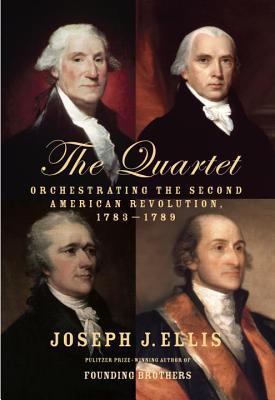
The Quartet: Orchestrating the Second American Revolution, 1783-1789
by Joseph J. Ellis
- Author:
- Joseph J. Ellis
- Status:
- Done
- Format:
- eBook
- Genres:
- History , Nonfiction , American History , Politics , Biography , American Revolution
- Pages:
- 320
- Highlights:
- 74
Review
I’m reminded of that classic line on /r/AskHistorians - “more can always be said but…”
This book manages to be short, punchy and engaging by deliberately narrowing it’s scope. The author’s central idea is that the drafting and ratification of the Constitution in 1787-89 was nothing short of a Second American Revolution. He doesn’t bother with the Declaration of Independence, the Revolutionary War or any details after, like the Washington Presidency.
But that’s why it’s so fun to read! He focuses on the 4 people he credits with making making this revolution happen - Washington, Madison, Hamilton and Jay. Everyone else who played big roles before and after (Adams, Franklin, Jefferson etc) are elided.
3 takeaways
- The appreciation for how many coincidences had to go just right for America as a country to form. With hindsight we take it for granted, but these 4 had to move mountains to make it happen, they needed a lot of luck and things had to go just right. Even then, ratification turned out to be a close thing in the 2 biggest states. If this effort had failed, North America would have resembled Europe - a bunch of constantly warring states.
- How silly the doctrine of “originalism” feels after reading this. “Originalism” exalts the writers of the Constitution and the Federalist Papers like they’re infallible Gods. Far from it. Madison, who wrote much of it, vacillated a lot in his opinions. He went from being disappointed with what they drafted, to strongly supporting ratification, to later being an opponent of Hamilton. And there were obvious flaws in the document, like a lack of a concept of judicial review. These men would be the first to admit that they meant for the Constitution to be reinterpreted with the passage of time. To exalt them with a religious fervour feels obtuse. Also, the founding fathers were clearly radicals, who were pushing a crazy radical idea in creating America. It seems absurd to use them to prop up conservative thought of never changing. Hamilton especially would have abhorred being used as a prop in this way.
- Slavery. They completely ducked this question. I understand why they did it, because there was enough to disagree about without bringing that in. It had to be resolved eventually. I’m keen to read a history of the Civil War next.
Highlights
Page 11
In 1863 Lincoln had some compelling reasons for bending the arc of American history in a national direction, since he was then waging a civil war on behalf of a union that he claimed predated the existence of the states. This was a fundamental distortion of how history happened, though we may wish to forgive Lincoln, since it was the only way for him to claim the political authority to end slavery. Truth be known, nationhood was never a goal of the war for independence, and all the political institutions necessary for a viable American nation-state were thoroughly stigmatized in the most heartfelt convictions of revolutionary ideology. The only thing holding the American colonies together until 1776 was their membership in the British Empire. The only thing holding them together after 1776 was their common resolve to leave that empire. Once the war was won, that cord was cut, and the states began to float into their own at best regional orbits. Any historically informed prophet who was straddling that postwar moment could have safely predicted that North America was destined to become a western version of Europe, a constellation of rival political camps and countries, all jockeying for primacy. That, at least, was the clear direction in which American history was headed. 5
Note: Author has convinced me.
Page 13
So how do we explain such a seismic shift in the gravitational field of American political history? Well, the kind of bottom-up explanation that works so well to convey popular opposition to British imperial policy in the 1760s and 1770s will not work in the 1780s. Mobs did not appear, urging the creation of a fully empowered American nation. Quite the opposite: the dominant historical forces in the 1780s were centrifugal rather than centripetal, meaning that the vast majority of citizens had no interest in American nationhood; indeed, they regarded the very idea of a national government as irrelevant to their local lives and ominously reminiscent of the British leviathan they had recently vanquished. There was no popular insurgency for a national government because such a thing was not popular.
Page 14
My argument is that four men made the transition from confederation to nation happen. They are George Washington, Alexander Hamilton, John Jay, and James Madison. If they are the stars of the story, the supporting cast consists of Robert Morris, Gouverneur Morris (no relation), and Thomas Jefferson. Readers can and should decide for themselves, but my contention is that this political quartet diagnosed the systemic dysfunctions under the Articles, manipulated the political process to force a calling of the Constitutional Convention, collaborated to set the agenda in Philadelphia, attempted somewhat successfully to orchestrate the debates in the state ratifying conventions, then drafted the Bill of Rights as an insurance policy to ensure state compliance with the constitutional settlement. If I am right, this was arguably the most creative and consequential act of political leadership in American history.
Page 15
Perhaps the best way to understand the term American Revolution is to realize that it describes a two-tiered political process. The first American Revolution achieved independence. It was a mere, or perhaps not so mere, colonial rebellion. It also created a series of mini-republics in the former colonies, now states, but it did so in ways that were inherently incompatible with any national political agenda. The second American Revolution modified the republican framework existent in the states in order to create a nation-size republic. The overly succinct way to put it is that the American Revolution did not become a full-fledged revolution until it became more expansively American. Or even more succinctly, the first phase of the American Revolution was about the rejection of political power; the second phase was about controlling it. More practically, the United States could not become the dominant model for the liberal state in the modern world until the second American Revolution of 1787–88.
Note: Oh man, this author seems like the kind where I’m highlighting everything he says.
Page 17
My immersion in this extraordinarily rich body of primary evidence has made me even more aware that the second American Revolution occurred in a chronological place that must be recovered on its own terms before it can be evaluated by ours. In effect, we must be prepared to perform an exercise in anthropology over time rather than space. The residents of late-eighteenth-century America lacked access to many of our modern values, meaning that they lived in a premodern world that is forever lost to us. That world was predemocratic, pre-Darwin, pre-Freud, pre-Einstein, pre-Keynes, and pre–Martin Luther King, Jr. The distinctive mentality of that world makes it dangerous to solicit their advice or wisdom in response to our current controversies (i.e.: What would George Washington say about our invasion and occupation of Iraq?). Such efforts resemble the futile attempt to plant cut flowers. But the same interpretive problem also flows in the opposite direction. Viewing and judging the founding generation through the lens of our own values is inherently presumptive and presentistic, much like evaluating the child-rearing practices of indigenous tribes in Samoa by the standards of Dr. Spock. There are two especially salient danger zones where our modern presumptions can most easily lead us astray. The first is our creedal conviction that democracy is the political gold standard against which all responsible governments must be measured. The second is our political certainty, in truth recently arrived at, that racial equality is morally superior to any race-based alternative. Neither of those modern assumptions would have been either comprehensible or credible to the founding generation. The term democracy remained an epithet until the third decade of the nineteenth century. It meant mob rule, the manipulation of majority opinion by demagogues, and shortsighted political initiatives on behalf of the putative “people” that ran counter to the long-term interests of the “public.” In the 1780s democracy meant the refusal to pay taxes to reduce the federal debt incurred in the war, the preference for an inflated currency that privileged debtors over creditors, the illegal confiscation of loyalist estates, and the repudiation of any political authority that subordinated local interests to some larger, national agenda. It is true that the first American Revolution gave newfound credence to egalitarian assumptions that fed the democratic ethos and eventually undermined the hierarchical assumptions of colonial America. But it took fifty years for democratic values to become hegemonic, and the second American Revolution predated that development. The democratic society that Alexis de Tocqueville described in the 1830s was still aborning in the 1780s. The operative word for the revolutionary generation was republic rather than democracy. And therefore we should expect to see them searching for a way to harness the primal energies of popular opinion within a multitiered political architecture that filtered the swoonish swings “of the people” through layers of deliberation controlled by what Jefferson called “the natural aristocracy.” That filtration process was what the Constitution was all about, which does not make that seminal document antidemocratic so much as predemocratic. 9 Race and slavery present even more daunting interpretive challenges. There is no way to finesse the fact that slavery was built into the American founding, just as it was built into the economy of all the states south of the Potomac. Historians who prefer to downplay that awkward reality thereby obscure the most consequential and tragic choice the founders were forced to make. Although most of the prominent founders, and all the men featured here, fully recognized that slavery was incompatible with the values of the American Revolution, they consciously subordinated the moral to the political agenda, permitting the continuance and expansion of slavery as the price to pay for nationhood. This decision meant that tragedy was also built into the American founding, and the only question we can ask is whether it was a Greek tragedy, meaning inevitable and unavoidable, or a Shakespearean tragedy, meaning that it could have gone the other way, and the failure was a function of the racial prejudices the founders harbored in their heads and hearts. 10
Note: I strongly agree with this. Judge them by their era and their values, not ours.
Page 22
Certain I am that unless Congress speaks in a more decisive tone; unless they are vested with powers by the several states competent to the great purposes of War…, that our cause is lost…. I see one head gradually changing into thirteen. George Washington to Joseph Jones MAY 31, 1780
Note: This has always been my view because of the strength of China, US and India. They are all stronger than they would have been as a confederation. But I have the benefit of hindsight. George here was speaking with the reality of leading an army in an ongoing war.
Page 24
A closer look at the recently ratified document that promoted all those salvos and illuminations reveals that Tucker’s skepticism about any emergent American nation-state was not that far off the mark. For the Articles of Confederation were not, and were not intended to be, a political framework for a national government. Indeed, the Articles were not designed to establish any kind of government at all. As its name suggests, the Articles created a confederation of thirteen sovereign states that were nations themselves, entering, as Article III put it, “into a firm league of friendship with each other, for their common defence, the security of their liberties, and their mutual and general welfare.” It was less a constitution than a diplomatic treaty among sovereign powers. 3
Page 25
In at least two other aspects, it was clear that the political framework created by the Articles was not designed to function as a national government. First, the proper model for a republican government had been established in the state constitutions, almost all of which followed the guidelines proposed by John Adams in his Thoughts on Government (1776). The central ingredients in the Adams political recipe were a bicameral legislature, an elected or appointed governor, and an independent judiciary, an early version of the separation-of-powers doctrine later embodied in the federal Constitution. The structure of the Articles—a single-house legislature and an appointed but powerless president—dispensed with all the political wisdom that had accumulated in the states about a properly balanced republican government, because, in truth, that is not what the Articles were intended to be. 5
Note: Guess some people might have objected to the power grab if they had set up a full strength government to start with?
Page 27
The debate focused on a document written by a committee of twelve delegates in June, prior to the vote on independence, and chaired by John Dickinson, the leader of the moderate faction in Congress. Called the Dickinson Draft, it is an elusive text that has caused several generations of historians to throw up their hands in frustration, because Dickinson attempted to synthesize the competing convictions of a large committee that harbored fundamentally different ideas about what the emergent American republic should look like. The Dickinson Draft is, in truth, one of the most revealing documents of the revolutionary era, not in spite of but because of its intellectual incoherence. For what Dickinson attempted to achieve was a political compromise between those who wanted a state-based confederation and those who wanted a federal government with enumerated powers over the states. In other words, Dickinson tried and failed to do in the summer of 1776 what James Madison and his Federalist colleagues succeeded in doing in the summer of 1787.8
Page 28
Slavery was too volatile a subject to be addressed directly; indeed, there was an unspoken policy of silence surrounding the topic based on the broadly shared sense that it, more than any other issue, possessed the potential to destroy the political consensus that had formed around independence. But slavery was too embedded in the economy of the southern states to avoid altogether, and it came up, albeit obliquely, during debate over Article XII of the Dickinson Draft, which proposed that “the expenses for the war and the general welfare shall be defrayed out of a Common Treasury, which shall be supplied by the several colonies in proportion to the Number of Inhabitants of every Age, Sex and Quality, except Indians.” An argument then ensued over how to count “Inhabitants,” which soon became an argument over slaves: Were they persons or property?
Note: I empathise with the constraints. They needed everyone to stay united, so they tiptoed around slavery.
Page 29
In the long view, which is to say looking down the road another eight decades or so, this debate proved prophetic. It was the first occasion when the intractable dilemma posed by slavery found its way into the public record. And in 1861 South Carolina acted on the same secessionist threat it first made in the summer of 1776. More immediately, both northern and southern delegates recognized the need to deflect the “Inhabitants” question, and they revised the Dickinson Draft so that each state would be billed “in proportion to the value of all land within each state,” thereby skirting the slavery question but in the process producing a criterion for taxation that proved inherently immeasurable and infinitely manipulable by the state legislatures.
Page 33
It was distressing to realize that, beyond independence, there was no consensus on what being an American meant, or whether there was such a thing at all. For Adams it was especially distressing to witness such conspicuous failure “in the first formation of Government erected by the People themselves on their own Authority, without the poisonous Interposition of Kings and Priests.” There was, to be sure, such a thing as “The Cause,” but the glorious potency of that concept did not translate to “The People of the United States.” 16
Page 34
The final draft of the Articles of Confederation that was sent to the states in November 1777, then, had been cleansed of any language that envisioned the existence of an American nation-state after the war. To be sure, the Dickinson Draft had always been a tortured document that leaned toward a state-based confederation. And it was always clear that the vast majority of Americans did not regard the war for independence as a movement for American nationhood, to the extent they gave the matter any thought at all. The final draft of the Articles of Confederation, then, merely confirmed and institutionalized that conviction.
Page 35
There are two enormous and overlapping ironies at work here, which taken together represent a central paradox of the American Revolution: namely, the two institutions that made victory in the war for independence possible, the Continental Congress and the Continental Army, represented a consolidated kind of political and military power that defied the republican principles on which the American Revolution was purportedly founded. If we wished to push this line of argument to its logical limit, we would say that the ideological and emotional hostility to any conspicuous and centralized expression of political authority rendered a viable American nation inherently incompatible with the goals of the American Revolution.
Page 36
In October 1776 Congress approved all the requests. But when President John Hancock sent the troop quotas to the respective state legislatures, they were regarded as requests, and none of the states complied. What was militarily necessary was clear, but what was politically impossible was clearer. The states, after all, needed to protect their own people, best done with militia, often paid at a higher rate than soldiers in the Continental Army. As for the creation of a cadre of Continentals committed to service “for the duration,” that smelled distinctly like a “standing army” in the British mode, which the American Revolution was designed to destroy. The hard core of the Continental Army was eventually comprised of misfits—indentured servants, recently arrived immigrants, emancipated slaves, unemployed artisans. The vast majority of “the soldiery,” as Washington called them, were one-year enlistees who came and went like transients, an army of amateurs. Washington’s reports from the field became a litany of lamentations: bemoaning the lack of food, clothing, shoes, ammunition; warning that the one-year enlistments put the very survival of the army at risk on an annual basis; urging the necessity of a larger army of veteran troops who could assume the offensive instead of fighting a purely defensive war. But the unspoken and unattractive truth was that the marginal status of the Continental Army was reassuring for the vast majority of Americans, since a robust and professional army on the British model contradicted the very values it was supposedly fighting for. It had to be just strong enough to win the war, or perhaps more accurately not lose it, but not so strong as to threaten the republican goals the war was ultimately about. 21 Beginning in 1780, Washington went on the offensive, claiming that the lack of support for the Continental Army was a direct consequence of the failure of the Continental Congress to impose its will on the states. “Certain I am,” he warned, “that unless Congress speaks in a more decisive tone; unless they are vested with powers by the several states competent to the great purpose of War…, that our Cause is lost…. I see one head gradually changing into thirteen.” Over and over he repeated the refrain that a confederation of sovereign states, almost by definition, lacked the unity of purpose necessary to win the war: “In a word, our measures are not under the influence and direction of one council, but thirteen, each of which is actuated by local views and politics.” As a result, “we have become a many-headed Monster, a heterogeneous Mass, that never will Nor can steer to the same point.” Though his own personal honor was obviously invested in the eventual triumph of American independence, he wanted it placed in the record that “if we fail for want of proper exertions in any of the State Governments, I trust the responsibility will fall where it ought, and that I shall stand justified to the Congress, to my Country, and to the World.” If a potent Congress and powerful army were, in fact, incompatible with the principles on which the American Revolution was based, then everyone needed to realize that the war could not be won, and all those principles would prove meaningless. 22
Note: Insane that he won with such an army
Page 42
From the beginning, then, the war for Washington was an all-or-nothing wager. There were, to be sure, enormous political considerations at stake. He announced from the start that he regarded the Continental Army as subservient to civilian control, as embodied in the Continental Congress. This was done without much pondering, almost breezily, a decision that becomes significant only when one realizes that Julius Caesar, Oliver Cromwell, Napoleon Bonaparte, and Simon Bolívar never managed to make it.
Note: A man apart, even in this hallowed company.
Page 43
The only subject on which all those voices could agree was that, whatever the American Revolution meant, Washington epitomized it. He was, as the toasts in his honor put it, “the man who unites all hearts.”
Page 44
I am decided in my opinion, that if the powers of Congress are not enlarged, and made competent to all general purposes, that the Blood which has been spilt, the expense that has been incurred, and the distress that have been felt, will avail in nothing; and that the band, already too weak, which hold us together, will soon be broken; when anarchy and confusion must prevail. 29
Page 52
At the first session of the Confederation Congress, it was decided that nine states constituted a quorum, with two delegates necessary for a state to qualify as present. But on multiple occasions throughout the spring and summer of 1781, no official business could be done because five or more state delegations were either absent altogether or only partially represented. Part of the problem lay with the state legislatures, which were often slow to select their delegates; part of the problem was that the leading candidates refused to serve, preferring to perform their public duties at the state level. John Witherspoon of New Jersey became the most frequent and vocal critic of this sorry situation, waiting around with nothing to do because his erstwhile colleagues had failed to show up, but the attendance problem accurately reflected the political priorities of the most prominent American leaders. In truth, it would be misleading to say that local and state concerns trumped the national interest, because in most minds no such thing as the national interest even existed. 1
Note: The author is doing a good job of conveying the difference between us and them. Things that we take for granted like the national interest weren’t being ignored, they simply did not exist in the minds of some men then.
Page 61
In addition to an enormous fortune, he brought two convictions to the task at hand: first, a firm belief that patriotism and its intellectual accomplice, virtue, were less effective motivating forces than interest; and second, an answer to the question everyone was asking—what will hold the states together once the war ends? Washington believed the answer was the western domain. Morris believed the answer was debt.
Note: Interesting
Page 62
All this became strikingly relevant when the Financier took command of the American economy. For Morris’s way of thinking was terra incognita for most southern delegates in Congress, especially the Virginians, who still regarded land, not money, as the ultimate measure of wealth, and for whom the manipulation of numbers on a balance sheet came across as some sinister form of magic, eerily similar to the calculations their English and Scottish creditors were employing to drive them into bankruptcy.
Page 77
That core mistake, currently embodied in the Articles, obviously had to be corrected, which should be the work of “those with the enlightened and liberal views necessary to make a great and flourishing people”—in other words, men like himself. But beyond the specific political reforms that would be necessary, there was also a grand illusion that had to be dispelled, which was another unfortunate by-product of the movement for independence: namely, the belief that political power itself was inherently evil and ultimately unnecessary, because virtuous citizens would internalize such a high level of sacrifice to the collective good that all forms of political coercion would prove superfluous. Hamilton unleashed all his political energy against what he regarded as the most seductive delusion generated by the patriotic rhetoric of the American Revolution: We may preach till we are tired of the theme, the necessity of disinterestedness in republics without making a single proselyte…. We might as well reconcile ourselves to the Spartan community of goods and wives, to their iron coin, their long beards, or their black broth; for it is as ridiculous to seek for models in the simple ages of Greece and Rome as it would be to go in quest of them among the Hottentots and Laplanders. 38
Page 77
While Madison was still evolving in a national direction, Hamilton was already there. Part of the reason was his wartime experience, where the inadequacies of the state-based confederation were experienced on a daily basis in the form of periodic starvation and troops without shoes. Part of the reason was that as a recent immigrant with no long-standing loyalty to a particular state, Hamilton had no local or regional allegiance that needed to be overcome. (This was Madison’s problem.) And part of the reason was Hamilton’s distinctive personality, which instinctively regarded halfway measures as mere bromides, incremental acts that defied the aggressive core of his character. Whether Hamilton was charging a British redoubt or arguing about the full meaning of the American Revolution, he had to be out front. Nothing less was psychologically tolerable.
Note: Maybe it’s my lack of knowledge of these people and this era but everything the author says makes sense. The analysis of the two characters seems accurate.
Page 78
There was but one answer, the resolution concluded, and that was to call a constitutional convention “to revise and amend the confederation.” The delegates in the Congress promptly and without debate sent the resolution to a committee, which just as promptly buried it in a pile of papers, never to be seen again. Political combat, it turned out, was not like charging a redoubt, because a leader could get too far ahead of his constituents. This was a problem that would haunt Hamilton throughout the decade, for he was so far ahead of public opinion that his views were often discounted or ignored altogether.
Note: That’s hilarious 😆
Page 82
The audience sat in frozen silence for several seconds after Washington had finished, momentarily obscuring their reaction to his words. Then Washington pulled out of his waistcoat a recently acquired pair of spectacles and said: “Gentlemen, you will permit me to put on my spectacles, for I have not only grown grey, but almost blind in service to my country.” Several officers began to sob, then came a smattering of applause, then resounding applause, then a standing ovation. All prospects for a military coup died at that moment. Within the long arc of American history, Washington’s speech is significant because it prevented the American Revolution from descending the path taken by previous and future revolutionary movements, from republican ideals to military dictatorships. Which is to say that Washington did not do what Julius Caesar and Oliver Cromwell had done before him and Napoleon would do after him. In the crucible of that moment, however, the more immediate significance was that the army ceased to be a pawn in a plot to expand the powers of the Congress. The failure of the Newburgh Conspiracy meant that whatever dim prospects for a revision of the Articles it had created were now dead.
Note: A mediocre commander, but this moment is remarkable.
Page 84
At least in retrospect, the dissolution of the Continental Army in the spring of 1783 was one of the most poignant scenes in American history, as the men who had stayed the course and won the war were ushered off without pay, with paper pensions and only grudging recognition of their service. Washington could only weep: “To be disbanded… like a set of beggars, needy, distressed, and without prospect… will drive every man of Honor and Sensibility to the extreme Horrors of Despair.”
Page 85
Throughout his tenure as superintendent of finance, Morris had acted on the assumption that the United States were in fact bound together by a common debt incurred in the war for independence, and that bond created a common obligation to support a national fiscal policy. But it was now clear beyond any doubt that very few Americans shared that assumption. “I hope my successor will be more fortunate than I have been,” Morris explained to Washington upon resigning, “and that our glorious Revolution may be crowned by those Acts of Justice, without which the greatest human Glory is but the Shadow of Shade.” 52
Page 94
Elected to the Continental Congress in 1778, he was almost immediately chosen to serve as president. This kept happening to Jay, in large part because his peers viewed him as a man of principle who could be trusted even by those who disagreed with his principles. His massive probity, combined with his persistent geniality, made him impossible to hate. He lacked Washington’s gravitas, Hamilton’s charisma, and Madison’s cerebral power, but he more than compensated with a conspicuous cogency in both his conversation and his prose that suggested a deep reservoir of learning he could tap at will. Permanently poised, always the calm center of the storm, when a controversial issue arose, he always seemed to have thought it through more clearly and deeply than anyone else, so that his opinion had a matter-of-fact quality that made dissent seem impolite.
Note: Being genial and likeable is a superpower. It led to success just like gravitas, charisma and cerebral power did for the others.
Page 94
In 1778 he was appointed to the Continental Congress to defend New York’s claim against Vermont’s petition for statehood. But Jay decided, upon reflection, that New York’s case was petty and partisan, and that the larger interest of the confederation would be best served by accepting Vermont into the union. Despite pressure from the New York legislature, he would not budge from his conviction that the whole needed to take precedence over the parts, the first clear expression of his national orientation. Despite his best efforts, the Vermont question became a victim of gridlock in the Congress. As he put it with obvious disdain, “the issue was ‘bitched’ in its last as well as its first stages.” 9
Note: Rare instance of an elected representative telling his constituents that they’re wrong and they need to sacrifice for a greater cause.
Page 97
In the year since the war had ended, a majority of candidates elected to serve in the Congress had declined, or just failed to show up, and on fourteen occasions no business could be conducted for lack of a quorum. More dispiriting than any clash of opinions was the pervasive indifference that rendered argument itself impossible. There was not even a quorum available to ratify the definitive version of the Treaty of Paris or to accept Washington’s highly symbolic resignation as commander in chief at Annapolis.
Note: It’s very clear that the states saw this as an irrelevant sideshow.
Page 97
Jay was being asked to convert the American cacophony on foreign policy into a chorus.
Note: Very nice turn of phrase. Don’t think I’ve heard it before.
Page 98
A distinctively different voice then entered the conversation, less interested in the revenue to be acquired than in the values that should guide American western expansion. In the deed ceding its claims to land northwest of the Ohio River, the Virginia delegation proposed the following principles: “The Territory so ceded shall be laid out and formed into states containing a suitable extent of Territory not less than one hundred or more than one hundred and fifty square miles… and that the states so formed shall be distinctive Republican States and admitted members of the Federal Union, having the same rights of Sovereignty, Freedom, and Independence as the other states.” These words were written by Thomas Jefferson, and it is possible to argue that, apart from his more famous phrases in the Declaration of Independence, they are the most historically consequential words he ever wrote, since they defined the political and legal framework that would shape American expansion across the entire North American continent for the next century. 14
Page 100
There was no need to encourage migration. The flow of settlers over the Alleghenies already threatened to become a flood. The challenge was to channel it in accord with republican principles. For Jefferson, that meant westward expansion should benefit settlers rather than speculators; that each new territory, once sufficiently populated at twenty thousand souls, should decide on what form of republican government it wanted; and then, when its population matched that of the smallest state, it could apply for admission into the confederation. There would be no permanent colonies in the expanding American republic. If you decided to carry your family west, you would know that there was a plan in place to ensure that you and your descendants would be folded into the United States as equal citizens.
Note: How did they have so many far sighted thinkers in the right place at the right time.
Page 103
By controlling the demographic flow of western migration and ensuring its density, the Ordinance of 1785 minimized the likelihood of Indian wars, the idea being to sign treaties with the resident tribes in advance of the surveyors. The treaties signed with the Six Nations at Fort Stanwix, the Cherokees at Hopewell, and the Ohio tribes at Fort McIntosh were all one-sided affairs in which American negotiators claimed ownership of all the land east of the Mississippi, citing the Treaty of Paris, which rendered the Native American population “a conquered people” who should be grateful to be consulted at all. 19 But the conquest theory had the distinct appearance of imperialism in the European mode, making it awkwardly clear that the republican principles that were supposed to govern westward expansion did not apply to Native Americans. Although there was an unspoken understanding that Indian removal east of the Mississippi was inevitable, how that removal was to occur did matter, meaning that outright coercion needed to be replaced with some semblance of mutual consent. Philip Schuyler, a former general in the Continental Army who had extensive experience dealing with the Six Nations during the war (and who, it so happened, was Alexander Hamilton’s father-in-law), came up with an alternative way of thinking about Native Americans other than as “a conquered people.” “As our settlements approach their country,” Schuyler explained, “they [Indians] must, from scarcity of game, retire further back, and dispose of their lands, until they dwindle comparatively to nothing, as all savages have done… when compelled to live in the vicinity of civilized people.” In effect, demography would do the work of armies. 20 What Schuyler attributed to a cultural collision that would cause Native American societies to disintegrate upon contact with white civilization was most probably as much biological as cultural. Settlers of European ancestry carried diseases, chiefly smallpox and measles, to which most Native Americans had never been exposed, making them vulnerable to epidemics that on occasion generated mortality rates of 90 percent or higher. The real weapons of mass destruction in the eighteenth century were viruses, and the major reason the Native American population would recede upon contact with the front edge of white settlements was that they were defenseless against such biological weapons. What Schuyler liked to think of as the march of civilization was in fact a policy of genocide in slow motion, in which the march of white migration was accompanied by an artillery barrage of microbes that cleared the way. 21
Note: Good on the author for acknowledging the role of smallpox in Manifest Destiny.
Page 106
It was the political version of the decisive moment in a great battle, he claimed, that could go either way, depending on how western expansion was managed. “The western settlers stand as if it were upon a pivot,” he warned, “and the touch of a feather would turn them any way.” Unless there was a viable American nation-state to join, Washington worried that the western territories would drift into the orbit of lurking European powers or go off on their own to form independent states. Washington’s great fear was that North America would become a version of Europe, a collection of coexistent sovereignties rather than a coherent nation of its own. All the evidence seemed to support the conclusion that the very term United States was becoming a preposterous illusion. 25
Page 115
Conspiracy theories usually look rather bizarre in retrospect, when the issues at stake have lost their relevance and the political temperatures have cooled down. In order to comprehend the irrational edge of the southern argument against Jay’s proposed treaty, one needs to recover the following forgotten facts: first, that the Virginians were accustomed to regarding themselves as the proprietors of the Ohio Country and therefore deeply resented any policy toward western expansion that spoke with a northern rather than a southern accent; second, any discussion of the Mississippi generated a kind of electromagnetic field in which alternative visions of America’s future hovered like mirages over the western horizon; and third, Jay’s previous diplomatic posts in Madrid and Paris had allowed him considerable independence from Congress—a discretion that came with distance—but what worked so well abroad generated resentment at home. It also did not help that he was the person who officially apprised all the southern states that they were obliged by treaty to pay back debts owed to British creditors, a price tag that Monroe estimated at £ 2.8 million for Virginia.
Page 125
This was Hamilton’s out-front brand of leadership in its most flamboyant form. A convention called to address the modest matter of commercial reform had just failed to attract even a quorum, and now Hamilton was using this grim occasion to announce the date for another convention that would tackle all the problems affecting the confederation at once. It was as if a prizefighter, having just been knocked out by a journeyman boxer, declared his intention to challenge the heavyweight champion of the world. Given the overwhelming indifference that had suffocated all previous attempts at comprehensive reform of the Articles, no one with any semblance of sanity could possibly believe that Hamilton’s proposal enjoyed even the slightest chance of success.
Page 131
Even a glance at Washington’s postwar correspondence reveals that there was more to his reticence than a desire to stay on script. The phrase that keeps recurring in his letters is “gliding down the stream of life,” his way of realizing that, to shift the metaphor, the sands in his hourglass were running out. He was profoundly aware that no male in the Washington line had lived beyond his fifties, so he was much closer to the end than the beginning. After an extended visit by Lafayette, whom he regarded as an adopted son, he waxed eloquent, almost elegiac, on the likelihood that they would ever meet again: I called to mind the days of my youth, & found they had long since fled to return no more, that I was descending the hill I had been 52 years climbing—& that tho’ I was blessed with a good Constitution, I was of a short lived family—and might soon expect to be entombed in the dreary mansion of my fathers—These things darkened the shades & gave a gloom to the picture… but I will not repine—I have had my day. 15
Note: Damn. I can’t imagine a person today talking like this.
Page 133
Left unsaid, but obvious to all, was that Washington’s inclusion instantly transformed a highly problematic cause into something suddenly serious. With Washington on board, the embarrassment at Annapolis would not be repeated at Philadelphia. And if the assembled delegates decided not just to revise the Articles but to replace them altogether with a new government, Washington’s presence would provide an invaluable veneer of legitimacy for extensive reform that was, strictly speaking, a violation of the mandate soon to be issued by the Confederation Congress. 18
Page 140
On the sovereignty question, Madison suggested a subtler and in the end more ingenious solution, which was to abandon the belief that it must be singular and indivisible: “I have sought for some middle ground, which may at once support a due supremacy of the national authority, and not exclude the local authorities when they can be subordinately useful.” Instead of arguing about the ultimate location of sovereignty, Madison was suggesting that no such place existed. In purely rhetorical terms, Jay’s resort to “the people” worked well, but in practical terms it might prove preferable to embrace some version of shared sovereignty that blurred the line between federal and state authority. Madison was inventing what came to be called “federalism,” a government in which sovereignty was a matter of ongoing negotiations between the state and federal governments on a case-by-case basis. The genius of Madison’s formulation was that it imposed a national grid in lieu of the state-based Articles but left room for local, state, and regional loyalties to remain relevant. 29 This was actually Madison’s “fallback” position, a compromise on the all-important sovereignty question that he was prepared to share, in confidence with Washington in the spring of 1787, but then vigorously oppose during the deliberations in Philadelphia. He would embrace it again during the ratification debates of 1787–88, once the delegates at the Constitutional Convention had rejected his more radical insistence that the sovereignty question be clearly resolved. Since it turned out to be a defining principle of federalism and perhaps Madison’s central contribution to American political thought, it is interesting to note that the germ of the idea was there from the start.
Page 143
Madison’s trademark talent was superior preparation. While serving on the Governor’s Council (1778–79), then again in the Virginia legislature (1779–80), he seldom missed a session and always seemed to have more facts at his fingertips than anyone else. Amid the flamboyant orators of the Virginia dynasty he was almost invisible and wholly unthreatening, but the acknowledged master of the inoffensive argument that so often proved decisive. He seemed so innocuous, even gentle, that it was impossible to unleash one’s full fury against him without seeming a belligerent fool. His style, in effect, was not to have one. As a result, a Madisonian argument lacked all the emotional affectations but struck with the force of pure thought, embedded in often overwhelming amounts of evidence. As one commentator put it later, “Never have I seen so much mind in so little matter.” 31
Note: Such a special man.
Page 145
His evolution continued apace in a more radical direction over the next three years. Hamilton, Jay, and Washington had reached that conclusion by an earlier and faster route. Madison arrived at the same destination more gradually and grudgingly, because a national perspective did not come to him naturally. Though obvious in retrospect, it came as a revelation to him that a state-based confederation could not regulate interstate commerce because each state had its own economic agenda. “They can no more exercise this power separately,” Madison now recognized, “than they could separately carry on war, or separately form treaties.” And yet cooperation on the economic front was unlikely, because it would appear “unpalatable on minds unaccustomed to consider the interests of their state as interwoven with those of the Confederacy.” The great strength of the confederation model was its flexible accommodation of multiple and diverse interests under one canopy. The great weakness, now being embarrassingly exposed, was its inherent incoherence. The center could not hold because it did not exist. And it did not exist because local, state, and at best regional allegiances remained more potent than any larger sense of national unity. Madison understood that problem viscerally because up until then he had thought of himself as a Virginian rather than an American. 34
Note: I feel like I’m with him, realising this. Great work by the author.
Page 162
Madison’s aversion to unfettered (or unfiltered) democracy was less theoretical than practical. The state governments created during and after the war for independence were the closest thing to laboratories for democracy ever established beyond the local level in recorded history. And there was little doubt in his mind that these political experiments, Virginia’s included, were demonstrable failures, clear examples of how easily demagogues could manipulate popular opinion and provincial prejudices, thereby rendering any considerations of the larger public interest impossible. His argument about the inherent advantages of a large republic represented his way to bring demography and geography to the rescue by enlarging the political arena. His argument for filtration represented his attempt to achieve a similar goal—that is, to harness the raw energies of that semi-sacred thing called “the people” while simultaneously controlling and refining its inevitable excesses. A large and properly layered republican government, therefore, would have a popular foundation and a meritocratic infrastructure, which was the political equivalent to having your cake and eating it too.
Note: I don’t think it makes sense to think to Madison as wrong or right about this. With the level of education and knowledge dissemination at that time, this seems reasonable. Keeping up with political news was a full time job.
Later when people became more educated and had access to newspapers it made sense to change senate seats to being directly elected.
Page 167
Finally, two other procedural decisions made at the start would turn out to have an abiding influence on the deliberations in Philadelphia and the ways they would be regarded by posterity. The first was the decision that absolute secrecy must prevail, that “nothing spoken in the House be printed, or otherwise published, or communicated without leave.” There would be no journalists or spectators in attendance, sentries would be posted at the doors, and delegates were prohibited from discussing the debates in public or in correspondence. 26 These restrictions were designed to ensure confidentiality and thereby promote the freer exchange of ideas during the debates. And based on the subsequent testimony of the delegates, there is good reason to believe that they did just that. But they ever after made the Constitutional Convention vulnerable to charges of conspiracy, corruption, and skullduggery. And since it is unimaginable in any modern context for such restricted conditions to exist for any political gathering charged with significant responsibility over matters of such consequence, the specter of conspiracy has understandably haunted all histories of the convention. Ironically, to the extent that the delegates at Philadelphia succeeded, their success was dependent on violating all of our contemporary convictions about transparency and diversity, which is one reason why their success could never be duplicated in our time.
Note: This feels similar to the idea that a benevolent, ethical, moral, intelligent, empathetic dictatorship is the best form of government.
Transparency is good because it prevents corruption. But if you have men of such quality then it’s a hindrance.
Page 169
Looked upon as a collective, the fifty-five delegates to the Constitutional Convention were surprisingly young—average age forty-four—and disproportionately well educated. Twenty-nine had college degrees, and the same number had studied law. Their educational backgrounds were more conspicuous than their wealth, making them more an intellectual than an economic elite. Thirty-five had served as officers in the Continental Army, and forty-two had served in the Continental or Confederation Congress. 28 This was the most important political indicator of all, for it meant that a sizable majority of the delegates had had intimate experience with the inadequacy of the Articles as a makeshift government during and after the war. Army veterans could testify more poignantly than anyone else that the very structure of the state-based government under the Articles had relegated their sacrifices to oblivion. Whether you served in the Continental Congress or the Continental Army, you tended to understand more palpably how the current arrangement under the Articles was not working.
Note: If they had delayed this moment further they wouldn’t have had as many veterans. Veterans who had suffered due to a lack of funds. Some would have passed away or retired from politics.
Page 172
There were two ghosts at the banquet, though they haunted the deliberations in decidedly different ways. The first, monarchy, was an ever-present evil, a word on everyone’s lips, a specter so sinister that both nationalists and confederationists felt obliged to register their dread of its reappearance in America in even the faintest form. Any robust expression of executive power was, therefore, forced to fight a constant rearguard action against accusations of monarchy. Madison’s proposal for an executive veto over state legislation was dead on arrival at the convention because it seemed almost designed to conjure up the ghastly image of George III imposing his presumptive power in arbitrary and capricious fashion. Since the American Revolution had supposedly ended forever such monarchical travesties, all discussions of executive power lived under a shadow of suspicion as a species of monarchy, the rough equivalent of a Trojan horse in the republican fortress. 31 The debate over the executive took up more time and energy than any other issue at the convention, largely because the delegates could not agree on how much authority to place in the office; whether it should be a single person or a troika representing the northern, middle, and southern states; how long he should serve (a woman was unimaginable); and how he should be elected and impeached. The resolution in the Virginia Plan was elliptical on all those details, saying only that “a National Executive be instituted, to be chosen by the National Legislature for the term of ____ years.” If some form of that vague proposal had been accepted, the United States would have had a parliamentary system of government.
Page 173
The other ghost at the banquet was slavery, which was simultaneously omnipresent and unmentionable. Lincoln subsequently claimed that the decision to avoid the word slavery in the founding document accurately reflected the widespread recognition that the “peculiar institution” was fundamentally incompatible with the values on which the American Revolution was based, so that the bulk of the delegates realized that any explicit mention of the offensive term would, over time, prove embarrassing. 34 This was true enough, but the more palpable and pressing truth in the summer of 1787 was that slavery was deeply embedded in the economies of all states south of the Potomac and that no political plan that questioned that reality had any prospect of winning approval. Much like the big-state-small-state conflict, then, a sectional split was, from the beginning, built into the very structure of the convention, and some kind of political compromise was inevitable if the Constitution were to stand any chance of passage and ratification. Madison himself believed that slavery was the most elemental source of conflict. “The states were divided into different interests not by their difference in size,” he recalled later, “but principally from their having or not having slaves…. It did not lie between the large and small states, it lay between the Northern and Southern.” 35 The crucial compromise was an agreement to avoid any direct discussion of the divisive issue and to use euphemisms like “that species of property” when the forbidden topic forced itself onto the agenda. The two most explicit decisions implicitly endorsing slavery were the agreement to count slaves as three-fifths of a person for purposes of representation in the House and a prohibition against ending the slave trade for twenty years, concessions to the Deep South, especially South Carolina, that appear horrific to our eyes but without which the Constitution almost certainly could never have come into existence. 36 There were, to be sure, flashes of emotional honesty that exposed the depth of the sectional divide. Luther Martin of Maryland denounced slavery as “an odious bargain with sin, inconsistent with the principles of the revolution and dishonorable to the American character.” Gouverneur Morris pronounced slavery “a curse,” an anachronistic “vestige of feudalism” that would actually retard the economic development of the South, and “the most prominent feature in the aristocratic countenance of the proposed Constitution.” On the pro-slavery side, the most succinct statement came from Charles Cotesworth Pinckney of South Carolina: “South Carolina and Georgia cannot do without slaves.” 37 Such statements accurately expressed the broadly shared recognition that slavery was, on the one hand, a cancerous tumor in the American body politic and, on the other, a malignancy so deeply embedded that it could not be removed without killing the patient, which in this case was a newly created American nation. As a result, the most salient piece of evidence is silence. No one proposed any provision condemning slavery and insisting that it be put on the road to extinction. And no one proposed that the Constitution contain language explicitly justifying or protecting slavery or defending its permanent place in American society. The euphemisms and circumlocutions in the language of the Constitution accurately reflected the ambiguous and ambivalent mentality of the delegates. If there was one explosive device that could blow up the entire national enterprise, this was it, and the delegates knew it. Leadership, as they saw it, meant evading rather than facing the moral implications of the slavery question. Whether this was a failure of moral leadership or a realistic recognition of the politically possible can be debated until the end of time. By transforming slavery from a moral to a political problem, the delegates made it susceptible to compromise, but this achievement came at a cost. Writing in his notebook on July 9, John Dickinson of Delaware expressed his personal disappointment that the moral question posed by slavery was being conveniently obscured: “Acting before the World, what will be said of this new principle of founding a Right to govern Freemen on a power derived from Slaves…. The omitting of the WORD will be regarded as an Endeavor to conceal a principle of which we are ashamed.” 38
Note: Any past compromise to accept an evil idea is hard to accept when judging by the moral standards of the present. My opinion is that if they hadn’t compromised and created a union slavery would have lasted a lot longer.
Or maybe not, hard to say. Perhaps the individual states would have come under the hegemony of Britain which was to outlaw slavery in 1807. Although maybe Britain might not have done that if they had major economic interests in the American South. Hard to know.
Page 178
The crucial vote came on July 16. Madison and Gouverneur Morris each delivered a passionate plea for proportional representation in both branches of Congress, Morris somewhat melodramatically predicting civil war if the new government did not accurately represent the will of all its citizens. The nationalists were destined to lose this debate because voting in the convention followed the state-based model under the Articles that they were rejecting for the new Constitution. The so-called Great Compromise, also called the Connecticut Compromise because its chief sponsor came from that state, was a classic split-the-difference solution, making representation proportional in the House and state-based in the Senate, with two representatives for each state. 41 Both Madison and Washington interpreted the compromise as a devastating defeat, because the principle of state sovereignty had been qualified but not killed. Writing in code to Jefferson in Paris, Madison shared his deep disappointment at the outcome, which blasted his hopes for a fully empowered national government. “I hazard an opinion,” he lamented, “that the plan should it be adopted will neither effectively answer the national object nor prevent the local mischiefs which everywhere excite disgust agst the state governments.” The new political framework was going to be partly national and partly federal, thereby leaving the all-important sovereignty question inherently ambiguous. He had not been able to keep his promise to Washington that only a radical, wholly national solution would be acceptable. 42 Washington was slightly more sanguine. In a letter to his beloved Lafayette, he viewed the hybrid character of the proposed constitution as an inherently equivocal document that almost invited contradictory interpretations: “It is now a child of fortune to be fostered by some and buffeted by others. What will be the General opinion on, or reception of it, is not for me to decide, nor shall I say anything for or against it.” Given the diversity of opinions at the convention, however, Washington believed that “it was probably the best that could be obtained at this time.” 43
Note: I can understand why Madison was disappointed. But I wonder if he would be disappointed if he could see how the Senate performed in the next 250 years.
Page 181
More important, while the Constitution was clearly the creation of many hands, Morris was the man who actually wrote it. Both Hamilton and Madison served with him on the Committee on Style and Arrangement in mid-September, but Madison later testified that it was Morris who gave the final draft of the document its “finish,” adding that “a better choice could not have been made, as the performance of the task proves.” 44 Morris took the earlier draft prepared by the Committee on Detail and compressed the twenty-three articles in that somewhat legalistic and tangled version to seven, giving the final draft of the Constitution a clarity and accessibility that it had not previously possessed. Morris’s Constitution does not quite sing like Jefferson’s Declaration, which had the rhetorical advantage of being about founding principles rather than about the political structure to implement those principles. But Morris’s language cast the Constitution into an elevated format that rose above the nettlesome details of its content. Finally, Morris revised the preamble of the previous draft in a fashion that has continued to echo through the ages. The Committee on Detail had written “We the people of the states of New Hampshire, Massachusetts, Rhode Island…” and then down the Atlantic coast on a state-by-state basis. Morris single-handedly chose to change that to “We the People of the United States.” This was not just a stylistic revision, for it imposed, at least verbally, a crucial and clear presumption that the rest of the document was designed to finesse: namely, that the newly created government operated directly on the whole American citizenry, not indirectly through the states. Just as Jefferson had smuggled an expansive liberal mandate into the Declaration, Morris smuggled the national agenda into the preamble of the Constitution. In retrospect, this was probably the most consequential editorial act in American history, the political equivalent at the end of the convention of Madison’s bold decision to impose a national agenda at the start. 45
Note: I’ll admit, I didn’t see the significance of that change until the author explained it.
Page 182
I confess that I do not entirely approve this Constitution at present, but Sir, I am not sure I shall never approve it: For having lived long, I have experienced many Instances of being oblig’d, by better Information or fuller Consideration, to change opinions on important Subjects, which I once thought Right, but found to be otherwise. It is therefore that the older I grow the more apt I am to doubt my own Judgment, and to pay more respect to the Judgment of others….
Note: I hope I can be as accommodating and deferential of the intelligence and wisdom of others.
Page 183
Hamilton, Madison, and Washington all left town thinking they had failed to transform a confederation into a full-blooded nation. Franklin’s eloquent elegy served to remind them that perfection was never in the cards, that they had, in fact, designed the framework for a government that assumed human imperfection, which turned out to be an elemental insight denied his French friends. Within that realistic context, they had done their best. The fact that they had been unable to resolve the question of federal versus state sovereignty, or even to face the moral implications of the slavery question, did not mean that they had failed but rather that, in the current political context, those issues were irresolvable. The Constitution had created a framework in which the argument could continue. For the present, that was the most that history allowed, even more than Franklin, with all his seasoned wisdom, had allowed himself to expect.
Page 190
Three additional advantages also came their way, even before the ratification debates began. The Confederation Congress forwarded the Constitution to the state governments as requested and, after some confusion, did so unanimously. Many observers misinterpreted the unanimity of the vote as an endorsement of the Constitution itself rather than of the ratification process. “The appearance of unanimity will have its effects,” Washington commented to Madison, knowing that the true intentions of the Confederation Congress were being misconstrued: “Not every one has opportunities to peep behind the curtain, and as the multitude often judge by externals, the appearance of unanimity in that body, on this occasion, will be of great importance.” 6 Second, ratification became much more likely when the Confederation Congress silently accepted Article VII of the Constitution, which declared that the new government would go into effect after nine states had ratified. Technically, this was an illegal provision, since the procedural rules under the Articles required a unanimous vote for any amendments. The delegates in Philadelphia, many of them veteran observers of the gridlock in the Confederation Congress, most especially Rhode Island’s recalcitrance on the impost, realized a unanimous requirement for ratification would have been politically suicidal, since Rhode Island had already declared its intention to boycott the ratification process, just as it had boycotted the convention. They simply decided on their own that nine states constituted a sufficient consensus, probably drawing on the provision in the Articles requiring nine votes for all major legislation. 7 There was a hidden as well as an obvious advantage to the nine-vote requirement, and Madison, ever the political operative, was the first to recognize it. “It is generally believed that nine States at least will embrace the plan,” he predicted, “consequently that the tardy remainder must be reduced to the dilemma of either shifting for themselves or coming in without any credit for it.” The chronological sequence of the state ratifying conventions only enhanced this momentum factor. Virginia and New York, two of the largest states where opposition was most formidable, came late in the schedule, so that political pressure to ratify would build in the spring and early summer of 1788 to recognize that opposition was a lost cause. Madison believed that political arguments would become irrelevant once nine states had ratified. 8 Finally, before the debates began, the advocates for ratification won the rhetorical battle by claiming the title Federalists, which left their opponents with the limp label Antifederalists. This nomenclature was both inaccurate and grossly unfair to the “Antis.” Both sides were really federalists, the difference being how they wished to apportion authority between the federal government and the states. (A more accurate set of labels would have been nationalists versus confederationists.) In the predebate skirmishes, then, the maneuvering for both votes and vocabulary went to the pro-Constitution side. It also helped that only twelve of the ninety American newspapers and magazines gave equivalent space to the opponents of ratification. The press was decidedly pronationalist. 9 From the beginning, then, the “Antis” were placed on the political defensive. As Madison kept mentioning, their cause was further burdened by the fact that they did not agree on what they wanted in lieu of the Constitution. Was it more modest reform of the Articles, amendments to the proposed Constitution, or a second Constitutional Convention that would take into account their grievances? They agreed on what they were against, but not on what they were for. In that sense, the term Antis was accurate. On the other hand, the opponents of ratification enjoyed one enormous ideological advantage: namely, that the government proposed in the Constitution defied the principles of the American Revolution as understood in 1776. Given the size and scale of a nation-size American republic, the very definition of representation would have to change. How, for example, could a representative in the House really know the needs and interests of his thirty thousand constituents? How could Virginians agree to be taxed because voters in New England decided to do so? At a time when distance made a huge difference, how could a faraway federal government possibly fathom the thoughts and feelings of farmers on the frontier? The proposed Constitution, therefore, required a fundamental political and psychological shift in the meaning of the American Revolution. With one crucial exception, all the arguments that American colonists had made against Parliament and the king in 1776 applied equally to the government created in the Constitution in 1787. The obvious difference was that the colonists had not been represented in Parliament, whereas they were represented in the House and the Senate under the Constitution. But were they? It came back to how you defined representation. Given the local orientation of the vast majority of Americans, the Constitution was proposing the creation of a strange new world that defied their limited horizons. The enemies of ratification, then, were speaking for the original impulse of the American Revolution. By all rights, to the extent that the ratification process accurately reflected the will of the American citizenry, the opponents should have enjoyed a clear political advantage. But they did not, because the framework for the debate had been controlled by a small group of nationalists, who were overrepresented in most of the state ratifying conventions. As a result, on the eve of the ratification debates, the momentum belonged to the nationalists. 10
Note: Skilful politicking.
Page 202
At the same time that he was counting delegates in his obsessive Madisonian mode, his thought process, or perhaps his way of thinking about the ratification process, was beginning to change as he read the newspaper essays and editorials from multiple states. It gradually dawned on him that if he had gotten what he wanted at the Philadelphia convention, the prospects for ratification of the Constitution would have been remote in the extreme. In a long and quite extraordinary letter to Jefferson, the fullest and clearest exposition of what the Constitutional Convention had achieved that Madison ever wrote, he described the hybrid creature that the Constitution had created as part confederation and part nation. The delegates had, willy-nilly, managed “to draw a line of demarcation which would give to the General Government every power requisite for general purposes, and leave to the states every power which might be most beneficial to them.” 27 Left unsaid was that no one knew where that line existed, or what “general purposes” meant. Although it would take Madison several months to develop the full implications of this evolving idea, its outlines were already clear in the letter to Jefferson in late October 1787. The key insight might be called the beauty of ambiguity. Madison had misguidedly, he now realized, pushed for an unambiguous resolution of the sovereignty question during the convention. Now it was becoming clear to him that the great achievement of the convention, and of the Constitution as well, was to embrace the inconvenient truth that there was no consensus on the sovereignty question, either in the convention or in the country itself. So what they had created, albeit out of necessity rather then choice, was a political framework that deliberately blurred the sovereignty question. Most historians and constitutional scholars over the last fifty years have agreed that Madison’s preconvention preparations constituted an impressively creative moment that effectively set the agenda for the debate in Philadelphia that summer. Few have recognized that Madison’s postconvention thinking constituted a second creative moment of equivalent or greater historical significance. For it produced a political perspective that had short-term consequences for the all-important ratification process and long-term consequences for how the Constitution should be comprehended as the defining document of the new, and eventually not so new, American republic.
Note: Yeah I have to agree that it takes genius to recognise this as he did.
Page 204
In the long run—and this was probably Madison’s most creative insight—the multiple ambiguities embedded in the Constitution made it an inherently “living” document. For it was designed not to offer clear answers to the sovereignty question (or, for that matter, to the scope of executive or judicial authority) but instead to provide a political arena in which arguments about those contested issues could continue in a deliberative fashion. The Constitution was intended less to resolve arguments than to make argument itself the solution. For judicial devotees of “originalism” or “original intent,” this should be a disarming insight, since it made the Constitution the foundation for an ever-shifting political dialogue that, like history itself, was an argument without end. Madison’s “original intention” was to make all “original intentions” infinitely negotiable in the future. 28
Note: Strongly agree with this. This is a great way of thinking about orignalism.
Page 206
To say, then, that ratification represented a clear statement about the will of the American people in 1787–88 would be grossly misleading. What ratification really represented was the triumph of superior organization, more talented leadership, and a political process that had been designed from the start to define the options narrowly (i.e., up or down), and the successful outcome broadly (i.e., nine states). And despite their built-in advantages, it was still a close call. A shift of six votes in Virginia would have probably produced a shock wave that left four states—Virginia, New York, North Carolina, and Rhode Island—out of the union. And even though nine states had ratified, so that the Constitution was legally adopted, it is difficult to imagine an American nation surviving in such a geographically splintered condition.
Note: I think this is a recurring theme. Major political changes are made on narrow majorities or purely on luck. And posterity writes history with hindsight in a way that makes it seem inevitable. That even if it hadn’t happened then, it would have happened eventually and we know this because everyone agrees with it now. But everyone agrees now because we live in a world where it’s been an accepted fact for decades or centuries.
This is clearest with major conflicts that hinged on a battle that could have gone either way. But this second American revolution is the same.
Page 208
The same men who had instigated the calling of the Constitutional Convention, recruited Washington to the task, and imposed the national agenda in Philadelphia now took the lead in attempting to orchestrate the ratification process. Between November 1787 and March 1788, Hamilton (51), Madison (29), and Jay (5), wrote eighty-five essays under the common pseudonym Publius entitled the Federalist Papers. It was a project conceived by Hamilton, who recruited Jay and Madison to the task. Over the ensuing centuries the Federalist Papers have assumed the stature of an iconic text, the classic expression of the great deliberation about the viability of a nation-size republican government. In several senses, this reputation is both unwarranted and misleading. The Federalist Papers were, in fact, perhaps the supreme example of improvisational journalism, composed against tight deadlines without much time for deliberation at all. Madison later claimed that he was making changes as the printer set the type. And Hamilton, whose phenomenal output in such a brief time almost defies credibility, began the series writing on scrap paper atop a wooden box while traveling on a sloop between New York City and Albany. 31 Even our modern inclination to see the Federalist Papers as the seminal statement of “the original intentions” of the framers is historically incorrect, since Publius represented only one side of the ratification debate—the winning side, to be sure, but a wholly partisan perspective. Finally, the Federalist Papers were aimed not at posterity but at a limited audience of the moment. As Madison later explained, Publius was intended “to promote the ratification of the new Constitution by the State of N. York, where it was powerfully opposed, and where success was deemed of critical importance.” Scholarly studies of its distribution beyond New York suggest a very limited influence. It is highly likely the Federalist Papers have exercised a larger effect on our later perceptions of the debate over ratification than they did over the debate itself. 32 All that said, the Federalist Papers remain an American masterpiece—mostly Hamilton’s masterpiece—the classical statement for the viability of a nation-size republic. Washington was remarkably prescient on this score. When Hamilton presented him with a two-volume edition in August 1788, Washington offered the following opinion: I have read every performance which has been printed on one side and the other on the question lately agitated and regarded the Production of your Triumvirate as best by far…. When the transient circumstances and fugitive performances which attend this crisis shall have disappeared, that work will merit the notice of Posterity, [because it] identified the principles underlying our noble experiment in permanent and classical form. 33 Posterity has tended to confirm Washington’s prediction, though it required more than a century for it to come true. In the twentieth century Madison’s Federalist 10 became the most analyzed political essay in American history, so convincing in its argument for the viability of a large-scale republic that one is left to wonder why Montesquieu’s argument on the other side was ever taken seriously. Or consider these words from Federalist 51, also an obligatory entry in any modern textbook on the origins of American government: But what is government itself but the greatest of all reflections on human nature? If men were angels, no government would be necessary. If angels were to govern men, neither external nor internal controls would be necessary. In framing a government which is to be administered by men over men, the greatest difficulty lies in this: You must first enable the government to control the governed; and in the next place oblige it to control itself. A dependence on the people is no doubt the primary control on government, but experience has taught mankind the necessity of auxiliary precautions. 34
Note: I wonder if it’s worth reading the Federalist Papers. Would I learn something not covered here?
Page 214
As Jefferson put it to Madison, there seemed no way to deal with Henry “except to ardently pray for his imminent death.”
Note: That’s hilarious. I have thought this many times about contemporary politicians.
Page 215
As Marshall so nicely put it, “Mr. Henry had without doubt the greatest power to persuade, [but] Mr. Madison had the greatest power to convince.”
Page 218
In retrospect, we can see clearly that Henry spoke for the past and Madison spoke for the future. But Henry deserves full attention for making the case for what we might call the first American Revolution with such clarity. “Have they said, ‘we the states’… this would be a confederation…. The question turns, Sir, on that poor little thing, the expression ‘We, the people,’ instead of the States of America.” Henry was right. That was the core issue.
Page 218
In an extremely revealing aside, Henry posed the following question: “Suppose every delegate from Virginia in the new government opposed a law levying a tax, but it passes. So you are taxed not by your own consent, but by the people who have no connection with you.” In Henry’s political universe, non-Virginians were not fellow citizens but foreigners, whose interests were not aligned with the values of the Old Dominion. Any wholly national government that attempted to unite the states created a domestic version of Parliament, which was precisely the kind of arbitrary and unrepresentative government that Americans had spent so much blood and treasure to escape. 46
Note: I wonder why he didn’t bring up the idea of them stopping slavery? Because northerners rode into Richmond Virginia and burned parts of it as they forced the end of slavery. Did he not bring it up because the end of slavery was a far fetched idea in Virginia 1788?
I understand why the delegates at the convention avoided slavery. But why did everyone in the ratification debates also avoid it?
Page 220
All the arguments that Madison made in Richmond on behalf of shared sovereignty represented a repudiation of the arguments he had made in Philadelphia in favor of a clear statement of sovereignty at the federal level. But the political circumstances had changed, and Madison, ever the political animal, had changed with them. If he had to abandon some of his fondest convictions to win ratification in Virginia, he was fully prepared to do so.
Note: Love this guy. What a chameleon.
Page 223
As he put it to Madison, “to be shipwrecked in sight of the Port would be the severest of all aggravations.” Madison concurred, describing New York’s circular letter as an “act of desperation with a most pestilent tendency.”
Page 224
Somewhat strangely, Jay endorsed the circular letter and even had a major hand in its drafting. He had made a career out of being his own man, and in this instance, much as in his handling of the Mississippi Question, he concluded that a temporary concession would do no harm, especially if you knew that your cause would triumph in the end. “I think we should not have much danger to apprehend of it,” he apprised Washington, “especially if the new Government should in the mean Time recommend itself to the People by the wisdom of its Proceedings, which I flatter myself will be the Case.” 56 Jay apparently believed that New York was engaging in a political tantrum, an exercise in bravado in response to the unacceptable fact of its political irrelevance in the ratification process. Since they had provided no deadline for acceptance of their amendments, Jay observed, the Clintonites were clearly bluffing. Best to humor them, harmlessly endorse their sense of significance, then fold them into the union with their honor intact. Although Madison, who for good reasons regarded himself as the chief conductor of the ratification symphony, spent most of August and September 1788 worrying that New York’s desperate gambit might transform the music of ratification into a cacophony, events proved Jay’s judgment correct.
Note: John Jay had a crystal ball 🔮. There’s no other explanation.
Page 229
There was one person who was utterly indispensable, the only man in America capable of transcending the local, state, and regional divisions, the “singular figure” whom every American could agree embodied the American Revolution in all its multiple manifestations. Like everyone else, Hamilton assumed that George Washington would become the first president of the United States, and a number of delegates to the Constitutional Convention and state ratifying conventions had voted to endorse the Constitution primarily on the presumption that Washington would head the new federal government. There was, however, one man in America who did not share that presumption, and it happened to be Washington himself. Ever since the spring of 1788, when the prospects for ratification began to look likely, Washington had seen fit to apprise all who inquired that he was permanently embedded beneath his vines and fig tree at Mount Vernon and had no desire or intention to budge. “I am so wedded to a state of retirement,” he explained, “and find the occupations of a rural life so congenial with my feelings, that to be drawn into public life at this advanced age would be a sacrifice that could afford no compensation.” 3
Note: Dawg, you’re 56. Touch grass, please.
Page 233
During the ratification debates, both Madison and James Wilson developed elaborate political arguments to justify the absence of a bill of rights, essentially insisting that there was no need for such a thing because the Constitution gave only enumerated powers to the new federal government, making explicit guarantees of personal rights (i.e., the right to a jury trial, freedom of the press, freedom of speech) unnecessary since they were already embedded in the state constitutions. Madison added the somewhat strained argument that assembling such a list of rights was actually dangerous, because one could never know if the list would be sufficiently comprehensive and complete. But as the debates in the state ratifying conventions demonstrated, many reluctant delegates did not buy that argument, and the major reason given by those opposing ratification was the absence of a bill of rights that would provide a clear zone of immunity from federal intrusion into their private lives and into the more proximate authority of their local and state governments. Of the 124 different amendments proposed by six states, the vast majority focused on fears of federal power, which a bill of rights would have considerably mollified. 12
Note: What an idiotic argument by Madison. At least we know he wasn’t behind saying stupid things.
Page 234
The first Congress, not a second convention, was the proper place to amend the Constitution, and he vowed to lead that effort: “It is, accordingly, my sincere opinion, and wish, that in order to effect these purposes, the Congress, which is to meet in March, should undertake the salutary work.” By having the revisions to the Constitution occur in the first Congress, the authority of the new federal government would actually be enhanced, whereas the unspoken agenda of second convention advocates was to undermine that authority. Madison’s chief goal was to disarm the outright opponents of the Constitution and to demonstrate his good faith with those reluctant ratifiers who had recommended all those amendments, thereby drawing them into the fold just as Jay had envisioned. 14
Page 239
Soon after his inauguration, Washington had asked him to draft a letter to the members of Congress, expressing his desire to work closely with them. The members of Congress, not knowing of Madison’s involvement, asked him to draft their reply to Washington. It was Madison writing to Madison. He had become the second most prominent figure in the new government. 23
Note: Like Love in the Time of Cholera. There’s also an instance of a constitution being discussed there, recalling Madison’s words about “angels”.
Page 241
During the debate in the House, Roger Sherman of Connecticut called attention to the problem with this approach: namely, it revised the document that the framers in Philadelphia had signed without their authorization or knowledge. In effect, it created the illusion that the amendments had been drafted at the Constitutional Convention. (By now, Madison surely wished that they had.) The more appropriate way to proceed, Sherman argued, was to regard the amendments as a separate codicil to the original text of the Constitution, which was, in fact, what they were. 27 Madison immediately recognized this as an unanswerable argument and conceded the point, which also relieved him of the daunting task of deciding how to corkscrew a series of civil rights and restrictions on federal power into the original text of the Constitution. The result was to give the Bill of Rights a separate status as an epilogue that accurately reflected the concerns of so many delegates at the ratifying conventions. Over time this separate placement allowed the Bill of Rights to assume an iconic status of its own, as the legal version of the liberal values first articulated in the Declaration of Independence, and as the classic statement of rights beyond the reach of government, the American version of the Magna Carta. Small wonder, then, that Jefferson regarded it as more important than the Constitution itself. 28
Page 244
Second, moving in exactly the opposite direction, Madison proposed an amendment of his own that no state had recommended: “No state shall violate the equal rights of conscience, or the freedom of the press, or the trial by jury in criminal cases.” At the Constitutional Convention he had tried and failed to enact a provision allowing for a federal veto of state laws. Now he was trying to smuggle that same principle into his bill of rights under the guise of ensuring federal standards for agreed-upon human rights at the state level. It would take the Supreme Court over a century to recognize federal jurisdiction in the Madisonian manner. And history proved Madison right when, as he had predicted to Jefferson, more abuses of individual rights would occur at the state than at the federal level. 33
Note: Crystal ball.
Page 246
Madison was responding to recommended amendments from five states, calling for the prohibition of a permanent standing army on the grounds that it had historically proven to be an enduring threat to republican values. It is clear that Madison’s intention in drafting his proposed amendment was to assure those skeptical souls that the defense of the United States would depend on state militias rather than a professional, federal army. In Madison’s formulation, the right to bear arms was not inherent but derivative, depending on service in the militia. The recent Supreme Court decision (Heller v. District of Columbia, 2008) that found the right to bear arms an inherent and nearly unlimited right is clearly at odds with Madison’s original intentions. 37
Note: “Clearly at odds” - not that clear to the majority in Heller.
Page 249
Washington so respected Jay that he offered him any post he wished in the new government. Jay turned down the opportunity to become the first secretary of state—Jefferson then got that job—in favor of an appointment as the first chief justice of the Supreme Court. But his major contribution was in foreign policy, where he negotiated an agreement that avoided war with Great Britain in a landmark treaty that bore his name. He later went on to serve as governor of New York, where his foremost achievement was a law putting slavery on the road to extinction in what had begun to call itself the Empire State.
Note: I must confess, I knew nothing of John Jay before reading this book, even though he’s had a pivotal role here and later. A major oversight by me.
Page 250
Madison was the exception. In the early months of Washington’s presidency, Madison continued to serve as his closest confidant and liaison in Congress. But for reasons that have baffled historians ever since, by 1791 Madison had switched sides and joined with Jefferson to lead the opposition against Hamilton’s financial plan as well as the entire domestic and foreign policy agenda of the Federalist Party. The former champion of an ultranationalist vision now embraced a Virginia-writ-large conception of the union. This conversion process culminated in Madison’s Virginia Resolutions (1798), where he articulated a states-rights interpretation of the Constitution, essentially making the same arguments that Patrick Henry had made and Madison had opposed at the Virginia convention, and that later became the position of the Confederacy in 1861. It was one of the most breathtaking turnarounds in American political history, and the easiest way to explain it is to observe that, upon Jefferson’s return from France, Madison chose to harness all his formidable powers of argument to the political agenda of his mentor and hero. That is surely part of the explanation but hardly the whole. One would need to explore Madison’s sudden realization that Hamilton’s financial plan favored the commercial North over the agrarian South and his sense of loyalty to his constituents in Virginia. But that is another Madison and, as they say, another story. 42
Note: Top 10 Anime Betrayal.
Page 254
most of the men featured in this story would be astonished to learn that it abides, with amendments, over two centuries later. It has endured not because it embodies timeless truths that the founders fathomed as tongues of fire danced over their heads, but because it manages to combine the two time-bound truths of its own time: namely, that any legitimate government must rest on a popular foundation, and that popular majorities cannot be trusted to act responsibly, a paradox that has aged remarkably well.
Note: This is it right here. The money quote.
Page 255
Some men look at constitutions with sanctimonious reverence, and deem them like the ark of the covenant, too sacred to be touched. They ascribe to the preceding age a wisdom more than human, and suppose what they did to be beyond amendment. I knew that age well; I belonged to it and labored with it. It deserved well of its country…. But I know also, that laws and institutions must go hand in hand with the progress of the human mind. As that becomes more developed, more enlightened, as new discoveries are made, new truths discovered… institutions must advance also, and keep pace with the times. We might as well require a man to wear still the coat which fitted him as a boy as civilized society to remain ever under the regime of their barbarous ancestors. 44 Jefferson spoke for all the most prominent members of the revolutionary generation in urging posterity not to regard their political prescriptions as sacred script. It is richly ironic that one of the few original intentions they all shared was opposition to any judicial doctrine of “original intent.” To be sure, they all wished to be remembered, but they did not want to be embalmed.
Note: Great ending. It has endured because it was flexible. Unlike, like the author points out, Marxist texts or (IMO) religious texts.