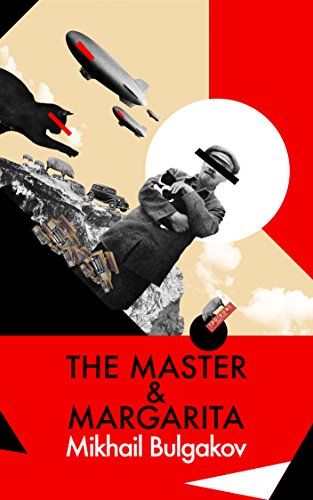
The Master and Margarita
by Mikhail Bulgakov
- Author:
- Mikhail Bulgakov
- Status:
- Abandoned
- Format:
- eBook
- Genres:
- Classics , Fiction , Fantasy , Russia , Russian Literature , Magical Realism , Literature
- Pages:
- 412
- Highlights:
- 14
Highlights
Page 39
“…so who are you in the end?” “I am a part of that power which eternally desires evil and eternally does good.” Goethe, Faust*
Page 88
It is hard to say what precisely had let Ivan Nikolayevich down – whether it had been the graphic power of his talent, or his utter unfamiliarity with the question on which he was writing – but his Jesus had come out as just a living Jesus who had once existed: only, true, a Jesus furnished with all the negative features possible. And Berlioz wanted to demonstrate to the poet that the main thing was not what Jesus was like, whether he was good or bad, but that this Jesus, as a person, had not existed in the world at all, and that all the stories about him were simply inventions, the most commonplace myth.
Note: An important distinction
Page 93
It must be noted that the editor was a well-read man, and pointed very skilfully in his speech to the ancient historians, for example, to the celebrated Philo of Alexandria* and to the brilliantly educated Josephus Flavius,* who had never said a word about the existence of Jesus. Displaying sound erudition, Mikhail Alexandrovich also informed the poet, incidentally, that the passage in book fifteen, chapter forty-four of the celebrated Annales of Tacitus,* where the execution of Jesus is spoken of, is nothing other than a later forged insertion.
Note: I’m very impressed by his knowledge of history. But he probably researched what historians had to say on the matter.
Page 102
Berlioz’s high tenor resounded in the deserted avenue, and the deeper Mikhail Alexandrovich clambered into the thickets into which only a very educated man can clamber without the risk of coming a cropper, the more and more interesting and useful were the things the poet learnt about the Egyptian Osiris, the most merciful god and son of heaven and earth,* and about the Phoenician god Tammuz,* and about Marduk,* and even about the lesser-known stern god Huitzilopochtli, who was at one time much revered by the Aztecs in Mexico.*
Note: Nice metaphor with the cropper. I would be interested to learn the similarities in these stories.
Page 109
Subsequently – when, frankly speaking, it was already too late – various organizations presented their reports with a description of this person. A comparison of the reports cannot help but cause amazement. Thus in the first of them it is said that this person was small in stature, had gold teeth and limped on his right leg. In the second the person was enormous in stature, had platinum crowns and limped on his left leg. The third states laconically that the person had no distinguishing features. It has to be acknowledged that not one of those reports is of any use at all.
Page 126
“Ivan,” said Berlioz, “your depiction of, for example, the birth of Jesus, the Son of God, was very good and satirical, but the real point is that a whole series of sons of god had already been born before Jesus, like, let’s say, the Phoenician Adonis, the Phrygian Attis, the Persian Mithras. To put it briefly, not one of them was ever born and none of them existed, including Jesus too, and it’s essential that, instead of depicting the birth or, let’s suppose, the visit of the Magi, you should depict the absurd rumours about that visit. Otherwise, according to your narrative, it turns out that he actually was born!”
Page 164
“But permit me to ask you,” began the foreign guest after an anxious hesitation, “what’s to be done about the proofs of God’s existence, of which there are, as is well known, exactly five?” “Alas!” replied Berlioz with regret. “Not one of those proofs is worth a thing, and mankind gave them up as a bad job long ago. You must agree, after all, that in the sphere of reason there can be no proof of the existence of God.” “Bravo!” exclaimed the foreigner. “Bravo! You’ve repeated in its entirety that restless old man Immanuel’s idea on that score. But here’s a curious thing: he completely demolished all five proofs, and then, as though in mockery of himself, constructed his own sixth proof!” “Kant’s proof,” objected the educated editor with a thin smile, “is also unconvincing.*
Note: What are these proofs?
Page 186
“But this is the question that’s troubling me: if there’s no God, then who, one wonders, is directing human life and all order on earth in general?”
Note: I wonder if this book is about making fun of atheists. Obviously stupid to be atheist while talking to the devil, not so much otherwise.
Page 298
From the wings at the rear of the palace that quartered the Twelfth Lightning Legion’s First Cohort,
Note: XII Fulminata
Page 477
In the duration of its flight, a formula had taken shape in the now lucid and lightened head of the Procurator. It was this: the Hegemon has heard the case of the vagrant philosopher Yeshua, also known as Ha-Nozri, and failed to find corpus delicti.
Note: New Latin phrase
Page 516
“Yes,” continued Yeshua, a little surprised at how well-informed the Procurator was, “he asked me to set out my opinion on the power of the state. He was extremely interested in that question.” “And so what did you say?” asked Pilate. “Or will you reply that you’ve forgotten what you said?” But there was already a hopelessness in Pilate’s tone. “Among other things,” the prisoner recounted, “I said that any sort of power is coercion of the people, and that the time will come when there will be no power, neither of the caesars, nor of any other sort of authority. Man will move on to the kingdom of truth and justice where no kind of power will be needed at all.”
Note: Commentary on the soviet state?
Page 730
With the moaning of the crowd, which was beginning to fall quiet, were mingled the readily discernible, piercing cries of the public criers, repeating, some in Aramaic, others in Greek, everything the Procurator had shouted from the platform. The staccato clatter of approaching horses’ hoofs reached his ears too, and a trumpet trumpeting something briefly and merrily. In reply to these sounds, from the roofs of the houses on the street leading out from the bazaar into the square of the hippodrome came the piercing whistling of little boys and cries of “look out!” The solitary soldier standing in the cleared space of the square with a standard in his hand waved it in alarm, and then the Procurator, the legate of the legion, the secretary and the escort stopped. The cavalry ala, working up ever more of a canter, flew out into the square to cut across one side of it, passing the throng of people by, and to gallop by the shortest route, down a lane beside a stone wall with a vine creeping over it, to Bald Mountain. On drawing level with Pilate, the fast-trotting commander of the ala, a Syrian as small as a boy and as dark as a mulatto, shouted something shrilly and drew his sword out from its scabbard. The wild, black, lathered horse shied and reared up on its hind legs. Thrusting the sword into its scabbard, the commander struck the horse across the neck with a lash, straightened it up, and rode into the lane, moving into a gallop. After him in a cloud of dust flew the horsemen in rows of three, the ends of their light bamboo lances began to bounce, and past the Procurator sped faces that seemed especially swarthy under their white turbans, and with cheerfully bared, gleaming teeth. Raising the dust to the sky, the ala burst into the lane, and last to ride past Pilate was a soldier with a trumpet that burned in the sun behind his back. Shielding himself from the dust with his hand, and with a discontented frown on his face, Pilate moved onwards, heading for the gates of the palace garden, and the legate, the secretary and the escort moved off after him. It was about ten o’clock in the morning.
Note: What is this imagery supposed to evoke?
Page 837
The tram covered Berlioz, and a round, dark object was thrown out under the railings of Patriarch’s avenue onto the cobbled, sloping verge. Rolling down off the slope, it started bouncing along the cobblestones of Bronnaya. It was Berlioz’s severed head.
Note: The tone of the book changed quite suddenly
Page 949
In the deserted, cheerless lane the poet gazed around, looking for the fugitive, but he was nowhere about. Then Ivan said firmly to himself: “But of course, he’s on the Moscow River! Onwards!” It would quite likely have been the right thing to ask Ivan Nikolayevich why he specifically supposed the Professor was on the Moscow River, and not in some other place elsewhere. But the trouble is that there was no one to ask him. The loathsome lane was completely empty.
Note: WTF