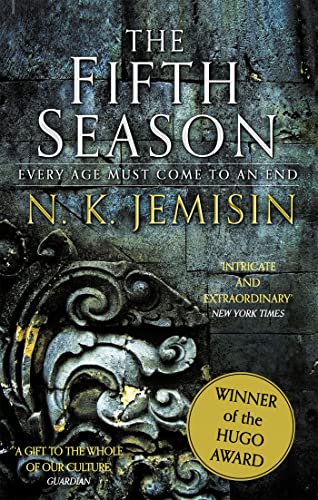
The Fifth Season
by N.K. Jemisin
- Author:
- N.K. Jemisin
- Status:
- Done
- Format:
- eBook
- Reading Time:
- 6:35
- Genres:
- Fantasy , Fiction , Science Fiction , Dystopia , Adult , Science Fiction Fantasy
- Pages:
- 512
- Highlights:
- 36
Review
3 Hugo Awards for the 3 books in this fantasy series. That’s an astounding achievement, and after reading the trilogy I heartily agree. The first book was especially good, from the magic system to fully fleshed out world to the constant action, it was perfect. The three main characters (Essun, Syenite, Damaya) were unique, endearing and a damn pleasure to read about. Even when they did seemingly irrational things, it was easy to empathise with their motives. The second and third books were good, but didn’t reach the highs of the first one.
Highlights
Page 16
She will cover Uche’s broken little body with a blanket—except his face, because he is afraid of the dark—and
Note: Second paragraph and I already know how deeply this character grieves because of the present tense. Martin did the same with “Ned loves my hair”
Page 22
It is ordinary, as lands go. Mountains and plateaus and canyons and river deltas, the usual. Ordinary, except for its size and its dynamism. It moves a lot, this land. Like an old man lying restlessly abed it heaves and sighs, puckers and farts, yawns and swallows. Naturally this land’s people have named it the Stillness. It is a land of quiet and bitter irony.
Note: Poetry lol
Page 45
None of these places or people matter, by the way. I simply point them out for context.
Note: Haha
Page 46
But here is a man who will matter a great deal. You can imagine how he looks, for now. You may also imagine what he’s thinking. This might be wrong, mere conjecture, but a certain amount of likelihood applies nevertheless. Based on his subsequent actions, there are only a few thoughts that could be in his mind in this moment.
Note: I like this narrative style!
Page 51
fallow-planted
Page 53
tremolo
Page 64
There is an art to smiling in a way that others will believe. It is always important to include the eyes; otherwise, people will know you hate them.
Page 79
And then he reaches forth with all the fine control that the world has brainwashed and backstabbed and brutalized out of him, and all the sensitivity that his masters have bred into him through generations of rape and coercion and highly unnatural selection. His fingers spread and twitch as he feels several reverberating points on the map of his awareness: his fellow slaves. He cannot free them, not in the practical sense. He’s tried before and failed. He can, however, make their suffering serve a cause greater than one city’s hubris, and one empire’s fear. So he reaches deep and takes hold of the humming tapping bustling reverberating rippling vastness of the city, and the quieter bedrock beneath it, and the roiling churn of heat and pressure beneath that. Then he reaches wide, taking hold of the great sliding-puzzle piece of earthshell on which the continent sits. Lastly, he reaches up. For power. He takes all that, the strata and the magma and the people and the power, in his imaginary hands. Everything. He holds it. He is not alone. The earth is with him. Then he breaks it.
Note: Beautiful. Didn’t realise who this was until the second read through. The part about brainwashing, rape and freeing slaves didn’t occur to me
Page 96
The people of the Stillness live in a perpetual state of disaster preparedness. They’ve built walls and dug wells and put away food, and they can easily last five, ten, even twenty-five years in a world without sun. Eventually meaning in this case in a few thousand years. Look, the ash clouds are spreading already.
Note: Brutal
Page 100
The obelisks had other names once, back when they were first built and deployed and used, but no one remembers those names or the great devices’ purpose. Memories are fragile as slate in the Stillness.
Page 102
massive crystalline shards that hover amid the clouds, rotating slowly and drifting along incomprehensible flight paths, blurring now and again as if they are not quite real—though this may only be a trick of the light. (It isn’t.)
Note: Love the use of parentheses
Page 109
Back to the personal. Need to keep things grounded, ha ha.
Note: I love this narrator
Page 169
This is what you must remember: the ending of one story is just the beginning of another. This has happened before, after all. People die. Old orders pass. New societies are born. When we say “the world has ended,” it’s usually a lie, because the planet is just fine. But this is the way the world ends. This is the way the world ends. This is the way the world ends. For the last time.
Page 678
Far below the ground, where no one but you can detect, the clay walls of the underground aquifer that supplies the village wells are breached. The aquifer begins to drain. They will not realize for weeks that you killed the town in this moment, but they will remember when the wells run dry.
Note: Jesus
Page 690
These people killed Uche. Their hate, their fear, their unprovoked violence. They. (He.) Killed your son. (Jija killed your son.) People run out into the streets, screaming and wondering why there was no warning, and you kill any of them who are stupid or panicked enough to come near. Jija. They are Jija. The whole rusting town is Jija.
Note: She’s murdering innocent people but it’s understandable.
Page 755
Feldspar smiles thinly. “I have six children.” Ah. Nothing more to be said, then.
Note: I don’t know what this means and it’s a bit frustrating when everything is so new and the narrator says “nothing more need be said”
Page 778
pausing now and again to appreciate the artfully arranged patterns of light and shadow cast by the narrow windows. She’s not sure what makes the patterns so special, actually, but everyone says they’re stunning works of art, so she needs to be seen appreciating.
Note: :D
Page 808
“I’m here to fuck you, Earth burn it. Is that worth disturbing your beauty rest?”
Note: Good reveal
Page 885
But this is what it means to be civilized—doing what her betters say she should, for the ostensible good of all. And it’s not like she gains no benefit from this: a year or so of discomfort, a baby she doesn’t have to bother raising because it will be turned over to the lower creche as soon as it’s born, and a high-profile mission completed under the mentorship of a powerful senior. With the experience and boost to her reputation, she’ll be that much closer to her fifth ring. That means her own apartment; no more roommates. Better missions, longer leave, more say in her own life. That’s worth it. Earthfire yes, it’s worth it.
Page 892
“Tell them they can be great someday, like us. Tell them they belong among us, no matter how we treat them. Tell them they must earn the respect which everyone else receives by default. Tell them there is a standard for acceptance; that standard is simply perfection. Kill those who scoff at these contradictions, and tell the rest that the dead deserved annihilation for their weakness and doubt. Then they’ll break themselves trying for what they’ll never achieve.” —Erlsset, twenty-third emperor of the Sanzed Equatorial Affiliation, in the thirteenth year of the Season of Teeth. Comment recorded at a party, shortly before the founding of the Fulcrum.
Note: Wow
Page 083
When he straightens and falls silent, Damaya does not prompt him to tell another story, as she might have done. She doesn’t like the one he just told, not anymore. And she is somehow, suddenly certain: He did not intend for her to like it.
Note: Nice storytelling
Page 186
“You no longer have a home, Damaya. But you will, soon, in Yumenes. You’ll have teachers there, and friends. A whole new life.” He smiles.
Note: I just realised that Damaya, Syenite and Essun could all be the same person
Page 428
In the morning they copulate. There are no better words she can use for the act—vulgarities don’t fit because it’s too dull, and euphemisms aren’t necessary to downplay its intimacy because it’s not intimate. It’s perfunctory, an exercise, like the stretches she’s learned to do before they start riding for the day.
Note: Word choices are great
Page 476
—and then she sesses it. Evil Earth, it’s a big one! An eighter or niner. No, bigger.
Note: So much for my Syenite is Essun theory
Page 768
Winter, Spring, Summer, Fall; Death is the fifth, and master of all. —Arctic proverb
Note: The title explained
Page 781
But then, how can they? Who misses what they have never, ever even imagined? That would not be human nature. How fortunate, then, that there are more people in this world than just humankind.
Page 863
flare.
Note: Strange to find a mistake
Page 666
“Home is people,” she says to Asael, softly. Asael blinks. “Home is what you take with you, not what you leave behind.”
Page 244
Hoa cocks his head a little, his eyes glittering in pure menace. It’s as shocking to see as his diamond teeth; you’d started thinking of him as a rather sweet creature, if a bit eccentric. Now you’re not sure what to think. “You don’t command me.” Ykka, to your greater amazement, leans over and puts her face right in front of his. “Let me put it this way,” she says. “You can keep doing what you’ve obviously been doing, trying to be as avalanche-subtle as your kind ever gets, or I can start telling everyone what all of you are really up to.” And Hoa… flinches. His eyes—only his eyes—flick toward the not-woman on the porch. The one on the porch smiles again, though she doesn’t show her teeth this time, and there’s a rueful edge to it. You don’t know what any of this means, but Hoa seems to sag a little. “Very well,” he says to Ykka, with an odd formality. “I agree to your terms.”
Note: Now you have my attention
Page 295
calderas.
Page 917
“If I pass.” Damaya closes her eyes. She can’t look at him and say this. Not without letting him see the it isn’t right in her eyes. “I, I picked a rogga name.” He does not chide her on her language. “Have you, now?” He sounds pleased. “What?” She licks her lips. “Syenite.”
Note: Gottem. I was right that Damaya was Syenite. But I will be sad if Syenite turns into Essun
Page 124
“Sorry,” he says. He genuinely sounds it, so she doesn’t storm off right then. “I was just trying to make a point.” He’s made it. Not that she hadn’t known it before: that she is a slave, that all roggas are slaves, that the security and sense of self-worth the Fulcrum offers is wrapped in the chain of her right to live, and even the right to control her own body. It’s one thing to know this, to admit it to herself, but it’s the sort of truth that none of them use against each other—not even to make a point—because doing so is cruel and unnecessary. This is why she hates Alabaster: not because he is more powerful, not even because he is crazy, but because he refuses to allow her any of the polite fictions and unspoken truths that have kept her comfortable, and safe, for years.
Page 407
’Baster doesn’t want her, not that way, nor she him. And yet it’s unbelievably arousing for her to watch Innon drive him to moaning and begging, and Alabaster also clearly gets off on her going to pieces with someone else. She likes it more when ’Baster’s watching, in fact. They can’t stand sex with each other directly, but vicariously it’s amazing. And what do they even call this? It’s not a threesome, or a love triangle. It’s a two-and-a-half-some, an affection dihedron. (And, well, maybe it’s love.)
Note: Vicky Christina Barcelona
Page 503
And at the height of human hubris and might, it was the orogenes who did something that even Earth could not forgive: They destroyed his only child. No lorist that Syenite has ever talked to knows what this cryptic phrase means. It isn’t stonelore, just oral tradition occasionally recorded on ephemerals like paper and hide, and too many Seasons have changed it. Sometimes it’s the Earth’s favorite glassknife that the orogenes destroyed; sometimes it’s his shadow; sometimes it’s his most valued Breeder. Whatever the words mean, the lorists and ’mests agree on what happened after the orogenes committed their great sin: Father Earth’s surface cracked like an eggshell.
Page 612
“Binof. Leadership. Yumenes,”
Note: Sad. Syenite became Essun
Page 297
To you, Essun. Rust it, you’ll be glad when you finally figure out who you really are.
Note: Essun loses her memory?