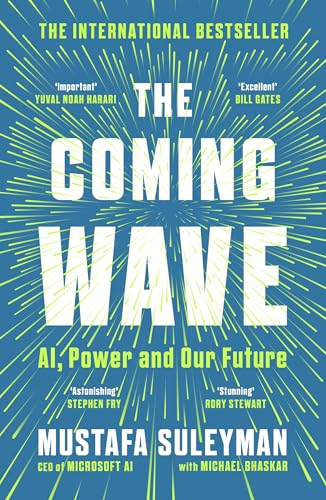
The Coming Wave: AI, Power and Our Future
by Mustafa Suleyman
- Author:
- Mustafa Suleyman
- Status:
- Abandoned
- Format:
- eBook
- Genres:
- Nonfiction , Artificial Intelligence , Technology , Science , Business , Politics
- Pages:
- 332
- Highlights:
- 6
Highlights
Page 479
Today, AI systems can almost perfectly recognize faces and objects. We take speech-to-text transcription and instant language translation for granted. AI can navigate roads and traffic well enough to drive autonomously in some settings. Based on a few simple prompts, a new generation of AI models can generate novel images and compose text with extraordinary levels of detail and coherence. AI systems can produce synthetic voices with uncanny realism and compose music of stunning beauty. Even in more challenging domains, ones long thought to be uniquely suited to human capabilities like long-term planning, imagination, and simulation of complex ideas, progress leaps forward. AI has been climbing the ladder of cognitive abilities for decades, and it now looks set to reach human-level performance across a very wide range of tasks within the next three years. That is a big claim, but if I’m even close to right, the implications are truly profound. What had, when we founded DeepMind, felt quixotic has become not just plausible but seemingly inevitable.
Note: I will admit, a lot of these groundbreaking advancements feel passé to me now.
Page 508
Equally plausible is a Luddite reaction. Bans, boycotts, and moratoriums will ensue. Is it even possible to step away from developing new technologies and introduce a series of moratoriums? Unlikely. With their enormous geostrategic and commercial value, it’s difficult to see how nation-states or corporations will be persuaded to unilaterally give up the transformative powers unleashed by these breakthroughs. Moreover, attempting to ban development of new technologies is itself a risk: technologically stagnant societies are historically unstable and prone to collapse. Eventually, they lose the capacity to solve problems, to progress.
Note: To the last point
“An obstacle downstream propagates upstream. If you’re not allowed to implement new ideas, you stop having them. And vice versa: when you can do whatever you want, you have more ideas about what to do”
Paul Graham
Page 528
I also underscored AI’s potential to put large numbers of people out of work. I asked the room to consider automation and mechanization’s long history of displacing labor. First come more efficient ways of doing specific tasks, and then entire roles become redundant, and soon entire sectors require orders of magnitude fewer workers. Over the next few decades, I argued, AI systems would replace “intellectual manual labor” in much the same way, and certainly long before robots replace physical labor. In the past, new jobs were created at the same time as old ones were made obsolete, but what if AI could simply do most of those as well? There was, I suggested, little precedent for the new forms of concentrated power that were coming. Even though they felt distant, potentially grave threats were hurtling toward society.
Note: As of 2025, I have to be honest and say this is quite possible.
Page 535
In the concluding slide I showed a still from The Simpsons. In the scene, the townspeople of Springfield have risen up, and the cast of familiar characters charges forward carrying clubs and torches. The message was clear, but I spelled it out anyway. “The pitchforks are coming,” I said. Coming for us, the makers of technology. It was up to us to ensure the future was better than this. Around the table, I was met with blank stares. The room was unmoved. The message didn’t land. Dismissals came thick and fast. Why didn’t economic indicators show any sign of what I was saying? AI would spur new demand, which would create new jobs. It would augment and empower people to be even more productive. Maybe there were some risks, they conceded, but they weren’t too bad. People were smart. Solutions have always been found. No worries, they seemed to think, on to the next presentation.
Note: I feel like the author underestimated Jevons Paradox. But equally, the CGP Grey horse quote applies - there is no law of economics that says that technological advancement leads to more, better jobs for horses. Even though every technological advancement until the automobile had had that effect.
Page 560
But the presentation gnawed at me for months afterward. Why wasn’t I, why weren’t we all, taking it more seriously? Why do we awkwardly sidestep further discussion? Why do some get snarky and accuse people who raise these questions of catastrophizing or of “overlooking the amazing good” of technology? This widespread emotional reaction I was observing is something I have come to call the pessimism-aversion trap: the misguided analysis that arises when you are overwhelmed by a fear of confronting potentially dark realities, and the resulting tendency to look the other way. Pretty much everyone has some version of this reaction, and the consequence is that it’s leading us to overlook a number of critical trends unfolding right before our eyes. It’s almost an innate physiological response. Our species is not wired to truly grapple with transformation at this scale, let alone the potential that technology might fail us in this way. I’ve experienced this feeling throughout my career, and I’ve seen many, many others have the same visceral response. Confronting this feeling is one of the purposes of this book. To take a cold hard look at the facts, however uncomfortable.
Note: Yeah ok fair enough, that feeling does exist and it is widespread. It’s the default reaction to a warning to horrible to comprehend.
Page 710
So, what is a wave? Put simply, a wave is a set8 of technologies coming together around the same time, powered by one or several new general-purpose technologies with profound societal implications. By “general-purpose technologies,”9 I mean those that enable seismic advances in what human beings can do. Society unfolds in concert with these leaps. We see it over and over; a new piece of technology, like the internal combustion engine, proliferates and transforms everything around it.