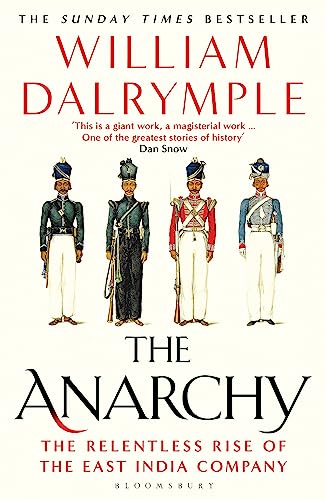
The Anarchy: The Relentless Rise of the East India Company
by William Dalrymple
- Author:
- William Dalrymple
- Status:
- Done
- Format:
- eBook
- Pages:
- 522
- Highlights:
- 100
Highlights
Page 643
It is always a mistake to read history backwards. We know that the East India Company (EIC) eventually grew to control almost half the world’s trade and become the most powerful corporation in history, as Edmund Burke famously put it, ‘a state in the guise of a merchant’. In retrospect, the rise of the Company seems almost inevitable. But that was not how it looked in 1599, for at its founding few enterprises could have seemed less sure of success. At that time England was a relatively impoverished, largely agricultural country, which had spent almost a century at war with itself over the most divisive subject of the time: religion.8 In the course of this, in what seemed to many of its wisest minds an act of wilful self-harm, the English had unilaterally cut themselves off from the most powerful institution in Europe, so turning themselves in the eyes of many Europeans into something of a pariah nation. As a result, isolated from their baffled neighbours, the English were forced to scour the globe for new markets and commercial openings further afield. This they did with a piratical enthusiasm.
Page 665
Many of those the Spanish ambassador would also have considered pirates were present that day in the Founders’ Hall. The Company’s potential investors knew that this group of mariners and adventurers, whatever their talents as freebooters, had to date shown little success in the more demanding skills of long-distance trade or in the art of planting and patiently sustaining viable colonies. Indeed, compared to many of their European neighbours, the English were rank amateurs at both endeavours.
Page 719
The final straw was when the Dutch sent a delegation to London to try to buy up English shipping for further voyages eastwards. This was too much for the pride of Elizabethan London. The Amsterdam Agents, waiting in the Old Steelyard of the Hamburg Company, were told, ‘Our merchants of London have need of all our ships and none to sell to the Dutch. We ourselves intend forthwith to have trade with the East Indies.’18 The meeting at the Founders’ Hall was the direct result of that retort. As they told Elizabeth’s Privy Council in their petition, they were moved ‘with no less affection to advance the trade of their native country than the Dutch merchants were to benefit their commonwealth … For the honour of our native country and the advancement of trade … to set forth a voyage this present year to the East Indies.’
Page 741
The idea of a joint stock company was one of Tudor England’s most brilliant and revolutionary innovations. The spark of the idea sprang from the flint of the medieval craft guilds, where merchants and manufacturers could pool their resources to undertake ventures none could afford to make individually. But the crucial difference in a joint stock company was that the latter could bring in passive investors who had the cash to subscribe to a project but were not themselves involved in the running of it. Such shares could be bought and sold by anyone, and their price could rise or fall depending on demand and the success of the venture. Such a company would be ‘one body corporate and politick’ – that is, it would be a corporation, and so could have a legal identity and a form of corporate immortality that allowed it to transcend the deaths of individual shareholders, ‘in like manner’, wrote the legal scholar William Blackstone, ‘as the River Thames is still the same river, though the parts which compose it are changing every instance’.
Page 883
India then had a population of 150 million – about a fifth of the world’s total – and was producing about a quarter of global manufacturing; indeed, in many ways it was the world’s industrial powerhouse and the world’s leader in manufactured textiles. Not for nothing are so many English words connected with weaving – chintz, calico, shawl, pyjamas, khaki, dungarees, cummerbund, taffetas – of Indian origin.44 It was certainly responsible for a much larger share of world trade than any comparable zone and the weight of its economic power even reached Mexico, whose textile manufacture suffered a crisis of ‘de-industrialisation’ due to Indian cloth imports.45 In comparison, England then had just 5 per cent of India’s population and was producing just under 3 per cent of the world’s manufactured goods.46 A good proportion of the profits on this found its way to the Mughal exchequer in Agra, making the Mughal Emperor, with an income of around £100 million,g by far the richest monarch in the world.
Note: This is the claim that I find surprising. I don’t doubt it because Dalrymple is saying it, but it does challenge views I held previously. And I love the etymology.
Page 899
For their grubby contemporaries in the West, stumbling around in their codpieces, the silk-clad Mughals, dripping in jewels, were the living embodiment of wealth and power – a meaning that has remained impregnated in the word ‘mogul’ ever since.
Note: Etymology!
Page 901
By the early seventeenth century, Europeans had become used to easy military victories over the other peoples of the world. In the 1520s the Spanish had swept away the vast armies of the mighty Aztec Empire in a matter of months. In the Spice Islands of the Moluccas, the Dutch had recently begun to turn their cannons on the same rulers they had earlier traded with, slaughtering those islanders who rode out in canoes to greet them, burning down their cities and seizing their ports. On one island alone, Lontor, 800 inhabitants were enslaved and forcibly deported to work on new Dutch spice plantations in Java; forty-seven chiefs were tortured and executed.48 But as Captain Hawkins soon realised, there was no question of any European nation attempting to do this with the Great Mughals, not least because the Mughals kept a staggering 4 million men under arms.49 When, in 1632, the Emperor discovered that the Portuguese had been building unauthorised fortifications and ‘dwellings of the utmost splendour and strength’ in Hughli in Bengal, as well as flouting Mughal rules by making forced conversions to Christianity, he commanded that the Portuguese settlement should be attacked and the Portuguese expelled.
Page 001
Yet for all its clumsiness, Roe’s mission was the beginning of a Mughal–Company relationship that would develop into something approaching a partnership and see the EIC gradually drawn into the Mughal nexus. Over the next 200 years it would slowly learn to operate skilfully within the Mughal system and to do so in the Mughal idiom, with its officials learning good Persian, the correct court etiquette, the art of bribing the right officials and, in time, outmanoeuvring all their rivals – Portuguese, Dutch and French – for imperial favour. Indeed, much of the Company’s success at this period was facilitated by its scrupulous regard for Mughal authority.63 Before long, indeed, the Company would begin portraying itself to the Mughals, as the historian Sanjay Subrahmanyam has nicely described it, as ‘not a corporate entity but instead an anthropomorphized one, an Indo-Persian creature called Kampani Bahadur’.64
Page 046
Two years later, the EIC tried again. The head of the Armagon factory, Francis Day, negotiated with the local governor of what was left of the waning and fragmented South Indian Vijayanagara empire for the right to build a new EIC fort above a fishing village called Madraspatnam, just north of the Portuguese settlement at San Thome. Again, it was neither commercial nor military considerations which dictated the choice of site. Day, it was said, had a liaison with a Tamil lady whose village lay inland from Madraspatnam. According to one contemporary source Day ‘was so enamoured of her’ and so anxious that their ‘interviews’ might be ‘more frequent and uninterrupted’ that his selection of the site of Fort St George lying immediately adjacent to her home village was a foregone conclusion.73
Note: Didn’t know this about Santhome
Page 155
The Emperor, unloved by his father, grew up into a bitter and bigoted Islamic puritan, as intolerant as he was grimly dogmatic. He was a ruthlessly talented general and a brilliantly calculating strategist, but entirely lacked the winning charm of his predecessors. His rule became increasingly harsh, repressive and unpopular as he grew older. He made a clean break with the liberal and inclusive policies towards the Hindu majority of his subjects pioneered by his great-grandfather Akbar, and instead allowed the ulama to impose far stricter interpretations of Sharia law. Wine was banned, as was hashish, and the Emperor ended his personal patronage of musicians. He also ended Hindu customs adopted by the Mughals such as appearing daily to his subjects at the jharoka palace window in the centre of the royal apartments in the Red Fort. Around a dozen Hindu temples across the country were destroyed, and in 1672 he issued an order recalling all endowed land given to Hindus and reserved all future land grants for Muslims. In 1679 the Emperor reimposed the jizya tax on all non-Muslims that had been abolished by Akbar; he also executed Teg Bahadur, the ninth of the gurus of the Sikhs.90 While it is true that Aurangzeb is a more complex and pragmatic figure than some of his critics allow, the religious wounds Aurangzeb opened in India have never entirely healed, and at the time they tore the country in two.m Unable to trust anyone, Aurangzeb marched to and fro across the Empire, viciously putting down successive rebellions by his subjects. The Empire had been built on a pragmatic tolerance and an alliance with the Hindus, especially with the warrior Rajputs, who formed the core of the Mughal war machine. The pressure put on that alliance and the Emperor’s retreat into bigotry helped to shatter the Mughal state and, on Aurangzeb’s death, it finally lost them the backbone of their army.
Note: Tis true. The rifts never healed nor will they ever.
Page 226
But in his last years, Aurangzeb’s winning streak began to fail him. Avoiding pitched battles, the Marathas’ predatory cavalry armies adopted guerrilla tactics, attacking Mughal supply trains and leaving the slow, heavily encumbered Mughal columns to starve or else return, outmanoeuvred, to their base in Aurangabad. The Emperor marched personally to take fort after fort, only to see each lost immediately his back was turned. ‘So long as a single breath of this mortal life remains,’ he wrote, ‘there is no release from this labour and work.’99 The Mughal Empire had reached its widest extent yet, stretching from Kabul to the Carnatic, but there was suddenly disruption everywhere. Towards the end it was no longer just the Marathas: by the 1680s there was now in addition a growing insurgency in the imperial heartlands from peasant desertion and rebellion among the Jats of the Gangetic Doab and the Sikhs of the Punjab. Across the Empire, the landowning zamindar gentry were breaking into revolt and openly battling tax assessments and attempts by the Mughal state to penetrate rural areas and regulate matters that had previously been left to the discretion of hereditary local rulers. Banditry became endemic: in the mid-1690s the Italian traveller Giovanni Gemelli Careri complained that Mughal India did not offer travellers ‘safety from thieves’.100 Even Aurangzeb’s son Prince Akbar went over to the Rajputs and raised the standard of rebellion. These different acts of resistance significantly diminished the flow of rents, customs and revenues to the exchequer, leading for the first time in Mughal history to a treasury struggling to pay for the costs of administering the Empire or provide salaries for its officials. As military expenses continued to climb, the cracks in the Mughal state widened into, first, fissures, then crevasses. According to a slightly later text, the Ahkam-i Alamgiri, the Emperor himself acknowledged ‘there is no province or district where the infidels have not raised a tumult, and since they are not chastised, they have established themselves everywhere. Most of the country has been rendered desolate and if any place is inhabited, the peasants have probably come to terms with the robbers.’101
Note: But this context is lost when they show a map of the subcontinent in 1707.
Page 274
Yet if the Marathas were violent in war, they could in times of peace be mild rulers.106 Another French traveller noted, ‘The Marathas willingly ruin the land of their enemies with a truly detestable barbarity, but they faithfully maintain the peace with their allies, and in their own domains make agriculture and commerce flourish. When seen from the outside, this style of government is terrible, as the nation is naturally prone to brigandage; but seen from the inside, it is gentle and benevolent. The areas of India which have submitted to the Marathas are the happiest and most flourishing.’107 By the early eighteenth century, the Marathas had fanned out to control much of central and western India. They were organised under five chieftains who constituted the Maratha Confederacy. These five chiefs established hereditary families which ruled over five different regions. The Peshwa – a Persian term for Prime Minister that the Bahmani Sultans had introduced in the fourteenth century – controlled Maharashtra and was head of the Confederacy, keeping up an active correspondence with all his regional governors. Bhonsle was in charge of Orissa, Gaekwad controlled Gujarat, Holkar dominated in central India and Scindia was in command of a growing swathe of territory in Rajasthan and north India. The Marathas continued to use Mughal administrative procedures and practices, in most cases making the transition to their rule so smooth it was almost imperceptible.108
Note: Two things. Successful empires are by necessity brutal to outsiders. If they aren’t they wouldn’t be empires.
Second, damn those names. They’re still associated with those areas, like Scindia family politicians in Rajasthan. I thought it was a Rajput name. TIL it is Maratha.
Page 323
From an early period, East India Company officials realised that the Jagat Seths were their natural allies in the disordered Indian political scene, and that their interests in most matters coincided. They also took regular and liberal advantage of the Jagat Seths’ credit facilities: between 1718 and 1730, the East India Company borrowed on average Rs400,000 annually from the firm.n In time, the alliance, ‘based on reciprocity and mutual advantage’ of these two financial giants, and the access these Marwari bankers gave the EIC to streams of Indian finance, would radically change the course of Indian history.114
Page 338
The Company’s emissary, Venetian adventurer Niccolao Manucci, who was now living as a doctor in Madras, replied that the EIC had transformed a sandy beach into a flourishing port; if Da’ud Khan was harsh and overtaxed them, the EIC would simply move its operations elsewhere. The losers would be the local weavers and merchants who earned his kingdom lakhso of pagodas each year through trade with the foreigners. The tactic worked: Da’ud Khan backed off. In this way the EIC prefigured by 300 years the response of many modern corporates when faced with the regulating and taxation demands of the nation state: treat us with indulgence, they whisper, or we take our business elsewhere. It was certainly not the last time a ruler on this coastline would complain, like Da’ud Khan, that the ‘hat-wearers had drunk the wine of arrogance’.
Page 424
The Nizam was right to be apprehensive. On 7 January 1738, Baji Rao’s Maratha army surprised the Nizam near Bhopal, encircling and surrounding him. At first, Baji Rao was too intimidated to take on the Nizam’s fortified position, but he attacked anyway and, somewhat to the surprise of both sides, defeated the veteran Mughal general. The captive Nizam pledged to get the grant of the governorship of Malwa for Baji Rao, hoping to turn the Maratha poachers into Mughal gamekeepers and co-opt them into the Mughal system.
Note: Haha, what an offer. Clever. And I love the analogy used by the author.
Page 489
The massacre continued until the Nizam went bareheaded, his hands tied with his turban, and begged Nader on his knees to spare the inhabitants and instead to take revenge on him. Nader Shah ordered his troops to stop the killing; they obeyed immediately. He did so, however, on the condition that the Nizam would give him 100 crore (1 billion) rupeesr before he would agree to leave Delhi. ‘The robbing, torture and plundering still continues,’ noted a Dutch observer, ‘but not, thankfully, the killing.’138 In the days that followed, the Nizam found himself in the unhappy position of having to loot his own city to pay the promised indemnity. The city was divided into five blocks and vast sums were demanded of each: ‘Now commenced the work of spoliation,’ remarked Anand Ram Mukhlis, ‘watered by the tears of the people … Not only was their money taken, but whole families were ruined. Many swallowed poison, and others ended their days with the stab of a knife … In short the accumulated wealth of 348 years changed masters in a moment.’139
Note: I’m beginning to come around to the idea that India’s wealth was looted and never recovered. My previous thinking was that new wealth is created every year but it’s not quite true. A nation can be impoverished and then forced into debt bondage that can’t be escaped. Even wealth generated by future generations will belong to the debt holders.
Page 520
In a single swift blow, Nader Shah had broken the Mughal spell.
Note: Wonder how long the decline would have taken without him
Page 535
Many observers, like the nobleman Shakir Khan, put the blame on the corruption and decadence of society under Muhammad Shah, and turned to a more austere form of Islam in reaction to the Emperor’s careless hedonism: ‘At the beginning of this period,’ he wrote, ‘there was music and drinking, noisy entertainers and crowds of prostitutes, a time of foolery and joking, effeminacy, and chasing after transvestites.’
Note: Yeah yeah, every single time the religious people say this happened because we weren’t religious enough. Piss off.
Page 552
The days of huge imperial armies, financed by an overflowing treasury, had ended for ever. Instead, as authority disintegrated, everyone took measures for their own protection and India became a decentralised and disjointed but profoundly militarised society. Almost everybody now carried weapons. Almost everybody was potentially a soldier. A military labour market sprang up across Hindustan – one of the most thriving free markets of fighting men anywhere in the world – all up for sale to the highest bidder. Indeed, warfare came to be regarded as a sort of business enterprise.143 By the end of the eighteenth century, substantial sections of the peasantry were armed and spent part of their year as mercenaries serving in distant locations. Sometimes they moved their family and agricultural bases to take advantage of opportunities for military earnings. Meanwhile, the regional rulers they fought for had to find ways of paying for them and the expensive new armies they needed in order to compete with their rivals. To do this they developed new state instruments of bureaucracy and fiscal reputation, attempting to exercise a much deeper control over commerce and production than the Mughal regime they had replaced.144
Page 597
As the EIC writer William Bolts later noted, seeing a handful of Persians take Delhi with such ease spurred the Europeans’ dreams of conquests and Empire in India. Nader Shah had shown the way.
Page 630
France in the 1740s had by far the larger economy, double that of Britain; it also had three times the population and the largest army in Europe. Britain, however, had a much larger navy and was the dominant power on the seas; moreover, since the Glorious Revolution of 1688, it had more advanced financial institutions built with Dutch expertise, and capable of raising large amounts of war finance very quickly.
Note: I’m glad this author looks at finance. Something that is very overlooked
Page 650
Immediately, Dupleix took the initiative. His new regiments of sepoys and the African and French reinforcements from Mauritius were all sent north on troop transports overnight, supported by eight men-of-war. Landing just to the south of Madras, near St Thomas Mount, they then marched quickly north, moving in to invest the city from the opposite direction to that from which they were expected.
Note: Chennai landmark!
Page 674
Mafuz Khan also ran on foot, until he reached his elephant, and mounting this, quickly made his escape. He and his troops did not cease their flight until they reached Kunattur. The rout was general, so much so that not a fly, not a sparrow, not a crow was to be seen in all Mylapore.153 Another account – written by the court historian of the Nawabs of the Carnatic – claimed that the French attacked at night and ‘since the Nawab’s army had not the least suspicion of a night attack, they were unready, so the Mughal army got confused in the darkness’. Whatever the truth, the Battle of Adyar River proved a turning point in Indian history. Only two French sepoys were killed, while Mughal casualties were over 300. For the first time, techniques of eighteenth-century European warfare, developed in Prussia and tested on the battlefields of France and Flanders, had been tried out in India. It was immediately clear that nothing in the Mughal armoury could match their force. Europeans had long suspected they were superior to the Mughals in tactical prowess, but they had not appreciated how great this advantage had become due to military developments in the previous half-century since 1687 when the pike-wielding Jacobean troops of Sir Josiah Child were quickly overwhelmed by Aurangzeb’s Mughal troopers. But the wars of late seventeenth-century Europe had seen rapid development in military tactics, particularly the widespread introduction of flintlock muskets and socket bayonets to replace pikes. The organisation of the infantry into battalions, regiments and brigades made continuous firing and complex battlefield manoeuvres by infantry a possibility. The standard infantry tactic was now a bayonet charge after devastating volley firing, supported by mobile and accurate field artillery. The invention of screws for elevating the guns gave the artillery greater precision and increased the firepower of the foot soldiers, giving them an edge in battle against cavalry. The Battle of Adyar River, the first time these tactics were tried out in India, had shown that a small body of infantry armed with the new flintlock muskets and bayonets, and supported by quick-firing mobile artillery, could now scatter a whole army just as easily as they could in Europe. The lesson was not forgotten. The trained sepoy with his file-firing muskets and hollow squares, and supported by artillery quick-firing grape and canister shot, would be an unstoppable force in Indian warfare for the next century.154
Note: More Chennai landmarks! And it is true, you need to be wealthy and secure when a tech upgrade happens or you can’t adopt it.
Lastly Dupleix was more skilful than I knew. I only knew of his losses to Clive
Page 971
None of his letters from Madras contain a word about the wonders of India, and he gives no hint of the sights he saw; nor does he seem to have made any attempt to learn the languages. He had no interest in the country, no eye for its beauty, no inquisitiveness about its history, religions and ancient civilisations, and not the slightest curiosity about its people whom he dismissed as universally ‘indolent, luxurious, ignorant and cowardly’.13 ‘I think only of my dear Native England,’ he wrote home in 1745. What he did have, from the beginning, was a streetfighter’s eye for sizing up an opponent, a talent at seizing the opportunities presented by happenchance, a willingness to take great risks and a breathtaking audacity. He was also blessed with a reckless bravery; and, when he chose to exercise it, a dark personal magnetism that gave him power over men.
Note: A brute, but an effective brute.
Page 121
Among the refugees were those who would go on to found some of the city’s most illustrious dynasties such as Nabakrishna Deb and Ramdulal Dey.33 But it was not just the protection of a fortification that was the attraction. Already Calcutta had become a haven of private enterprise, drawing in not just Bengali textile merchants and moneylenders, but also Parsis, Gujaratis and Marwari entrepreneurs and business houses who found it a safe and sheltered environment in which to make their fortunes.34 This large Indian population also included many wealthy merchants who simply wanted to live out of the reach of the Nawab’s taxation net. Others took advantage of the protection of the British fleet to make trading expeditions to Persia, the Gulf and eastwards through the Strait of Malacca to China.35 The city’s legal system, and the availability of a framework of English commercial law and formal commercial contracts, enforceable by the state, all contributed to making it increasingly the destination of choice for merchants and bankers from across Asia.36
Page 274
Aliverdi had occasionally pressed the European Companies for substantial contributions to the defence of Bengal against the Marathas, much to their displeasure; but in general they appreciated the peace and prosperity safeguarded by his strong rule. He in turn was aware of the wealth and other benefits that the trading companies brought to his realm: ‘merchants are the kingdom’s benefactors,’ he believed, ‘their imports and exports are an advantage to all men.’
Page 285
In retrospect, Bengalis came to remember the last years of Aliverdi Khan as a golden age, which all subsequent epochs failed to match: the country was rich and flourishing – Bengal’s revenues had risen by 40 per cent since the 1720s – and one single market near Murshidabad was said alone to handle 650,000 tons of rice annually.55 The region’s export products – sugar, opium and indigo, as well as the textiles produced by its 1 million weavers – were desired all over the world, and, since the defeat of the Marathas, the state enjoyed a period of great peace. In 1753, an Englishman wrote that merchants could send bullion from one end of Bengal to another ‘under the care frequently of one, two or three peons only’.
Note: Both industry and agriculture flourished. There was no reason for it to not continue.
Page 328
Siraj’s most serious error was to alienate the great bankers of Bengal, the Jagat Seths. The Seths’ machinations had brought Aliverdi to power, and anyone who wanted to operate in the region did well to cultivate their favour; but Siraj did the opposite to the two men of the family who were now in charge of the banking house, Mahtab Rai, the current holder of the title Jagat Seth, and Swaroop Chand, his first cousin, who had been accorded the title ‘Maharaja’ by Aliverdi Khan. In the early days of his rule, when he wished to arm and equip a force to take on his cousin in Purnea, Siraj ordered the bankers to provide Rs30,000,000;g when Mahtab Rai said it was impossible, Siraj struck him.59 According to Ghulam Hussain Khan, ‘Jagat Seth, the principal citizen of the capital, whom he had often used with slight and derision, and whom he had mortally affronted by sometimes threatening him with circumcision, was in his heart totally alienated and lost [to Siraj’s regime].’60 It was an easily avoided mistake, and one that he would later come to regret.
Note: I guess it wasn’t always easy for rulers to find a mutually beneficial accommodation with bankers. The ruler only has violence or the threat of violence while the banker has the threat of bankrolling a coup or a replacement.
Page 679
The following day, the Black Town was comprehensively looted: ‘vast numbers entered our bounds, plundering and setting fire to every house, and by the evening the whole town was surrounded … Several thousands this night got into the great bazaar where they murdered every person they met and plundered and set fire to all the houses.’7 The garrison did not make the slightest effort to protect the Black Town or offer shelter in the fort to the terrified inhabitants. No wonder, then, that by the second day all the Indian support staff had defected, leaving the garrison without lascars to pull the guns, coolies to carry shot and powder, carpenters to build batteries and repair the gun carriages, or even cooks to feed the militia.
Note: Truly just bizarre
Page 810
News of the fall of Kasimbazar, and a first request for military assistance, reached Madras on 14 July. It was a full month later, on 16 August, that the news of Siraj ud-Daula’s successful attack on Fort William finally arrived. In normal circumstances, Madras would probably have sent a delegation to Murshidabad, negotiations would have taken place, apologies and assurances would have been issued, an indemnity would have been paid and trading would have carried on as before, to the benefit of both sides. But on this occasion, due not to good planning so much as chance, there was another option. For, as fate would have it, Robert Clive and his three regiments of Royal Artillery had just arrived on the Coromandel Coast at Fort St David, south of Madras, aboard Admiral Watson’s flotilla of fully armed and battle-ready men-of-war. The force was intended to take on the French, not the Nawab of Bengal, and in the discussions that followed several members of Madras Council argued that the fleet should stay in the Coromandel and continue to guard against the French flotilla believed sent from Port Lorient. This was expected any day, along with news of the outbreak of war, and a strong case was made by several Council members that, having lost one major trading station, it would be an act of extreme carelessness on the part of the Company to risk losing a second. Moreover, Admiral Watson, as a loyal servant of the Crown, initially saw his role to defend British national interests against the French, not to defend the Company’s economic interests from local potentates. But Clive was not going to miss his big chance, especially as he had just lost substantial sums invested both directly in Bengal and indirectly in Company stock. He forcefully, and ultimately successfully, argued for a more aggressive course of action, eventually winning over the other Council members, and persuading Watson to come with him, along with all four of his battleships and a frigate.
Page 880
The fleet then proceeded further up the river, and two more of Siraj’s forts were abandoned without a fight. As dawn broke on 2 January 1757, the squadron came within sight of Fort William. The marines were landed and a single broadside unleashed on the defences. There was a brief exchange of fire, leaving nine men dead, before Manikchand again withdrew: ‘The senseless governor of the place,’ wrote Ghulam Hussain Khan, ‘intimidated by so much boldness, and not finding in himself courage enough to stand an engagement, thought it prudent to decline a nearer approach, and he fled with all his might. The English general [Clive], seeing the enemy disappearing, took possession of the factory and the fort, raised everywhere his victorious standards, and sent the refugee gentlemen, everyone to his ancient abode, and everyone to his own home.’35
Note: More luck that a complete lackey was the first boss to defeat. Anyone half decent could have held this fort.
Page 951
Quite unknown to Clive at the time, his night attack was in fact a decisive turning point. Terrified by the unexpected nature of the assault, Siraj struck camp and retreated ten miles that morning. The following day he sent an ambassador with proposals for peace. Even before the night attack, he had been aware of the damage done to the Bengal economy by the destruction of Calcutta, and he was prepared to be a little generous. But on 9 February he signed the Treaty of Alinagar, which granted almost all the Company’s main demands, restoring all the existing English privileges and freeing all English goods of taxes, as well as allowing the Company to keep their fortifications and establish a mint. His only insistence was that Drake be removed – ‘Tell Roger Drake’ not to ‘disturb our affairs’ – something the Company was more than happy to grant.45
Note: More and more luck. This wouldn’t have happened if the man wasn’t a coward.
Can completely understand if a commander outskills his opponent like Napoleon. But this fuckface just keeps failing upward.
Page 033
As April drew to a close, Clive and Watson began to pack up and prepare their troops to leave Bengal for the Coromandel, nervous at how long they had left Madras undefended and open to a French attack. There the whole Bengal campaign would have ended, but for the hatred and disgust now felt for Siraj ud-Daula by his own court, and especially Bengal’s all-powerful dynasty of bankers, the Jagat Seths.
Note: Arguably the largest stroke of luck so far.
I think it is fair to say Clive was good at battle strategy. When everyone else is slow, it pays to be quick. He couldn’t have succeeded without this skill and the force of his personality. But he also couldn’t have succeeded without these large dollops of luck.
But if he hadn’t succeeded, someone else might have done in his place. If not then, some time later. The Industrial Revolution and the innovations in military tactics taught by Frederick would have eventually told.
I read these sections with some trepidation because these incompetent, corrupt buffoons do end up destroying wealth and deindustrialising a successful subcontinent. However I must keep in mind that ultimately they unwittingly created a successful nation state that can navigate the 21st century with some confidence of success. I don’t see many alternate futures where this would have happened. At best there may have been short lived empires like the Marathas, but their rule would have chafed among the second class citizens.
200 years of poverty, famines and epigenetic damage, in exchange for a united India? No person, living then or now could be qualified to make this trade. But now that we’ve made it, I’m much happier that India is united instead being a bunch of petty states ruled by strongmen wasting resources in squabbling with each other. Such states are easy to exploit by outsiders, and will never see true success.
Why this exposition? Because when I read history I generally start “rooting” for one side and stop reading when that side begins to lose. I’m motivating myself to finish this book by telling myself two things - my rooting makes no difference to the outcome and ultimately the outcome (British suzerainty, with Indian discontent) was the only one to my limited knowledge that could have led to long term success anyway.
Page 080
The bankers and merchants of Bengal who sustained Siraj ud-Daula’s regime had finally turned against him and united with the disaffected parts of his own military; now they sought to bring in the mercenary troops of the East India Company to help depose him. This was something quite new in Indian history: a group of Indian financiers plotting with an international trading corporation to use its own private security force to overthrow a regime they saw threatening the income they earned from trade.60 This was not part of any imperial masterplan. In fact, the EIC men on the ground were ignoring their strict instructions from London, which were only to repulse French attacks and avoid potentially ruinous wars with their Mughal hosts. But seeing opportunities for personal enrichment as well as political and economic gain for the Company, they dressed up the conspiracy in colours that they knew would appeal to their masters and presented the coup as if it were primarily aimed at excluding the French from Bengal for ever.
Note: Fascinating
Page 209
Then, towards noon, the skies began to darken, thunder boomed and a torrential monsoon storm broke over the battlefield, soaking the men and turning the ground instantly into a muddy swamp. The Company troops made sure to keep their powder and fuses dry under tarpaulins; but the Mughals did not. Within ten minutes of the commencement of the downpour, and by the time Clive had reappeared on the roof of the hunting lodge having changed into a dry uniform, all Siraj’s guns had fallen completely silent. Imagining that the Company’s guns would also be disabled, the Nawab’s cavalry commander, Mir Madan, gave the order to advance, and 5,000 of his elite Afghan horse charged forward to the Company’s right: ‘the fire of battle and slaughter, that had hitherto been kept alive under a heap of embers, now blazed out into flames,’ wrote Ghulam Hussain Khan.
Note: I am absolutely gobsmacked by how lucky this man is. Granted, he consistently took the most aggressive course of action. But this rain is too much. And the fact that the other side was stupid as shit was fortuitous as well. What the fuck did he mean “French experts” manning the cannon?
Page 352
Bengal had always produced the biggest and most easily collected revenue surplus in the Mughal Empire. Plassey allowed the EIC to begin seizing much of that surplus – a piece of financial happenchance that would provide for the Company the resources it would need to defeat a succession of rivals until they finally seized the Mughal capital of Delhi itself in 1803. The Company was now no longer simply one of a number of European trading companies competing for Indian markets and products. Rather, it found that it had become a kingmaker and an autonomous power in its own right. It was not just that the East India Company had assisted in a palace coup for which it had been very well paid. With this victory, the whole balance of power in India had now shifted. The British had become the dominant military and political force in Bengal. They now suspected that if they grew their army sufficiently they could probably seize any part of the country they took a fancy to, and rule it either directly or through a pliant puppet. Moreover, many Indians were beginning to understand this, too, meaning that the Company would become the focus for the attentions of all the dethroned, dispossessed and dissatisfied rulers, leading to a kaleidoscope of perpetually reforming and dissolving alliances that occurred from this point and which offered the region little prospect of peace or stability.
Note: They suspected correctly.
More than the technology, it was the organisation. All their troops were loyal to the Company and later the Crown. They would always beat feudal lords dependent on the shifting loyalties of vassals.
Page 370
Clive and his colleagues had intended to do little more than re-establish British trade on a favourable footing and to ensure the accession of a more friendly Nawab. But what they had in fact done was fatally and permanently to undermine the authority of the Nawabs, bringing chaos to what had been up to that point the most peaceful and profitable part of the old Mughal Empire.94
Page 409
Clive, characteristically, was more cutting: the ‘humane, generous and honest prince’, whose impeccable character he had vouched for to the directors before Plassey, and who he had claimed to honour ‘with the same regard as a son has for a father’, he now regularly referred to as ‘the old fool’, while his son Miran was dismissed as ‘a worthless young dog’.3 Indolence, incompetence and opium had changed Mir Jafar, Clive wrote to London. The man he had raised to the throne had now become ‘haughty, avaricious, abusive … and this behaviour has alienated the hearts of his subjects’.4 If anyone had changed it was in reality the smugly victorious and now supremely wealthy Clive. Indeed, such was Clive’s swaggering self-confidence at this period that he began to show signs of regretting sharing power with the Mughals at all. In despatches to London he flirted with the idea of seizing full and immediate control of Bengal with the now greatly enhanced power of his ever-growing cohort of tightly disciplined sepoy regiments. By the end of 1758 he was dismissively writing to the chairman of the EIC directors, ‘I can assert with some degree of confidence that this rich and flourishing kingdom may be totally subdued by so small a force as 2,000 Europeans’:
Note: Money changes people 😢
Page 463
The young Warren Hastings, now the Company’s Resident (effectively ambassador) at Murshidabad, had been the first to sound the alarm, urging his boss to stay on and settle the anarchy he had helped unleash. In particular, he cited the growing instability at the Murshidabad court. Just before Clive left, Mir Jafar had been able to pay only three of his army’s thirteen months’ arrears of pay. As a result the unpaid troops were openly mutinous and some were starving: ‘their horses are mere skeletons,’ he wrote, ‘and their riders little better. Even the Jamadars [officers] are many of them clothed with rags.’9 It had taken only three years since Plassey to impoverish what had recently been probably the wealthiest town in India.
Note: What a fool. Even the meanest tinpot dictator realises the army needs to have full bellies. Completely incompetent, yet another stroke for Clive avargalayum
Page 484
The ever astute and watchful Jagat Seths were among the first to realise they had for once backed a loser, and began to refuse loans for military expeditions to put down the different revolts which had begun to spread across the state like wildfires.
Page 564
By then, working as a buyer of silk in the villages around Murshidabad, fluent in Urdu and Bengali, and working hard on his Persian, Hastings had already fallen for his adopted country, which he always maintained he ‘loved a little more’ than his native one. A portrait from the period shows a thin, plainly dressed and balding young man in simple brown fustian with an open face and a highly intelligent, somewhat wistful expression, but with a hint of sense of humour in the set of his lips. His letters chime with this impression, revealing a diffident, austere, sensitive and unusually self-contained young man who rose at dawn, had a cold bath then rode for an hour, occasionally with a hawk on his arm. He seems to have kept his own company, drinking ‘but little wine’ and spending his evenings reading, strumming a guitar and working on his Persian. His letters home are full of requests for books.25 From the beginning he was fierce in his defence of the rights of the Bengalis who had found themselves defenceless in the face of the plunder and exploitation of Company gomastas after Plassey: the oppressions of these agents were often so ‘scandalous,’ he wrote, ‘that I can no longer put up with them without injury to my own character … I am tired of complaining to people who are strangers to justice, remorse or shame.’26 Brilliant, hardworking and an unusually skilled linguist, he was quickly promoted to become the Company’s Resident at Mir Jafar’s court where his job was to try and keep the hapless Nawab’s regime from collapse.
Page 595
As a result of these abuses, by 1760 both Mir Ashraf and the influential Jagat Seths had turned against the new regime and were actively writing letters to the one force they thought might still be able to liberate Bengal from the encroachments of the Company. This was the new Mughal Emperor, Shah Alam, who since his escape from Delhi had been wandering the Ganges plains, actively looking for a kingdom to rule, and surrounding himself with followers hoping for a return of the old Mughal order.28
Note: Lmao, I really thought the Jagat Seths were galaxy brain dudes who always won. But let’s see, maybe their dissatisfaction with the EIC won’t last.
Page 734
It was here, midway between Murshidabad and Calcutta, that the imperial army made the mistake of pausing for three days, while they rested and gathered more recruits, money and equipment from among the disaffected nobility of Bengal. As a relieved Caillaud himself wrote afterwards, ‘Either from irresolution or some dissention among his commanders, he [Shah Alam] committed an unpardonable and capital error in hesitating to attack the old Nabob immediately, while the two armies were still divided. The delay completely ruined his design, at first so masterly concerted, and till then with so much steadiness carried on.’46
Note: The shred of competence shown was short lived
Page 754
According to Ghulam Hussain Khan, people initially loved the idea of the return of the good order of Mughal government, but instead they ‘experienced from his unruly troops, and from his disorderly generals, every act of oppression and extortion imaginable; and, on the other hand, they saw every day what a strict discipline the English officers of those days did observe, and how amongst them that travelled, [the officers] carried so strict a hand upon their troops, as to suffer not a blade of grass to be touched; then indeed the scales were turned and when the Prince made his second expedition into those parts, I heard people load him with imprecations, and pray for victory to the English army.’
Note: That’s a Mughal historian saying that. People did not care about the nation before the nation or nationalism was invented. What they cared about was their food not being extorted from them, not the idea of being ruled by a brown person.
But sadly it was the wrong bet to make in the long term. They could not have known about the famines to come.
Page 793
Later, in the Company camp, the historian was appalled by the boorishness of Mir Jafar’s Murshidabad soldiers who began to taunt the captured Law, asking ‘where is the Bibi [Mistress] Law now?’ Carnac was furious at the impropriety of the remark: ‘This man,’ he said, ‘had fought bravely, and deserves the attention of all brave men; the impertinences which you have been offering him may be customary amongst your friends and your nation, but cannot be suffered in ours, for whom it is a standing rule never to offer injury to a vanquished foe.’ The man whom had taunted Law, checked by this reprimand, held his tongue and did not answer a word. He went away much abashed, and although he was a commander of importance … No one spoke to him any more, or made a show of standing up at his departure. The incident caused Ghulam Hussain Khan to pay a rare compliment to the British, a nation he regarded as having wrecked his motherland: This reprimand did much honour to the English; and it must be acknowledged, to the honour of these strangers, that their conduct in war and battle is worthy of admiration, just as, on the other hand, nothing is more becoming than their behaviour to an enemy, whether in the heat of action, or in the pride of success and victory.54
Note: Always one or two decent people.
Page 854
But the elderly, failing former Nawab, now of no further use to the Company, was allowed neither of his preferred options. Instead he was given a modest townhouse in north Calcutta, and an equally modest pension, and for several months was kept under strict house arrest. The second revolution engineered by the Company, this time against their own puppet, turned out to be even smoother than the first, and completely bloodless. But the man they had just put in charge of Bengal would prove to be less easy to bully than Mir Jafar. As the Tarikh-i Muzaffari succinctly put it, ‘Mir Qasim quickly succeeded in achieving a degree of independence from the English that is now hard to imagine.’64
Note: None of this was planned. At each point they do whatever makes sense, which I suppose is fair enough.
Page 920
But beyond the efficiency a darker side to the rule of the new Nawab began to emerge. Many men began to disappear. Rich landowners and bureaucrats were summoned to Monghyr, imprisoned, tortured and stripped of their wealth, whether they were guilty of corruption or not: ‘Many were executed on a mere suspicion,’ wrote Ansari. ‘These killings instilled such fear in the hearts of people, that they dared not speak out against him or his policies, and no-one felt safe in their own home.’73
Page 931
Yet it was only now, after the Company had defeated Shah Alam, and his army had largely dissolved, that the British began to understand the moral power still wielded by the Emperor. Shah Alam had lost everything – even his personal baggage, writing table and calligraphy case, which had fallen from his howdah when his elephant charged off the battlefield – and he could now offer his followers almost nothing of any practical value. And yet they continued to revere him: ‘It is inconceivable how the name of the king merely should prepossess all minds so strongly in his favour,’ wrote Carnac. ‘Yet so it is that even in his present distressed condition he is held by both Musselmans and Gentoos [Muslims and Hindus] in a kind of adoration.’
Note: No other power had ruled for as long or as wide I guess.
Page 936
Carnac was as skilled a politician as he was a soldier, and noted, perceptively: ‘We may hereafter have it in our power to employ this prepossession to our advantage; in the meantime the axe is laid to the root of the troubles which have so long infested this province.’75 In the aftermath of his defeat, Shah Alam had also had time to revaluate his position with regard to the Company and realised that both sides had much to offer each other. After all, he had no wish to rule Bengal directly. Ever since the time Akbar made his former Rajput enemy Raja Jai Singh the commander of his army, the Mughals had always had the happy knack of turning their former enemies into useful allies. Perhaps now, Shah Alam seems to have wondered, he could use the British in the same way Akbar used the Rajputs to effect his ends? In the eyes of most Indians the Company lacked any legal right to rule. It was in Shah Alam’s power to grant them the legitimacy they needed. Maybe an alliance could be formed, and British arms could carry him back to Delhi, remove the usurper, Imad ul-Mulk, and restore him to his rightful throne?
Note: Ok this I have to admit required a lot of thinking. This wasn’t luck at all.
Page 010
Over the next two years, 1761–2, relations between the two rival governments of Bengal became openly hostile. The cause of the steady deterioration was the violent and rapacious way private Company traders increasingly abused their privileges to penetrate the Bengali economy and undermine Mir Qasim’s rule. These private traders regularly arrested and ill-treated the Nawab’s officers, making it almost impossible for him to rule. The Nawab, in turn, became increasingly paranoid that William Ellis, the Chief Factor of the English factory in Patna, was actively fomenting a rebellion against him. Ellis had lost a leg at the siege of Calcutta in 1756 and his subsequent hatred for all things Indian made him take a perverse, almost sadistic, pleasure in disregarding Mir Qasim’s sovereignty and doing all he could to overrule his nominal independence. Henry Vansittart believed that Mir Qasim was a man much more sinned against than sinning, and in this he was seconded by his closest ally on the Council, Warren Hastings. Hastings had been fast-promoted to be Vansittart’s deputy after making a success of his time as Resident in Murshidabad; he was now being talked about as a possible future Governor. Anxious to make joint Mughal–Company rule a success in Bengal, Hastings had been the first to spot Mir Qasim’s capacity for business and now was quick to defend his protégé. ‘I never met a man with more candour or moderation than the Nabob,’ he wrote. ‘Was there but half the disposition shown on our side which he bears to peace, no subject of difference could ever rise between us … He has been exposed to daily affronts such as a spirit superior to a worm when trodden on could not have brooked … The world sees the Nabob’s authority publicly insulted, his officers imprisoned, and sepoys sent against his forts.’84 He added: ‘If our people instead of erecting themselves into lords and oppressors of the country, confine themselves to an honest and fair trade, they will everywhere be courted and respected.’85 Then, in early February 1762, Ellis took it upon himself to arrest and imprison in the English factory a senior Armenian official of Mir Qasim’s, Khoja Antoon. Mir Qasim wrote to Ellis complaining that ‘my servants are subjected to such insults, my writing can be of no use. How much my authority is weakened by such proceedings I cannot describe.’ After this Mir Qasim vowed not to correspond any further with Ellis.86 Thereafter, week after week, in long and increasingly desperate Persian letters, Mir Qasim poured out his heart to Vansittart in Calcutta, but the young Governor was no Clive, and seemed unable to enforce his will on his colleagues, particularly those under Ellis in the Patna factory. Ellis and his men, wrote Mir Qasim in May 1762, ‘have decided to disrupt my rule. They insult and humiliate my people, and from the frontiers of Hindustan up to Calcutta, they denigrate and insult me.’
Note: But I guess being assholes worked out for the Company
Page 050
In April, Vansittart sent Hastings upriver to Monghyr and Patna in an attempt to defuse the growing crisis and restore harmony. On the way, Hastings wrote a series of letters, at once waxing lyrical about the beauty of Bengal, and expressing his horror at the way the Company was responsible for raping and looting it. On arrival in Monghyr, where ducks clustered on the marshes amid ‘beautiful prospects’, he wrote with eloquence and feeling of ‘the oppression carried out under the sanction of the English name’ which he had observed in his travels. ‘This evil I am well assured is not confined to our dependants alone, but is practised all over the country by people assuming the habit of our sepoys or calling themselves our managers …’
Note: The White Saviour 😍
Page 074
As the urbane Gentil rightly noted, ‘The English would have avoided great misfortunes when they broke with the Nawab, had they but followed the wise counsel of Mr Hastings – but a few bankrupt and dissipated English councillors, who had got themselves into debt and were determined to rebuild their personal fortunes at whatever public cost, pursued their ambitions and caused a war.’91
Note: Greedy and immoral folks overruled Hastings
Page 186
An outraged Mir Qasim wrote to Calcutta complaining that Ellis, ‘like a night robber, assaulted the Qila of Patna, robbed and plundered the bazaar and all the merchants and inhabitants, ravaging and slaying from morning to the afternoon … You gentlemen must answer for the injury which the Company’s affairs have suffered; and since you have cruelly and unjustly ravaged the city and destroyed its people, and plundered to the value of hundreds of thousands of rupees, it becomes the justice of the Company to make reparation for the poor, as was formerly done for Calcutta [after its sack by Siraj ud-Daula].’7 But it was far too late for that. There was now no going back. Across Bihar and Bengal, the provincial Mughal elite rose as one behind Nawab Mir Qasim in a last desperate bid to protect their collapsing world from the alien and exploitative rule of a foreign trading company. Whether Mir Qasim realised it or not, all-out war was now unavoidable.
Page 212
It was quickly becoming clear that Mir Qasim’s New Army was still not sufficiently well armed or trained to take on the Company’s veteran sepoys. The Company was certainly taking much higher casualties than it had done when facing old-fashioned Mughal cavalry armies, but each time the two infantry armies closed it was Mir Qasim’s troops who eventually fled. The Company victory at Katwa, where Major Adams ambushed and killed one of Mir Qasim’s bravest generals, Mohammad Taki, was followed by a second at Gheria three weeks later: ‘After a fierce, heroically courageous struggle, the forces of Mir Qasim Khan were again broken and scattered,’ wrote Mohammad Ali Khan Ansari, ‘and the breeze of victory fluttered in the flags of the Company.’
Note: Thus it has always been in what I’ve read. Once an army gets used to winning, it becomes hard to stop. Experience matters above all.
Page 468
The Nawab Vizier descended from his elephant and was greeted by His Highness at the entrance with all pomp and ceremony. They exchanged greetings, and holding hands, mounted the thrones together. His Highness of Bengal sent to His Majesty 21 trays of precious robes and jewels, as well as elephants majestic as mountains. The Nawab Vizier was impressed by the opulence with which Mir Qasim was travelling, and, with all the desire of his enormous appetites, dreamed of extracting from the English huge sums of gold and all the riches of Bengal. He talked gently to his guest and commiserated with his loss, promising help and seconding his demand for the English to return his confiscated provinces. Then Mir Qasim and Shuja ud-Daula went to wait on His Majesty the Emperor, and, sitting on one elephant, like a conjunction of two auspicious constellations, processed into the royal camp.
Note: The more I read of this book, the more it occurs to me that these Mughals are not that much different from Company employees.
- both have some conscientious, skilled administrators and some rapacious, incompetent ones. The Mughals edge it on incompetence though.
- both extort and oppress the smallholders of whatever they can. While Mughals are mostly content living off the golden eggs, the English strangle the golden goose.
But both are a difference of degree, not of kind. People deserve to live without violence and with low taxes and ultimately that is only possible in a democracy (according to Dictators Handbook).
The decisive difference between the two is the vast gulf of competency in military matters. And with every victory, the troops become more and more veteran, ensuring future success.
Page 504
Shuja expected to be congratulated by the poet. But the grey-bearded Shaikh merely smiled and said ‘With untrained troops like yours, who mostly haven’t learned how to un-sheath their swords or handle a shield properly, who have never seen the face of war close-up on a modern battlefield, where human bodies scatter and shatter and fall with their livers blown out, you intend to confront the most experienced and disciplined army this country has ever seen? You ask my advice? I tell you it is a shameful folly, and it is hopeless to expect victory. The Firangis are past-masters at strategy … only if unity and discipline entirely collapses among them will you ever have any chance of victory.’
Note: The importance of experience has always been known.
Page 530
‘There was so little order and discipline amongst these troops,’ wrote Ghulam Hussain Khan, ‘and so little were the men accustomed to command, that in the very middle of the camp, they fought, killed and murdered each other, and went out a-plundering and a-marauding without the least scruple or the least control. No one would inquire into these matters; and those ungovernable men scrupled not to strip and kill the people of their own army if they chanced to lag behind their main, or to be found in some lonely spot. They behaved exactly like a troupe of highwaymen … carrying away every head of cattle they could discover.’45 ‘The plundering troops were so destructive that within a radius of ten miles they left no trace of prosperity, habitation or cultivation,’ added Ansari. ‘The common people were reduced to desperation.’46
Note: Indians sitting centuries later wondering how much better it would have been ruled by brown people instead. But I sympathise, such a large army needs to be fed and modern supply chains didn’t exist.
Page 595
But, rather than drilling his troops and actively preparing for the coming campaign, Shuja instead ‘sank again into a circle of entertainments, pleasures, and amusements, without once bestowing a thought on the necessary quantity of [cannon] balls, or their quality, or that of the powder; and without consulting anyone about the methods of fighting the enemy. He even declined listening to the requests of one of the officers of the artillery who wanted necessaries for their office. Upon all those subjects he was quite careless and inattentive, spending his time instead in playing at dice, in observing the flight of his pigeons, looking at performances of his dance women, and amusing himself with pastimes of all sorts.’
Note: Such incompetence is hard for me to read about. I want to read about campaigns of skilled commanders. Not where an average dude defeats a dolt.
Page 646
Before long, the Company flank had broken and Shuja’s cavalry were through the Grenadiers and in among the reserves, slashing left and right: as Lieutenant Gabriel Harper wrote later: ‘I fancy had but one or two thousand of the enemy’s cavalry behaved as well as those that attacked the Grenadiers, we should have lost the day … The chance was more than once against us, and I am of the opinion the sepoys would not have been able to stand the cannonade five minutes longer than they did.’57 But once the Mughal cavalry had broken through, they carried on into the Company camp, where they put to flight the irregular cavalry guarding the baggage, the treasure and the ammunition. Then they promptly dismounted and began to loot. Thereafter they were lost to Shuja’s control and played no further part in the battle.
Note: The Mughal reliance on cavalry put them in a bit of an innovators dilemma. In hindsight it was obvious that they had to put everything into training sepoys and buying muskets and cannon. And there was enough money to do it. But cavalry remained too influential. The entire economy was built on the aristocracy and their patronage. It could have reformed with time but matters proceeded too quickly for the Mughals. Just 8 years. Maybe with 30 or 40 years it might have been possible.
Page 695
The three great armies of the Mughal world had come together to defeat the Company and expel it from India. When instead it was the Mughals that were defeated, the Company was left the dominant military force in north-east India. Buxar confirmed the Company’s control of Bengal and the coast and opened the way for them to extend their influence far inland to the west. The Company, which had started off as an enterprise dominated by privateers and former Caribbean pirates, had already transformed itself once into a relatively respectable international trading corporation, with a share price so reliable its stock was regarded almost as a form of international currency. Now the Company was transformed a second time, not just as a vehicle of trade operating from a scattering of Indian coastal enclaves, but as the ruler of a rich and expansive territorial empire extending across South Asia. For this, above all, was the moment this corporate trading organisation succeeded in laying the ground for its territorial conquest of India. A business enterprise had now emerged from its chrysalis, transformed into an autonomous imperial power, backed by a vast army, already larger than that of the British Crown, and was poised now to exercise administrative control over 20 million Indians. A body of merchants had been transformed into the de facto sovereign rulers of much of northern India. As one contemporary observer put it: ‘Through many unexpected contingencies, an incorporated society of private traders [has become] a cabinet of Asiatic princes.’65 The result was what Adam Smith would call ‘a strange absurdity’ – a Company State.66
Page 759
Munro, meanwhile, was well aware what a puppet Shah Alam could give to the Company’s expansionist ambitions in terms of a Mughal seal of legitimacy: ‘To avoid giving any umbrage or jealousy of our power to the King or nobles of the Empire,’ he wrote to Calcutta, ‘we will have everything done under the Sanction of his Authority, that We may appear as holding our Acquisitions from him, and acting in the War under his Authority.’77
Page 840
It was a hugely significant moment: with one stroke of the pen, in return for a relatively modest payment of Rs2.6 million,h and Clive’s cynical promise on behalf of the Company to govern ‘agreeably to the rules of Mahomed and the law of the Empire’, the Emperor agreed to recognise all the Company’s conquests and hand over to it financial control of all north-eastern India. Henceforth, 250 East India Company clerks backed by the military force of 20,000 Indian sepoys would now run the finances of India’s three richest provinces, effectively ending independent government in Bengal for 200 years. For a stock market-listed company with profit as its main raison d’être, this was a transformative, revolutionary moment. Even though the Company’s military power was now placed within a ritualised Mughal framework, the radical change on the ground brought about by what the Company referred to as the Treaty of Allahabad was immediately apparent. As the Riyazu-s-salatin noted shortly afterwards: ‘The English have now acquired dominion over the three subahs [provinces] and have appointed their own district officers, they make assessments and collections of revenue, administer justice, appoint and dismiss collectors and perform other functions of governance. The sway and authority of the English prevails … and their soldiers are quartering themselves everywhere in the dominions of the Nawab, ostensibly as his servants, but acquiring influence over all affairs. Heaven knows what will be the eventual upshot of this state of things.’89 In fact, the upshot was very quickly clear. Bengal was now plundered more thoroughly and brutally than ever before, and the youthful Bengal Nawab was left little more than a powerless, ritualised figurehead: ‘Nothing remains to him but the Name and the Shadow of Authority’ was how Clive put it.90 He and a succession of his descendants might survive for a time as nominal governors in their vast riverside palaces in Murshidabad, but it was the EIC that now openly ruled, and exploited, Bengal. Clive took great care to distance the EIC from the humdrum affairs of daily administration: even the existing methods of revenue collection were maintained, run out of Murshidabad offices that were still entirely staffed with Mughal officials. But frock-coated and periwigged British officials were now everywhere at the apex of the administrative pyramid, making all the decisions and taking all the revenues. A trading corporation had become both colonial proprietor and corporate state, legally free, for the first time, to do all the things that governments do: control the law, administer justice, assess taxes, mint coins, provide protection, impose punishments, make peace and wage war. From now on, the land revenues of those portions of India under the Company corporate control were to be conceived simply as gross profits for the EIC which would, as Clive wrote, ‘defray all the expenses of the investment [the goods bought for export to London],…
Note: They got everything they wanted. But they very much wanted to be seen as a continuance of the existing state
Page 866
Up to now, gold bullion had represented 75 per cent of the EIC’s imports to Bengal, and was the source for much of the ‘prodigious ancient riches of the province’. But now the Company no longer had to ship anything from Britain in order to pay for the textiles, spices and saltpetre it wished to buy and export: Indian tax revenues were now being used to provide the finance for all such purchases. India would henceforth be treated as if it were a vast plantation to be milked and exploited, with all its profits shipped overseas to London.91 As a result, in the words of Richard Becher, the new Company Resident in Murshidabad, ‘the first Consideration seems to have been the raising of as large Sums from the Country as could be collected’ – in other words simply to secure as large a revenue as possible through land taxes, and then to transfer that surplus to London bank accounts.
Note: Straight to London bank accounts. Comes back to my note from earlier where I reassess my view that historical theft can’t affect present wealth.
Page 881
But for the people of Bengal, the granting of the Diwani was an unmitigated catastrophe. The Nawab was no longer able to provide even a modicum of protection for his people: tax collectors and farmers of revenue plundered the peasantry to raise funds from the land, and no one felt in the least bit responsible for the wellbeing of the ordinary cultivator. Merchants and weavers were forced to work for the Company at far below market rates; they also seized by force textiles made for their French and Dutch rivals. Merchants who refused to sign papers agreeing to the Company’s harsh terms were caned or jailed or were publicly humiliated by being made to rub their noses on the ground.94 A few years later, in 1769, Becher recorded, ‘it must give pain to an Englishman to think that since the accession of the Company to the Diwani, the condition of the people of the country has been worse than it was before; yet I am afraid the fact is undoubted. This fine country, which flourished under the most despotic and arbitrary government, is now verging towards ruin.’95 The economic indicators were all bad, he wrote, and growing daily worse: land revenues had been declining since the Diwani was handed over, coin was short and Bengal’s internal trade was shrinking.
Note: They could have milked it slowly but I guess the company had to post quarterly profits above all.
Page 910
Moreover, wrote Ghulam Hussain Khan, the Company’s conquests represented an entirely different form of imperial exploitation from anything India had previously experienced. He articulated, long before any other Indian, both what being a subject colony entailed, and how different this strange and utterly alien form of corporate colonialism was to Mughal rule. ‘It was quickly observed that money had commenced to become scarce in Bengal,’ he wrote. Initially no one knew whether ‘this scarcity was owing to the oppressions and exactions committed by the rulers, or the stinginess of the public expenses, or lastly of the vast exportation of coin which is carried every year to the country of England.’ But it rapidly became clear that the drain of wealth was real. It soon became common ‘to see every year five or six Englishmen, or even more, who repair to their homes with large fortunes. Lakhs upon lakhs have therefore been drained from this country.’98 This, he wrote, was quite different from the system of the Mughals, who though also initially outsiders, determined ‘to settle forever [in India] and to fix the foot of permanency and residency in this country, with a mind of turning their conquest into a patrimony for themselves, and of making it their property and inheritance’: These bent the whole strength of their genius in securing the happiness of their new subjects; nor did they ever abate from their effort, until they had intermarried with the natives, and got children and families from them, and had become naturalized. Their immediate successors having learned the language of the country, behaved to its inhabitants as brothers of one mother and one language … [Hindus and Muslims] have come to coalesce together into one whole, like milk and sugar that have received a simmering.99 In contrast, he wrote, the British felt nothing for the country, not even for their closest allies and servants. This was why those Indians who initially welcomed the British quickly changed their minds because ‘these new rulers pay no regard to the concerns of Hindustanis, and suffered them to be mercilessly plundered, fleeced, oppressed and tormented by those officers of their appointing’. The English have a custom of coming for a number of years, and then of going away to pay a visit to their native country, without any of them shewing an inclination to fix themselves in this land. And as they join to that custom another one of theirs, which every one holds as a divine obligation: that of scraping together as much money as they can in this country, and carrying these immense sums to the Kingdom of England; so it should not be surprising that these two customs, blended together, should be ever undermining and ruining this country, and should become an eternal bar to it ever flourishing again.100 As Macaulay later put it, the Company looked on Bengal ‘merely as a Buccaneer would look on a galleon’.101 It took five years for the full effects of this regime of unregulated…
Note: What a terrible curse it must have been for this guy to know all that was about to happen but being unable to stop it.
Page 003
In reality, there were other remedies to hand which did not require divine intervention. Famines had been a baleful feature of Indian history from time immemorial, whenever the rains failed. But for centuries, and certainly by the time of the Mughals, elaborate systems of grain stores, public works and famine relief measures had been developed to blunt the worst effect of the drought. Even now, some of the more resourceful and imaginative Mughal administrators took initiatives to import rice and set up gruel kitchens.13 Ghulam Hussain Khan was especially impressed by the work done by Shitab Rai, the new Governor of Patna. Shitab Rai had been the deputy of Raja Ram Narain and had narrowly escaped death when his master was executed by Mir Qasim. Now he showed himself to be the most effective administrator in the region: ‘Shitab Rai, melted by the sufferings of the people, provided in a handsome manner for the necessities of the poor, of the decrepit, the old and the distressed,’ wrote the historian. ‘In that dreadful year, when famine and mortality, going hand in hand, stalked everywhere, mowing down mankind by the thousands, Shitab Rai heard that the grain was a little cheaper, and in greater plenty in Benares, and set apart a sum of thirty thousand rupees,a and directed that the boats and rowers belonging to his household should bring regularly to Patna, three times a month, the grain provided at Benares.’
Note: The Mughals fought famines because they were in it for the long haul, not a quarterly profit.
Page 026
On the report of such generosity, the English and Dutch [in Patna] took the hint, and on his example, lodged the poor in several enclosures, where they were regularly fed and tended. In this manner, an immense multitude came to be rescued from the jaws of imminent death … But [elsewhere in Bengal] such a proceeding never came to anyone’s head. Indeed some who had been appointed overseers of the poor proved so intent on their own interest, that so far from working to procure plenty of grain, they were foremost in the use of violent methods to engross it. Whenever any loaded boat chanced to come to the market, the grain was dragged away by force.14
Note: But the English elsewhere never took the hint, and will swear up and down that it was a natural calamity.
Page 041
But in many of the worst affected areas, Company efforts to alleviate the famine were contemptible. In Rangpur, the senior EIC officer, John Grose, could only bring himself daily to distribute Rs5b of rice to the poor, even though ‘half the labouring and working people’ had died by June 1770 and the entire area was being reduced to ‘graveyard silence’.18 Moreover, the Company administration as a whole did not engage in any famine relief works. Nor did it make seed or credit available to the vulnerable, or assist cultivators with materials to begin planting their next harvest, even though the government had ample cash reserves to do so. Instead, anxious to maintain their revenues at a time of low production and high military expenditure, the Company, in one of the greatest failures of corporate responsibility in history, rigorously enforced tax collection and in some cases even increased revenue assessments by 10 per cent. Platoons of sepoys were marched out into the countryside to enforce payment, where they erected gibbets in prominent places to hang those who resisted the tax collection.19 Even starving families were expected to pay up; there were no remissions authorised on humanitarian grounds. Richard Becher in Murshidabad was appalled by what he saw and wrote to Calcutta for instructions: ‘Am I really quietly to stand by and see them commit the vilest acts of oppression, without being able to render the aggrieved redress?’ he asked. ‘The creatures of our government enrich themselves at the people’s expense, nay even their ruin.’20 As a result of such heartless methods of revenue collection, the famine initially made no impression on Company ledgers, as tax collections were, in the words of Warren Hastings, ‘violently kept up to their former standards’.21 In February 1771, the Council was able to tell the directors in London that ‘notwithstanding the great severity of the late famine, and the great reduction of people thereby, some increase [in revenue] has been made’.22
Note: Thank god the shareholders are alright. God, this chapter could make Ayn Rand into a communist.
Page 082
This unnamed speculator was not alone: in 1770–71, at the height of the Bengal famine, an astounding £1,086,255 was transferred to London by Company executives – perhaps £100 million in modern currency.27
Note: So glad that they were able to grow rich off the famine.
Page 113
As Bengal lay racked by famine, ‘with the greatest part of the land now entirely uncultivated … owing to the scarcity of the inhabitants’, in London, Company shareholders, relieved to see tax revenues maintained at normal levels, and aware that the share price was now higher than it had ever been – more than double its pre-Diwani rate – celebrated by voting themselves an unprecedented 12.5 per cent dividend.
Note: The dividend 😍
Page 124
We have outdone the Spaniards in Peru! They were at least butchers on a religious principle, however diabolical their zeal. We have murdered, deposed, plundered, usurped – say what think you of the famine in Bengal, in which three millions perished, being caused by a monopoly of the provisions by the servants of the East India Company? All this is come out, is coming out – unless the gold that inspired these horrors can quash them.30
Note: Mostly successful in suppressing this though.
Page 160
Then, in June 1772, the Haymarket Theatre, just off Piccadilly Circus, mounted a play, The Nabob, newly written by the Haymarket’s proprietor, Samuel Foote. In this bawdy satire, Sir Matthew Mite is an obnoxious India-returned parvenu ‘Nabob’ hoping to use his Bengal loot to marry into an ancient family and corruptly buy election to Parliament for the constituency of Bribe ’em. At one point in the play, Mite’s assistant, Touchit, explains the methods by which Mite and his cronies made their fortunes: Touchit: We cunningly encroach and fortify little by little, till at length, we are growing too strong for the natives, and then we turn them out of their lands, and take possession of their money and jewels. Mayor: And don’t you think, Mr Touchit, that is a little uncivil of us? Touchit: Oh, nothing at all! These people are little better than Tartars or Turks. Mayor: No, no, Mr Touchit; just the reverse: it is they who have caught the Tartars in us.38
Page 177
One especially powerful attack on the Company’s record was published by a returned EIC official, the Scottish philosopher, historian and mercantilist Alexander Dow, who concluded his scholarly translation from the Persian of Ferishta’s History of Hindostan with an excoriating attack on the Company’s rule of Bengal. Humane, informed and well argued, Dow’s attack was the product of one individual’s appalled anger at the incompetence and barbarism of the Company’s tenure of Bengal and is an invaluable eyewitness account by an intelligent insider: ‘Bengal, from the mildness of its climate, the fertility of its soil, and the natural industry of the Hindus, was always remarkable for its commerce,’ he wrote. ‘The balance of trade was against all nations in favour of Bengal, and it was the sink where gold and silver disappeared, without the least prospect of return … [But since the Company took over] the country was depopulated by every species of public distress.’ In the space of six years, half the great cities of an opulent kingdom were rendered desolate; the most fertile fields in the world laid waste; and five millions of harmless and industrious people were either expelled or destroyed. Want of foresight became more fatal than innate barbarism; and [the company’s servants] found themselves wading through blood and ruin, when their object was only spoil. A barbarous enemy may slay a prostrate foe, but a civilised conqueror can ruin nations without the sword. Monopolies and an exclusive trade joined issue with additional taxations … The unfortunate were deprived of the means, whilst the demands upon them were, with peculiar absurdity, increased … We may date the commencement of the decline from the day on which Bengal fell under the dominion of foreigners; who were more anxious to improve the present moment of their own emolument than to secure a permanent advantage to the nation. With particular want of foresight they began to drain the reservoir without turning into it any stream to prevent it from being exhausted … ‘The Bengal carcase is now bleaching in the wind,’ concluded Dow, ‘and is almost picked to the bone.’40
Page 195
However, by far the most influential and damaging of the many tracts against the EIC to be published in 1772 was William Bolts’ Considerations on Indian Affairs.41 Bolts, who was of Anglo-Dutch origins, had actually been one of the Company’s most unscrupulous operators, an associate of William Ellis of Patna, who had been involved in the Company’s brutal transactions during the reign of Mir Qasim. But having fallen out with Clive and been expelled forcibly from Bengal for illegal trading, he vowed to bring down the former Governor. He returned to London, where he promptly set himself up as a whistleblower. Considerations on Indian Affairs was his attempt to destroy Clive by lifting the lid on the Company’s most disreputable transactions in Bengal, many of which Bolts himself had actually had a direct hand in.42 Bolts wrote of Company officials ‘unjustly imprisoning the natives and black [Indian] merchants and by violence extorting great sums of money from them’. He also mentions the self-mutilation of weavers who ‘cut off their own thumbs’ in order to prevent them being press-ganged to wind silk in prison-like factory camps.43 There was no justice available against the perpetrators: ‘We behold the impotency of power on this side of the ocean that not one delinquent in India is brought to justice in Europe.’ Bolts’ most thought-provoking idea was that the Company’s claim to have obtained the Diwani by the Treaty of Allahabad was in fact a legal nonsense, invented by Clive to mask the reality of his military conquests. The Company, he wrote, ‘are become sovereigns of extensive, rich and populous Kingdoms, with a standing army of above 60,000 men at their command’. The Nawab of Bengal and Shah Alam were merely ‘nominal nabobs … puppets’, dangling at the EIC’s whim, and the land held not by law or treaty but ‘possessions acquired and held in reality by either violence or usurpation’. This was so because ‘no [Mughal] laws or empire [still] exist’. The Company had become ‘an absolute government of monopolists’ which was impoverishing Bengal and working against long-term British interests. In comparison, wrote Bolts, the Mughal government which preceded the Company Raj was a model of fair-trade principles in its steady encouragement of merchants and artisans.44 Bolts’ solution was for the Crown to take over Bengal as a government colony, so ending the asset-stripping of the province by a for-profit Company. Throughout, Bolts addressed himself to the King, suggesting that he should assume his rightful position and extend his benign hand to protect his ‘subjects in Asia’, whether British or Indian. The book was full of embittered half-truths and false accusations; and many of the worst abuses enumerated were actually the work of Bolts himself, along with his friend Ellis. But Considerations was nonetheless hugely influential. It anticipated many later criticisms of Empire, and it broke much new ground in confronting issues which were then novel problems,…
Note: At least no one can accuse Bolts of not seeing the crimes he committed first hand.
Page 232
Bolts concluded his rant with a warning about the financial stability of the Company: ‘The Company may be compared to a stupendous edifice,’ he wrote, ‘suddenly built upon a foundation not previously well examined or secured, inhabited by momentary proprietors and governors, divided by different interests opposed to each other; and who, while one set of them is overloading the superstructure, another is undermining the foundations.’47 It proved a prophetic passage. For, only five months later, the EIC’s financial foundations gave way in the most spectacular fashion.
Note: Want to highlight the next few pages whole. Banks collapsing, company going begging for money while returning employees live like kings, Bank of England being unable to pay, and yet no nationalisation because of vested interests of MPs.
Page 321
The Prime Minister, Lord North, may have lost one battle, but he was still determined to bring the EIC to heel. Shortly after Burgoyne’s bill of censure had been defeated, he declared, ‘I think, sir, it is allowed that Parliament have a right over the East India Company … Such continual excesses, such frauds at home, oppressions abroad, that all the world may cry out, let it go to the Crown.’63 His aim was to take all the EIC’s Indian territories, and the 20 million Indians who lived there, under the authority of the state. As one MP put it, the House must ‘make some attempt to rescue so many unhappy, industrious natives of the country from the yoke of this government they now live under’.64 But in this, too, North ultimately failed. The Company enjoyed chartered privileges, guaranteed by the Crown, and its shareholders were tenacious in their defence of them. Moreover, too many MPs owned EIC stock, and the EIC’s taxes contributed too much to the economy – customs duties alone generated £886,922k annually – for it to be possible for any government to even consider letting the Company sink. Ultimately, it was saved by its size: the Company now came close to generating nearly half of Britain’s trade and was, genuinely, too big to fail.
Page 339
On 19 June 1773, Lord North’s bill passed its final reading by 47 votes to 15. The world’s first aggressive multinational corporation was saved by one of history’s first mega-bailouts, an early example of a nation state extracting, as its price for saving a failing corporation, the right to regulate and rein it in. But despite much parliamentary rhetoric, the EIC still remained a semi-autonomous imperial power in its own right, albeit one now partially incorporated within the Hanoverian state machinery. In itself, the Regulating Act did little to muzzle the worst excesses of the EIC, but it did create a precedent, and it marked the beginning of a steady process of state interference in the Company that would ultimately end in its nationalisation eighty years later, in 1858.
Page 358
The other casualty of the Regulating Act and the parliamentary debates which swirled around it was, perhaps surprisingly, Clive himself. Although he was ultimately vindicated by Parliament, he never recovered from the bruising treatment he received at the hands of Burgoyne and his Select Committee. Despite escaping formal censure, he was now a notorious and deeply unpopular figure and widely regarded around the country as Lord Vulture, the monstrous embodiment of all that was most corrupt and unprincipled about the East India Company. Shortly after the passing of the Regulating Act, Clive set off abroad on the Grand Tour, dining with some of his former Compagnie des Indes adversaries as he passed through France. For a year, he toured the classical sites of Italy, collecting artworks and meeting some of the most powerful and fashionable figures in Europe; but he never recovered his peace of mind. He had always suffered from depression, and twice in his youth had tried to shoot himself. Since then, despite maintaining an exterior of unbroken poise and self-confidence, he had suffered at least one major breakdown. To this burden was now added agonising stomach pains and gout. Not long after his return to England, on 22 November 1774, at the age of only forty-nine, Robert Clive committed suicide in his townhouse in Berkeley Square.
Note: Fuck him. I hope he’s still burning in hell.
Page 382
Clive left no suicide note, but Samuel Johnson reflected the widespread view as to his motives: Clive, he wrote, ‘had acquired his fortune by such crimes that his consciousness of them impelled him to cut his own throat’.
Note: I disagree. I don’t think his conscience pricked him because he clearly was some kind of psychopath. I think he lamented his loss of prestige at home.
Think he would have made an excellent Fortune 500 CEO though. Risk taking, decisive psychopath is exactly what you need.
Page 417
Hastings had every reason to feel aggrieved. Far from being regarded as the incarnation of Company corruption, up to the arrival of Francis, Hastings had been regarded as a man with a spotless reputation. Tall, thin, clean-living, quietly spoken and dryly scholarly, Hastings was one of the few Company servants who had always stood up against the wilder excesses of Company rule. He was also widely admired for his remarkable administrative ability and sheer industry. The artist William Hodges, who travelled up the Ganges with Warren Hastings, remarked on his plain attire, amid the pomp of his colleagues, and noted how firmly he stopped his attendants treating ordinary Indians roughly. He was constantly lending money to friends in distress and he looked after his household with generosity and consideration: his pension list remembered the widow of his very first servant in Kasimbazar and even a blind man who used to sing for him in the streets of Calcutta.76 Ghulam Hussain Khan, who has little good to say about any British official, wrote a long and singular passage in his history praising Hastings’ struggles for justice for ordinary people under Company rule, as well as his personal generosity: ‘May the Almighty Bestower of Graces and Favor reward the Governor for having hastened to the assistance of so many afflicted families … and of listening to the groans and sobs of so many thousands of oppressed ones, who know how to suffer but cannot speak.’
Note: If GHK likes him then I like him.
Page 454
Throughout 1773, Hastings worked with extraordinary energy. He unified currency systems, ordered the codification of Hindu laws and digests of Muslim law books, reformed the tax and customs system, fixed land revenue and stopped the worst oppression being carried out on behalf of private traders by the local agents. He created an efficient postal service, backed a proper cartographical survey of India by James Rennell and built a series of public granaries, including the great Gola at Patna, to make sure the famine of 1770–71 was never repeated.83
Note: Not bad for a yearly self review.
Page 816
Few would disagree. Never had the Company’s position in India seemed so shaky. One early analysis of the defeat expressed surprise that the different Indian rivals of the Company did not take more advantage of the crucial opportunity Pollilur presented: ‘Had the French sent timely assistance to the enemy,’ he wrote, ‘as there was every reason to expect, and had the Mahratta states, instead of remaining quiet spectators … joined their confederate forces and acted with unanimity, there could not have been a doubt but the British must have been dispossessed of almost every settlement on the Peninsula. Had Haidar pursued his success after the defeat of Baillie considering the shattered and dispirited state of the rest of the army, there could scarcely have been a hope of it not falling, together with Fort St George, almost a defenceless prey into the hands of the enemy.’131 Fortunately for the Company, Haidar was determined to preserve his forces. He avoided any further decisive engagements and focused on harassing Company supply lines by launching hit-and-run raids with his cavalry. The Company kept its toehold in the south only by the lack of confidence and initiative shown by its adversaries, and the quick supply of reinforcements from Calcutta. Over the months to come, with a mixture of imaginatively wide-ranging military action and deft diplomacy, Hastings managed to break both the Triple Alliance and the unity of the Maratha Confederacy when, on 17 May 1782, he signed the Treaty of Salbai, a separate peace with the Maratha commander Mahadji Scindia, who then became a British ally. For the Company’s enemies it was a major missed opportunity. In 1780, one last small push could have expelled the Company for good. Never again would such an opportunity present itself, and the failure to take further immediate offensive action was something that the durbars of both Pune and Mysore would later both bitterly come to regret.
Note: Impressed by Hastings. Nothing unusual about a lack of initiative or daring shown by a native ruler. That seems to be the theme seen so far. I guess that was the Indian method of increasing power - playing the long game.
Page 187
The Delhi Shah Alam returned to at the end of his campaign against Zabita Khan bore little resemblance to the magnificent capital in which he had grown up. Thirty years of incessant warfare, conquest and plunder since 1739 had left the city ruined and depopulated. One traveller described what it was like arriving at Delhi in this period: ‘As far as the eye can reach is one general scene of ruined buildings, long walls, vast arches, and parts of domes … It is impossible to contemplate the ruins of this grand and venerable city without feeling the deepest impressions of melancholy … They extend along the banks of the river, not less than fourteen miles … The great Masjid, built of red stone, is greatly gone to decay. Adjacent to it is the [Chandni] Chowk, now a ruin; even the fort itself, from its having frequently changed its masters in the course of the last seventy years, is going rapidly to desolation …’47 The Swiss adventurer Antoine Polier painted an equally bleak vision. Delhi, he wrote, was now a ‘heap of ruins and rubbish’. The mansions were dilapidated, the gorgeously carved balconies had been sawn up for firewood by the Rohillas; the canals in the Faiz Bazaar and Chandni Chowk were clogged and dry. ‘The only houses in good repair were those belonging to merchants or bankers,’ noted the Comte de Modave.48 A third of the city was completely wrecked. Polier blamed Zabita Khan’s father, Najib ud-Daula, who he said had ‘committed every kind of outrage in the city … the devastations and plunders of Nader Shah and Ahmad Shah Durrani were like violent tempests which carried everything before them but soon subsided; whereas the havoc made by the Rohillas over a decade resembled pestilential gales which keep up a continual agitation and destroy a country’.
Page 458
He has the failings of all weak rulers, and that is to hate those he is constrained to promote, which is the case with his general Najaf Khan – they both mistrust each other, and are continually falling out … Even though Shah Alam has taken part in war, he has never developed any taste for the military profession, even though the position he finds himself in would demand that he make fighting his principal occupation. One wastes one’s time trying to persuade him to go on campaign; since his return to Delhi, he has either avoided or refused all proposals made to him on that subject.
Note: He didn’t even have the stomach to accompany a winning general. He deserved his fate,
Page 468
But the most serious problem for the court was not internal divisions and intrigues so much as Shah Alam’s perennial lack of funds. On 9 September 1773, Shah Alam wrote to Warren Hastings asking for the tribute of Bengal. He said he had received no money from the Company ‘for the last two years and our distress is therefore very great now’. He reminded the Company of their treaty obligations – to remit revenue and to allow him the lands awarded to him at Kora and Allahabad.77 The appeal was unsuccessful. Hastings, appalled by the suffering of the Bengalis in the great famine, made up his mind to stop all payments to ‘this wretched King of shreds and patches’.78 ‘I am entrusted with the care and protection of the people of these provinces,’ he wrote, ‘and their condition, which is at this time on the edge of misery, would be ruined past remedy by draining the country of the little wealth which remains in it.’79 This did not, however, stop him from allowing his Company colleagues to remit much larger amounts of their savings back to England.
Page 535
Mirza Najaf Khan died on 6 April 1782, aged only forty-six. For ten years he had worked against all the odds, and usually without thanks, to restore to Shah Alam the empire of his ancestors. Thereafter, as one historian put it, ‘The rays of hope for the recovery of the Mughal glory that had begun to shine were dissipated in the growing cloud of anarchy.’87 Najaf Khan was remembered as the last really powerful nobleman of the Mughal rule in India and was given the honorific title of Zul-Fiqaru’d-Daula (the Ultimate Discriminator of the Kingdom).88 He was buried in a modest tomb in a garden a short distance from that of Safdar Jung.j Like much of his life’s work, it was never completed. Almost immediately, the court disintegrated into rival factions as Najaf Khan’s lieutenants scrambled for power. Afrasiyab Khan, Najaf Khan’s most capable officer and his own choice of successor, was the convert son of a Hindu tradesman, and was supported by Anupgiri Gossain and his battalions of warrior ascetics; but because of his humble background he had little backing in the court. His rise was strongly opposed by Najaf’s grand-nephew, the urbanely aristocratic Mirza Muhammad Shafi, who organised a counter-coup on 10 September 1782, directing military operations from the top of the steps of the Jama Masjid. The two rival factions battled each other in the streets of Delhi, while outside the city the Sikhs, Jat and Rohillas all took the opportunity to rise as one in revolt. Shah Alam’s attempt to reconcile both sides with marriage alliances came to nothing.
Note: This worthless wretch deserved nothing. Everything he had was because of the luck of birth, the luck of Najaf serving him or the luck of Marathas retreating. His complete lack of ability shines in this moment.
The Mughals had to go, and it was because more often than not, they had useless dudes like this one at the helm.
Page 012
If anything, the Impeachment demonstrated above all the sheer ignorance of the British about the subcontinent they had been looting so comprehensively, and profitably, for thirty years. Indeed, some of the charges were almost comically confused: the illiterate and piratical Rohilla Afghan warlord Hafiz Rehmat Khan, for example, was conflated by Burke with the fourteenth-century mystical Persian love poet Hafez, who had been dead in his grave for 400 years by the time of the Impeachment.
Page 078
All this meant that the Company state was able to keep building its army and apportion over £3 million annually to military expenditure, a sum no other South Asian power could possibly match.31 From 2,900 sepoys in 1757 after Plassey, the Bengal army had grown to around 50,000 men by the arrival of Cornwallis.32 The Company also had the pick of the best candidates in the military labour market since it paid its sepoys significantly more, and more regularly, than anyone else: Bengal army sepoys classed as ‘gentlemen troopers’ earned around Rs300 a year, while their equivalents in Mysore earned annually only Rs192 (four times the Rs48 Tipu paid an ordinary soldier); those in Avadh earned annually as little as Rs80.e33 As Burton Stein nicely put it: ‘The colonial conquest of India was as much bought as fought.’34
Note: These hard numbers are great. Helpful for anyone who wonders why someone would fight for a foreign entity.
Page 139
Keeping in mind his father’s advice to win the love of his subjects, Tipu went out of his way to woo and protect the Hindus of his own dominions. From the beginning of his reign he had loaded the temples of his realm with presents, honours and land. Few of his chancery records survive, but from the temple archives of the region we know, for example, that in 1784 he gave a land grant to one Venkatachala Sastri and a group of Brahmins, begging them ‘to pray for the length of his life and prosperity’. A year later he sent the temple complex of Melkote twelve elephants and a kettledrum, while also sending a Sanskrit verse recording his grant of lands ‘to the temples and Brahmins on the banks of the Tungabhadra’. So it continued at the rate of at least three or four major endowments or gifts of money, bells, pensions, villages, jewels or ‘padshah lingams’ per year, for the rest of his reign, mostly in return for requests for prayers, pujas ‘for the success of the King’s armies’ or temple processions.40 But it was the great temple of Sringeri that always received his most generous patronage, as a stash of correspondence discovered within the temple in the 1950s bears witness. Tipu put on record his horror at the damage done to the temple by a Maratha Pindari raiding party during a Maratha invasion of Mysore: ‘People who have sinned against such a holy place are sure to suffer the consequences of their misdeeds,’ wrote Tipu. ‘Those who commit evil deeds smiling, will reap the consequences weeping. Treachery to gurus will undoubtedly result in the destruction of the line of descent.’41 Sending a large sum of cash and a consignment of grain ‘for the consecration of the goddess Sarada’, and to ‘feed one thousand Brahmins’, Tipu asked the Swami ‘please to pray for the increase of our prosperity and the destruction of our enemies’. Shortly after this, he sent another note, along with a present of an elephant, writing that ‘wrong-doers to gurus and our country will soon perish by the grace of God! Those who took away elephants, horses, palanquins and other things from your monastery will surely be punished by God. Cloth for the Goddess has been sent. Please consecrate the Goddess, and pray for our welfare and the destruction of our foes.’42 This was not just a matter of statecraft. Tipu, despite being a devout Muslim and viewing himself as a champion of Islam, thoroughly embraced the syncretic culture of his time and believed strongly in the power of Hindu gods. In his dreams, which he diligently recorded every morning in a dream book, Tipu encountered not only long-dead Sufi saints, but also Hindu gods and goddesses: in one dream sequence, there are references to him finding himself in a ruined temple with idols whose eyes moved: one talked to him and as a result Tipu ordered the temple rebuilt.43 It is recorded that Tipu made all his troops, Hindu and Muslim, take ritual baths in holy rivers ‘by the advice of his [Brahmin] augurs’ in order to wash away…
Note: Pretty fair account. Bit rich that he would criticise others destroying temples when he would gleefully do so himself.
Page 255
Late on 5 February 1792, the three armies arrived in front of the formidable walls of Srirangapatnam island for the second time. Without waiting for Tipu to make the first move, and without telling his allies of his plans, Cornwallis launched an immediate attack, taking advantage of the moonless night. He concentrated his initial fire on Tipu’s fortified encampment on the high ground opposite the island which overlooked and guarded the bridges and fords over the Kaveri. Tipu, who had thought Cornwallis would wait until his entire force had assembled, was taken completely by surprise. He led a brave resistance for two hours, but by midnight had retreated onto the island and into the walls of his citadel.
Note: The Company had the right person in charge in each of the three phases - Clive, Hastings and Cornwallis.
Page 299
The reforms Cornwallis initiated on his return to Calcutta further consolidated this position. In America, Britain had lost its colonies not to Native Americans, but to the descendants of European settlers. Cornwallis was determined to make sure that a settled colonial class never emerged in India to undermine British rule as it had done, to his own humiliation, in America. By this period one in three British men in India were cohabiting with Indian women, and there were believed to be more than 11,000 Anglo-Indians in the three Presidency towns.61 Now Cornwallis brought in a whole raft of unembarrassedly racist legislation aimed at excluding the children of British men who had Indian wives, or bibis, from employment by the Company. In 1786 an order had already been passed banning the Anglo-Indian orphans of British soldiers from qualifying for service in the Company army. In 1791 the door was slammed shut when an order was issued that no one with an Indian parent could be employed by the Civil, Military or Marine branches of the Company. A year later, this was extended to ‘officers of the Company ships’. In 1795, further legislation was issued, again explicitly disqualifying anyone not descended from European parents on both sides from serving in the Company’s armies except as ‘pipers, drummers, bandsmen and farriers’. Yet, like their British fathers, the Anglo-Indians were also banned from owning land. Thus excluded from all the most obvious sources of lucrative employment, the Anglo-Indians quickly found themselves at the beginning of a long slide down the social scale. This would continue until, a century later, the Anglo-Indians had been reduced to a community of minor clerks, postmen and train drivers.62
Note: Disgusting, but insanely far sighted. Not so much preventing Englishmen from enjoying themselves but rather discouraging it. The main aim was ensuring that Anglo Indians would never have political power of any sort.
Page 321
Cornwallis then set about making a series of land and taxation reforms guaranteeing a steady flow of revenue, particularly in time of war, as well as reinforcing the Company’s control of the land it had conquered. The Permanent Settlement, introduced in 1793, gave absolute rights to land to zamindar landowners, on the condition that they paid a sum of land tax which Company officials now fixed in perpetuity. So long as zamindars paid their revenues punctually, they had security over the land from which the revenue came. If they failed to pay up, the land would be sold to someone else.65 These reforms quickly produced a revolution in landholding in Company Bengal: many large old estates were split up, with former servants flocking to sale rooms to buy up their ex-masters’ holdings. In the ensuing decades, draconian tax assessments led to nearly 50 per cent of estates changing hands. Many old Mughal landowning families were ruined and forced to sell, a highly unequal agrarian society was produced and the peasant farmers found their lives harder than ever. But from the point of view of the Company, Cornwallis’s reforms were a huge success. Income from land revenues was both stabilised and enormously increased; taxes now arrived punctually and in full. Moreover, those who had bought land from the old zamindars were in many ways throwing in their lot with the new Company order. In this way, a new class of largely Hindu pro-British Bengali bankers and traders began to emerge as moneyed landowners to whom the Company could devolve local responsibility. So even as the old Mughal aristocracy was losing high office, a new Hindu service gentry came to replace them at the top of the social ladder in Company-ruled Bengal. This group of emergent Bengali bhadralok (upper-middle classes) represented by families such as the Tagores, the Debs and the Mullicks, tightened their grip on mid-level public office in Calcutta, as well as their control of agrarian peasant production and the trade of the bazaars. They participated in the new cash crop trades to Calcutta – Dwarkanath Tagore, for example, making a fortune at this time in indigo – while continuing to lend the Company money, often for as much as 10–12 per cent interest. It was loans from this class which helped finance colonial armies and bought the muskets, cannon, horses, elephants, bullocks and paid the military salaries which allowed Company armies to wage and win their wars against other Indian states. The Company’s ever-growing Indian empire could not have been achieved without the political and economic support of regional power groups and local communities. The edifice of the East India Company was sustained by the delicate balance that the Company was able to maintain with merchants and mercenaries, its allied nawabs and rajas, and above all, its tame bankers.66
Note: So much to unpack here. The biggest being that zamindars were actually a major innovation in increasing revenues. Obviously their services were no longer needed in modern India.
Page 773
That night the city of Srirangapatnam, home to 100,000 people, was given over to an unrestrained orgy of rape, looting and killing. Arthur Wellesley told his mother, ‘Scarcely a house in the town was left unplundered, and I understand that in camp jewels of the greatest value, bars of gold etc etc have been offered for sale in the bazaars of the army by our soldiers, sepoys and followers. I came in to take command of the army of the morning of the 5th and with the greatest exertion, by hanging, flogging etc etc, in the course of that day I restored order …’56
Note: Thus it always is I suppose.
Page 834
‘Ladies and gentlemen,’ said Lord Wellesley, raising a glass, when the news of Tipu’s death was brought to him, ‘I drink to the corpse of India.’66 In less than two years, Wellesley had managed to disarm the largest French force in India, and to defeat and destroy the second largest. Now only the French-commanded corps of the Marathas stood between him and complete mastery of peninsular India. Further conflict was, sooner or later, inevitable. The Marathas still controlled great swathes of western, central and southern India – very much more of the country than was then held by the Company. Had they been able to form a united front they could yet have re-emerged as the pre-eminent power in India; but their forces were now more hopelessly divided than ever, and this was something Wellesley took the greatest pleasure in exploiting. The final act of the great Maratha Confederacy opened with the death, on 13 March 1800, of its veteran Prime Minister, the brilliant Nana Phadnavis, who had controlled Maratha diplomacy and administration for a quarter of a century.
Note: Stroke of luck on the Marathas, but far thinking to get rid of the first two.
Page 939
The Emperor had outlived all his enemies – Nader Shah, Imad ul-Mulk, Clive, Carnac, Shuja ud-Daula, Ghulam Qadir – but this was really his only victory. In old age, he was at least realistic about his failures, telling his heir apparent, Akbar Shah, that from the day that he arrived back in Delhi he was a ruler in name only. He was merely a high-class prisoner, he said, and his sons should not consider themselves more than that.
Page 980
Daulat Rao may not have realised the value of controlling the elderly Mughal Emperor, but Lord Wellesley certainly did. He understood the vital distinction that, while Shah Alam may not have commanded any significant military power, he still held substantial symbolic authority, and that his decisions instantly conferred legality. ‘Notwithstanding His Majesty’s total deprivation of real power, dominion, and authority,’ he wrote, ‘almost every state and every class of people in India continue to acknowledge his nominal sovereignty. The current coin of every established power is struck in the name of Shah Alam …’82
Page 055
Unlike the perennially cash-strapped Warren Hastings, Wellesley had no problem paying for this vastly increased military establishment. After the rural upheavals of Cornwallis’s land reforms had settled down, the Company in Bengal found it had a considerable annual revenue surplus of Rs25 million. In contrast, Scindia was able to realise only Rs1.2 millionf from his poorly irrigated home base in Malwa. This dependable surplus in turn allowed the Company easy access to credit from the Bengal money market, so much so that under Wellesley, between 1798 and 1806, the Company’s debt in India more than tripled. The Company was also able efficiently to redistribute these financial resources around India. The bankers of Benares and the west coast house of Gopaldas-Manohardas, both of whom were given the protection of the Company’s army, now began to send representatives to travel with it, supplying cash as required both to the troops themselves and their army paymasters. Indeed, bankers from across India began to compete among themselves to supply the Company army with finance. Two Benares banking houses, Mannu Lal and Beniparshad, went as far as asking for assurances that the Company ‘would honour them with a preference on being permitted to furnish supplies of cash that may be required for the use of the army’.94 Ultimately the East India Company succeeded in war precisely because it had found a way to provide a secure financial base for its powerful mercenary army, and always found it easier than any of its rivals to persuade Indian seths, sahukaras and shroffs quickly to realise the cash needed to pay the army’s salaries and feed its hungry troops. In contrast, as the young Arthur Wellesley noted, ‘there is not a Maratha in the whole country, from the Peshwa down to lowest horseman, who has a shilling’. This was hardly surprising as, by 1801, Arthur had noted that after the devastations of the Maratha civil war, there was ‘not a tree or an ear of corn standing for 150 miles around Pune’.
Page 092
Wellesley also worked hard to keep the warring Maratha armies from patching up their differences. In particular, adopting the old Roman maxim divide et impera, divide and rule, Wellesley did all he could to keep Scindia and Holkar from reconciling. In this he was especially successful. By the end of June 1803, Holkar had gathered his entire army near Aurangabad but still equivocated about joining the coalition with his brother’s murderers to fight the Company. Here Wellesley’s masterstroke was to send Holkar a captured letter from Scindia in which the latter plotted with Peshwa Baji Rao to overthrow Holkar after the war was over: ‘Let us make a show of satisfying his demands,’ wrote Daulat Rao. ‘After the war is over, we shall both wreak our full vengeance upon him.’101 After receiving this, Holkar, who had just made the first two days’ march towards Scindia, turned back, and firmly declined to join the coalition. Shortly afterwards, he recrossed the Narmada and set off back towards his central Indian base at Maheshwar.102 This allowed Wellesley first to pick off Scindia and his ally Raghuji Bhosle, Raja of Berar, and only later to move his forces against Holkar. This, perhaps more than any other factor, gave the Company its most overwhelming advantage against its still militarily powerful but politically fractured Maratha adversaries.
Page 202
Indeed, so battered were his forces that Wellesley declared pursuit of Scindia and his fleeing men impossible, writing to his elder brother, ‘Scindia’s French[-trained] infantry were far better than Tipu’s, his artillery excellent, and his ordnance so good, and so well equipped, that it answers for our service. We never could use Tipu’s. Our loss is great, but the action, I believe, was the most severe that ever was fought in this country.’117 As one of Wellesley’s senior officers wrote to the major general soon afterwards: ‘I hope you will not have occasion to purchase any more victories at such a high price.’118
Note: If only the Marathas were united is probably the biggest what if.
Page 410
In London there was surprisingly little awareness as yet of what had been achieved. The country was still obsessed with the struggle with Napoleon, and despite the swathe of territories Lord Wellesley had conquered, there was little interest in what had taken place in India outside those organisations or people directly concerned with it. Even Wellesley’s ultimate boss, the Foreign Secretary, Lord Grenville, declared himself ‘totally unacquainted with every part of this subject’ when Lord Wellesley’s aggressively expansionist Indian policy was briefly discussed in a half-empty House of Lords.