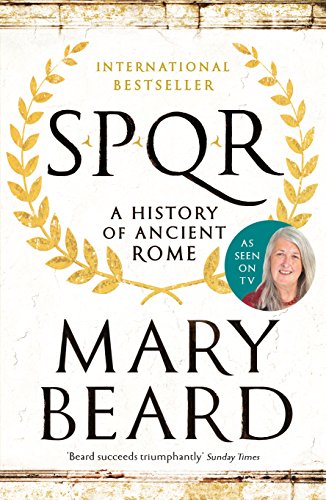
SPQR: A History of Ancient Rome
by Mary Beard
- Author:
- Mary Beard
- Status:
- Done
- Format:
- eBook
- Genres:
- History , Nonfiction , Ancient History , Historical , Italy , Roman History
- Pages:
- 606
- Highlights:
- 147
Highlights
Page 115
Yet the history of ancient Rome has changed dramatically over the past fifty years, and even more so over the almost 250 years since Edward Gibbon wrote The Decline and Fall of the Roman Empire, his idiosyncratic historical experiment that began the modern study of Roman history in the English-speaking world. That is partly because of the new ways of looking at the old evidence, and the different questions we choose to put to it. It is a dangerous myth that we are better historians than our predecessors. We are not. But we come to Roman history with different priorities – from gender identity to food supply – that make the ancient past speak to us in a new idiom.
Note: Very good point about not being better historians
Page 128
Roman history is always being rewritten, and always has been; in some ways we know more about ancient Rome than the Romans themselves did. Roman history, in other words, is a work in progress. This book is my contribution to that bigger project; it offers my version of why it matters.
Note: Bold claim that we know more than they did
Page 152
Rome was not simply the thuggish younger sibling of classical Greece, committed to engineering, military efficiency and absolutism, whereas the Greeks preferred intellectual inquiry, theatre and democracy. It suited some Romans to pretend that was the case, and it has suited many modern historians to present the classical world in terms of a simple dichotomy between two very different cultures. That is, as we shall see, misleading, on both sides. The Greek city-states were as keen on winning battles as the Romans were, and most had little to do with the brief Athenian democratic experiment. Far from being unthinking advocates of imperial might, several Roman writers were the most powerful critics of imperialism there have ever been. ‘They create desolation and call it peace’ is a slogan that has often summed up the consequences of military conquest. It was written in the second century CE by the Roman historian Tacitus, referring to Roman power in Britain.
Note: Nuance doesn’t fit in 140 characters, but this was a problem long before social media I guess
Page 198
It is only in the first century BCE that we can start to explore Rome, close up and in vivid detail, through contemporary eyes. An extraordinary wealth of words survives from this period: from private letters to public speeches, from philosophy to poetry – epic and erotic, scholarly and straight from the street. Thanks to all this, we can still follow the day-to-day wheeling and dealing of Rome’s political grandees. We can eavesdrop on their bargaining and their trade-offs and glimpse their back-stabbing, metaphorical and literal. We can even get a taste of their private lives: their marital tiffs, their cash-flow problems, their grief at the death of beloved children, or occasionally of their beloved slaves. There is no earlier period in the history of the West that it is possible to get to know quite so well or so intimately (we have nothing like such rich and varied evidence from classical Athens). It is not for more than a millennium, in the world of Renaissance Florence, that we find any other place that we can know in such detail again.
Page 239
Whatever its rights and wrongs, ‘The Conspiracy’ takes us to the centre of Roman political life in the first century BCE, to its conventions, controversies and conflicts. In doing so, it allows us to glimpse in action the ‘Senate’ and the ‘Roman People’ – the two institutions whose names are embedded in my title, SPQR (Senatus PopulusQue Romanus). Individually, and sometimes in bitter opposition, these were the main sources of political authority in first-century BCE Rome. Together they formed a shorthand slogan for the legitimate power of the Roman state, a slogan that lasted throughout Roman history and continues to be used in Italy in the twenty-first century CE. More widely still, the senate (minus the PopulusQue Romanus) has lent its name to modern legislative assemblies the world over, from the USA to Rwanda.
Page 278
Catiline himself had a successful early career and was elected to a series of junior political offices, but in 63 BCE he was close to bankruptcy. A string of crimes was attached to his name, from the murder of his first wife and his own son to sex with a virgin priestess. But whatever his expensive vices, his financial problems came partly from his repeated attempts to secure election as one of the two consuls, the most powerful political posts in the city.
Note: I see the difference between Beard and other historians. This is meant for popular consumption. That’s why she doesn’t say “quaestor” or “vestal virgin”
Page 286
That was Catiline’s position after he had been beaten in the annual elections for the consulship in both 64 and 63 BCE. Although the usual story is that he had been leaning in that direction before, he now had little option but to resort to ‘revolution’ or ‘direct action’ or ‘terrorism’, whichever you choose to call it. Joining forces with other upper-class desperadoes in similar straits, he appealed to the support of the discontented poor within the city while mustering his makeshift army outside it. And there was no end to his rash promises of debt relief (one of the most despicable forms of radicalism in the eyes of the Roman landed classes) or to his bold threats to take out the leading politicians and to put the whole city to flames.
Note: That tool David Graeber probably salivating at this
Page 339
And togas were white, with the addition of a purple border for anyone who held public office. In fact, the modern word ‘candidate’ derives from the Latin candidatus, which means ‘whitened’ and refers to the specially whitened togas that Romans wore during election campaigns, to impress the voters. In a world where status needed to be on show, the niceties of dress went even further: there was also a broad purple stripe on senators’ tunics, worn beneath the toga, and a slightly narrower one if you were the next rank down in Roman society, an ‘equestrian’ or ‘knight’, and special shoes for both ranks.
Note: I enjoy learning tidbits like this. Especially ways in which historical quirks influence modern life
Page 406
So far in this story the Populus(Que) Romanus (the PQR in SPQR) has not played a particularly prominent role. The ‘people’ was a much larger and amorphous body than the senate, made up, in political terms, of all male Roman citizens; the women had no formal political rights. In 63 BCE that was around a million men spread across the capital and throughout Italy, as well as a few beyond. In practice, it usually comprised the few thousand or the few hundred who, on any particular occasion, chose to turn up to elections, votes or meetings in the city of Rome. Exactly how influential the people were has always – even in the ancient world – been one of the big controversies in Roman history; but two things are certain. At this period, they alone could elect the political officials of the Roman state; no matter how blue-blooded you were, you could only hold office as, say, consul if the Roman people elected you. And they alone, unlike the senate, could make law. In 58 BCE Cicero’s enemies argued that, whatever authority he had claimed under the senate’s prevention of terrorism decree, his executions of Catiline’s followers had flouted the fundamental right of any Roman citizen to a proper trial. It was up to the people to exile him.
Note: This distinction between the two is fascinating
Page 426
The single most extraordinary fact about the Roman world is that so much of what the Romans wrote has survived, over two millennia. We have their poetry, letters, essays, speeches and histories, to which I have already referred, but also novels, geographies, satires and reams and reams of technical writing on everything from water engineering to medicine and disease. The survival is largely due to the diligence of medieval monks who transcribed by hand, again and again, what they believed were the most important, or useful, works of classical literature, with a significant but often forgotten contribution from medieval Islamic scholars who translated into Arabic some of the philosophy and scientific material. And thanks to archaeologists who have excavated papyri from the sands and the rubbish dumps of Egypt, wooden writing tablets from Roman military bases in the north of England and eloquent tombstones from all over the empire, we have glimpses of the life and letters of some rather more ordinary inhabitants of the Roman world. We have notes sent home, shopping lists, account books and last messages inscribed on graves. Even if this is a small proportion of what once existed, we have access to more Roman literature – and more Roman writing in general – than any one person could now thoroughly master in the course of a lifetime.
Note: Even more than what’s mentioned. We have graves of pets, graffiti from Pompei. But this sticks to the authors goal of analysing how and why we know what we know, rather than merely what
Page 494
It did not take long for the opening words of Cicero’s speech given on 8 November (the First Catilinarian) to become one of the best known and instantly recognisable quotes of the Roman world: ‘Quo usque tandem abutere, Catilina, patientia nostra?’ (‘How long, Catiline, will you go on abusing our patience?’); and it was closely followed, a few lines later in the written text, by the snappy, and still much repeated, slogan ‘O tempora, o mores’ (‘O what a world we live in!’, or, literally, ‘O the times, O the customs!’). In fact, the phrase ‘Quo usque tandem …’ must already have been firmly embedded in the Roman literary consciousness by the time that Sallust was writing his account of the ‘war’, just twenty years later. So firmly embedded was it that, in pointed or playful irony, Sallust could put it into Catiline’s mouth. ‘Quae quo usque tandem patiemini, o fortissimi viri?’ (‘How long will you go on putting up with this, my braves?’) is how Sallust’s revolutionary stirs up his followers, reminding them of the injustices they were suffering at the hands of the elite. The words are purely imaginary. Ancient writers regularly scripted speeches for their protagonists, much as historians today like to ascribe feelings or motives to their characters. The joke here is that Catiline, Cicero’s greatest enemy, is made to voice his antagonist’s most famous slogan.
Note: Good point about how modern historians act. I hadn’t thought about that, like it was just taken for granted.
Page 522
Might there not be another side to the story? The detailed evidence we have from Cicero’s pen, or point of view, means that his perspective will always be dominant. But it does not necessarily mean that it is true in any simple sense, or that it is the only way of seeing things. People have wondered for centuries quite how loaded an account Cicero offers us, and have detected alternative views and interpretations just beneath the surface of his version of events. Sallust himself hints as much. For, although his account is heavily based on Cicero’s writing, by transferring the famous ‘Quo usque tandem’ from the mouth of Cicero to that of Catiline, he may well have been reminding his readers that the facts and their interpretations were, at the very least, fluid.
Note: History was written by the Victor, or in this case, the survivor and superior orator
Page 548
Cicero casts Catiline as a desperado with terrible gambling debts, thanks entirely to his moral failings. But the situation cannot have been so simple. There was some sort of credit crunch in Rome in 63 BCE, and more economic and social problems than Cicero was prepared to acknowledge. Another achievement of his ‘great consulate’ was to scotch a proposal to distribute land in Italy to some of the poor in the city. To put it another way, if Catiline behaved like a desperado, he might have had a good reason, and the support of many ordinary people driven to desperate measures by similar distress.
Page 565
According to these calculations, the number of coins being minted in the late 60s BCE fell so sharply that there were fewer overall in circulation than there had been a few years before. The reasons for this we cannot reconstruct. Like most states before the eighteenth century or even later, Rome had no monetary policy as such, nor any financial institutions where that kind of policy could be developed. But the likely consequences are obvious. Whether he recklessly gambled away his fortune or not, Catiline – and many others – might have been short of cash; while those already in debt would have been faced with creditors, short of cash themselves, calling in their loans.
Page 578
Cicero, inevitably, had an interest in making the most of the danger that Catiline posed. Whatever his political success, he held a precarious position at the top of Roman society, among aristocratic families who claimed, like Catiline, a direct line back to the founders of the city, or even to the gods. Julius Caesar’s family, for example, was proud to trace its lineage back to the goddess Venus; another, more curiously, claimed descent from the equally mythical Pasiphae, the wife of King Minos, whose extraordinary coupling with a bull produced the monstrous Minotaur. In order to secure his position in these circles, Cicero was no doubt looking to make a splash during his year as consul. An impressive military victory against a barbarian enemy would have been ideal, and what most Romans would have dreamt of. Rome was always a warrior state, and victory in war the surest route to glory. Cicero, however, was no soldier: he had come to prominence in the law courts, not by leading his army in battle against dangerous, or unfortunate, foreigners. He needed to ‘save the state’ in some other way.
Note: Persuasive theory. Feels a bit conspiracy like, but the claim isn’t that Cicero made the whole thing up. Just that he portrayed himself in the best possible light
Page 732
As soon as she gave birth, to twins, Amulius ordered his servants to throw the babies into the nearby river Tiber to drown. But they survived. For, as often happens in stories like this in many cultures, the men who had been given this unpleasant task did not (or could not bring themselves to) follow the instructions to the letter. Instead, they left the twins in a basket not directly in the river but – as it was in flood – next to the water that had burst its banks. Before the babies were washed away to their death, the famous nurturing wolf came to their rescue. Livy was one of those Roman sceptics who tried to rationalise this particularly implausible aspect of the tale. The Latin word for ‘wolf’ (lupa) was also used as a colloquial term for ‘prostitute’ (lupanare was one standard term for ‘brothel’). Could it be that a local whore rather than a local wild beast had found and tended the twins?
Note: Now that the author mentions it, that trope is used a lot across cultures
Page 744
The twins disagreed about where exactly to site their new foundation – in particular, which one of the several hills that later made up the city (there are, in fact, more than the famous seven) should form the centre of the first settlement. Romulus chose the hill known as the Palatine, where the emperors’ grand residence later stood and which has given us our word ‘palace’.
Note: Love the trivia
Page 746
In the quarrel that ensued, Remus, who had opted for the Aventine, insultingly jumped over the defences that Romulus was constructing around his preferred spot. There were various versions of what happened next. But the commonest (according to Livy) was that Romulus responded by killing his brother and so became the sole ruler of the place that took his name. As he struck the terrible, fratricidal blow, he shouted (in Livy’s words): ‘So perish anyone else who shall leap over my walls.’ It was an appropriate slogan for a city which went on to portray itself as a belligerent state, but one whose wars were always responses to the aggression of others, always ‘just’.
Note: That is true! These dudes were obsessed with finding casus belli
Page 779
Livy defends the early Romans. He insists that they seized only unmarried women; this was the origin of marriage, not of adultery. And by stressing the idea that the Romans did not choose the women but took them at random, he argues that they were resorting to a necessary expedient for the future of their community, which was followed by loving talk and promises of affection from the men to their new brides. He also presents the Roman action as a response to the unreasonable behaviour of the city’s neighbours. The Romans, he explains, had first done the correct thing, by asking the surrounding peoples for a treaty which would have given them the right to marry each other’s daughters. Livy explicitly – and wildly anachronistically – refers here to the legal right of conubium, or ‘intermarriage’, which much later was a regular part of Rome’s alliances with other states. The Romans turned to violence only when that request was unreasonably rebuffed. That is to say, this was another case of a ‘just war’.
Note: These dudes were massively delusional. Just indeed.
Page 830
The only thing recorded about this Egnatius is that he overturned the story of the murder entirely and asserted that Remus survived to a ripe old age, actually outliving his twin. It was a desperate, and no doubt unconvincing, attempt to escape the bleak message of the story: that fratricide was hard-wired into Roman politics and that the dreadful bouts of civil conflict that repeatedly blighted Rome’s history from the sixth century BCE on (the assassination of Julius Caesar in 44 BCE being only one example) were somehow predestined. For what city, founded on the murder of brother by brother, could ever escape the murder of citizen by citizen? The poet Quintus Horatius Flaccus (‘Horace’) was just one writer of many who answered that question in the obvious way. Writing around 30 BCE, in the aftermath of the decade of fighting that followed Caesar’s death, he lamented: ‘Bitter fate pursues the Romans, and the crime of a brother’s murder, ever since the blood of blameless Remus was spilt onto the ground to be a curse on his descendants.’ Civil war, we might say, was in the Roman genes.
Page 846
Edgy in a different way was the idea of the asylum, and the welcome, that Romulus gave to all comers – foreigners, criminals and runaways – in finding citizens for his new town. There were positive aspects to this. In particular, it reflected Roman political culture’s extraordinary openness and willingness to incorporate outsiders, which set it apart from every other ancient Western society that we know. No ancient Greek city was remotely as incorporating as this; Athens in particular rigidly restricted access to citizenship. This is not a tribute to any ‘liberal’ temperament of the Romans in the modern sense of the word. They conquered vast swathes of territory in Europe and beyond, sometimes with terrible brutality; and they were often xenophobic and dismissive of people they called ‘barbarians’. Yet, in a process unique in any pre-industrial empire, the inhabitants of those conquered territories, ‘provinces’ as Romans called them, were gradually given full Roman citizenship, and the legal rights and protections that went with it. That culminated in 212 CE (where my SPQR ends), when the emperor Caracalla made every free inhabitant of the empire a Roman citizen.
Note: By co-opting local elites, they cemented their power. I guess this was “inclusivity” by ancient standards
Page 860
Even before then, the elite of the provinces had entered the political hierarchy of the capital, in large numbers. The Roman senate gradually became what we might now describe as a decidedly multicultural body, and the full list of Roman emperors contains many whose origins lay outside Italy: Caracalla’s father, Septimius Severus, was the first emperor from Roman territory in Africa; Trajan and Hadrian, who reigned half a century earlier, had come from the Roman province of Spain. When in 48 CE the emperor Claudius – whose avuncular image owes more to Robert Graves’ novel I, Claudius than to real life – was arguing to a slightly reluctant senate that citizens from Gaul should be allowed to become senators, he spent some time reminding the meeting that Rome had been open to foreigners from the beginning. The text of his speech, including some of the heckling that apparently even an emperor had to endure, was inscribed on bronze and put on display in the province, in what is now the city of Lyon, where it still survives. Claudius, it seems, did not get the chance that Cicero had to make adjustments for publication.
Note: These dudes were far thinking
Page 869
There was a similar process with slavery. Roman slavery was in some respects as brutal as Roman methods of military conquest. But for many Roman slaves, particularly those working in urban domestic contexts rather than toiling in the fields or mines, it was not necessarily a life sentence. They were regularly given their freedom, or they bought it with cash they had managed to save up; and if their owner was a Roman citizen, then they also gained full Roman citizenship, with almost no disadvantages as against those who were freeborn. The contrast with classical Athens is again striking: there, very few slaves were freed, and those who were certainly did not gain Athenian citizenship in the process, but went into a form of stateless limbo. This practice of emancipation – or manumission, to follow the Latin term – was such a distinctive feature of Roman culture that outsiders at the time remarked upon it and saw it as a powerful factor in Rome’s success. As one king of Macedon observed in the third century BCE, it was in this way that ‘the Romans have enlarged their country’. The scale was so great that some historians reckon that, by the second century CE, the majority of the free citizen population of the city of Rome had slaves somewhere in their ancestry.
Note: Slavers, but with policies that made the state stronger in the long run
Page 882
In the late first or early second century CE, the satiric poet ‘Juvenal’ – Decimus Junius Juvenalis – who loved to pour scorn on Roman pretensions, lambasted the snobbery that was another side of life at Rome, and he ridiculed those aristocrats who boasted of a family tree going back centuries. He ends one of his poems with a sideswipe at Rome’s origins. What are all these pretensions based on, anyway? Rome was from its very beginning a city made up of slaves and runaways (‘Whoever your earliest ancestor was, he was either a shepherd or something I’d rather not mention’). Cicero may have been making a similar point when he joked in a letter to his friend Atticus about the ‘the crap’ or ‘the dregs’ of Romulus. He was poking fun at one of his contemporaries, who, he said, addressed the senate as if he were living ‘in the Republic of Plato’, referring to the philosopher’s ideal state – ‘when in fact he is in the faex (crap) of Romulus.’
Note: Fascinating
Page 918
But gradually the different views coalesced around the middle of what we call the eighth century BCE, as scholarly opinion reached the conclusion that Greek and Roman history ‘began’ at roughly the same time. What became the canonical date, and one still quoted in many modern textbooks, partly goes back to a scholarly treatise, the Book of Chronology, by none other than Cicero’s friend and correspondent Atticus. It does not survive, but it is supposed to have pinpointed Romulus’ foundation of the city to the third year of the sixth cycle of Olympic Games; that is to say, 753 BCE. Other calculations narrowed this down further, to 21 April, the date on which modern Romans still, to this day, celebrate the birthday of their city, with some rather tacky parades and mock gladiatorial spectacles.
Note: Alright, completely made up then
Page 924
There is often a fuzzy boundary between myth and history (think of King Arthur or Pocahontas), and, as we shall see, Rome is one of those cultures where that boundary is particularly blurred. But despite all the historical acumen that Romans brought to bear on this story, there is every reason for us to see it, in our terms, as more or less pure myth. For a start, there was almost certainly no such thing as a founding moment of the city of Rome. Very few towns or cities are founded at a stroke, by a single individual. They are usually the product of gradual changes in population, in patterns of settlement, social organisation and sense of identity. Most ‘foundations’ are retrospective constructions, projecting back into the distant past a microcosm, or imagined primitive version, of the later city. The name ‘Romulus’ is itself a give-away. Although Romans usually assumed that he had lent his name to his newly established city, we are now fairly confident that the opposite was the case: ‘Romulus’ was an imaginative construction out of ‘Roma’. ‘Romulus’ was merely the archetypal ‘Mr Rome’.
Page 948
Of course, to put it another way, it is precisely because the story of Romulus is mythic rather than historical, in the narrow sense, that it encapsulates so sharply some of the central cultural questions of ancient Rome and is so important for understanding Roman history, in its wider definition. The Romans had not, as they assumed, simply inherited the priorities and concerns of their founder. Quite the reverse: over centuries of retelling and then rewriting the story, they themselves had constructed and reconstructed the founding figure of Romulus as a powerful symbol of their preferences, debates, ideologies and anxieties. It was not, in other words, to go back to Horace, that civil war was the curse and destiny of Rome from its birth; Rome had projected its obsessions with the apparently unending cycle of civil conflict back onto its founder.
Page 018
The message is clear: however far back you go, the inhabitants of Rome were always already from somewhere else.
Page 292
Livy, for example, quotes the very first Roman historian, Quintus Fabius Pictor, who wrote around 200 BCE and claimed that towards the end of the regal period the number of adult male citizens was 80,000, making a total population of well over 200,000. This is a ludicrous figure for a new community in archaic Italy (it is not far short of the total population of the territories of Athens or Sparta at their height, in the mid fifth century BCE), and there is no archaeological evidence for a city of any such size at this time, although the number does at least have the virtue of matching the aggrandising views of early Rome found in all ancient writers.
Note: At least they were consistent
Page 301
Military activity is another good case in point. Here geography alone should give us pause. We need simply look at the location of these heroic battles: they were all fought within a radius of about 12 miles of the city of Rome. Despite the style in which they are recounted, as if they were mini-versions of Rome against Hannibal, they were probably something closer, in our terms, to cattle raids. They may not even have been ‘Roman’ engagements in the strict sense of the word at all. In most early communities, it took a long time before the various forms of private violence, from rough justice and vendetta to guerrilla warfare, came fully under public control. Conflict of all sorts was regularly in the hands of individuals with their own following, the ancient equivalents of what we might call private warlords; and there was a blurry distinction between what was conducted on behalf of the ‘state’ and what on behalf of some powerful leader. Almost certainly that was the case in early Rome.
Page 364
This did not make Numa a holy figure along the lines of Moses, the Buddha, Jesus or Muhammad. The traditional religion of Rome was significantly different from religion as we usually understand it now. So much modern religious vocabulary – including the word ‘religion’, as well as ‘pontiff’ – is borrowed from Latin that it tends to obscure some of the major differences between ancient Roman religion and our own. In Rome there was no doctrine as such, no holy book and hardly even what we would call a belief system. Romans knew the gods existed; they did not believe in them in the internalised sense familiar from most modern world religions. Nor was ancient Roman religion particularly concerned with personal salvation or morality. Instead it mainly focused on the performance of rituals that were intended to keep the relationship between Rome and the gods in good order, and so ensure Roman success and prosperity. The sacrifice of animals was a central element in most of these rituals, which otherwise were extraordinarily varied. Some were so outlandish that they undermine better than anything else the modern stereotype of the Romans as stuffy and sedate: at the festival of Lupercalia in February, for example, naked young men ran round the city whipping any women they met (this is the festival that the opening scene of Shakespeare’s Julius Caesar re-creates). In general, it was a religion of doing, not believing.
Page 381
Among all the things we fancy we have inherited from ancient Rome, from drains to place names, or the offices of the Catholic Church, the calendar is probably the most important and the most often overlooked. It is a surprising link between that early regal period and our world.
Page 393
In fact, the earliest written version of a Roman calendar that we have – although itself from no earlier than the first century BCE – points strongly in that direction. It is an extraordinary survival, found painted on a wall in the town of Antium (modern Anzio), some 35 miles south of Rome, and offers a vivid, if slightly perplexing, glimpse of how Romans of Cicero’s time pictured their year. Nothing in early Rome would have been as complex as this. There are signs of all kinds of developments over the centuries, including some radical changes in the ordering of months and in the starting point of the year – for how else could November and December, meaning literally ‘ninth month’ and ‘tenth month’, respectively, have ended up in this calendar, and our own, as the eleventh and twelfth months in the sequence? But there are also hints of an ancient pedigree in this first-century BCE version.
Note: I wonder if any Roman author opined on this
Page 401
Its system is basically one of twelve lunar months, with an extra month (the distant precursor of our extra day in a leap year) inserted from time to time to keep this calendar in proper alignment with the solar year. The biggest challenge facing primitive calendars everywhere is the fact that the two most obvious, natural systems of timekeeping are incompatible: that is to say, twelve lunar months, from new moon to new moon, add up to just over 354 days; and this cannot be made to match in any convenient way the 365¼ days of the solar year, which is the time it takes for the earth to make one complete circuit of the sun, from spring equinox to spring equinox, for instance. The wholesale insertion of an extra month every few years is just the kind of rough-and-ready method typical of early attempts to solve the problem.
Note: Honestly, it’s a reasonable solution
Page 458
Cicero reflects exactly that when he sums up Servius Tullius’ political objectives in approving tones: ‘He divided the people in this way to ensure that voting power was under the control not of the rabble but of the wealthy, and he saw to it that the greatest number did not have the greatest power – a principle that we should always stand by in politics.’ In fact, this principle came to be vigorously contested in the politics of Rome.
Page 685
The end of the monarchy was also the birth of liberty and of the free Roman Republic. For the rest of Roman history, ‘king’, or rex, was a term of loathing in Roman politics, despite the fact that so many of Rome’s defining institutions were supposed to have their origins in the regal period. There were any number of cases in the centuries that followed when the accusation that he was aiming at kingship brought a swift end to a man’s political career. His royal name even proved disastrous for Lucretia’s unfortunate widower, who, because he was a relation of the Tarquins, was shortly sent into exile. In foreign conflicts too, kings were the most desirable of enemies. Over the next few hundred years, there was always a particular frisson when a triumphal procession through the streets of the city paraded some enemy king in all his regal finery for the Roman populace to jeer and pelt.
Page 729
The Republic, in other words, was not just a political system. It was a complex set of interrelationships between politics, time, geography and the Roman cityscape. Dates were directly correlated with the elected consuls; years were marked by the nails hammered into the temple whose dedication was traced back to the first year of the new regime; even the island in the Tiber was a product, quite literally, of the expulsion of the kings. Underpinning the whole thing was one single, overriding principle: namely, freedom, or libertas.
Page 792
The epitaph was composed soon after his death. It is four lines long and must count as the earliest historical and biographical narrative to survive from ancient Rome. Short as it is, it is one of the major turning points in our understanding of Roman history. For it provides hard, more or less contemporary information on Barbatus’ career – quite different from the imaginative reconstructions, faint hints buried in the soil or modern deductions about ‘what must have been’ that surround the fall of the monarchy. It is eloquent on the ideology and world view of the Roman elite at this period: ‘Cornelius Lucius Scipio Barbatus, offspring of his father Gnaeus, a brave man and wise, whose appearance was a match for his virtus. He was consul and censor and aedile among you. He took Taurasia and Cisauna from Samnium. He subdued the whole of Lucania and took hostages.’
Page 862
Not that this was a story of unchallenged expansion. Soon after the defeat of Veii, in 390 BCE a posse of marauding ‘Gauls’ sacked Rome. Exactly who these people were is now impossible to know; Roman writers were not good at distinguishing between those whom it was convenient to lump together as ‘barbarian tribes’ from the north, nor much interested in analysing their motives. But according to Livy, the effects were so devastating that the city had to be refounded (yet again), under the leadership of Marcus Furius Camillus – war leader, dictator, ‘colonel’, sometime exile and another ‘second Romulus’.
Page 938
It is a much simpler society, and its horizons much more restricted, than Livy’s account ever implies. That is clear from the language and forms of expression as much as from the content. Although modern translations do their best to make it all sound fairly lucid, the original Latin wording is often far from that. In particular, the absence of nouns and differentiated pronouns can make it almost impossible to know who is doing what to whom. ‘If he summons to law, he is to go. If he does not go, he is to call to witness, then is to seize him’ presumably means, as it is usually translated, ‘If a plaintiff summons a defendant to law, the defendant is to go. If he does not go, the plaintiff is to call someone else to witness, then is to seize the defendant.’ But it does not exactly say that. All the signs are that whoever drafted this and many other clauses was still struggling to use written language to frame precise regulations, and that the conventions of logical argument and rational expression were very much in their infancy.
Page 978
To judge from the Twelve Tables, Rome in the mid fifth century BCE was an agricultural town, complex enough to recognise basic divisions between slave and free and between different ranks of citizen and sophisticated enough to have devised some formal civic procedures to deal consistently with disputes, to regulate social and family relations and to impose some basic rules on such human activities as the disposal of the dead. But there is no evidence that it was more than that. The strikingly tentative formulation of the regulations, in places awkward or even confusing, should call into question some of the references in Livy and other ancient writers to complicated laws and treaties at this period. And the absence, at least from the selection of clauses preserved, of any reference to a specific public official, apart from a Vestal Virgin (who as a priestess was to be free of her father’s control), certainly does not suggest a dominant state apparatus. What is more, there is hardly any mention of the world outside Rome – beyond a couple of references to how particular rules applied to a hostis (a ‘foreigner’ or an ‘enemy’; the same Latin word, significantly, can mean both) and one possible reference to sale into slavery ‘in foreign country across the Tiber’, as a punishment of last resort for debt. Maybe this collection had an intentionally internal rather than external focus. All the same, there is no hint in the Twelve Tables that this was a community putting a high priority on relations, whether of dominance, exploitation or friendship, beyond its locality.
Page 997
In Rome it was seen ever after as a heroic vindication of the political liberty of the ordinary citizen, and it has left its mark on the politics, and political vocabulary, of the modern world too. The word ‘plebeian’ remains an especially loaded term in our class conflicts; even in 2012, the allegation that a British Conservative politician had insulted a policeman by calling him a ‘pleb’ – short for ‘plebeian’ – led to his resignation from the government.
Page 000
As the story of this conflict unfolds, it was only a few years after the Republic had been established, at the beginning of the fifth century BCE, that the plebeians began objecting to their exclusion from power and their exploitation by the patricians. Why fight in Rome’s wars, they repeatedly asked, when all the profits of their service lined patrician pockets? How could they count themselves full citizens when they were subject to random and arbitrary punishment, even enslavement if they fell into debt? What right had the patricians to keep the plebeians as an underclass? Or, as Livy scripted the ironic words of one plebeian reformer, in terms uncannily reminiscent of twentieth-century opposition to apartheid, ‘Why don’t you pass a law to stop a plebeian from living next door to a patrician, or walking down the same street, or going to the same party, or standing side by side in the same Forum?’
Note: It’s true. It’s the same struggle.
Page 007
In 494 BCE, plagued by problems of debt, the plebeians staged the first of several mass walkouts from the city, a combination of a mutiny and a strike, to try to force reform on the patricians. It worked. For it launched a long series of concessions which gradually eroded all the significant differences between patricians and plebeians and effectively rewrote the political power structure of the city. Two hundred years later there was little to patrician privilege beyond the right to hold a few ancient priesthoods and to wear a particular form of fancy footwear.
Note: Good for them
Page 016
Finally, after one last walkout, in a reform that Scipio Barbatus would have witnessed in 287 BCE, the decisions of this assembly were given the automatic binding force of law over all Roman citizens. A plebeian institution, in other words, was given the right to legislate over, and on behalf of, the state as a whole.
Page 019
Between 494 and 287 BCE, amid yet more stirring rhetoric, strikes and threats of violence, all major offices and priesthoods were step by step opened up to plebeians and their second-class status was dismantled. One of the most famed plebeian victories came in 326 BCE, when the system of enslavement for debt was abolished, establishing the principle that the liberty of a Roman citizen was an inalienable right. An equally significant but more narrowly political milestone had been passed forty years earlier, in 367 BCE. After decades of dogged refusal and claims by hard-line patricians that ‘it would be a crime against the gods to let a plebeian be consul,’ it was decided to open one of the consulships to plebeians. From 342 BCE it was agreed that both consuls could be plebeian, if so elected.
Note: Crime against the gods wow. Fighting words.
Page 053
This story of the Conflict of the Orders adds up to one of the most radical and coherent manifestos of popular power and liberty to survive from the ancient world – far more radical than anything to survive from classical democratic Athens, most of whose writers, when they had anything explicitly to say on the subject, were opposed to democracy and popular power. Taken together, the demands put into the mouths of the plebeians offered a systematic programme of political reform, based on different aspects of the freedom of the citizen, from freedom to participate in the government of the state and freedom to share in its rewards to freedom from exploitation and freedom of information. It is hardly surprising that working class movements in many countries in the nineteenth and early twentieth centuries found a memorable precedent, and some winning rhetoric, in the ancient story of how the concerted action of the Roman people wrung concessions from the hereditary patrician aristocracy and secured full political rights for the plebeians. Nor is it surprising that early trades unions could look to the plebeian walkouts as a model for a successful strike.
Page 226
Alexander, he concedes, was a great general, though not without his faults, drunkenness among others. But the Romans had the advantage of not depending on a single charismatic leader. They had depth in their command, supported by extraordinary military discipline. They also, he insisted, could call on far greater numbers of well-trained troops and – thanks to Roman alliances throughout Italy – summon reinforcements more or less at will. His answer, in short, was that, if given the chance, the Romans would have beaten Alexander.
Note: The most delusional homer take. There’s just no way any ancient army would have stood a chance against Alexanders veterans. Maybe Caesar fresh after Gaul, but it’s a stretch. His troops had the experience but not the diversity. The Macedonian cavalry would have given Alexander the edge.
Either way, this ancient discourse is at the level of LeBron vs Jordan. The very premise is kinda dumb 😅
Page 236
Two things are clear and undermine a couple of misleading modern myths about Roman power and ‘character’. First, the Romans were not by nature more belligerent than their neighbours and contemporaries, any more than they were naturally better at building roads and bridges. It is true that Roman culture placed an extraordinarily – for us, uncomfortably – high value on success in fighting. Prowess, bravery and deadly violence in battle were repeatedly celebrated, from the successful general parading through the streets and the cheering crowds in his triumphal procession to the rank-and-file soldiers showing off their battle scars in the middle of political debates in the hope of adding weight to their arguments. In the middle of the fourth century BCE the base of the main platform for speakers in the Forum was decorated with the bronze rams of enemy warships captured from the city of Antium during the Latin War, as if to symbolise the military foundation of Roman political power. The Latin word for ‘rams’, rostra, became the name of the platform and gave modern English its word ‘rostrum’.
Note: Love a good etymology. Agree with what she’s saying about how military prowess and achievements were celebrated
Page 252
Second, the Romans did not plan to conquer and control Italy. No Roman cabal in the fourth century BCE sat down with a map, plotting a land grab in the territorial way that we associate with imperialist nation-states in the nineteenth and twentieth centuries. For a start, simple as it sounds, they had no maps. What this implies for how they, or any other ‘precartographic’ people, conceived the world around them, or just over their horizons, is one of history’s great mysteries. I have tended to write of the spread of Roman power through the peninsula of Italy, but no one knows how many – or, realistically, how few – Romans at this date thought of their homeland as part of a peninsula in the way we picture it. A rudimentary version of the idea is perhaps implied by references in literature of the second century BCE to the Adriatic as the Upper Sea and the Tyrrhenian as the Lower Sea, but notably this is on a different orientation from ours, east–west rather than north–south.
Note: Maps. Rarely do we think of those.
Page 260
These Romans saw their expansion more in terms of changing relationships with other peoples than in terms of control of territory. Of course, Rome’s growing power did dramatically transform the landscape of Italy. There was little that was more obviously transformative than a brand-new Roman road striking out across empty fields, or land being annexed and divided up among new settlers. It continues to be convenient to measure Roman power in Italy in terms of geographical area. Yet Roman dominion was primarily over people, not places. As Livy saw, the relations that the Romans formed with those people were the key to the dynamics of early Roman expansion.
Page 264
There was one obligation that the Romans imposed on all those who came under their control: namely, to provide troops for the Roman armies. In fact, for most of those who were defeated by Rome and forced, or welcomed, into some form of ‘alliance’, the only long-term obligation seems to have been the provision and upkeep of soldiers. These peoples were not taken over by Rome in any other way; they had no Roman occupying forces or Roman-imposed government. Why this form of control was chosen is impossible to know. But it is unlikely that any particularly sophisticated, strategic calculation was involved. It was an imposition that conveniently demonstrated Roman dominance while requiring few Roman administrative structures or spare manpower to manage. The troops that the allies contributed were raised, equipped and in part commanded by the locals. Taxation in any other form would have been much more labour-intensive for the Romans; direct control of those they had defeated would have been even more so. The results may well have been unintended, but they were ground-breaking. For this system of alliances became an effective mechanism for converting Rome’s defeated enemies into part of its growing military machine; and at the same time it gave those allies a stake in the Roman enterprise, thanks to the booty and glory that were shared in the event of victory. Once the Romans’ military success started, they managed to make it self-sustaining, in a way that no other ancient city had ever systematically done. For the single most significant factor behind victory at this period was not tactics, equipment, skill or motivation. It was how many men you could deploy. By the end of the fourth century BCE, the Romans had probably not far short of…
Note: But this is somewhat similar to Persian kings right? Every time they conquered a new place, they levied troops from there. But I guess that had more direct control, with a Governor. And there was less of a carrot off shared spoils motivating the allies?
Page 297
The implications, however, were again revolutionary. In extending citizenship to people who had no direct territorial connections with the city of Rome, they broke the link, which most people in the classical world took for granted, between citizenship and a single city. In a systematic way that was then unparalleled, they made it possible not just to become Roman but also to be a citizen of two places at once: one’s home town and Rome. And in creating new Latin colonies all over Italy, they redefined the word ‘Latin’ so that it was no longer an ethnic identity but a political status unrelated to race or geography. This set the stage for a model of citizenship and ‘belonging’ that had enormous significance for Roman ideas of government, political rights, ethnicity and ‘nationhood’. This model was shortly extended overseas and eventually underpinned the Roman Empire.
Note: Remarkable. Why would local elites rebel when they had it pretty good in terms of representation, the cost of compliance was low (in the early years) and the cost of rebellion so high?
Page 317
So far in exploring this period, I have largely kept the internal history of Rome separate from the story of its expansion. It makes for a clearer story, but it tends to obscure the impact of politics at home on relations further afield, and vice versa. By 367 BCE, the Conflict of the Orders had done something far more significant and wide-ranging than simply end political discrimination against the plebeians. It had effectively replaced a governing class defined by birth with one defined by wealth and achievement. That is partly the point of Barbatus’ epitaph: patrician though the Scipio family was, what counts here are the offices he held, the personal qualities he displayed and the battles he won. No achievement was more demonstrable or more celebrated than victory in battle, and the desire for victory among the new elite was almost certainly an important factor in intensifying military activity and encouraging warfare.
Note: I’ve always felt this too. The success of the romans can be attributed to a combination of many things, but IMO the chief factor was that they always had capable leaders in times of need rather than nepo babies. Even people who should have been Nepo babies like Scipio Africanus turned out to be geniuses at war
Page 403
as Polybius sternly put it: ‘Who could be so indifferent or so idle that they did not want to find out how, and under what kind of political organisation, almost the whole of the inhabited world was conquered and fell under the sole power of the Romans in less than fifty-three years, something previously unparalleled?’ Who indeed?
Note: 53? Cmon, it’s more like 100 just considering Carthage. Completely agree that no one can be indifferent though.
Page 602
Predictably, modern historians have found it hard to know quite where to fix the boundary between Polybius the Roman hostage and critic of Roman rule and Polybius the Roman collaborator. He certainly sometimes performed a deft balancing act between his different loyalties, giving behind-the-scenes advice at one point to a distinguished Syrian hostage on how to slip away from his detention, while carefully insisting in his Histories that on the day of the great escape he himself was at home, ‘ill in bed’. But whatever Polybius’ political stance, he had the advantage of knowing both sides of the Roman story, and he had the opportunity to quiz some of the leading Roman players. He dissected Rome’s internal organisation – which he insisted underpinned its success abroad – from a vantage point that combined a couple of decades of first-hand experience with all the sophistication of the Greek political theory in which he had been trained back home. His work is, in effect, one of the earliest surviving attempts at comparative political anthropology.
Page 642
The secret, Polybius suggested, lay in a delicate relationship of checks and balances between consuls, the senate and the people, so that neither monarchy nor aristocracy nor democracy ever entirely prevailed. The consuls, for example, might have had full, monarchical command on campaign, but they had to be elected by the people in the first place, and they depended on the senate for funding – and it was the senate which decided whether the successful general should be awarded a triumph at the end of his campaign, and a vote of the people was required to ratify any treaty that might be made. And so on. It was, Polybius argued, such balances across the political system that produced the internal stability on which Roman external success was built. This is a clever piece of analysis, sensitive to the tiny differences and subtle nuances which distinguish one political system from another. To be sure, in some respects Polybius tries to shoehorn the political life that he witnessed at Rome into a Greek analytical model that does not entirely fit. Saddling his discussion with terms like ‘democracy’ is, for example, deeply misleading. ‘Democracy’ (demokratia) was rooted politically and linguistically in the Greek world. It was never a rallying cry at Rome, even in its limited ancient sense or even for the most radical of Roman popular politicians. In most of the conservative writing that survives, the word means something close to ‘mob rule’. There is little point in asking how ‘democratic’ the politics of Republican Rome were: Romans fought for, and about, liberty, not democracy. Yet, in another way, by nudging his readers to keep sight of the people in their picture of Roman politics and to look beyond the power of the elected officials and the aristocratic senate, Polybius sparked an important debate that is still alive today. How influential was the popular voice in Roman Republican politics? Who controlled Rome? How should we characterise this Roman political system?
Page 682
There are also all kinds of anecdotes about the importance and intensity of canvassing, and how the vote of the people could be won or lost. Polybius tells a curious story about the Syrian king Antiochus IV (Epiphanes, ‘famous’ or even ‘manifest god’), the son of Antiochus the Great, who had been ‘crushed’ by Scipio Asiaticus. As a young man he had lived more than a decade as a hostage in Rome before being swapped for a younger relative, the one whom Polybius later advised on his escape plans. On his return to the East, he took with him a variety of Roman habits that he had picked up during his stay. These mostly came down to displaying a popular touch: talking with anyone he met, giving presents to ordinary people and making the rounds of craftsmen’s shops. But most striking of all, he would dress up in a toga and go around the marketplace as if he were a candidate for election, shaking people by the hand and asking for their vote. This baffled the people in his showy capital city of Antioch, who were not used to this kind of thing from a monarch and nicknamed him Epimanes (‘bonkers’ or, to preserve the pun, ‘fatuous’). But it is clear that one lesson that Antiochus had drawn from Rome was that the common people and their votes were important.
Note: Fascinating anecdote
Page 716
Much like the extension of Roman control within Italy, this expansion overseas in the third and second centuries BCE was more complicated than the familiar myth of the Roman legions marching in, conquering and taking over foreign territory. First, the Romans were not the only agents in the process. They did not invade a world of peace-loving peoples, who were just minding their own business until these voracious thugs came along. However cynical we might rightly be about Roman claims that they went to war only in response to requests for assistance from friends and allies (that has been the excuse for some of the most aggressive wars in history), part of the pressure for Rome to intervene did come from outside.
Note: We always underestimate how much war was going on
Page 742
The silence of our text on the outcome of these approaches hints that things did not go the Abderans’ way. But the snapshot here of rival representatives not merely beating a path to the senate but pressing their case daily on individual senators gives an idea of just how actively and persistently Roman assistance could be sought. And the literally hundreds of statues of individual Romans – as ‘saviours and benefactors’ – put up in the cities of the Greek world show how that intervention, if successful, could be celebrated. We cannot now identify every piece of doublethink behind such words: there was no doubt as much fear and flattery involved as sincere gratitude. But they are a useful reminder that the simple shorthand ‘Roman conquest’ can obscure a wide range of perspectives, motivations and aspirations on every side of the encounter.
Page 755
And Polybius, who visited Spain in the mid second century BCE, wrote of 40,000 miners, mostly slaves no doubt, working just one region of mining territory alone (not literally, perhaps: ‘40,000’ was a common ancient shorthand for ‘a very large number’, like our ‘millions’).
Page 762
Romans took the profits and tried to ensure that they got their own way when they wanted, with the threat of force always in the background. It was not an empire of annexation in the sense that later Romans would understand it. There was no detailed legal framework of control, rules or regulations – or, for that matter, visionary aspirations. At this period, even the Latin word imperium, which by the end of the first century BCE could mean ‘empire’, in the sense of the whole area under direct Roman government, meant something much closer to ‘the power to issue orders that are obeyed’. And provincia (or ‘province’), which became the standard term for a carefully defined subdivision of empire under the control of a governor, was not a geographical term but meant a responsibility assigned to Roman officials. That could be, and often was, an assignment of military activity or administration in a particular place.
Note: Love how words change meaning, especially a word as important as imperium.
Page 774
What was at stake for the Romans was whether they could win in battle and then whether – by persuasion, bullying or force – they could impose their will where, when and if they chose. The style of this imperium is vividly summed up in the story of the last encounter between Antiochus Epiphanes and the Romans. The king was invading Egypt for the second time, and the Egyptians had asked the Romans for help. A Roman envoy, Gaius Popilius Laenas, was dispatched and met Antiochus outside Alexandria. After his long familiarity with the Romans, the king no doubt expected a rather civil meeting. Instead, Laenas handed him a decree of the senate instructing him to withdraw from Egypt immediately. When Antiochus asked for time to consult his advisors, Laenas picked up a stick and drew a circle in the dust around him. There was to be no stepping out of that circle before he had given his answer. Stunned, Antiochus meekly agreed to the senate’s demands. This was an empire of obedience.
Page 832
By the mid second century BCE, well over half the adult male citizens of Rome would have seen something of the world abroad, leaving an unknown number of children where they went. To put it another way, the Roman population had suddenly become by far the most travelled of any state ever in the ancient Mediterranean, with only Alexander the Great’s Macedonians or the traders of Carthage as possible rivals. Even for those who never stepped abroad, there were new imaginative horizons, new glimpses of places overseas and new ways of understanding their place in the world.
Page 894
Was this a simple conservative backlash against newfangled ideas being brought into Rome from outside, a bout of ‘culture wars’ between traditionalists and modernisers? In part, perhaps, it was. But it was also more complicated, and interesting, than that. For all his huffing and puffing, Cato had taught his son Greek, and his surviving writing – notably, a technical essay on farming and agricultural management, and substantial quotations from his speeches and from his history of Italy – shows that he was well practised in the Greek rhetorical tricks that he claimed to deplore. And some of the claims being made about ‘Roman tradition’ were little short of imaginative fantasy. There is no reason whatsoever to suppose that venerable old Romans had watched theatrical performances standing up. The evidence we have suggests quite the reverse. The truth is that Cato’s version of old-fashioned, no-nonsense Roman values was as much an invention of his own day as a defence of long-standing Roman traditions. Cultural identity is always a slippery notion, and we have no idea how early Romans thought about their particular character and what distinguished them from their neighbours. But the distinctive, hard-edged sense of tough Roman austerity – which later Romans eagerly projected back on to their founding fathers and which has remained a powerful vision of Romanness into the modern world – was the product of a powerful cultural clash, in this period of expansion abroad, over what it was to be Roman in this new, wider imperial world, and in the context of such an array of alternatives. To put it another way, ‘Greeknesss’ and ‘Romanness’ were as inseparably bound up as they were polar opposites.
Page 992
Whatever motivations lay behind the violence of 146 BCE, the events of that year were soon seen as a turning point. In one way, they marked the acme of Roman military success. Rome had now annihilated its richest, oldest and most powerful rivals in the Mediterranean world. As Virgil presented it more than a hundred years later in the Aeneid, Mummius, by conquering Corinth, had at last avenged the defeat of Aeneas’ Trojans by the Greeks in the Trojan War. But in another way, the events of 146 BCE were seen as the beginning of the collapse of the Republic and as the herald of a century of civil wars, mass murder and assassinations that led to the return of autocratic rule. Fear of the enemy, so this argument went, had been good for Rome; without any significant external threat, ‘the path of virtue was abandoned for that of corruption’. Sallust was particularly eloquent on the theme.
Note: Agree that an external enemy is needed. America lost its way for the same reason.
Page 037
The first was in 133 BCE, when Tiberius Sempronius Gracchus, a tribune of the people with radical plans to distribute land to the Roman poor, decided to seek a second year in office. To put a stop to this, an unofficial posse of senators and their hangers-on interrupted the elections, bludgeoned Gracchus and hundreds of his supporters to death and threw their bodies into the Tiber. Conveniently forgetting the violence that had accompanied the Conflict of the Orders, many Romans held this to be ‘the first political dispute since the fall of the monarchy to be settled by bloodshed and the death of citizens’. There was soon another. Just over a decade later, Tiberius Gracchus’ brother Gaius met the same fate. He had introduced an even more radical programme of reform, including a subsidised grain allowance for Roman citizens, and was successfully elected tribune for a second time. But in 121 BCE, when he was trying to prevent his legislation from being dismantled, he became the victim of another, more official, posse of senators. On this occasion the bodies of thousands of his supporters clogged the river. And it happened again in 100 BCE, when other reformers were battered to death in the senate house itself, the assailants using tiles from the building’s roof as their weapons.
Note: I was hoping for a lot more analysis of the Gracchi
Page 053
Before the Social War was over, one of its commanders, Lucius Cornelius Sulla, a consul in 88 BCE, became the first Roman since the mythical Coriolanus to lead his army against the city of Rome. Sulla was forcing the hand of the senate to give him command in a war in the East, and when he returned from that victorious four years later, he marched on his home town once again and had himself appointed dictator. Before resigning in 79 BCE, he introduced a wholesale conservative reform programme and presided over a reign of terror and the first organised purge of political enemies in Roman history. In these ‘proscriptions’ (that is, ‘notices’, as they were known, in a chilling euphemism), the names of thousands of men, including about a third of all senators, were posted throughout Italy, a generous price on their heads for anyone cruel, greedy or desperate enough to kill them.
Note: I did not know the extent of Sulla’s proscriptions
Page 078
The essentials of what happened next are clear, even if the details are almost impenetrably complicated. Leaving Gaul in early 49 BCE, Caesar famously crossed the river Rubicon, which formed the boundary of Italy, and marched towards Rome. Forty years had made a big difference. When Sulla turned his army on the city, all but one of his senior officers had refused to follow him. When Caesar did the same, all but one stayed with him. It was an apt symbol of how far scruples had eroded in such a short time.
Note: The next few Jan 6th uprisings won’t see universal unity. More and more, violence will become normalised.
Page 092
It is also a story that historians, both ancient and modern, tell with all the advantages and disadvantages of hindsight. Once the outcome is known, it is easy to present the period as a series of irrevocable and brutal steps in the direction of crisis or as a slow countdown to both the end of the free state and the return of one-man rule. But the last century of the Republic was more than a mere bloodbath. As the flowering of poetry, theory and art suggests, it was also a period when Romans grappled with the issues that were undermining their political process and came up with some of their greatest inventions, including the radical principle that the state had some responsibility for ensuring that its citizens had enough to eat. For the first time, they confronted the question of how an empire should be administered and governed, rather than simply acquired, and devised elaborate codes of practice for Roman rule. In other words, this was also an extraordinary period of political analysis and innovation. Roman senators did not sit idly by as their political institutions lapsed into chaos, nor did they simply fan the flames of the crisis to their own short-term advantage (though there was certainly a bit of that). Many of them, from different ends of the political spectrum, tried to find some effective remedies. We should not allow our hindsight, their ultimate failure or the succession of civil wars and assassinations to blind us to their efforts, which are the main theme of this and the next chapter.
Note: Meta history
Page 120
How far the smallholders really had disappeared from the land has puzzled modern historians much more than it did their ancient counterparts. It is not difficult to see how an agricultural revolution of that kind might have been a logical consequence of Roman warfare and expansion. During the war against Hannibal, at the end of the third century BCE, rival armies had tramped up and down the Italian peninsula for a couple of decades, with devastating effects on the farmland. The demands of service with the army overseas removed manpower from the agricultural workforce for years on end, leaving family farms without essential labour. Both of these factors could have made small-holders particularly vulnerable to failure, bankruptcy or buy-outs by the rich, who used the wealth they acquired from overseas conquest to build up vast land holdings, worked as agricultural ranches by the glut of slave labour. One modern historian echoed the sentiments of Tiberius when he grimly summed this up: whatever booty they came home with, many ordinary soldiers had been in effect ‘fighting for their own displacement’. A good proportion of them would have drifted to Rome or other towns in search of a living, so swelling the urban underclass. It is a plausible scenario. But there is not much hard evidence to back it up. Leaving aside the propagandist tone of Tiberius’ eye-opening journey through Etruria (had he not travelled 40 miles north before?), there are few archaeological traces of the new-style ranches he reported and considerable evidence, on the contrary, for the widespread survival of small-scale farms. It is not even certain that either war damage or the absence of young unmarried men abroad would have had the devastating, long-term effect that is often imagined. Most agricultural land recovers quickly from that kind of trauma, and there would have been plenty of other family members to recruit to the workforce; and even if not, a few slave labourers would have been within the means of even relatively humble farmers. In fact, many historians now think that, if his motives were sincere, Tiberius seriously misread the situation.
Note: Had me in the first half, not gonna lie. It played right into my political biases and I was completely on board until the author revealed evidence to the contrary.
Page 187
The clash in 133 BCE revealed dramatically different views of the power of the people. When Tiberius persuaded them to vote out of office the tribune who opposed him, his argument went along the lines of ‘if the people’s tribune no longer does what the people want, then he should be deposed’. That raised an issue still familiar in modern electoral systems. Are Members of Parliament, for example, to be seen as delegates of the voters, bound to follow the will of their electorate? Or are they representatives, elected to exercise their own judgement in the changing circumstances of government? This was the first time, so far as we know, that this question had been explicitly raised in Rome, and it was no more easily answered then than it is now. For some, Tiberius’ actions vindicated the rights of the people; for others they undermined the rights of a properly elected official.
Page 201
But their argument with Tiberius was a fundamental one, which framed Roman political debate for the rest of the Republic. Cicero, looking back from the middle of the next century, could present 133 BCE as a decisive year precisely because it opened up a major fault line in Roman politics and society that was not closed again during his lifetime: ‘The death of Tiberius Gracchus,’ he wrote, ‘and even before that the whole rationale behind his tribunate, divided a united people into two distinct groups [partes].’ This is a rhetorical oversimplification. The idea that there had been a calm consensus at Rome between rich and poor until Tiberius Gracchus shattered it is at best a nostalgic fiction. It seems likely, from what is known of the political debates in the decade or so before 133 BCE (which is not much), that others had already asserted the rights of the people along much the same lines. In 139 BCE, for example, one radical tribune had introduced a law to ensure that Roman elections were conducted by secret ballot. There is little evidence to help flesh out the man behind this or to throw light on the opposition it must have aroused – though Cicero gives a hint when he says that ‘everyone knows that the ballot law robbed the aristocrats of all their influence’ and describes the proposer as ‘a filthy nobody’. But it was a milestone reform and a fundamental guarantee of political freedom for all citizens, and one that was unknown in elections in the classical Greek world, democratic or not. Nevertheless, it was the events of 133 BCE that crystallised the opposition between those who championed the rights, liberty and benefits of the people and those who, to put it in their own terms, thought it prudent for the state to be guided by the experience and wisdom of the ‘best men’ (optimi), who in practice were more or less synonymous with the rich. Cicero uses the word partes for these two groups (populares and optimates, as they were sometimes called), but they were not parties in the modern sense: they had no members, official leaders or agreed manifestos. They represented two sharply divergent views of the aims and methods of government, which were repeatedly to clash for almost a hundred years.
Note: I’m glad she calls out Cicero for obvious BS. I feel like historians are often too deferential to contemporary sources.
Page 242
Charitable aims, however, were not the only thing in Gaius’ mind, nor even the hard-headed logic, sometimes in evidence at Rome, that a hungry populace was a dangerous one. His plan also had an underlying political agenda about the sharing of the state’s resources. That certainly is the point of a reported exchange between Gaius and one of his most implacable opponents, the wealthy ex-consul Lucius Calpurnius Piso Frugi (his last name, appropriately enough, means ‘stingy’). After the law had been passed, Gaius spotted Frugi standing in line for his allocation of grain and asked him why he was there, since he so disapproved of the measure. ‘I’m not keen, Gracchus,’ he replied, ‘on you getting the idea of sharing out my property man by man, but if that’s what you’re going to do, I’ll take my cut.’ He was presumably turning Gaius’ rhetoric back on him. The debate was about who had a claim on the property of the state and where the boundary lay between private and public wealth.
Note: Ayn Rand’s ancestor
Page 286
In response, the senate passed a decree urging the consuls ‘to make sure that the state should come to no harm’, the same emergency powers act as was later passed during Cicero’s clash with Catiline in 63 BCE. Opimius took the cue, gathered together an amateur militia of his supporters and put some 3,000 Gracchans to death, either on the spot or later in an impromptu court. It established a dubious and deadly precedent. For this was the first occasion of several over the next hundred years when this decree was used to confront various crises, from civil disorder to alleged treason. It may have been devised as an attempt to put some kind of regulatory framework on the use of official force. Rome at this period had no police of any kind and hardly any resources for controlling violence beyond what individual powerful men could scratch together. The instruction ‘to make sure that the state should come to no harm’ could in theory have been intended to draw a line between the unauthorised actions of a Scipio Nasica and those sanctioned by the senate. In practice, it was a lynch mob’s charter, a partisan excuse to suspend civil liberties and a legal fig leaf for premeditated violence against radical reformers. It is, for example, hard to believe that the ‘Cretan archers’ who joined Opimius’ local supporters were on hand purely by chance. But the decree was always controversial and always liable to rebound, as Cicero discovered. Opimius was duly put on trial, and though he was acquitted, his reputation never entirely recovered. When he had the nerve, or naivety, to celebrate his suppression of the Gracchans by lavishly restoring the temple of the goddess Concord (‘Harmony’) in the Forum, some realist with a chisel summed up the whole murderous debacle by carving across the façade the words ‘An act of senseless Discord produces a Temple of Concord’.
Page 310
It ended with many of the allies going to war on Rome in the Social War, one of the deadliest and most puzzling conflicts in Roman history. The puzzle turns largely on what the aims of the allies were. Did they resort to violence to force Rome to grant them full Roman citizenship? Or were they trying to shake themselves free of Rome? Did they want in or out?
Note: Really strange we don’t know that.
Page 341
sense of political exclusion, and second-class status, on the part of leading allies. The senate began to take it for granted that it could lay down the law for the whole of Italy. Tiberius Gracchus’ land reform, popular as it might have been to poor Romans, was a provocation to rich Italians whose ‘public land’ was removed, while excluding poor Italians from the distributions. The close personal relationships that some of the Italian elite had with leading Romans (how else did they enlist Scipio Aemilianus’ help against Tiberius’ land reform?) did not make up for the fact that they had no formal stake in Roman politics or decision-making.
Note: I understand why Tiberius did that, but still, doesn’t look good by 21st century standards.
Page 349
At the same time, in Rome, fears about outsiders flooding into the city were whipped up in a way familiar from many modern campaigns of xenophobia. One of Gaius’ opponents, addressing a contio, or public meeting, conjured up visions of Romans being swamped. ‘Once you have given citizenship to the Latins,’ he urged his audience, ‘I mean, do you think there will be any space for you, like there is now, in a contio or at games or festivals? Don’t you realise they’ll take over everything?’
Note: Ahhhh, so familiar
Page 374
For the contemporary propaganda and organisation of the Italian side suggest that it was actually a breakaway movement, aiming at total independence from Rome. The allies seem to have gone some way towards establishing a rival state, under the name ‘Italia’, with a capital at a town renamed ‘Italica’ and even the word Itali (‘Italians’) stamped on their lead shots. They minted coins displaying a memorable image of a bull, the symbol of Italy, goring a wolf, the symbol of Rome. And one of the Italian leaders neatly turned the story of Romulus and Remus on its head by dubbing the Romans ‘the wolves who have ravished Italian liberty’. That does not look like a plea for integration.
Page 384
Whatever the causes of the Social War, the effects of the legislation of 90 and 89 BCE that extended full citizenship to most of the peninsula were dramatic. Italy was now the closest thing to a nation state that the classical world ever knew, and the principle we glimpsed centuries earlier that ‘Romans’ could have dual citizenship and two civic identities, that of Rome and that of their home town, became the norm. If the figures reported by ancient writers are at all accurate, the number of Roman citizens increased at a stroke by about threefold, to something over a million.
Note: Closest to a nation state
Page 418
The Roman commander at the siege of Pompeii in 89 BCE, where the teenaged Cicero served as a very junior officer, was Lucius Cornelius Sulla Felix, meaning ‘lucky’ or, rather more imposingly, ‘the favourite of the goddess Venus’.
Note: I didn’t know the alternate meaning
Page 485
Sulla introduced a programme of reform on an even bigger scale than Gaius Gracchus. He cancelled some of the recent popular measures, including the subsidised corn ration. And he introduced a series of legal procedures and rules and regulations for office holding, many of which reasserted the central position of the senate as a state institution. He drafted in hundreds of members to double its size from about 300 to about 600 (there was never an absolutely fixed number), and he astutely changed the method of recruitment for the future to ensure that the new size would be maintained. Rather than senators being enrolled individually by the censors, from now on anyone who held the junior office of quaestor would automatically enter the senate, and at the same time the number of quaestors was increased from eight to twenty; this meant enough new recruits more or less to replace those who would have died each year. Sulla also insisted that political offices be held in a particular order and at a minimum age (no one could become quaestor, for example, before the age of thirty), and no office was to be held twice within ten years. This was an attempt to prevent exactly the build-up of personal power that he himself enjoyed. These reforms were dressed up as a return to traditional Roman practice. In fact, many were nothing of the sort. There had been one or two previous attempts to regularise patterns of office holding, but by and large the earlier you go back in Rome’s history, the more fluid any such rules become. There were also some unintended consequences. Increasing the number of quaestors solved one problem – senatorial recruitment – but in doing so created another. As the number of consuls remained just two, more and more men were being brought into the political race at the bottom who could never make it to the top position. To be sure, some did not want to, and some died before they reached the new minimum age, normally forty-two, for the consulship. But the system was almost guaranteed to intensify political competition and produce disgruntled failures, just like Catiline a couple of decades later.
Note: Solve one problem, create a new problem.
Page 594
The case over, and keen not to waste his hard work, Cicero circulated in written form what he had said at the opening of the trial, along with the remaining speeches that he would have given against Verres had it continued. The full text of these still survives, copied and recopied throughout the ancient world and the Middle Ages as a model of how to denounce an enemy. Several hundred pages in all, it is a litany of lurid examples of Verres’ cruel exploitation of the inhabitants of Sicily, with flashbacks to earlier villainies before he reached the island in 73 BCE. It is the fullest account to survive of the crimes that Romans could commit abroad, under the cloak of their official status. For Cicero, the hallmark of Verres’ behaviour, in Sicily and in his earlier overseas postings, was a grotesque combination of cruelty, greed and lust, whether for women, cash or works of art. Cicero details, at enormous length, Verres’ grooming of innocent virgins, his fiddling of the taxes, his profiteering from the corn supply, and his systematic thieving of some of the famous masterpieces of Sicily, interspersed with poignant tales of the victims. He lingers, for example, on the plight of one Heius, once the proud possessor of statues by some of the most renowned classical Greek sculptors, including Praxiteles and Polyclitus, heirlooms kept in a ‘shrine’ in his house. Other Romans had admired these, even borrowed them. Verres turned up and forced him to sell them for a ridiculously low price. Even worse, according to the culminating anecdote in this anthology of crime, was the fate of Publius Gavius, a Roman citizen living in Sicily. Verres had Gavius thrown into prison, tortured and crucified, on the specious grounds that he was a spy for Spartacus. Roman citizenship should have protected him from this degrading punishment. So, as he was flogged, the poor man repeatedly cried out, ‘Civis Romanus sum’ (‘I am a Roman citizen’), but to no avail. Presumably, when they chose to repeat this phrase, both Palmerston and Kennedy (see p. 137) must have forgotten that its most famous ancient use was as the unsuccessful plea of an innocent victim under a sentence of death imposed by a rogue Roman governor. Judging a court case two thousand years old, when the arguments of only one side survive, and most of those written up later, is an impossible task. As prosecutors are almost bound to do, Cicero certainly exaggerated the wickedness of Verres, in a memorable but sometimes misleading combination of moral outrage, half-truths, self-promotion and jokes (in particular on the name ‘Verres’, which literally means ‘hog’ or perhaps ‘snout in the trough’). And there are all kinds of cracks in his argument that any decent defence might well have exploited. Dreadful as the punishment of Gavius was, for example, no responsible Roman official on Sicily at that date could have failed to be on the lookout for agents of Spartacus; in fact, Spartacus was widely reported to be…
Note: Love how the author mounts a valiant defence
Page 637
This was a pattern of repeated office holding that Sulla later banned, in his reforms of the late 80s BCE. But the underlying problem did not go away. The demands of defending, policing and sometimes extending the empire encouraged, or compelled, the Romans to hand over enormous financial and military resources to individual commanders for years on end, in a way that challenged the traditional structures of the state even more fundamentally than disputes at home between optimates and populares ever did. By the middle of the first century BCE, riding on the back of overseas conquest, Pompey the Great and Julius Caesar had become rivals for autocratic power: they commanded what were effectively their own private armies; they had flouted Republican principles even more comprehensively than Sulla or Marius; and they had opened up the prospect of one-man rule, which Caesar’s assassination did not block. In short, as the last part of this chapter reveals, the empire created the emperors – not the other way round.
Note: The author is celebrated because she’s able to come up with ideas like this and defend them.
Page 647
Verres is often seen as symptomatic of Roman rule abroad at this period, even allowing for gross exaggeration on Cicero’s part: a particularly rotten apple maybe, but one of a generally poor crop.
Note: I like the writing
Page 671
Less of a joking matter was a problem over loans made by Marcus Junius Brutus. The man who six years later led Caesar’s assassins was at this point up to his neck in usury, busy lending money to the people of Salamis, in Cyprus, at the illegal interest rate of 48 per cent. Cicero clearly sympathised with the Salaminians and withdrew the detachment of Roman soldiers that his predecessor had ‘lent’ to Brutus’ agents to help them extract what they were owed; they were said to have besieged the council chamber in Salamis and starved to death five of the local councillors. But then, rather than offend the well-connected creditor, he proceeded to turn a blind eye to the whole issue. His main priority, anyway, was to quit the province and the job of governor as soon as he legitimately could (‘the business bores me’). When his year was up, he walked out, leaving the vast region in the charge of one of his underlings, whom he admitted was ‘only a boy, probably stupid, with no authority or self-control’: so much for responsible government.
Page 686
Many of the tales of misdeeds were part of a wider discussion that began towards the end of the second century BCE about what the rules and ethical principles for overseas government should be, or – to put it even more generally – about how Rome should relate to the outside world when foreigners became people to be governed as well as fought. This was a distinctive, and novel, Roman contribution to political theory in the ancient world. Cicero’s earliest philosophical treatise, written in 59 BCE in the form of a letter to his brother, is largely concerned with honesty, integrity, impartiality and consistency in provincial rule. And a century before, in 149 BCE, a permanent criminal court had been established at Rome, with the main aim of giving foreigners compensation and the right of redress against extortion by their Roman rulers. No ancient Mediterranean empire had ever systematically tried to do this before. It may be a sign that corrupt government abroad started early. It also shows that there had long been a political will to tackle corruption. The law under which Verres was indicted, originally part of Gaius Gracchus’ reform programme, shows what an enormous amount of care, precision and sophisticated legal thought had been devoted to this problem by the 120s BCE.
Note: This redress mechanism was One more contributing factor to how long Roman rule lasted.
Page 749
The compensation law drove a wedge between senators and equites. The original initiative combined the protection of Rome’s subjects with the control of senatorial (mis)conduct. By specifying a wholly equestrian jury, it aimed to ensure that there was no collusion possible between a senatorial defendant and a jury of his friends, and – just to be on the safe side – equestrians with senators in their close family were also forbidden to participate in these trials. But the upshot was to bring senators and equites into conflict and sometimes to catch in the crossfire the very provincials whom the law had been passed to protect. It was often alleged, for example, that far from acting as impartial assessors of senatorial corruption, the equestrian jurors were such partisan supporters of the tax contractors that they would routinely return a guilty verdict on any innocent provincial governor who had tried to confront the contractors’ depredations. One notorious case concerned a senator, convicted of extortion by a biased equestrian jury, who was so confident of his honourable record, reputation and popularity that he went into exile in the very province that was supposedly the scene of his crimes. There is a whiff of senatorial special pleading here. But even so, such stories point to a long-running controversy about who could be trusted to sit in judgement on Roman behaviour abroad: senators or equites? Over the decades following the passage of Gaius’ law, reformers of different political persuasions reassigned the juries back and forth between the two groups.
Note: I guess they never figured out separation of powers
Page 790
This lamentable record in North Africa raised big questions. Was the senate capable of running the empire and of protecting Rome’s interests overseas? If not, what kind of talent was required, and where could it be found? For several Roman observers, senatorial weakness for bribery was one major factor lying behind their failure: ‘Rome’s a city for sale and bound to fall as soon as it finds a buyer’, as Jugurtha was supposed to have quipped when he left the city. The general incompetence of the governing class was another. For Sallust, that incompetence was a consequence of their narrow elitism and their refusal to recognise talent outside their own small group. The exclusion of the plebeians from political office had long ago been broken down, but two hundred years later – so this argument went – the new mixed aristocracy of patricians and plebeians had become in practice almost as exclusive. The same families monopolised the highest offices and the most prestigious commands, for generation after generation, and were not keen to let competent ‘new men’ in. The senate was dominated by the ancient equivalent of the old boy network.
Note: They were more likely to find talent than dynasties entirely dependant on a few families, and therefore lasted longer. But better is clearly relative.
Page 813
Marius’ career had an enormous impact on the rest of Republican history, in ways he can hardly have planned. First, when he returned to Africa to take command against Jugurtha, he enrolled in his army any citizen who was prepared to volunteer. Up to then, except in emergencies, Roman soldiers had officially been recruited only from families with some property. On that basis, recruitment problems had been evident for some time and may have lain behind Tiberius Gracchus’ anxieties about the landless poor; for, if they had no land, they could not serve in the legions. By enrolling all comers, Marius cut through that, but in the process he created a dependent, quasi-professional Roman army, which destabilised domestic politics for eighty years or so. These new-style legions increasingly relied on their commanders not only for a share of the booty but also for a settlement package, preferably of land, at the end of their military service, which would give them some guarantee of making a living in the future. The effects of this were felt in many ways. The conflicts in the small town of Pompeii after Sulla foisted his veterans on the place in 80 BCE were only one of many cases of local clashes, exploitation and resentment. Where the land for these soldiers was to come from, and at whose expense, became a perennial problem. But it was the relationship created between individual generals and their troops that had the most drastic consequences. In essence, the soldiers exchanged absolute loyalty to their commander for the promise of a retirement package – in a trade-off that at best bypassed the interests of the state and at worst turned the legions into a new style of private militia focused entirely on the interests of their general. When the soldiers of Sulla, and later of Julius Caesar, followed their leader and invaded the city of Rome, it was partly because of the relationship between legions and commanders forged by Marius.
Note: Probably the biggest change, because without this civil wars are hard to fight. But equally, they don’t have the sustained military success without it. Like the cursus honorum change, led to success and failure both.
Page 867
In making the case for this special command, Cicero pointed to Pompey’s lightning success the previous year in clearing the Mediterranean of pirates, also thanks to sweeping powers voted by a popular assembly. Pirates in the ancient world were both an endemic menace and a usefully unspecific figure of fear, not far different from the modern ‘terrorist’ – including anything from the navy of a rogue state to small-time human traffickers. Pompey got rid of them within three months (suggesting they may have been an easier target than they were painted) and followed up his success with a resettlement policy, unusually enlightened for either the ancient or the modern world. He gave the ex-pirates smallholdings at a safe distance from the coast, where they could make an honest livelihood.
Note: Yeah, I knew this story but I didn’t consider that it might have been exaggerated. Also, good on him for sparing lives on both sides by offering land
Page 941
There are also signs that even in Rome Pompey was presented, much like later emperors, in godlike terms. This was already a theme in Cicero’s speech of 66 BCE which repeatedly refers to Pompey’s talents as ‘divine’ or ‘endowed by the gods’, singling out his ‘incredibilis ac divina virtus’ (‘his unbelievable and godlike virtus’). Quite how literally to take the word divina is unclear, but in the Roman world it never became the completely dead metaphor that ‘divine’ often is now. At the very least, there was something a bit more than human about Pompey. That is strongly implied too by an honour voted to him on the proposal of two tribunes in 63 BCE, in anticipation of his return from the East: Pompey was to be allowed to wear the dress of a triumphing general whenever he attended the circus races. 44. A recent attempt to reconstruct the theatre that was the centrepiece of Pompey’s building scheme, with its elaborate stage backdrop, and an auditorium that seated, according to one ancient estimate, 40,000 spectators, almost as many as the Colosseum. At the back of the auditorium was a small temple of Venus Victrix (‘Giver of Victory’), pointing to the support of the gods for Pompey and to the military victory that financed the construction. This was much more significant than it may sound and certainly more than a matter of dress code. For the special costume traditionally worn by the successful general in his triumphal procession was identical to the costume worn by the statue of the god Jupiter in his temple on the Capitoline Hill. It was as if military victory allowed the general literally to step into a god’s shoes, just for the day – which explains why the slave standing behind him in the chariot was supposed to have whispered in his ear, over and over again, ‘Remember you’re (just) a man.’ To allow Pompey to dress up in triumphal regalia on other occasions was tantamount to giving him divine status outside that strictly defined ritual context. It must have seemed a risky step to take, for Pompey is said to have tried his new privilege only once – and that, as one Roman writer sharply observed some seventy years later, ‘was once too often’.
Note: I must admit, I didn’t understand the significance of that honour. I guess that’s the thing right - even after reading so much I don’t have an instinctive understanding of their cultural mores.
Page 981
For many ancient observers this was another milestone on the road to the breakdown of Republican government. The poet Horace, looking back from the other side of that breakdown, was only one of those who singled out the year 60 BCE, when he referred, according to traditional Roman dating, to ‘the civil war that began when Metellus was consul’. ‘Cato the Younger’ – the great grandson of ‘the Elder’ (p. 204) and one of Caesar’s most uncompromising enemies – argued that the city was overturned not when Caesar and Pompey fell out but when they became friends. The idea that the political process had been fixed behind the scenes seemed in some ways worse than the open violence of the previous decades. Cicero captured the point nicely when he observed that in Pompey’s notebook there was a list not only of past consuls but of future ones too.
Page 008
The controversies of this period in the mid first century BCE are documented in vivid microdetail, thanks largely to the letters of Cicero, sometimes written daily and full of unsubstantiated rumours, second-guessing, hints of plots, half-truths, gossip, unreliable speculation and foreboding. ‘The political situation alarms me more each day’ and ‘There is a whiff of dictatorship in the air’ are typical refrains, among more practical exchanges about loans and debts or triumphalist news of Caesar’s daring, if very temporary, landing on Britain. They offer extraordinary evidence for politics as it happened that is unique in the classical world, and probably in any world before the fifteenth century CE. Yet they also tend to exaggerate the impression of confusion and political breakdown, or at least present a picture that is hard to compare with earlier periods. How disordered and cut-throat might the world of Scipio Africanus and Fabius Cunctator appear had their private letters and jottings survived rather than just the retrospective accounts of Livy and others? What is more, the overwhelming quantity of material from Cicero’s pen can make it hard to see beyond his perspectives and prejudices. The career of Publius Clodius Pulcher is a case in point. Clodius first crossed swords with Cicero in a scandal at the end of 62 BCE, after a man was discovered in what was supposed to be a solemn, all-female religious festival being led by Julius Caesar’s wife. Some suspected that this was a lovers’ tryst rather than a simple prank, and Caesar took the precaution of a speedy divorce, on the famous grounds that ‘Caesar’s wife must be above suspicion’. Many pointed the finger of blame at Clodius, who was put on trial, with Cicero appearing as a key witness for the prosecution. The upshot was an acquittal and lasting enmity between Clodius and Cicero – who predictably, but possibly wrongly, claimed that massive bribery had secured the verdict of not guilty. Clodius’ subsequent reputation for outright villainy has been almost entirely formed by Cicero’s enmity. He has gone down in history as the mad patrician who not only arranged to be adopted into a plebeian family in order to stand for the tribunate but also put two fingers up to the whole process by choosing an adoptive father younger than himself. Once elected, in 58 BCE he engineered Cicero’s exile for the tough line he had taken against Catiline’s associates, introduced a series of laws that attacked the whole basis of Roman government, and terrorised the streets with his private militia. Rome was saved from this monster only when he was killed in 52 BCE after picking a fight with the slaves of one of Cicero’s friends, at the so-called Battle of Bovillae. No alternative views of Clodius have survived. But almost certainly the other side of the story would have made him a radical reformer in the tradition of the Gracchi (one of his laws made the distribution of grain in the city entirely free), lynched by…
Note: It’s a good point that we have very vague accounts for most of history. But like the author says we shouldn’t mistake detail for accuracy.
Page 187
Other measures harked back to familiar themes from the previous hundred years. Caesar launched, for example, a large number of new overseas colonies to resettle the poor from the city of Rome, following up Gaius Gracchus’ initiative with a successful foundation at Carthage. It was this, presumably, that allowed him to get away with reducing the number of recipients of free grain by about half, to 150,000 in all. He also extended Roman citizenship to those living in the far north of Italy, beyond the river Po, and at least proposed granting Latin status to the population of Sicily. But he had even more ambitious plans to overhaul Roman government, including attempts to regularise – even micromanage – all kinds of aspects of civic organisation, both in Rome and throughout Italy. These ranged from questions of who could hold office in local Italian communities (no gravediggers, pimps, actors or auctioneers unless they were retired) to issues of road maintenance (householders to be responsible for the footpath in front of their house) and traffic management (no heavy-goods vehicles in Rome during the daytime except for the purposes of temple building or repair, or for removing demolition rubble).
Note: A busy man with many ideas. Kinda like Napoleon.
Page 196
Caesar also became part of the calendar, as well as rewriting it. It may not have been until after his assassination that the month Quintilis was renamed Julius, our July, after him; Roman writers do not always make the chronology clear. But it was overweening honours of that sort, voted during his lifetime by a compliant senate, combined with his more or less official takeover of the democratic processes that provoked the deadly opposition. This went far beyond his head on the coinage. He was allowed to wear triumphal dress almost wherever he liked, including the triumphal laurel wreath, which he found convenient for disguising his bald patch. Temples and a priesthood in his honour seem to have been promised too, and his statue was placed in all the existing temples of Rome. His private house was even to be decorated with a triangular gable (or pediment), to give it the appearance of a temple, the home of a god. Almost worse within the Roman context were the strong hints that he was aiming at becoming a king. On one famous but rather murky occasion, just a month before his assassination, his loyal lieutenant and one of the consuls of the year, Mark Antony, used the religious festival of the Lupercalia to offer Caesar a royal crown. It was obviously a carefully choreographed piece of propaganda, and it may have been designed as a test of public opinion. Would the watching crowd cheer when Caesar was offered the crown or not? If it did, would that be a cue to accept? Even at the time, Caesar’s response and the overall message were disputed. Did he, as Cicero thought, ask Antony to send the crown to the Temple of Jupiter, the god who – Caesar insisted – was the only king of Rome? Or was it thrown to the audience and then put on a statue of Caesar? It was suspiciously unclear whether he was saying ‘No, thank you’ or ‘Yes, please’.
Note: Laurel wreath for a Bald patch 😂😂😂
Page 221
What might now appear to be Caesar’s best quality was, ironically, the one most flagrantly at odds with Republican tradition. He made much of his clementia, or mercy. He pardoned rather than punished his enemies, and he made a display of renouncing cruel retribution against fellow Romans, provided they gave up their opposition to him (Cato, Metellus Scipio and most Gauls were quite another matter, and deserved all they got). Caesar had pardoned several of his future assassins, Brutus among them, after they had fought on the Pompeian side in the civil war. In many ways, clementia was the political slogan of Caesar’s dictatorship. Yet it provoked as much opposition as gratitude, for the simple reason that, virtue though it may have been in some respects, it was an entirely monarchical one. Only those with the power to do otherwise can exercise mercy. Clementia, in other words, was the antithesis of Republican libertas. Cato was said to have killed himself to escape it. So it was not just a case of simple ingratitude when Brutus and the others turned on the man who had given them a second chance. It was partly that. It was partly motivated by self-interest and disgruntlement, driven by the assassins’ sense of dignitas. But they were also defending one view of liberty and one view of the importance of Republican traditions going back, in Rome’s mythology, to the moment when Brutus’ distant ancestor was instrumental in expelling the Tarquins and became one of the first pair of consuls. In fact, the design of a silver coin later issued by the assassins underscores that very point, by featuring the distinctive hat – the pileus, or cap of liberty – that slaves wore when they were granted their freedom. The message was that the Roman people had been liberated.
Note: Again, another mind blowing revelation from this author. I never knew or suspected this despite reading so much about Caesar, and even now it’s hard to accept.
Page 343
Roman marriage was, in essence, a simple and private business. Unlike in the modern world, the state played little part in it. In most cases a man and a woman were assumed to be married if they claimed that they were married, and they ceased to be married if they (or if one of them) claimed they no longer were. That, plus a party or two to celebrate the union, was probably all there was to it for the majority of ordinary Roman citizens. For the wealthier, there were often more formal and more expensive wedding ceremonies, featuring a relatively familiar line-up for such a rite of passage: special clothes (brides traditionally wore yellow), songs and processions and the new wife being carried over the threshold of the marital home. Considerations of property bulked larger for the rich too, in particular a dowry that the father of the bride provided, to be returned in the event of divorce. One of Cicero’s problems in the 40s BCE was that he had been forced to repay Terentia’s dowry, while the cash-strapped Dolabella seems not to have repaid Tullia’s, or at least not in full. Marriage to young Publilia would have held out the prospect of a substantial fortune to compensate.
Note: I guess there state hadn’t evolved to the point where the state saw fit to interfere in marriage through say, taxation.
Page 387
Colourful as this material is, it cannot be taken at face value. Part of it is not much more than erotic fantasy. Part of it is a classic reflection of common patriarchal anxieties. Throughout history, some men have justified their domination of women by simultaneously relishing and deploring an image of the dangerous and transgressive female, whose largely imaginary crimes, sexual promiscuity (with the uncomfortable question marks this poses over any child’s paternity) and irresponsible drunkenness demonstrate the need for tight male control. The story of Egnatius Metellus’ uncompromising line with his tipsy wife and the rumours of Clodia’s wild parties are two sides of the same ideological coin. Besides, in many cases the lurid descriptions of female criminality, power and excess are often not really about the women they purport to describe at all but vehicles for a debate about something quite different.
Note: This is no different from the modern day, where single, independent women are hated. Women hate them because they’re afraid their husbands be tempted away, and men hate them because they’re afraid they might encourage their own wives to be independent.
Page 403
It is clear, however, that Roman women in general had much greater independence than women in most parts of the classical Greek or Near Eastern world, limited as it must seem in modern terms. The contrast is particularly striking with classical Athens, where women of wealthy families were supposed to live secluded lives, out of the public eye, largely segregated from men and male social life (the poor, needless to say, did not have the cash or the space to enforce any such divisions). There were, to be sure, uncomfortable restrictions on women in Rome too: the emperor Augustus, for example, relegated them to the back rows of the theatres and gladiatorial arenas; the suites for women in public baths were usually markedly more cramped than those for men; and in practice male activities probably dominated the swankier areas of a Roman house. But women were not meant to be publicly invisible, and domestic life does not seem to have been formally divided into male and female spaces, with gendered no-go areas. Women also regularly dined with men, and not only the sex workers, escorts and entertainers who provided the female company at classical Athenian parties. In fact, one of the early misdeeds of Verres turned on this difference between Greek and Roman dining practices. In the 80s BCE, when he was serving in Asia Minor, more than a decade before his stint in Sicily, Verres and some of his staff engineered an invitation to dinner with an unfortunate Greek, and after a considerable quantity of alcohol had been consumed they asked the host if his daughter could join them. When the man explained that respectable Greek women did not dine in male company, the Romans refused to believe him and set out to find her. A brawl followed in which one of Verres’ bodyguards was killed and the host was drenched with boiling water; he was later executed for murder. Cicero paints the whole incident in extravagant terms, almost as a rerun of the rape of Lucretia. But it also involved a series of drunken misunderstandings about the conventions of female behaviour across the cultural boundaries of the empire. Some of the legal rules that governed marriage and women’s rights at this period reflect this relative freedom. There were, it is true, some hard lines claimed on paper. It may have been a nostalgic myth that once upon a time a man had the right to cudgel to death his wife for the ‘crime’ of drinking a glass of wine. But there is some evidence that the execution of a wife who was caught in adultery was technically within the husband’s legal power. There is, however, not a single known example of this ever happening, and most evidence points in a different direction. A woman did not take her husband’s name or fall entirely under his legal authority. After the death of her father, an adult woman could own property in her own right, buy and sell, inherit or make a will and free slaves – many of the rights that women in Britain did not gain till the 1870s.
Page 428
In fact, one of the reforms of Augustus towards the end of the first century BCE or early in the next was to allow freeborn citizen women who had borne three children to be released from the requirement to have a guardian; ex-slaves had to have four to qualify. It was a clever piece of radical traditionalism: it allowed women new freedoms, provided they fulfilled their traditional role.
Note: Reminds me of modern laws that encourage marriage and child bearing/rearing
Page 458
Equally, there are plenty of signs of marital squabbles, discontents and disappointments. Tullia soon found Dolabella more rogue than engaging, and within three years the pair were living apart. But the most persistently miserable marriage in Cicero’s circle was that of his brother, Quintus, and Pomponia, the sister of Cicero’s friend Atticus. Predictably, and maybe unfairly, Cicero’s letters throw most of the blame at the wife, but they also capture some of the arguments in uncannily modern terms. On one occasion, when Pomponia snapped, ‘I feel like a stranger in my own house’, in front of guests, Quintus came out with the classic complaint ‘There, you see what I have to put up with every day!’ After twenty-five years of this, they eventually divorced. Quintus is supposed to have remarked, ‘Nothing is better than not having to share a bed.’ Pomponia’s reaction is unknown.
Note: People stay the same I guess.
Page 480
That said, the age gap of forty-five years caused puzzlement even at Rome. Why had Cicero done it? Was it just for the money? Or, as Terentia claimed, was it the silly infatuation of an old man? In fact, he faced some direct questions about why on earth, at his age, he was marrying a young virgin. On the day of the marriage he is supposed to have replied to one of these, ‘Don’t worry, she’ll be a grown-up woman [mulier] tomorrow’. The ancient critic who quoted this response thought that it was a brilliantly witty way of deflecting criticism and held it up for admiration. We are likely to put it somewhere on the spectrum between uncomfortably coarse and painfully bleak – one powerful marker of the distance between the Roman world and our own.
Page 498
The production of children was a dangerous obligation. Childbirth was always the biggest killer of young adult women at Rome, from senators’ wives to slaves. Thousands of such deaths are recorded, from high-profile casualties such as Tullia and Pompey’s Julia to the ordinary women across the empire commemorated on tombstones by their grieving husbands and families. One man in North Africa remembered his wife, who ‘lived for thirty-six years and forty days. It was her tenth delivery. On the third day she died.’ Another, from what is now Croatia, put up a simple memorial to ‘his fellow slave’ (and probably his partner), who ‘suffered agonies to give birth for four days, and did not give birth, and so she died’. To put this in a wider perspective, statistics available from more recent historical periods suggest that at least one in fifty women were likely to die in childbirth, with a higher chance if they were very young.
Note: God damn. 10 children??
Page 667
This pattern of property transfer raises several basic questions. The sums involved were very large. In 62 BCE Cicero had to hand over 3.5 million sesterces for his new house on the Palatine, and there is almost no information about how this kind of payment was organised in practice. It is unlikely that Cicero’s slaves simply wheeled truckloads of cash through the streets under armed guard. The whole transaction points instead either to the use of gold bullion, which would at least have required fewer trucks, or more likely to some system of paper finance or bonds, and so to a relatively sophisticated banking and credit system underpinning the Roman economy, for which only fleeting evidence now survives. Even more basically, where did all the money come from in the first place? Just after buying the Palatine house, Cicero joked in a letter to his friend Publius Sestius that he was so up to his ears in debt ‘that I’d be keen to join a conspiracy if there was one that would have me’ – a wry allusion to the Catilinarian conspiracy of the previous year.
Page 731
The attitudes of the free population to their slaves and to slavery as an institution were equally varied and ambivalent. For the owners, disdain and sadism sat side by side with a degree of fear and anxiety about their dependence and vulnerability, which numerous popular sayings and anecdotes capture. ‘All slaves are enemies’ was one piece of Roman wisdom. And in the reign of the emperor Nero, when someone had the bright idea to make slaves wear uniforms, it was rejected on the grounds that this would make clear to the slave population just how numerous they were. Yet any attempt to draw clear and consistent lines between slaves and free or to define the inferiority of slaves (were they things rather than people, some ancient theorists rather desperately wondered) was necessarily thwarted by social practice. Slaves and free in many contexts worked closely together. In the ordinary workshop, slaves might be friends and confidants as well as human chattel. And they were part of the Roman family; the Latin word familia always included the non-free and the free members of the household (see plates 16, 17). For many, slavery was in any case only a temporary status, which added to the conceptual confusion. The Roman habit of freeing so many slaves may have been driven by all kinds of coldly practical considerations: it was certainly cheaper, for example, to give slaves their freedom than to keep them in their unproductive old age. But this was one crucial aspect of the widespread image of Rome as an open culture, and it made the Roman citizen body the most ethnically diverse that there ever was before the modern world – and it was a further cause for cultural anxiety. Were Romans freeing too many slaves? they asked. Were they freeing them for the wrong reasons? And what was the consequence of that for any idea of Romanness?
Note: Slavery wasn’t the same throughout history. The fact that slaves could become free and then citizens (through service) led to this ethnic diversity. But we don’t know how the lives of descendants of slaves were and we probably never could because such folks might have suppressed that knowledge.
Page 819
An even bigger difference, however, in reconstructing this part of the story of Rome is that we must now largely do without the luxury, or constraint, of chronology. That is partly because of the geographical spread of the Roman world. There is no single narrative that links, in any useful or revealing way, the story of Roman Britain with the story of Roman Africa. There are numerous microstories and different histories of different regions which do not necessarily fit together and which, retold one by one, would make a decidedly unilluminating book. But it is also because, after the establishment of one-man rule at the end of the first century BCE, for more than two hundred years there is no significant history of change at Rome. Autocracy represented, in a sense, an end of history. Of course there were all kind of events, battles, assassinations, political stand-offs, new initiatives and inventions; and the participants would have had all kinds of exciting stories to tell and disputes to argue. But unlike the story of the development of the Republic and the growth of imperial power, which revolutionised almost every aspect of the world of Rome, there was no fundamental change in the structure of Roman politics, empire or society between the end of the first century BCE and the end of the second century CE.
Page 859
Cicero’s advice was clear: they should summon the senate to meet on the Capitoline straight away. But they dithered and left the initiative to Caesar’s followers, who soon exploited the popular mood, which was certainly not behind the killers, despite Cicero’s later fantasies that most ordinary Romans in the end believed that the tyrant had to go. The majority still preferred the reforms of Caesar – the support for the poor, the overseas settlements and the occasional cash handouts – to fine-sounding ideas of liberty, which might amount to not much more than an alibi for elite self-interest and the continued exploitation of the underclass, as those at the sharp end of Brutus’ exactions in Cyprus could well have observed.
Note: Ultimately talk about liberty was just elites huffing copium. The commoners never saw that liberty, really. They were better off under the dictator.
Page 952
The unsettling overlap of military and sexual violence, plus the standard Roman potshot at a receding hairline, is probably typical of the ribaldry found on the legionary front line: part bravado, part aggression, part misogyny, part ill-concealed fear.
Page 169
Among all this, however, there is almost no good evidence, and certainly none of it contemporary, about the nuts and bolts, disputes and decision-making that underpinned the new politics of Rome. The few private letters of Augustus that Suetonius excerpts were chosen for what they say about his luck on the gambling table or his lunch menu (‘a bit of bread and some dates in my carriage’) rather than about any political strategy. Roman historians complained about almost exactly the same issue as the modern historian faces: when they tried to write the history of this period, they found that so much of importance had happened in private, rather than publicly in the senate house or Forum as before, that it was hard to know exactly what had taken place, let alone how to explain it.
Page 181
A rare piece of archaeological good fortune has preserved this version of Augustus’ life story. In his will he asked that it be inscribed on two bronze pillars at the entrance to his vast family tomb, as a permanent record of what he had done and something not far short of a job description for his successors. The original pillars have long since been melted down, probably into some form of medieval ballistics, but the text was copied on stone in other parts of the empire, to memorialise his rule outside Rome too. Fragments of four of these copies have been discovered, including an almost complete version from Ankyra (modern Ankara). This version had been inscribed on the walls of a temple in honour of ‘Rome and Augustus’, both in the original Latin and in a Greek translation, for the benefit of the largely Greek-speaking inhabitants of the area – and was preserved because the temple was turned into a Christian church in the sixth century CE and then later into part of a mosque. There are all kinds of stories of heroic efforts expended from the mid sixteenth century onwards in deciphering and copying the emperor’s words at often perilous heights, until Kemal Atatürk, as the president of Turkey, proudly had the whole inscription uncovered and preserved in the 1930s to mark the 2,000th anniversary of Augustus’ birth. But the simple fact that the best text of the emperor’s words survives thousands of miles, and in the ancient world more than a month’s journey, away from Rome sums up a lot about the imperial regime and its public face.
Page 205
The Mausoleum of Augustus in Rome, outside which the bronze pillars bearing his account of his achievements once stood. It was on a scale quite out of proportion to even the richest tombs of the Republican aristocracy and stood in Rome throughout most of Augustus’ long reign. Its early completion was partly a precautionary measure (there were numerous scares over Augustus’ health) and partly an aggressive assertion of the emperor’s power, of his dynastic aspirations and of his commitment to be buried in Rome.
Note: All completely unrelated reasons, interestingly.
Page 251
The message is clear. It was an axiom of the Augustan regime that the emperor paraded his generosity to the ordinary people of the city of Rome and that they in turn were to look to him as their patron, protector and benefactor. He made the same point when he took (or, technically, was given) ‘the power of a tribune’ for life. He was linking himself to the tradition of popular politicians, going back at least to the Gracchi, who stood up for the rights and welfare of the Roman in the street.
Page 291
The big question in those early days was simple: how was he going to devise a form of rule that would win hearts and minds, defuse the opposition not wholly extinguished by the end of the war and allow him to stay alive? Part of the answer came down to the language of power. For obvious Roman reasons, he did not call himself king. He made an elaborate show of rejecting the title ‘dictator’ too, distancing himself from Caesar’s example. The story that a crowd of protesters once barricaded the senators in the senate house and threatened to burn it down over their heads if they did not make Augustus a dictator only added extra lustre to this refusal. Instead he chose to frame all his powers in terms of regular Republican office holding. To begin with, that meant being repeatedly elected consul, eleven times in all between 43 and 23 BCE, and on two isolated occasions later. Then, from the mid 20s BCE, he arranged to be granted a series of formal powers that were modelled on those of traditional Roman political offices but not the offices themselves: he took ‘the power of a tribune’ but did not hold the tribunate, and ‘the rights of a consul’ without holding the consulship. This was a long way from the realities of traditional Republican practice, especially when he piled up multiple titles and offices together: the power of a tribune on top of the rights of a consul at the same time was unheard of; so too was his holding of not just one but all the major Roman priesthoods together. Whatever the later allegations of hypocrisy, he can hardly have been using these comfortable, old-fashioned titles to pretend that this was a return to the politics of the past. Romans were not, by and large, so unobservant that they would have failed to spot the autocracy lurking behind the fig leaf of ‘the rights of a consul’. The point was that Augustus was cleverly adapting the traditional idioms to serve a new politics, justifying and making comprehensible a new axis of power by systematically reconfiguring an old language.
Page 376
In return, the senate became something much closer to an arm of administration in the service of the emperor. Augustus’ introduction of a senatorial retirement age is just one hint of that. Senators also lost some of their most important and traditional marks of glory and status. For centuries, the acme of Roman ambition, the dream of every commander, even of the awkwardly unmilitary Cicero, had been to celebrate a triumph, parading through the streets with his spoils, prisoners and jubilant troops, dressed up as the god Jupiter. When on 27 March 19 BCE Lucius Cornelius Balbus, a one-time henchman of Julius Caesar, celebrated some victories he had scored on behalf of the new Augustan regime against some powerful Berber people on the edge of the Sahara, it was the last triumphal procession that an ordinary senatorial general was ever to have. Henceforth the ceremony was restricted entirely to emperors and their close family. It was not in the interests of the autocracy to share the fame and prominence that a triumph brought, and this was another glaring sign that the old Republic was finished. It was also another case where a radical change of practice was made to seem somehow inevitable. As part of his celebration of the past – as the past – Augustus commissioned the register of all the triumphing generals, from Romulus to Balbus, displayed in the Roman Forum (p. 128). Much of it still survives, dug up in small fragments of a marble jigsaw puzzle that was first put together, it is said, by Michelangelo in the sixteenth century to decorate the new Palazzo dei Conservatori that he redesigned for the Capitoline Hill. It was laid out on four panels, and thanks to careful calculation on the part of the inscribers, the triumph of Balbus is recorded at the very bottom of the final panel, with no blank space underneath, leaving no room for more names. More than design symmetry was at stake here. The message was that the institution had not been interrupted in midstream. It had come to its natural end. There was no room for more.
Page 512
The emperor in his human form remained enigmatic to the last. Among his final words to his assembled friends, before a lingering kiss with Livia, was a characteristically shifty quotation from a Greek comedy: ‘If I have played my part well, then give me applause.’ What kind of act had he been playing all those years? they were supposed to wonder. And where was the real Augustus? And who wrote his lines? Those questions remain. How Augustus managed to recast so much of the political landscape of Rome, how he managed to get his own way for more than forty years, and with what support, is still puzzling. Who, for example, made the decision about his (or Livia’s) official image? What kind of discussions, and with whom, lay behind the new scheme for army service and pensions? How far was he simply lucky to have survived so long? Nonetheless, the broad framework he set out for being an emperor lasted for more than 200 years – or, to put it another way, for the rest of the period covered by this book. Every later emperor we shall meet was or at least impersonated Augustus. They used the name Augustus among their imperial titles, and they inherited his personal signet ring, which is supposed to have passed down the line from one to the next. This was no longer his original favourite, the sphinx. Over the decades he had changed the design, first to a portrait of Alexander the Great and finally to a portrait of himself. Augustus’ head, in other words, and his distinctive features became the signature of each of his successors. Whatever their idiosyncrasies, virtues, vices or backgrounds, whatever the different names we know them by, they were all better or worse reincarnations of Augustus, operating within the model of autocracy he established and dealing with the problems that he left unresolved.
Page 598
And his gleeful menace directed at the long-suffering Roman aristocracy became legendary. On one famous occasion he was caught bursting into laughter at a palace dinner party when he was reclining next to the two consuls. ‘What’s the joke?’ one asked politely. ‘Just the thought that I would only have to nod and your throats would be cut on the spot,’ came the reply. Someone else would have wielded the knife if Chaerea had not.
Note: This man wasn’t right in the head. Clearly all of it couldn’t be posthumous character assassination.
Page 628
Edgy negotiations, careful publicity and awkward decisions followed. Claudius gave each of the praetorians a vast handout: ‘the first emperor to use bribery to secure the loyalty of the soldiers’, carped the biographer Suetonius, as if Augustus had not done much the same thing.
Note: That’s the incisive commentary from the author I’ve come to love
Page 654
Some of these tales are simply implausible. Leaving aside his histrionics in the Bay of Naples, could he really have built a huge bridge in Rome from the Palatine Hill to the Capitoline Hill of which no sure trace remains? Almost all our stories were written years after the emperor’s death, and the most extravagant look weaker the more they are examined. The one about the seashells may well go back to a confusion around the Latin word musculi, which can mean both ‘shells’ and ‘military huts’. Were the soldiers actually dismantling a temporary camp and not on a shell hunt? And the first surviving reference to incest is found only at the end of the first century CE, while the clearest evidence for it seems to be his deep distress at the death of his sister Drusilla, which is hardly clinching proof of sexual relations. The idea of some modern writers that his dinner parties came close to orgies, with his sisters ‘underneath’ him and his wife ‘on top’, rests simply on a mistranslation of the words of Suetonius, who is referring to the place settings – ‘above’ and ‘below’ – at a Roman dining table. It would be naive to imagine that Gaius was an innocent and benevolent ruler, horribly misunderstood or consistently misrepresented. But it is hard to resist the conclusion that, whatever kernel of truth they might have, the stories told about him are an inextricable mixture of fact, exaggeration, wilful misinterpretation and outright invention – largely constructed after his death, and largely for the benefit of the new emperor, Claudius, whose legitimacy on the throne depended partly on the idea that his predecessor had been rightly eliminated. As it was in the interests of Augustus to vilify Antony so it was in the interests of the Claudian regime, and of those under the new emperor who wanted to distance themselves from the old, to pile abuse on Gaius, whatever the truth. To put it another way, Gaius may have been assassinated because he was a monster, but it is equally possible that he was made into a monster because he was assassinated.
Note: True of any history written about somebody. It’s there to suit a narrative. Caligula wasn’t as bad as his successors wanted to portray, nor Saladin as good, or Genghis as vicious
Page 670
But suppose – ignoring all suspicions – that the stories are entirely accurate, that the ordinary people had been merely gullible and that Rome had been under the rule of a mad sadist somewhere between a clinical psychopath and a Stalin. The truth is that, beyond making it absolutely clear that emperors had become a permanent fixture, the killing of Gaius had no significant impact on the long history of imperial rule at all. That was one thing the assassins of 41 CE had in common with the assassins of 44 BCE, who killed one autocrat (Julius Caesar) only to end up with another (Augustus). For all the excitement generated by the murder of Gaius, the suspense, the uncertainty of the moment and the flirtation with Republicanism, as brief as it was unrealistic, the end result was another emperor on the throne who was not all that unlike the one he had replaced. Claudius may have had a better and far more bookish posthumous reputation than Gaius; for it was not so obviously in the interests of his adopted son and successor, Nero, to damn his memory. But scratch the surface, and he too has a grim record of cruelty and criminality (35 senators, out of a total of about 600, and 300 equestrians put to death during his rule, according to one ancient tally), and he filled the same slot in the Roman power structure.
Note: Good analysis.
Page 711
These emperors are some of the most vividly drawn characters in the Roman world. But all the intriguing circumstantial details, from the swing of their togas to their bald patches, can deflect us from the more fundamental questions already glimpsed underneath the story of Gaius. How far it is useful to see Roman history in terms of imperial biographies or to divide the story of the empire into emperor-sized (or dynasty-sized) chunks? How accurate are the standard images of these rulers that have come down to us? What exactly did the emperor’s character explain? How much difference, and to whom, did the qualities of the man on the throne make? Ancient biographers, historians and political analysts certainly believed that it made a great deal of difference, hence their focus on the flaws and failings, hypocrisies and sadism of the Augusti, and occasionally on their sturdy patience or tolerant good humour. Suetonius, in his series of biographies The Twelve Caesars, ranging from Julius Caesar to Domitian, including the three short-lived claimants of 68 to 69 CE, gives pride of place to the kind of revealing personal anecdotes that I have just quoted, and he lavishes attention on the diagnostic minutiae of his subjects’ eating habits, style of dress, sex life and clever sayings, from jokes to last words. It is here that we read of Tiberius’ acne, Claudius’ recurrent indigestion and Domitian’s habit of going swimming with prostitutes. Even the far more cerebral Publius Cornelius Tacitus relished such personal details. In his account of the first two imperial dynasties, ending with Domitian, Tacitus, a successful senator and cynical historian, offers the most hard-hitting analysis of political corruption to survive from the ancient world – albeit written from the safe distance of the reign of Trajan in the early second century CE. He certainly had an eye for the big picture. The first sentence of his Annales (or Chronicles), a history of the Julio-Claudian emperors from Tiberius to Nero, runs simply ‘From the very beginning, kings have ruled the city of Rome’: ‘Urbem Romam a principio reges habuere.’ In just six Latin words, it was a direct challenge to the ideological foundations of the regime and the insistence of the Augusti that they were not a monarchy in the old sense. But Tacitus regularly rests his case on the character and the crimes of the individuals on the throne. He embellishes his description, for example, of the attempted murder of Nero’s mother, Agrippina, in the collapsible boat into a ghastly baroque tale, including one horrible detail of human naivety and imperial ruthlessness. While Agrippina swam gamely to the shore, her drowning maid tried to save her own skin by shouting out that she was the emperor’s mother: the desperate lie only ensured her instant slaughter at the hands of Nero’s henchmen. Much of the great tradition of modern writing on the Roman emperors has been framed in similar terms, around imperial characters good and…
Note: Broad claims based on little knowledge. But as the author persuasively argues, it’s nonsense to begin with. Whether a person is good or bad has no bearing on whether they’re a good ruler. This goes back to Martin’s tax policy quote. He was frustrated with fantasy writers, but this same delusion has gripped generations of historians as well.
Page 040
Roman accounts of this period, largely written from a senatorial point of view, make much of the stand-offs or open hostility between emperor and senators. Gloomy tallies are recorded, accurately or not, of senators executed or forced to suicide under every emperor, and notorious examples singled out. Most reigns are supposed to have started off with conciliatory noises from the emperor to the senate before in several cases degenerating into open hostility between the ruler and some sections of the elite. In his first speech to the assembled senators, Nero insisted that they ‘would keep their ancient privileges’, a promise that to some looked decidedly hollow only a few years later. Hadrian began with fine words about having no senator put to death without trial, though it was not long before four ex-consuls were executed after no more than a rumour of a plot against the new ruler. Tacitus is not the only ancient historian to conjure up an atmosphere of deadly suspicion between the Palatine and the senate house.
Note: My first and possibly only criticism of the authors writing. The author claims simultaneously that 200 years of imperial rule was continuous and inevitable, while casting these regular murders and executions as excessive. But that strikes me as hindsight bias - it’s possible that killing these senators kept the others in line and helped preserve imperial control. We can’t know that, obviously. But there may not have been an alternative for a ruler looking to preserve control.
Page 109
The most striking thing about Pliny’s career is its success, across different reigns and dynasties, from the assassinated Domitian, who first noticed and promoted him, through the elderly Nerva, to the adopted military man Trajan. This pattern was not unusual. In one of his letters he describes a dinner party held by Nerva, probably in 97 CE. Conversation fell to one of Domitian’s most vicious supporters, who had recently died. ‘What do you think he would be doing if he had survived?’ asked the emperor, with possibly faux naivety. ‘He would be dining with us,’ replied one of the clear-headed guests. The point was that it took only a little readjustment, and some appropriate vilification of the last man on the throne, to continue as a welcome guest at the new emperor’s dining table, still creeping up the ladder of senatorial power. Even Tacitus, a particularly vitriolic critic of Domitian, admitted that his own career had prospered under his hated rule. It is another sign that the characteristics of individual emperors did not matter so much as the biographical tradition tries to insist.
Page 137
Most Roman senators chose a mixture of collaboration and dissidence, which the first Augustus’ awkward compromise between senatorial power and senatorial service made almost inevitable. The outspoken opponents of the regime were no doubt men and women of trenchant principles, but also blind – bloody-minded, we might say – to the careful balancing act and delicate choreography that in practice gave the relationship between emperor and senate its fragile stability. The majority of the senators were different: more realistic, less stubborn and less confident in their own moral judgement. In the evenings, among friends, they may well have entertained one another with those horror stories of humiliation and the abuse of power that we still read. They no doubt warmed to the heroic opposition of martyrs in the cause of freedom. But, by and large, like Tacitus and most other ancient historians, they fought their battles in the past, against emperors whom it was now safe to demonise. In the day, like Pliny, they got on with the job of being senators – as most of us would.
Note: Not too many people criticising Putin now, but there’s no shortage of people talking shit about Soviet leaders.
Page 198
It was not the same when they were dead. Following the pattern of Julius Caesar, the senate might choose to incorporate a dead emperor or one of his close relations into the official pantheon; for it was a decision that was, formally at least, in the hands of the senate and a posthumous power over their ruler that some senators must have enjoyed. In this case the distinction between gods and emperors was negligible; there were priests and temples, sacrifices carried out to them, not on their behalf, and some wonderful surviving images that literally put the imperial gods in the Olympian heavens (see plate 20). But the differences were not entirely eroded. Roman writers, intellectuals and artists repeatedly wondered about the nature of the transition from emperor to god and how someone who had been a human being one day was divine the next. In a way reminiscent of the modern Catholic Church’s requirement of authenticated miracles in making a new saint, they claimed to ask for proof or witnesses; the appearance of a comet apparently demonstrated the apotheosis of Julius Caesar, but the stories of Livia’s suspiciously large cash reward to the senator who was prepared to say that he had seen Augustus ascend to heaven suggest some uncertainty about the process.
Note: The catholic tradition of canonisation is inspired by this. So glad that they insist on “proof”. Wouldn’t want people abusing this process.
Page 240
But many well-off inhabitants of the empire also led lives of privileged comfort. Vociferous Roman disapproval of ‘luxury’ and admiration of the simple, old-fashioned peasant life coexisted, as they often do, with massive expenditure and luxurious habits. Disapprovers always need something to disapprove of; and, in any case, the distinction between exquisite good taste (mine) and vulgar ostentation (yours) is necessarily a subjective one.
Page 309
Elite Roman writers were mostly disdainful of those less fortunate, and less rich, than themselves. Apart from their nostalgic admiration of a simple peasant way of life – a fantasy of country picnics, and lazy afternoons under shady trees – they found little virtue in poverty or in the poor or even in earning an honest day’s wages. Juvenal is not the only one to write off the priorities of the Roman people as ‘bread and circuses’. Fronto, the tutor of Marcus Aurelius, makes exactly the same point when he writes of the emperor Trajan that ‘he understood that the Roman people are kept in line by two things beyond all else: the corn dole and entertainments’. Cicero turned his scorn on those who worked for a living: ‘The cash that comes from selling your labour is vulgar and unacceptable for a gentleman … for wages are effectively the bonds of slavery.’ It became a cliché of Roman moralising that a true gentleman was supported by the profits of his estates, not by wage labour, which was inherently dishonourable. Latin vocabulary itself captured the idea: the desired state of humanity was otium (not so much ‘leisure’, as it is usually translated, but the state of being in control of one’s own time); ‘business’ of any kind was its undesirable opposite, negotium (‘not otium’).
Note: Really good point. We take this “bread and circuses” shit written by wealthy people at face value. But if they truly did nothing of value and only ate and entertained themselves, then who was creating the wealth that rich people were living on? In fact, it’s projection. These cunts actually didn’t do much other than eat, drink and have others entertain them.
Page 403
The epitaph of one tenant, Ancarenus Nothus, an ex-slave who died at the age of forty-three and whose ashes were buried in a shared tomb just outside the walls of Rome, hints at common complaints in some simple lines of verse, as if spoken from the afterlife: ‘I’m no longer worried that I shall die of hunger / I’m rid of aching legs and getting a deposit for my rent / I’m enjoying free board and lodging for eternity.’ But even if the landlord came down heavily on all of them, some tenants lived much more comfortably than others.
Page 423
Cicero and most of the elite professed to despise wage labour. But for the majority of the urban inhabitants of the Roman world, as now, their job was the key to their identity. It was usually tough. Most people who needed a regular income to survive (and that was most people) worked, if they could, until they died; the army was an exception in having any kind of retirement package, and even that usually involved working a small farm. Many children worked as soon as they were physically capable, whether they were free or slave. Skeletons of the very young have been discovered in excavations with clear signs in their bones and joints of hard physical labour; one particular cemetery just outside Rome, near an ancient laundry and textile works, contains the remains of young people who obviously had years of heavy work behind them (showing the effects of the stamping and the treading needed in the treatment of cloth, rather than of skipping and ball games). Children are even commemorated as workers in their epitaphs. Modern sensibilities might hope that the simple tombstone in Spain of a four-year-old child, shown carrying his mining tools, was put up in memory of some young local mining mascot. Most likely he was an active worker.
Note: Puts that bread and circuses shit in perspective. And that other section which mentions that everyone worked until death. Even soldiers who got land as a pension worked that land, after having learned agriculture as old men.
Page 579
Timgad, one board sums it all up with ‘Hunting, bathing, gaming, laughing: that’s living’
Page 981
What is certain is that the Romans made hardly any attempts, even during this more leisurely phase of imperial control, to impose their cultural norms or to eradicate local traditions. They did try to stamp out the Druids in Britain. The reports of the human sacrifice they practised may have been hugely exaggerated, and in any case it was a ritual not entirely unknown in Rome, but it was not something the Roman authorities were prepared to tolerate in these strange foreign priests. There was also the special case of the Christians. But those were exceptions. The eastern half of the empire continued largely to operate in Greek, not Latin. Local calendars were not much adjusted, apart from occasionally realigning to the life cycle of the emperor or celebrating his achievements. Travelling around the empire meant not just crossing time zones in our sense but moving between entirely different ways of calculating dates or hours of the day (how anyone managed their diary is a mystery). Local traditions flourished in everything from clothing (trousers and Greek cloaks) to religion. It was a world full of gods and of festivals in a vast variety, whose strangeness lost nothing in the telling.
Page 030
The details of these arrangements and encounters would have been very different in different parts of the empire. The literary salons of Roman Athens had almost nothing in common with the beer gardens of Roman Colchester. But the same underlying logic operated across the empire: pre-existing local hierarchies were transformed into hierarchies that served Rome, and the power of local leaders was harnessed to the needs of the imperial ruler.
Page 086
There was a dynamic combination of forces at work here: on the one hand, the power of Rome made Roman culture an aspirational goal; on the other, Rome’s traditional openness meant that those who wished to ‘do it the Roman way’ were welcome to do so – and, of course, it suited the stable maintenance of Roman rule that they should. The main beneficiaries (or victims, as Tacitus saw it) were the wealthy. But they were not the only ones to create a Roman identity for themselves.
Page 134
To give a sense of scale, the work of just one of these writers – Plutarch, the second-century CE biographer, philosopher, essayist and priest of the famous Greek oracle at Delphi – extends to as many modern pages as all the surviving work of the fifth century BCE put together, from the tragedies of Aeschylus to the history of Thucydides.
Page 147
It is, however, the prolific Plutarch who made the most systematic attempt to define the relationship between Greece and Rome, to dissect their differences and similarities and to wonder what a Greco-Roman culture might be. In his volumes of essays – on subjects as diverse as how to listen to lectures, how to tell a flatterer from a friend and the customs of his sanctuary at Delphi – he explores the details of religion, politics and traditions that distinguished (or united) the two cultures. Why, he wondered, did the Romans start the beginning of a new day at midnight? Why did Roman women wear white in mourning? But it is his Parallel Lives that is especially revealing, a series of pairs of biographies – twenty-two pairs still surviving – made up of the life story of one Greek and one Roman figure, with a short comparison at the end. He puts together two founding fathers, Romulus with the equally legendary Greek Theseus; two great orators, Cicero with the Athenian orator Demosthenes; two famous conquerors, Julius Caesar with Alexander the Great; and a pair of equally famous traitors, Coriolanus with his contemporary the glamorous but unreliable Athenian Alcibiades. Modern historians have tended to break up the pairs and to read them as individual life stories. That is to miss Plutarch’s point entirely. These were not just biographies. They were a concerted attempt to evaluate the great men (and they were all men) of Greece and Rome against each other, to think about the relative strengths and weaknesses of the two cultures and about what it meant to be ‘Greek’ or ‘Roman’. They were nicely ambivalent: putting the Roman subjects into the same league as the ancient Greek heroes and – to see it from the other perspective – making the characters from the ancient Greek past comparable to those who then ruled the world. In a way, this was the fulfilment of a project sketched out 250 years earlier by Polybius, who as a Greek hostage in Rome and friend of the Scipios had been the first to attempt that cross-cultural political anthropology of Rome and its empire and to try to explain systematically why Greece had lost to Rome.
Page 164
The cultural interaction that defined the Roman Empire was not something that took place only within peoples’ heads, whether humble potters or ancient theorists. And it was not merely a matter of different local accommodations to the power of Rome, although that was an important part of it. There were also massive movements of peoples and goods across the empire, which intensified this cultural diversity while bringing enormous profits to some and making victims out of others. This was a world in which people could, as never before on this scale, make their homes, their fortunes or their graves thousands of miles away from where they were born; in which the population of Rome relied on basic food grown at the edges of the empire; and in which trade distributed new tastes, smells and luxuries – spices, ivory, amber and silks – from one end of the Mediterranean to the other and beyond, and not only to the super-rich. Among the precious possessions of a fairly ordinary house in Pompeii was a delicate ivory figurine made in India; and a document from Vindolanda shows that quantities of pepper, from the Far East, were being sold to the garrison there.
Note: I wonder when trade recovered to this extent once more.
Page 244
Modern scientific analysis has shown how the distinctive imprint of the climate, water supply and diet of the growing child leaves traces in the teeth of the adult, giving hints about where any particular dead person grew up. The studies are still very provisional, but they seem to show that a substantial proportion of the urban population of, for example, Roman Britain grew up in a different climatic region from the one in which they died – whether that was the warm south coast of Britain versus the chilly north or the balmy south of France, is so far hard to tell.
Page 252
Some of those journeys can be traced in the stories of the people who ended up near Hadrian’s Wall. The picture often conjured up of a miserable bunch of soldiers from sunny Italy being forced to endure the fog, frost and rain of northern Britain is very misleading. The garrison was largely made up of forces recruited in equally foggy places across the English Channel, in what are now Holland, Belgium and Germany. But at all levels of the Wall community, individuals came from much further afield, even from the opposite ends of the empire. These range from Victor, an ex-slave of a cavalry soldier, whose tombstone identifies him as a ‘Moor’, to one of the grandest Romans in the province, Quintus Lollius Urbicus, the governor of Britain between 139 and 142 CE. Thanks to some lucky survivals we can still identify both the building work he sponsored in northern Britain and the family tomb he commissioned at the other end of the Roman world, in his home town (of Tiddis, as it is now called) in northern Algeria. Most evocative of all is the story of a man from Palmyra in Syria, Barates, who was working near Hadrian’s Wall in the second century CE. It is not known what brought him the 4,000 miles across the world (probably the longest journey of anyone in this book); it may have been trade, or he may have had some connection with the army. But he settled in Britain long enough to marry Regina (‘Queenie’), a British woman and ex-slave. When she died at the age of thirty, Barates commemorated her with a tombstone, near the Roman fort of Arbeia, modern South Shields. This depicts Queenie – who, as the epitaph makes clear, was born and bred just north of London – as if she were a stately Palmyrene matron; and underneath the Latin text, Barates had her name inscribed in the Aramaic language of his homeland. It is a memorial which nicely sums up the movement of peoples and the cultural mix that defined the Roman Empire, and raises even more tantalising questions. Who did Queenie think she was? Would she have recognised herself as that Palmyrene lady? And what would this couple have thought about the ‘Rome’ in whose world they lived?
Page 281
The Roman Empire does not appear to have been an empire of insurrection. That impression may be slightly misleading. Roman authorities, like many modern states, had a vested interest in writing off principled political rebellion as if it were treachery, riot or simple crime. It is impossible to know the aspirations of the so-called bandits who troubled Roman governors in many parts of the world or to pinpoint where exactly the boundary lay between highway robbery and ideological dissidence. And when the Jews in Jerusalem took to violence in the reign of Claudius after a Roman soldier exposed himself in the Temple, was that just a riot? Or should it be seen as the spark of an incipient rebellion, quashed by the Roman authorities in the province at the cost of thousands of Jewish lives? Besides, emperors hungry for military glory could find it convenient to represent the suppression of internal insurrection as if it were external conquest in the old tradition. The arch erected to commemorate the triumph of Vespasian and Titus over the Jews in 71 CE, before the final Roman victory at Masada, offers no clue that the victory was against armed internal rebels, not a foreign foe.
Note: The other side doesn’t have surviving writing to give their perspective.
Page 321
What Boudicca’s aims were we can only guess. Her true story is clouded by ancient and modern mythmaking. For Roman writers, she was a figure simultaneously of horror and of fascination. A warrior queen, intersex, barbarian Cleopatra: ‘very tall in stature, with a manly physique, piercing eyes and harsh voice, and a mass of red hair falling to her hips’, as she was described centuries later by someone who could not possibly have known what she looked like. In Britain over the past few centuries she has not only been turned into a national heroine, on the optimistic assumption that her more unsavoury aspects were Roman propaganda; she has also been reinvented as the ancestor of the British Empire that one day outstripped ancient Rome. ‘Regions Caesar never knew / Thy posterity shall sway’ is the message carved on the plinth of her statue by the Thames: empire to – even bigger – empire.
Note: Curious that they decided that they were Boudicca’s progeny and not Romans’. Especially so because Boudiccas bloodline probably perished with her while Romans probably have living descendants. Makes it nearly impossible to answer who is “us” and “them”.
Page 335
Most memorably of all, in Tacitus’ biography of his father-in-law, one of Rome’s enemies, as part of a set-piece speech delivered before he enters battle with Agricola, challenges Roman rule and what it adds up to. The Romans, he insists, are the robbers of the world, insatiable for domination and profit. And in a much-quoted phrase that still hits home, he sums up the Roman imperial project: ‘they create desolation and call it peace’, ‘solitudinem faciunt, pacem appellant’.
Page 344
These local rebels almost certainly did not utter any such fine phrases on the eve of battle. And the Roman historians who coined them could not possibly have known what was said on those occasions in any case and would have dreaded the thought of living under a Boudicca. But they knew exactly what the political objections to Roman rule might be and how to express it. While we must regret not being able to read the authentic views of the provincial dissidents of the empire, the idea that Roman writers could imagine what it was like to be in opposition to their own imperial power is perhaps even more important, and it is a distinguishing feature of Roman culture and power. At the end of the first century BCE, the historian Sallust, looking back, saw Rome’s destruction of Carthage and Corinth in 146 BCE as a turning point towards Roman decadence and could try to reconstruct some of King Jugurtha’s views of the Romans (as power hungry, corrupt and irrationally opposed to monarchy). A century or so later Tacitus and others imagined in vivid detail what the script of those provincials who rebelled against Rome might be. No one has ever framed a better critique of Roman imperial power than the words put into the mouths of rebels against Rome by Roman writers themselves.
Note: High praise from the author but I don’t agree completely. The only criticism of the Roman imperial project to have survived. Of course Romans would only preserve Roman writing.
Page 391
Whatever the letter of the law or the precise circumstances of any individual trial, there was an irreconcilable clash between traditional Roman values and Christianity. Roman religion was not only polytheistic but treated foreign gods much as it treated foreign peoples: by incorporation. As far back as the takeover of Veii in the early fourth century BCE, Rome had regularly welcomed the gods of the conquered. There were from time to time controversies and anxieties about this; the priests of the Egyptian goddess Isis found themselves expelled from the city of Rome on more than one occasion. But the basic rule was that as the Roman Empire expanded, so did its pantheon of deities. Christianity was, in theory, an exclusive monotheism, which rejected the gods who for centuries had guaranteed the success of Rome. In practice, for every Perpetua who went bravely, or in Roman eyes stubbornly, to her death, there were probably hundreds of ordinary Christians who chose to sacrifice to the traditional gods, cross their fingers and ask for forgiveness later. But on paper there could be no accommodation. The same was true, in a sense, of Judaism. But to a remarkable and in some ways unexpected degree, the Jews managed to operate within Roman culture. For the Romans, Christianity was far worse. First, it had no ancestral home. In their ordered religious geography, Romans expected deities to be from somewhere: Isis from Egypt, Mithras from Persia, the Jewish god from Judaea. The Christian god was rootless, claimed to be universal and sought more adherents. All kinds of mystical moments of enlightenment might attract new worshippers to (say) the religion of Isis. But Christianity was defined entirely by a process of spiritual conversion that was utterly new. What is more, some Christians were preaching values that threatened to overturn some of the most fundamental Greco-Roman assumptions about the nature of the world and of the people within it: that poverty, for example, was good; or that the body was to be tamed or rejected rather than cared for. All these factors help to explain the worries, confusion and hostility of Pliny and others like him. At the same time, the success of Christianity was rooted in the Roman Empire, in its territorial extent, in the mobility that it promoted, in its towns and its cultural mix. From Pliny’s Bithynia to Perpetua’s Carthage, Christianity spread from its small-scale origins in Judaea largely because of the channels of communication across the Mediterranean world that the Roman Empire had opened up and because of the movement through those channels of people, goods, books and ideas. The irony is that the only religion that the Romans ever attempted to eradicate was the one whose success their empire made possible and which grew up entirely within the Roman world.
Page 412
So was Christianity really a Roman religion? Yes and no. For it obviously depends on what we mean by ‘Roman’ – a malleable and elusive adjective that can be used in many senses, from political control to style of art, from place to period of time. The right answer to the question of how many ‘Romans’ lived in ‘Roman Britain’ could well be ‘about five’, if we mean only those born and bred in Rome. It could equally well be ‘around 50,000’, if every single soldier plus the small staff of the imperial administration, including slaves, are all deemed to count. It would be more like ‘3 million’ if we reckon that all the inhabitants of the Roman province were now in a way Roman, even though most of them, outside the towns, would probably not have known where in the world Rome was and would have had no more direct contact with Roman power than the occasional bit of loose change in their pockets.
Note: Really remarkable writing. Succinct, but thoughtful look into what “Roman” meant.
Page 433
More and more senators were also of provincial origin. They included Lollius Urbicus, the governor of Britain from North Africa; Agricola, whose family came from southern Gaul; and many more, who proudly displayed their achievements in the capital (‘the fifth man ever to enter the senate from the whole of Asia’) in inscriptions in their home towns. Some emperors promoted the trend. In his speech in 48 CE which advocated admitting to the senate men from northern Gaul (‘hairy Gaul’, as the Romans called it), Claudius explicitly justified the proposal by looking back to Rome’s openness to foreigners from its earliest days and forestalling one obvious objection: ‘If anyone concentrates on the fact that the Gauls gave Julius Caesar, now a god, such trouble in war for ten years, he should consider that they have also been loyal and trustworthy for a hundred years since then.’ By the end of the second century CE more than 50 per cent of the senators were from the provinces. They were not drawn evenly from different parts of the empire (none came from Britain), and some of them, like the first ‘foreign’ emperors, may have been the descendants of earlier Italian settlers in the provinces rather than ‘native’, but not all, or even most. In effect, the provincials were now ruling Rome. That does not mean the governing classes of Rome were part of some warm, liberal cultural melting pot. In our terms, they were relatively race blind. The reason that we can still debate the ethnic origins of the African emperor Septimius Severus is that ancient writers made no comment on them. But the Roman elite were certainly snobbish about senators from the provinces. People joked about them not being able to find their way to the senate house. Even Septimius Severus is supposed to have been so embarrassed by his sister’s bad Latin accent that he sent her back home. And Claudius’ speech arguing in favour of admitting ‘hairy Gauls’ to the senate was prompted by widespread senatorial objections to the proposal. Yet, at least by the second century CE, at the centre of the Roman world were a substantial number of men and women who saw the empire from both sides, who had two homes – Roman and provincial – and who were culturally bilingual.
Page 599
But, more than anything, this careful refabrication points to the historical distance between the first millennium of ancient Rome, which is the subject of my SPQR, and Rome’s second millennium, which is a story for another time, another book – and another writer.
Note: Good thing this writer chose to pursue it.
Page 611
I no longer think, as I once naively did, that we have much to learn directly from the Romans – or, for that matter, from the ancient Greeks, or from any other ancient civilisation. We do not need to read of the difficulties of the Roman legions in Mesopotamia or against the Parthians to understand why modern military interventions in western Asia might be ill advised. I am not even certain that those generals who claim to follow the tactics of Julius Caesar really do so in more than their own imaginations. And attractive as some Roman approaches to citizenship may sound, as I have tried to explain them, it would be folly to imagine that they could be applied to our situation, centuries later. Besides, ‘the Romans’ were as divided about how they thought the world worked, or should work, as we are. There is no simple Roman model to follow. If only things were that easy. But I am more and more convinced that we have an enormous amount to learn – as much about ourselves as about the past – by engaging with the history of the Romans, their poetry and prose, their controversies and arguments. Western culture has a very varied inheritance. Happily, we are not the heirs of the classical past alone. Nevertheless, since the Renaissance at least, many of our most fundamental assumptions about power, citizenship, responsibility, political violence, empire, luxury and beauty have been formed, and tested, in dialogue with the Romans and their writing. We do not want to follow Cicero’s example, but his clash with the bankrupt aristocrat, or popular revolutionary, with which I started this book still underlies our views of the rights of the citizen and still provides a language for political dissent: ‘Quo usque tandem abutere, Catilina, patientia nostra?’ The idea of ‘desolation’ masquerading as ‘peace’, as Tacitus put into the mouths of Rome’s British enemies, still echoes in modern critiques of imperialism. And the lurid vices that are attributed to the most memorable Roman emperors have always raised the question of where autocratic excess ends and a reign of terror begins. We do the Romans a disservice if we heroise them, as much as if we demonise them. But we do ourselves a disservice if we fail to take them seriously – and if we close our long conversation with them. This book, I hope, is not just A History of Ancient Rome but part of that conversation with its Senate and People: SPQR.
Note: 🐐. I’m grateful to the author for writing this magnificent book.