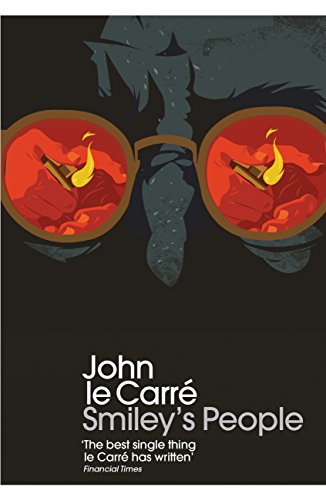
Smiley's People
by John le Carré
- Author:
- John le Carré
- Status:
- Done
- Format:
- eBook
- Reading Time:
- 4:38
- Genres:
- Fiction , Espionage , Thriller , Mystery , Spy Thriller , Suspense , Mystery Thriller
- Pages:
- 327
- Highlights:
- 11
Highlights
Page 8
With bitter experience she had learned the other lessons of interrogation too. A part of her was rehearsing them at this minute, and though they belonged, in terms of history, to a full generation earlier, they appeared to her now as bright as yesterday and as vital: never to match rudeness with rudeness, never to be provoked, never to score, never to be witty or superior or intellectual, never to be deflected by fury, or despair, or the surge of sudden hope that an occasional question might arouse. To match dullness with dullness and routine with routine.
Page 53
George, why can’t you listen? Shot dead. This evening. George, for Heaven’s sake wake up, we need you! Lacon loped off again, plucking at his signet ring as if it were too tight. I need you, thought Smiley, watching him gyrate. I love you, I hate you, I need you. Such apocalyptic statements reminded him of Ann when she had run out of money or love. The heart of the sentence is the subject, he thought. It is not the verb, least of all the object. It is the ego, demanding its feed.
Page 79
Against stupidity, the gods themselves fight in vain, thought Smiley: but Schiller had forgotten the bureaucrats.
Page 106
‘Punk is destructive. Society does not need it.’ The assertion caused him a moment’s indecision. ‘Oh, but society does,’ he wanted to reply; ‘society is an association of minorities.’
Page 170
With dismal foreboding Smiley agreed a date. After a lifetime of inventing cover stories for every occasion, he still found it impossible to talk his way out of a dinner invitation.
Page 174
He remembered Wilde: the fact that a man dies for a cause does not make that cause right.
Page 176
By the age of forty, someone clever had written ominously, a man gets the face he deserves. Smiley doubted it. He had known poetic souls condemned to life imprisonment behind harsh faces, and delinquents with the appearance of angels.
Page 184
All his professional life, it seemed to Smiley, he had listened to similar verbal antics signalling supposedly great changes in Whitehall doctrine; signalling restraint, self-denial, always another reason for doing nothing. He had watched Whitehall’s skirts go up, and come down again, her belts being tightened, loosened, tightened. He had been the witness, or victim – or even reluctant prophet – of such spurious cults as lateralism, parallelism, separatism, operational devolution, and now, if he remembered Lacon’s most recent meanderings correctly, of integration. Each new fashion had been hailed as a panacea: ‘Now we shall vanquish, now the machine will work!’ Each had gone out with a whimper, leaving behind it the familiar English muddle, of which, more and more, in retrospect, he saw himself as a lifelong moderator. He had forborne, hoping others would forbear, and they had not. He had toiled in back rooms while shallower men held the stage. They held it still. Even five years ago he would never have admitted to such sentiments. But today, peering calmly into his own heart, Smiley knew that he was unled, and perhaps unleadable; that the only restraints upon him were those of his own reason, and his own humanity. As with his marriage, so with his sense of public service. I invested my life in institutions – he thought without rancour – and all I am left with is myself.
Page 347
The anti-Communist phobia was overdone: Lacon had declared himself sure of it. Communists were only people, after all. They weren’t red-toothed monsters, not any more. Communists wanted what everyone wanted: prosperity and a bit of peace and quiet. A chance to take a breather from all this damned hostility. And if they didn’t – well, what could we do about it anyway? he had asked. Some problems – take Ireland – were insoluble, but you would never get the Americans to admit anything was insoluble. Britain was ungovernable; so would everywhere else be in a couple of years. Our future was with the collective, but our survival was with the individual, and the paradox was killing us every day. ‘Now, George, how do you see it? You’re out of harness after all. You have the objective view, the overall perspective.’ Smiley heard himself muttering something inane about a spectrum.
Page 450
He looked across the river into the darkness again, and an unholy vertigo seized him as the very evil he had fought against seemed to reach out and possess him and claim him despite his striving, calling him a traitor also; mocking him, yet at the same time applauding his betrayal. On Karla has descended the curse of Smiley’s compassion; on Smiley the curse of Karla’s fanaticism. I have destroyed him with the weapons I abhorred, and they are his. We have crossed each other’s frontiers, we are the no-men of this no-man’s-land.
Page 454
‘George, you won,’ said Guillam as they walked slowly towards the car. ‘Did I?’ said Smiley. ‘Yes. Yes, well I suppose I did.’