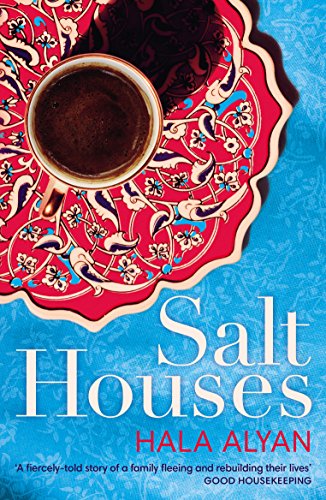
Salt Houses
by Hala Alyan
- Author:
- Hala Alyan
- Status:
- Done
- Format:
- eBook
- Reading Time:
- 6:42
- Genres:
- Historical Fiction , Fiction , Middle East , Book Club , Historical , Literary Fiction , War
- Pages:
- 312
- Highlights:
- 21
Highlights
Page 78
She never told Widad the truth, how Hussam had consulted her on the matter of Widad’s suitors, which he’d narrowed down to two men. The other was an academic, a professor of philosophy at the local university. Salma knew his sister from the mosque; he came from a well-mannered, educated family. But he was mired in Nablus, in Palestine—he would live and die here. When Hussam asked the boy where he intended to settle down, he answered, “In my homeland, sir. Nothing under this sky will budge me.” Salma, to Hussam’s surprise, chose Ghazi. At the time, the logic of her verdict was nebulous to her, half formed. It was only when she sat in the mosque and felt relief that she understood her own actions. Widad would be kept safe in Kuwait, far from this blazing country split in two. Her unhappiness, if it came, was worth the price of her life.
Note: Sad that they think leaving Palestine is better
Page 90
This betrayal of her body hobbled her; she felt shame at her belly, which stretched only to flatten again. In this way she failed, and, though Hussam was kind, bringing her tea each time she lay defeated in their bed, she knew his disappointment. She’d given him a daughter as firstborn—the first woman in five generations to do so—and was able to carry only one son in the basket of her womb.
Note: Patriarchy is strong
Page 115
Still, her heart stirred when Alia, even at six, seven years old, spoke with the reverence of a mythologist about the enormous Jaffa pomegranates, the seeds that could be spooned out and sprinkled with either salt or sugar, depending on their ripeness. “They were as big as the moon,” little Alia would say, holding her starfish hands out, her voice confident. It would become the girl’s most endearing and exasperating quality, how she could become enamored of things already gone.
Page 600
“She’s good,” Atef said to him once. “Others, they’ll see that. They’ll look past the rest.” The rest being the hut, the coughing mother, the litter of siblings, Aya’s own pliant body bucking under his. His mother’s horrified expression at her son marrying beneath him; Alia’s perplexity at his choice. The aunts and neighbors would talk for years. Even the men at the mosque, most of them educated and well off, would be taken aback; for all their talk of solidarity with the poor, they are repelled by them.
Page 711
Something clicked within Mustafa: the imam held the key to something. The imam would be the one to change it—everything—for him. In that instant, Mustafa realized just how unhappy he was. How much like a pauper he’d always felt, peering inside a window, watching life carry on while he remained apart, separated by glass. From Alia and Atef, from Aya. He suddenly understood his boredom, the way hours seemed to stretch unbearably in front of him, that, yes, yes, it was all bullshit. The waiting, the talking, the cigarettes, the coffee. What were they doing? The thought shook him with its violence. Sitting around while the years piled up, spending his father’s money and waiting. Waiting. While their land was gobbled up.
Page 717
“I like to imagine my father died before that. Before we went to Jerusalem. That he died from an enormous wave taking him while he knelt in front of a fish.” The imam’s eyes flashed. “They’ve even taken away our deaths. They’ve robbed us even of the dignity of death.” The imam gestured outside with a jut of his chin. “And our men? They dance to American music and kiss girls in the pool hall. They tell themselves that Palestine is this”—here he waved a hand dismissively—“only this, only the crumbs we’ve been given.”
Page 815
What she knows about her husband, what she thought she knew about the man, has scattered like dandelion seeds beneath a child’s breath since he returned from the war.
Page 918
planning. The true reason had nothing to do repaying the kindness of these dull people, most of whom worked with Ghazi, the wives friends with Widad. She couldn’t bear the thought of spending
Page 096
She misses Mustafa. Like a city after a tsunami, the earth is altered without him, wrecked. They never found out how he had died, just that he had, somewhere in an Israeli prison.
Page 233
Nostalgia is an affliction. Someone said that once in front of Alia, and the words reach her now, years later. Like a fever or a cancer, the longing for what had vanished wasting a person away.
Page 765
There was another garden, Riham has been told, though the details of it are hazy to her, almost fictional. All she knows is this garden was in Palestine, and it burned down. It is linked to the war she learned about in school and to her father being away a long time ago. The adults rarely speak of these things, giving vague responses to questions. It is clear they find this talk painful, and Riham isn’t the type of girl to ask for more.
Page 989
“Not Riham,” Alia says. She eyes Riham thoughtfully. “Are you looking forward to starting school?” Riham thinks about her school, the air-conditioned classrooms, the way the teachers love her, especially Madame Haddad, the librarian who saves the new books for Riham to read first. She thinks about her friends, who are quiet and awkward, never telling her to straighten her hair.
Page 033
“Why is he doing this?” she wonders aloud. “What does he need that we don’t give him?” “It’s not that simple.” Her father looks pained. “Those sorts of men, those meetings, they give you something that can’t be replicated.” “So what can I do? I worry about him. Latif worries about him.” “There’s nothing to do, Riham. He has to learn on his own.” He starts to walk, then pauses. “Those gatherings, they make boys feel like giants.”
Page 257
She sits down and reads on, engrossed in spite of herself. She agrees with some of the points—religion has become a side note, an afterthought, people are far too entangled with material things. But, she thinks, it is cowardly to coax rage, to turn to condemnation. Prayer is as good as bread, as simple as the dirt she turns over for seedlings. It was what her grandmother used to say in her garden: Allah is in the stem, in my fingers, in the water, and in the drought. Meaning good and bad. Meaning it was too intricate to be whittled down to something one could point at. This was the aversion Riham felt toward those shrewd, bearded men on television—they spoke of the greatness of Allah, of servitude and humility, but they were cloaked in fury, preoccupied with it. They were simply angry.
Page 414
Beirut called to her. She wanted somewhere new. She wanted to go home, she told Zain and Manar, though Manar just stared at her and said flatly, What home. Home as in somewhere familiar, somewhere people look like us, talk like us, where you guys can learn Arabic and be near your grandparents and never come home asking what raghead means.
Page 455
America wasn’t like that. You became what you coveted. Memories were short. She met Mexicans, Germans, Libyans, who spoke accented English but responded, From here, whenever asked. Souad became brown. People’s eyes glazed over when she tried to explain that, yes, she’d lived in Kuwait, but no, she wasn’t Kuwaiti, and no, she had never been to Palestine, but yes, she was Palestinian. That kind of circuitous logic had no place over there.
Page 816
SOMETIMES, IF LINAH begs enough, Tika will show her photographs of her home. Her town is named Matara and Tika once wrote it for her using Tamil letters and then gave Linah the slip of paper. It looked like dancing lines, a curlicue of beetles, not an alphabet.
Note: I think she means Madurai. But I don’t know what Tika is supposed to be. Edit: no, it’s a town in Sri Lanka -மாத்தறை
Page 911
“No madame!” the woman suddenly explodes. Her hair shudders around her as she snaps her head up. “No madame, no sir. They leave.” “Well, that’s none of my business,” Abu Rafi grumbles in Arabic. “They leave five days ago.” Now that she has begun talking, it is like a levee breaking, crests spilling from the woman’s lips, her hands moving wildly. “I wake up, they gone. I wait. Wait for lunch, then dinner, then sun goes down. I stay awake one night, two nights. I wait. I take the laundry down, soak the rice. But they no come back. They hear the war and they go. They go—” Here, her voice falters. “They leave me behind. Here. I look everywhere for passport, no find. I try to call embassy, they say no one can help. They say stay inside, away from windows. I cannot call my children. I cannot go home. The food is finishing. There is no electricity.”
Note: Surprised and happy that an Arab found some space to talk about how South Asians are treated in these countries. For most of this book it’s only about the kindnesses heaped on them by the main characters.
Varsha: enakku vayathu kalakkardhu 😣😭
Page 203
Beside him, Karam opens his mouth, then shuts it. Atef knows the boy wants to say the right thing. There is no right thing. Atef wants to tell his children that they don’t understand, that their view from the sidelines is incomplete, that somehow in the murky cave of his marriage—not exactly happy but not unhappy either, given to strain, months at a time when Alia retreats into her fury and Atef into himself—is a miraculous conch of love, something unpolished but alive, pulsing.
Page 278
They find Alia in the waiting room. Outside, they stand dully in the atrium. Atef crosses and then uncrosses his arms. “I guess we go home now.” Souad sniffles. She embraces her mother. Alia frowns and leans back, eyes her daughter sharply. “What have you done?” And in spite of themselves, even as Souad cries, they all laugh.
Page 514
“I thought I had more time—” Manar stops, embarrassed. Atef waits. “To ask her things.” “About what?” His granddaughter shrugs. “Her life.” He can feel their eyes upon him. Poor innocent things, he thinks. What is a life? A series of yeses and noes, photographs you shove in a drawer somewhere, loves you think will save you but that cannot. Continuing to move, enduring, not stopping even when there is pain. That’s all life is, he wants to tell her. It’s continuing.