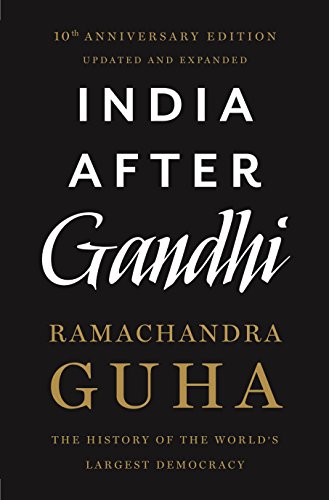
India After Gandhi
by Ramachandra Guha
- Author:
- Ramachandra Guha
- Status:
- Done
- Format:
- eBook
- Genres:
- History , India , Nonfiction , Politics , Indian Literature , Asia , Historical
- Pages:
- 992
- Highlights:
- 106
Highlights
Page 169
Large chunks of Strachey’s book are taken up by an administrative history of the Raj; of its army and civil services, its land and taxation policies, the peculiar position of the ‘native states’. This was a primer for those who might work in India after coming down from Cambridge. But there was also a larger theoretical argument to the effect that ‘India’ was merely a label of convenience, ‘a name which we give to a great region including a multitude of different countries’. In Strachey’s view, the differences between the countries of Europe were much smaller than those between the ‘countries’ of India. ‘Scotland is more like Spain than Bengal is like the Punjab.’ In India the diversities of race, language and religion were far greater. Unlike in Europe, these ‘countries’ were not nations; they did not have a distinct political or social identity. This, Strachey told his Cambridge audience, ‘is the first and most essential thing to learn about India – that there is not, and never was an India, or even any country of India possessing, according to any European ideas, any sort of unity, physical, political, social or religious’. There was no Indian nation or country in the past; nor would there be one in the future. Strachey thought it ‘conceivable that national sympathies may arise in particular Indian countries’, but ‘that they should ever extend to India generally, that men of the Punjab, Bengal, the North-western Provinces, and Madras, should ever feel that they belong to one Indian nation, is impossible. You might with as much reason and probability look forward to a time when a single nation will have taken the place of the various nations of Europe.’3
Note: I agree with him but he shouldn’t have been so certain.
Page 184
But we might also read them as a political exhortation, intended to stiffen the will of those in his audience who would end up in the service of the Raj. For the rise of every new ‘nation’ in India would mean a corresponding diminution in the power and prestige of Empire. Ironically, even as he spoke Strachey’s verdict was being disputed by a group of Indians. These had set up the Indian National Congress, a representative body that asked for a greater say for natives in the running of their affairs. As the name suggests, this body wished to unite Indians across the divisions of culture, territory, religion, and language, thus to construct what the colonialist thought inconceivable – namely, a single Indian nation.
Page 195
from the time the Congress was formed right up to when India was made free – and divided – there were sceptics who thought that Indian nationalism was not a natural phenomenon at all. There were, of course, British politicians and thinkers who welcomed Indian self-rule and, in their own way, aided its coming into being. (One of the prime movers of the Indian National Congress was a colonial official of Scottish parentage, A. O. Hume.) Yet there were many others who argued that, unlike France or Germany or Italy, there was here no national essence, no glue to bind the people and take them purposively forward. From this perspective stemmed the claim that it was only British rule that held India and the Indians together.
Page 212
Views such as these were widely prevalent among the British in India, and among the British at home as well. Politically speaking, the most important of these ‘Stracheyans’ was undoubtedly Winston Churchill. In the 1940s, with Indian independence manifestly round the corner, Churchill grumbled that he had not become the King’s first minister in order to preside over the liquidation of the British Empire. A decade previously he had tried to rebuild a fading political career on the plank of opposing self-government for Indians. After Gandhi’s ‘salt satyagraha’ of 1930 in protest against taxes on salt, the British government began speaking with Indian nationalists about the possibility of granting the colony dominion status. This was vaguely defined, with no timetable set for its realization. Even so, Churchill called the idea ‘not only fantastic in itself but criminally mischievous in its effects’. Since Indians were not fit for self-government, it was necessary to marshal ‘the sober and resolute forces of the British Empire’ to stall any such possibility.
Page 231
throughout the sixty years since India became independent, there has been speculation about how long it would stay united, or maintain the institutions and processes of democracy. With every death of a prime minister has been predicted the replacement of democracy by military rule; after every failure of the monsoon there has been anticipated countrywide famine; in every new secessionist movement has been seen the disappearance of India as a single entity. Among these doomsayers there have been many Western writers who, after 1947, were as likely to be American as British. Notably, India’s existence has been a puzzle not just to casual observers or commonsensical journalists; it has also been an anomaly for academic political science, according to whose axioms cultural heterogeneity and poverty do not make a nation, still less a democratic one. That India ‘could sustain democratic institutions seems, on the face of it, highly improbable’, wrote the distinguished political scientist Robert Dahl, adding: ‘It lacks all the favourable conditions.’ ‘India has a well-established reputation for violating social scientific generalizations’, wrote another American scholar, adding: ‘Nonetheless, the findings of this article furnish grounds for skepticism regarding the viability of democracy in India.’8
Page 280
this too is a story, above all, of social conflicts, of how these arise, how they are expressed, and how their resolution is sought. These conflicts run along many axes, among which we may – for the moment – single out four as pre-eminent. First, there is caste, a principal identity for many Indians, defining whom they might marry, associate with and fight against. ‘Caste’ is a Portuguese word that conflates two Indian words: jati, the endogamous group one is born into, and varna, the place that group occupies in the system of social stratification mandated by Hindu scripture. There are four varnas, with the former ‘Untouchables’ constituting a fifth (and lowest) strata. Into these varnas fit the 3,000 and more jatis, each challenging those, in the same region, that are ranked above it, and being in turn challenged by those below. Then there is language. The Constitution of India recognizes twenty-two languages as ‘official’. The most important of these is Hindi, which in one form or another is spoken by upwards of 400 million people. Others include Telugu, Kannada, Tamil, Malayalam, Marathi, Gujarati, Oriya, Punjabi, Bengali and Assamese, each of which is written in a distinct script and boasts many millions of native speakers. Naturally, national unity and linguistic diversity have not always been seen to be compatible. Indians speaking one tongue have fought with Indians who speak another. A third axis of conflict is religion. A vast majority of the billion-plus Indians are Hindus. But India also has the second largest population of Muslims in the world – about 140 million (only Indonesia has more). In addition there are substantial communities of Christians, Sikhs, Buddhists and Jains. Since faith is as fundamental a feature of human identity as language, it should scarcely be a surprise that Indians worshipping one variation of God have sometimes quarrelled with Indians worshipping another. The fourth major axis of conflict is class. India is a land of unparalleled cultural diversity but also, less appealingly, of massive social disparities. There are Indian entrepreneurs who are fabulously wealthy, owning huge homes in London and New York. Yet fully 26 per cent of the country’s population, about 300 million individuals, are said to live below the official poverty line. In the countryside there are deep inequalities in landholding; in the city, wide divergences in income. Not unexpectedly, these asymmetries have fuelled many movements of opposition. These axes of conflict operate both singly and in tandem. Sometimes a group professing a particular faith also speaks a separate language. Often the low castes are the subordinate classes as well. And to these four central axes one should perhaps add a fifth that cuts right across them: that of gender. Here, again, India offers the starkest contrasts. A woman served as prime minister for a full fifteen years, yet in some parts of India female infanticide is still very common. Landless labourers…
Page 320
The press nowadays – broadsheet and tabloid, pink and white, Indian and Western – is chock full of stories of India’s economic success, this reckoned to be so much at odds with its past history of poverty and deprivation. However, the real success story of modern India lies not in the domain of economics but in that of politics. The saluting of India’s ‘software boom’ might be premature. We do not yet know whether this will lead to a more general prosperity among the masses. But that India is still a single nation after sixty testing years of independence, and that it is still largely democratic – these are facts that should compel our deeper attention. A recent statistical analysis of the relationship between democracy and development in 135 countries found that ‘the odds against democracy in India were extremely high’. Given its low levels of income and literacy, and its high levels of social conflict, India was ‘predicted as [a] dictatorship during the entire period’ of the study (1950–90). Since, in fact, it was a democracy practically the entire period studied, there was only one way to characterize India, namely as ‘a major outlier’.11
Page 331
The forces that divide India are many. This book pays due attention to them. But there are also forces that have kept India together, that have helped transcend or contain the cleavages of class and culture, that – so far, at least – have nullified those many predictions that India would not stay united and not stay democratic. These moderating influences are far less visible; it is one aim of this book to make them more so. I think it premature now to identify them; they will become clearer as the narrative proceeds. Suffice it to say that they have included individuals as well as institutions.
Note: Think he covers these in the epilogue? Civil service, army etc.
Page 350
If, for Indian children, history comes to an end with Independence and Partition, this is because Indian adults have mandated it that way. In the academy, the discipline of history deals with the past, while the disciplines of political science and sociology deal with the present. This is a conventional and in many ways logical division. The difficulty is that in the Indian academy the past is defined as a single, immovable date: 15 August 1947. Thus, when the clock struck midnight and India became independent, history ended, and political science and sociology began.
Page 363
As it turned out, by custom and convention Indian history is seen as ‘ending’ on 15 August 1947 – although biographers of the Mahatma are allowed a six-month extension.
Note: 😅
Page 375
The Republic of India is a union of twenty-eight states, some larger than France. Yet not even the bigger or more important of these states have had their histories written. In the 1950s and 60s India pioneered a new approach to foreign policy, and to economic policy and planning as well. Authoritative or even adequate accounts of these experiments remain to be written. India has produced entrepreneurs of great vision and dynamism – but the stories of the institutions they built and the wealth they created are mostly unwritten. Again, there are no proper biographies of some of the key figures in our modern history: such as Sheikh Abdullah or Master Tara Singh or M. G. Ramachandran, ‘provincial’ leaders each of whose province is the size of a large European country.
Page 397
Those who write contemporary history know that the reader is not a passive vessel to receive the text placed before him or her. The reader is also a citizen, a critical citizen, with individual political and ideological preferences. These preferences direct and dictate the reader’s view of the past, and of leaders and lawmakers most particularly. We live with the consequences of decisions taken by modern politicians, and often presume that an alternate politician – someone modelled on oneself – would have taken better or wiser decisions. The further back we go in time, the less of a problem this is. Historians of the eighteenth century seek to interpret and understand that time, and so, following them, do their readers. A biographer of Jefferson or Napoleon can count on more trusting readers – they do not presume to know the things those men did, or wish they should have done them differently. Here, the reader is usually happy to be led and guided by the expert. But the biographer of John F. Kennedy or Charles de Gaulle is not so fortunate. Some, perhaps many, potential readers already know the ‘truth’ about these men, and are less willing to hear alternative versions of it, even if they are backed up by copious footnotes.
Note: He really understands the problem
Page 422
The disappearance of the British Raj in India is at present, and must for a long time be, simply inconceivable. That it should be replaced by a native Government or Governments is the wildest of wild dreams … As soon as the last British soldier sailed from Bombay or Karachi, India would become the battlefield of antagonistic racial and religious forces … [and] the peaceful and progressive civilisation, which Great Britain has slowly but surely brought into India, would shrivel up in a night. J. E. WELLDON, former Bishop of Calcutta, 1915
Note: Might be mistaken.
Page 453
Every year after 1930, Congress-minded Indians celebrated 26 January as Independence Day. However, when the British finally left the subcontinent, they chose to hand over power on 15 August 1947. This date was selected by the Viceroy, Lord Mountbatten, as it was the second anniversary of the Japanese surrender to the Allied Forces in the Second World War. He, and the politicians waiting to take office, were unwilling to delay until the date some others would have preferred – 26 January 1948.
Page 482
More notable perhaps were the names of those who were not from the Congress. These included two representatives of the world of commerce and one representative of the Sikhs. Three others were lifelong adversaries of the Congress. These were R. K. Shanmukham Chetty, a Madras businessman who possessed one of the best financial minds in India; B. R. Ambedkar, a brilliant legal scholar and an ‘Untouchable’ by caste; and Syama Prasad Mookerjee, a leading Bengal politician who belonged (at this time) to the Hindu Mahasabha. All three had collaborated with the rulers while the Congress men served time in British jails. But now Nehru and his colleagues wisely put aside these differences. Gandhi had reminded them that ‘freedom comes to India, not to the Congress’, urging the formation of a Cabinet that included the ablest men regardless of party affiliation.
Page 601
But there were some crucial differences between the two provinces as well. Bengal had a long history of often bloody conflict between Hindus and Muslims, dating back to (at least) the last decades of the nineteenth century. By contrast, in the Punjab the different communities had lived more or less in peace – there were no significant clashes on religious grounds before 1947. In Bengal large sections of the Hindu middle class actively sought Partition. They were quite happy to shuffle off the Muslim-dominated areas and make their home in or around the provincial capital. For several decades now, Hindu professionals had been making their way to the west, along with landlords who sold their holdings and invested the proceeds in property or businesses in Calcutta. By contrast, the large Hindu community in the Punjab was dominated by merchants and moneylenders, bound by close ties to the agrarian classes. They were unwilling to relocate, and hoped until the end that somehow Partition would be avoided.
Note: It’s the hope that kills you
Page 613
At the turn of the century, Sikhs from eastern Punjab had been asked by the British to settle areas in the west, newly served by irrigation. In a matter of a few decades they had built prosperous settlements in these ‘canal colonies’. Why now should they leave them? Their holy city, Amritsar, lay in the east, but Nankana Saheb (the birthplace of the founder of their religion) lay in the west. Why should they not enjoy free access to both places? Unlike the Hindus of Bengal, the Sikhs of Punjab were slow to comprehend the meaning and reality of Partition. At first they doggedly insisted that they would stay where they were. Then, as the possibility of division became more likely, they claimed a separate state for themselves, to be called ‘Khalistan’. This demand no one took seriously, not the Hindus, not the Muslims, and least of all the British.
Page 686
Tragically, no Pakistani politician was willing to take on religious fanaticism. Whatever their private thoughts, they were unwilling to speak out in public. As for Pakistan’s new governor general, Mohammad Ali Jinnah, he was headquartered in the coastal city of Karachi (the country’s capital), and had ‘only visited Lahore in purdah and most carefully guarded’. This timidity was in striking contrast to the brave defence of their minorities by the two pre-eminent Indian politicians. Indeed, as a British observer wrote, ‘Nehru’s and Gandhi’s stock has never been so high with the Muslims of West Punjab’.23
Page 695
‘I know I shall be able to tackle the Punjab too if I can control Calcutta. But if I falter now, the conflagration may spread and soon. I can see clearly two or three [foreign] Powers will be upon us and thus will end our short-lived dream of independence.’ ‘But if you die the conflagration will be worse,’ replied the friend. ‘At least I won’t be there to witness it,’ said Gandhi. ‘I shall have done my bit.’24
Page 703
But the Mahatma and his admirers might have treasured as much this tribute from the Statesman, a British-owned paper in Calcutta that had long opposed him and his politics: ‘On the ethics of fasting as a political instrument we have over many years failed to concur with India’s most renowned practitioner of it … But never in a long career has Mahatma Gandhi, in our eyes, fasted in a simpler, worthier cause than this, nor one calculated for immediate effective appeal to the public conscience.’25
Page 737
The worry was the greater because the fanatics were functioning in ‘a favourable atmosphere as far as public opinion was concerned’. In Delhi, especially, the Hindu and Sikh refugees from Pakistan were baying for blood. But the prime minister insisted that India must be a place where the Muslims could live and work freely. An Englishman on the governor general’s staff wrote in his diary of how ‘to see Nehru at close range during this ordeal is an inspiring experience. He vindicates one’s faith in the humanist and the civilised intellect. Almost alone in the turmoil of communalism, with all its variations, from individual intrigue to mass madness, he speaks with the voice of reason and charity.’31
Page 749
However, the Rashtriya Swayamsevak Sangh was actively sceptical of this viewpoint. Its sarsanghchalak, or head, was a lean, bearded science graduate named M. S. Golwalkar. Golwalkar was strongly opposed to the idea of a secular state that would not discriminate on the basis of religion. In the India of his conception, The non-Hindu people of Hindustan must either adopt Hindu culture and language, must learn and respect and hold in reverence the Hindu religion, must entertain no idea but of those of glorification of the Hindu race and culture … in a word they must cease to be foreigners, or may stay in the country, wholly subordinated to the Hindu nation, claiming nothing, deserving no privileges, far less any preferential treatment – not even citizens’ rights.33
Page 827
Three days after Gandhi’s assassination Nehru wrote Patel a letter which said that ‘with Bapu’s death, everything is changed and we have to face a different and more difficult world. The old controversies have ceased to have much significance and it seems to me that the urgent need of the hour is for all of us to function as closely and co-operatively as possible …’ Patel, in reply, said he ‘fully and heartily reciprocate[d] the sentiments you have so feelingly expressed … Recent events had made me very unhappy and I had written to Bapu … appealing to him to relieve me, but his death changes everything and the crisis that has overtaken us must awaken in us a fresh realisation of how much we have achieved together and the need for further joint efforts in our griefstricken country’s interests.’39 Gandhi could not reconcile, in life, Hindu with Muslim, but he did reconcile, through his death, Jawaharlal Nehru with Vallabhbhai Patel. It was a patch-up of rather considerable consequence for the new and very fragile nation.
Page 860
Why could not the unity of Punjab, or of India, be saved? There have been three rather different answers on offer. The first blames the Congress leadership for underestimating Jinnah and the Muslims. The second blames Jinnah for pursuing his goal of a separate country regardless of human consequences. The third holds the British responsible, claiming that they promoted a divide between Hindus and Muslims to perpetuate their rule.2 All three explanations, or should one say accusations, carry an element of truth. It is true that Nehru and Gandhi made major errors of judgement in their dealings with the Muslim League. In the 1920s Gandhi ignored Jinnah and tried to make common cause with the mullahs. In the 1930s Nehru arrogantly and, as it turned out, falsely, claimed that the Muslim masses would rather follow his socialist credo than a party based on faith. Meanwhile, the Muslims steadily moved over from the Congress to the League. In the 1930s, when Jinnah was willing to make a deal, he was ignored; in the 1940s, with the Muslims solidly behind him, he had no reason to cut a deal at all.
Page 893
Cripps, and other Labour leaders, would have liked to leave behind a united India for the Congress to govern and guide. But a note prepared for the Mission in December 1945 showed how unlikely this would be. Its author was Penderel Moon, a Fellow of All Souls and sometime member of the Indian Civil Service. Moon pointed out that ‘there is more likelihood of obtaining Hindu consent to Division than Muslim consent to Union’. From the British point of view, ‘to unite India against Muslim wishes would necessarily involve force. To divide India against Hindu wishes would not necessarily involve force; and at worst the force required is likely to be less. The Hindus of Madras, Bombay, U. P, and C. P. may loudly lament their brethren in Bengal and the Punjab being torn from the embrace of Mother India, but they are not likely to have the will or the power to undertake a Crusade on their behalf.’7 The next few months bore out the cold wisdom of these remarks. Early in 1946 elections were held to the various provincial assemblies. These were conducted on a franchise restricted by education and property. About 28 per cent of the adult population was eligible to vote – but this, in a land the size of British India, still amounted to some 41 million
Page 969
How many would it have been if the British had left, as planned, in June 1948? In a blistering attack on Mountbatten’s reputation, Andrew Roberts accuses him of softness and vacillation – ‘whenever he had to exhibit toughness, Mountbatten took the most invertebrate line possible’ – of being unwilling to crack down effectively on communal violence and, more specifically, of understaffing the Punjab Boundary Force and not supplying it with air cover. Contra Ziegler, Roberts is convinced that the ‘overhasty withdrawal’ led ‘to more rather than fewer deaths’.13
Page 984
Jenkins did in fact ask several times for more troops and for a ‘Tactical Reconnaissance Squadron’. One reason there were too few troops available to deal with rioters was that they were busy guarding the paranoid rulers, who were convinced that British civilians would be attacked as soon as the decision to leave was made public. This feeling was widespread among all sections of Europeans in India: among officers, priests, planters, and merchants. In the summer of 1946, a young English official wrote to his family that ‘we shall virtually have the whole country against us (for long enough at all events to wipe out our scattered European population) before the show becomes, as inevitably it will, a communal scrap between Hindus and Muslims’.16
Note: Mountbatten was an idiot and the rest of them more so.
Page 990
To make the protection of British lives the top priority was pretty much state policy. In February 1947 the governor of Bengal said that his ‘first action in the event of an announcement of a date for withdrawal of British power … would be to have the troops “standing to” and prepare for a concentration of outlying Europeans at very short notice as soon as hostile reactions began to show themselves’.17 In fact, in the summer of 1947 white men and women were the safest people in India. No one was interested in killing them.18 But their insecurity meant that many army units were placed near European settlements instead of being freed for riot control elsewhere.
Note: This is why they had to leave India. Hogging resources like this meant unnecessary, avoidable deaths among Indians.
Page 996
The instinct of self-preservation also lay behind the decision to postpone the Punjab boundary award until after the date of Independence. On 22 July, after a visit to Lahore, Lord Mountbatten wrote to Sir Cyril Radcliffe asking him to hurry things up, for ‘every extra day’ would lessen the risk of disorder. The announcement of the boundary award before Independence would have allowed movements of troops to be made in advance of the transfer of power. The governor of Punjab was also very keen that the award be announced as soon as it was finalized. As it happened, Radcliffe was ready with the award on 9 August itself. However, Mountbatten now changed his mind, and chose to make the award public only after the 15th. His explanation for the delay was strange, to say the least: ‘Without question, the earlier it was published, the more the British would have to bear responsibility for the disturbances which would undoubtedly result.’ By the same token, ‘the later we postponed publication, the less would the inevitable odium react upon the British’.19
Note: Mountbatten was a gutless worm. The whole family is. Disgusting people.
Page 019
Few men have been so concerned about how history would portray them as Lord Mountbatten, the last viceroy and governor general of India. As a veteran journalist once remarked, Mountbatten appeared to act as ‘his own Public Relations Officer’.1 An aide of Mountbatten was more blunt, calling his boss ‘the vainest man alive’. The viceroy always instructed photographers to shoot him from six inches above the eyeline because his friend, the actor Cary Grant, had told him that this way the wrinkles didn’t show. When Field Marshal Montgomery visited India, and the press clamoured for photos of the two together, Mountbatten was dismayed to find that Monty wore more medals than himself.2
Note: Too kind by half to this pig.
Page 032
After Mountbatten left India he worked hard to present the best possible spin on his tenure as viceroy. He commissioned or influenced a whole array of books that sought to magnify his successes and gloss his failures. These books project an impression of Mountbatten as a wise umpire successfully mediating between squabbling schoolboys, whether India and Pakistan, the Congress and the Muslim League, Mahatma Gandhi and M. A. Jinnah, or Jawaharlal Nehru and Vallabhbhai Patel.5 His credit claims are taken at face value, sometimes absurdly so, as in the suggestion that Nehru would not have included Patel in his Cabinet had it not been for Mountbatten’s recommendation.6
Note: Freedom at Midnight remains the worst book I’ve read for this very reason. The whole thing dictated by Mountbatten, showing him in exactly this wonderful light. But the book never mentions that Mountbatten had final approval over the manuscript.
Page 037
Curiously, Mountbatten’s real contribution to India and Indians has been rather underplayed by his hagiographers. This was his part in solving a geopolitical problem the like of which no newly independent state had ever faced (or is likely to face in the future). For when the British departed the subcontinent they left behind more than 500 distinct pieces of territory. Two of these were the newly created nations of India and Pakistan; the others comprised the assorted chiefdoms and states that made up what was known as ‘princely India’.
Note: Not true. Freedom at Midnight makes much of it.
Page 051
Whatever their past history, these states owed their mid-twentieth-century shape and powers – or lack thereof – to the British. Starting as a firm of traders, the East India Company gradually moved towards a position of overlordship. They were helped here by the decline of the Mughals after the death of Aurangzeb in 1707. Indian rulers were seen by the Company as strategic allies, useful in checking the ambitions of their common enemy, the French. The Company forced treaties on these states, which recognized it as the ‘paramount power’. Thus, while legally the territories the various Nawabs and Maharajas ruled over were their own, the British retained to themselves the right to appoint ministers and control succession, and to extract a large subsidy for the provision of administrative and military support. In many cases the treaties also transferred valuable areas from the Indian states to the British. It was no accident that, except for the states comprising Kathiawar and two chiefdoms in the south, no Indian state had a coastline. The political dependence was made more acute by economic dependence, with the states relying on British India for raw materials, industrial goods, and employment opportunities.8 The larger native states had their own railway, currency and stamps, vanities allowed them by the Crown. Few had any modern industry; fewer still modern forms of education. A British observer wrote in the early twentieth century that, taken as a whole, the states were ‘sinks of reaction and incompetence and unrestrained autocratic power sometimes exercised by vicious and deranged individuals’.
Note: Coastline - I hadn’t realised that. Without it they could never challenge the British economically or militarily. They were completely subordinate, like Nepal was, is and will be.
Page 131
The Instrument of Accession the princes were being asked to sign would cede away defence – but in any case, said Mountbatten, the states would, by themselves, ‘be cut off from any source of supplies of up-to-date arms or weapons’. It would cede away external affairs, but the princes could ‘hardly want to go to the expense of having ambassadors or ministers or consuls in all these foreign countries’. And it would also cede away communications, but this was ‘really a means of maintaining the life-blood of the whole sub-continent’. The Congress offer, said the viceroy, left the rulers ‘with great internal authority’ while divesting them of matters they could not deal with on their own.22 Mountbatten’s talk to the Chamber of Princes was a tour de force. In my opinion it ranks as the most significant of all his acts in India. It finally persuaded the princes that the British would no longer protect or patronize them, and that independence for them was a mirage.
Page 142
By 15 August virtually all the states had signed the Instrument of Accession. Meanwhile the British had departed, never to return. Now the Congress went back on the undertaking that if the princes signed up on the three specified subjects, ‘in other matters we would scrupulously respect their autonomous existence’.24 The praja mandals grew active once more. In Mysore a movement was launched for ‘full democratic government’ in the state. Three thousand people courted arrest.25 In some states in Kathiawar and Orissa, protesters took possession of government offices, courts and prisons.26 Vallabhbhai Patel and the Congress Party cleverly used the threat of popular protest to make the princes fall in line. They had already acceded; now they were being asked to integrate, that is to dissolve their states as independent entities and merge with the Union of India. In exchange they would be allowed to retain their titles and offered an annual allowance in perpetuity. If they desisted from complying, they faced the threat of uncontrolled (and possibly uncontrollable) agitation by subjects whose suppressed emotions had been released by the advent of Independence.27
Note: Diabolical, but necessary. Real slippery slope they created.
Page 159
As this account makes clear, the groundwork was done by Patel and V. P. Menon; but the finishing touch was applied by Mountbatten, a final interview with whom was sometimes a necessary concession to princely vanity. The governor general also visited the more important chiefdoms, where he saluted their ‘most wise and Statesmanlike decision’ to link up with India.29 Mountbatten dealt with the symbolism of the princes’ integration with India; V. P. Menon with the substance.
Page 432
Given the odds, and the opposition, the integration of these numerous and disparate states was indeed a staggering achievement. The job was so smoothly and comprehensively done that Indians quite quickly forgot that this was once not one country but 500. In 1947 and 1948 the threat of disintegration was very real, what with ‘honey-combs of intrigue’ such as Bhopal and Travancore and ‘strategic points of assault’ such as Hyderabad. But a mere five years after the last maharaja had signed away his land, Indians had ‘come to take integrated India so much for granted that it requires a mental effort today even to imagine that it could be different’.69
Note: No one appreciates the difficulty of this, or how easily it could have been different. That all of India now got to elect democratic representatives was a massive improvement. That there was no internal factionalism and rivalry for outsiders to exploit was even better.
Page 449
Patel’s guiding hand was indeed wise and sure; another Congress politician, even (or especially) Nehru, might not have supervised the princes’ extinction with such patience and foresight. But he could scarcely have done the job without V. P. Menon, who made hundreds of trips to the chiefdoms, chipping away at their rulers. In turn, Menon could have done little without the officials who effected the actual transition, creating the conditions for financial and social integration with the rest of India. In truth, both politicians and bureaucrats had as their indispensable allies the most faceless of all humans: the people. For some decades, the people of the princely states had been clamouring in numbers for the rights granted to the citizens of British India. Many states had vigorous and active praja mandals. The princes were deeply sensible of this; indeed, without the threat of popular protest from below, they would not have ceded power so easily to the Indian government.
Note: Guha allocates credit very well. Everyone gets their due and no more. It’s a credit to him that he remembers the people who made it happen, even if they weren’t in the rooms of power. And also that he credits Mountbatten. A fuck up he may be, but he did this bit very well.
Page 549
Notably, while Nehru always wanted Kashmir to be part of India, Patel was at one time inclined to allow the state to join Pakistan. His mind changed on 13 September, the day the Pakistan government accepted the accession of Junagadh. For ‘if Jinnah could take hold of a Hindu-majority State with a Muslim ruler, why should the Sardar not be interested in a Muslim-majority State with a Hindu ruler?’17
Note: Funnily enough I bet the Pakistani rationale for Junagadh was the same - if Nehru can take hold of Kashmir…
Page 630
So writes one historian of the Kashmir dispute, Alastair Lamb. He tells us that, apart from the attack on the convent, the Pathans also burnt shops owned by Hindus and Sikhs. Lamb says they did ‘what might be expected from warriors engaged on what they saw as a jihad, a holy war’.29 However, at Baramula the greed of the tribesmen conclusively triumphed over religious identity. For here they ‘invaded the houses of the peace-loving Kashmiri Moslems as well. They looted and plundered the latter’s houses and raped their young girls. Shrieks of terror and agony of those girls resounded across the town of Baramula.’30
Page 707
By now, Nehru was of the opinion that India must come to some ‘rapid and more or less final decisions about Kashmir with the Pakistan Government’. For continuing military operations would mean ‘grave difficulties and suffering for the people of the State’. In a letter to Maharaja Hari Singh, the Indian prime minister outlined the various forms a settlement could take. There could be a plebiscite for the whole state, to decide which dominion it would join. Or the state could survive as an independent entity, with its defence guaranteed by both India and Pakistan. A third option was of a partition, with Jammu going to India and the rest of the state to Pakistan. A fourth option had Jammu and the Valley staying with India, with Poonch and beyond being ceded to Pakistan. Nehru himself inclined to this last alternative. He saw that in Poonch ‘the majority of the population is likely to be against the Indian Union’. But he was loath to give up the vale of Kashmir, a National Conference stronghold whose population seemed to be inclined towards India. From the Indian point of view, said Nehru to the maharaja,
Page 721
This letter of Nehru’s is much less well known than it should be. Excluded (for whatever reason) from his own Selected Works, it lies buried in the correspondence of Vallabhbhai Patel, to whom he had sent a copy. It shows that, contrary to received wisdom, the Indian prime minister was quite prepared to compromise on Kashmir. Indeed, the four options he outlined in December 1947 remain the four options being debated today.
Page 813
When a diplomat in Delhi asked Abdullah what he thought of the option of independence, he answered that it would never work as Kashmir was too small and too poor. Besides, said the Sheikh, ‘Pakistan would swallow us up. They have tried it once. They would do it again.’
Page 854
The fragility of the Pakistani state and its ideology was personalized in the ambivalent identities of its main leaders. The governor general, M. A. Jinnah, was a Gujarati who had married a Parsi. The prime minister, Liaqat Ali Khan, was an aristocrat from the United Provinces who was married to a Christian. Neither was, in any sense of the term, a practising Muslim. The top civil servants of Pakistan were, like Jinnah and Liaqat, ‘mohajirs’, migrants whose ancestral homes lay on the Indian side of the border. The ruling class had no roots in what was now their state. This, one suspects, made them even more fervent in their desire to make Kashmir part of Pakistan.
Page 871
One might say that Brigadier Usman was to the Indian army what Sheikh Abdullah was to Indian politics, the symbol of its putatively inclusive secularism, the affirmation of it being, if it was anything at all, the Other of a theologically dogmatic and insular Pakistan.
Page 113
Unquestionably the main victims of Partition were women: Hindu, Sikh, and Muslim. As the respected Sindhi Congress politician Choitram Gidwani put it, ‘in no war have the women suffered so much’. Women were killed, maimed, violated and abandoned. After Independence the brothels of Delhi and Bombay came to be filled with refugee women, who had been thrown out by their families after what someone else had done to them – against their will.
Note: Nothing so Indian as this.
Page 130
By May 1948 some 12,500 women had been found and restored to their families. Ironically, and tragically, many of the women did not want to be rescued at all. For after their seizure they had made some kind of peace with their new surroundings. Now, as they were being reclaimed, these women were deeply unsure about how their original families would receive them. They had been ‘defiled’ and, in a further complication, many were pregnant. These women knew that even if they were accepted, their children – born out of a union with the ‘enemy’ – would never be. Often, the police and their accomplices had to use force to take them away. ‘You could not save us then,’ said the women, ‘what right have you to compel us now?’
Note: Tragic
Page 150
Their successes in Hyderabad had encouraged the communists to think of a countrywide peasant revolution. Telengana, they hoped, would be the beginning of a Red India. The party unveiled its new line at a secret conference held in Calcutta in February 1948. The mood was set by a speaker who said that the ‘heroic people of Telengana’ had shown the way ‘to freedom and real democracy’; they were the ‘real future of India and Pakistan’. If only the communist cadres could ‘create this spirit of revolution among the masses, among the toiling people, we shall find reaction collapsing like a house of cards’.
Note: India could easily have become communist.
Page 157
Joshi was a friend of Nehru who urged ‘loyal opposition’ to the ruling Congress Party. He argued that after the murder of Gandhi the survival of free India was at stake. He supervised the production of a party pamphlet whose title proclaimed, We Shall Defend the Nehru Government (against the forces of Hindu revivalism). Ranadive, however, was a hardliner who believed that India was controlled by a bourgeois government that was beholden to the imperialists. Now, in a complete about-turn, the party described Nehru as a lackey of American imperialism. The pamphlet printed by the former general secretary was pulped. Joshi himself was demoted to a status of an ordinary member and a whole series of charges were levelled against him. He was dubbed a reformist who had encouraged the growth of ‘anti-revolutionary’ tendencies in the party.34
Note: Typical commie moment. Can’t disagree with another person like normal folks, they have to brand him bourgeois, class traitor, counter revolutionary blah blah.
Page 193
So the RSS was banned, and its cadres arrested. However, after a year the government decided to make the organization legal once more. Its head, M. S. Golwalkar, had now agreed to ask his men to profess loyalty to the Constitution of India and the national flag, and to restrict the Sangh’s activities ‘to the cultural sphere abjuring violence or secrecy’. The RSS chief promised the home minister, Vallabhbhai Patel, that ‘while rendering help to the people in distress, we have laid our emphasis on promoting peace in the country’. Patel himself had mixed feelings about the RSS. While deploring their anti-Muslim rhetoric he admired their dedication and discipline.
Page 231
An hour later, after a wash and a change, Nehru arrived at Shivaji Park. Here, ‘a record crowd [had] stampeded the vast maidan grounds to hear him. More than six lakhs [600,000] assembled that memorable evening. There was one seething mass of humanity; men, women and children who had come … to hear him for they still had faith in his leadership and ability to show the way in these hard and trying times ahead of us.’46 A hundred thousand people had come to hear Golwalkar espouse the idea of a Hindu theocratic state for India. But in this Maharashtrian stronghold, six times as many came to cheer the prime minister’s defence of democracy against absolutism, and secularism against Hindu chauvinism. In this contest between competing ideas of India, Jawaharlal Nehru was winning hands down; for the time being, at any rate.
Note: For the time being is pretty good. They held the line for half a century.
Page 253
In the event, that help was not asked for, nor was it needed. Admittedly, the rulers had left behind a set of functioning institutions: the civil service and the police, the judiciary and the railways, among others. At Independence, the government of India invited British members of the ICS to stay on; with but the odd exception, they all left for home, along with their colleagues in the other services. Thus it came to be that the heroes remembered in these pages were all Indians – whether politicians like Nehru and Patel, bureaucrats like Tarlok Singh and V. P. Menon, or social workers like Kamaladevi Chattopadhyaya and Mridula Sarabhai. So too were the countless others who were unnamed then and continue to be unknown now: the officials who took in and acted upon applications for land allotment, the officials who built the houses and ran the hospitals and schools, the officials who sat in courts and secretariats. Also overwhelmingly Indian were the social workers who cajoled, consoled and cared for the refugees.
Note: Where you at Churchill
Page 267
India after the Second World War was much like the Soviet Union after the First. A nation was being built out of its fragments. In this case, however, the process was unaided by the extermination of class enemies or the creation of gulags.
Page 329
The speeches of symbolic importance were naturally made by Nehru. Just as naturally, the bulk of the back-room work was done by Vallabhbhai Patel. A consummate committee man, he played a key role in the drafting of the various reports. It was Patel, rather than the less-patient Nehru, who worked at mediating between warring groups, taking recalcitrant members with him on his morning walks and making them see the larger point of view. It was also Patel who moved one of the more contentious resolutions: that pertaining to minority rights.9
Page 351
Some advocated a ‘Gandhian constitution’, based on a revived panchayati raj system of village councils, with the village as the basic unit of politics and governance. This was sharply attacked by B. R. Ambedkar, who held that ‘these village republics have been the ruination of India’. Ambedkar was ‘surprised that those who condemn Provincialism and communalism should come forward as champions of the village. What is the village but a sink of localism, a den of ignorance, narrow-mindedness and communalism?’12
Note: Damn. It’s true, but he didn’t have to be so blunt. Not winning any popularity contests, this one.
Page 362
Ultimately it was the individual, rather than the village, that was chosen as the unit. In other respects, too, the constitution was to look towards Euro-American rather than Indian precedents. The American presidential system was considered and rejected, as was the Swiss method of directly electing Cabinet ministers. Several members argued for proportional representation (PR), but this was never taken very seriously. Another former British colony, Ireland, had adopted PR, but when the constitutional adviser, B. N. Rau, visited Dublin, Eamon de Valera himself told him that he wished the Irish had adopted the British ‘first-past-the-post’ system of elections and the British cabinet system. This, he felt, made for a strong government. In India, where the number of competing interest groups was immeasurably larger, it made even more sense to follow the British model.
Note: Yeah, if Modi and Nehru could never manage 50%, no one can. Better to have a working government than a perfect one.
Page 405
The right of due process was not allowed in property legislation, another instance in which the social good as defined by the state took precedence over individual rights. Land-reform laws were on the anvil in many provinces, and the government wanted to close the door to litigation by disaffected moneylenders and landlords.
Note: Thank god for this. Pakistan is worse off for this.
Page 450
The home minister, Sardar Patel, was deeply unsympathetic to this demand. Separate electorates had in the past led to the division of the country. ‘Those who want that kind of thing have a place in Pakistan, not here,’ thundered Patel to a burst of applause. ‘Here, we are building a nation and we are laying the foundations of One Nation, and those who choose to divide again and sow the seeds of disruption will have no place, no quarter, here, and I must say that plainly enough.’33
Note: The first recorded mention of “if you don’t like it then go to Pakistan”
Page 483
The constitution set aside seats in legislatures as well as jobs in government offices for the lowest castes. It also threw open Hindu temples to all castes, and asked for the abolition of untouchability in society at large. These provisions were very widely welcomed. Muniswamy Pillai of Madras remarked that ‘the fair name of India was a slur and a blot by having untouchability … [G]reat saints tried their level best to abolish untouchability but it is given to this august Assembly and the new Constitution to say in loud terms that no more untouchability shall stay in our country.’39
Note: Well alright then
Page 490
Khandekar suggested that despite the public commitment of the Congress, ‘except for Mahatma Gandhi and ten or twenty other [upper-caste] persons there is none to think of the uplift of the Harijans in the true sense’.
Note: And yet geniuses like that girl will slander Gandhi because Ambedkar didn’t like him.
Page 492
This member eloquently defended the extension of reservation to jobs in government. He alluded to the recent recruitment to the Indian Administrative Service, the successor to the ICS. Many Harijans were interviewed but all were found unsuitable on the grounds that their grades were not good enough. Addressing his upper-caste colleagues, Khandekar insisted that You are responsible for our being unfit today. We were suppressed for thousands of years. You engaged in your service to serve your own ends and suppressed us to such an extent that neither our minds nor our bodies and nor even our hearts work, nor are we able to march forward. This is the position. You have reduced us to such a position and then you say that we are not fit and that we have not secured the requisite marks. How can we secure them?40 The argument was hard, if not impossible, to refute. But some members warned against the possible abuse of the provisions. One thought that ‘those persons who are clamouring for these seats, for reservation, for consideration, represent a handful of persons, constituting the cream of Harijan society’.
Note: Good to see that the conversation hasn’t advanced in any way in 75 years.
Page 547
People who do not know Hindustani have no right to stay in India. People who are present in this House to fashion a constitution for India and do not know Hindustani are not worthy to be members of this Assembly. They had better leave. The remarks created a commotion in the House. ‘Order, order!’ yelled the chairman, but Dhulekar continued: I move that the Procedure Committee should frame rules in Hindustani and not in English. As an Indian I appeal that we, who are out to win freedom for our country and are fighting for it, should think and speak in our own language. We have all along been talking of America, Japan, Germany, Switzerland and House of Commons. It has given me a headache. I wonder why Indians do not speak in their own language. As an Indian I feel that the proceedings of the House should be conducted in Hindustani. We are not concerned with the history of the world. We have the history of our own country of millions of past years. The printed proceedings continue: The Chairman: Order, order! Shri R. V. Dhulekar (speaking still in Hindustani): I request you to allow me to move my amendment. The Chairman: Order, order! I do not permit you to proceed further. The House is with me that you are out of order.48
Note: Ivaloda thollai thaanga mudiyala. Adhe mentality ipo kuda oditiruku
Page 570
Hindustani, the lingua franca of much of northern India, was a unique amalgam of the two. From the nineteenth century, as Hindu–Muslim tension grew in northern India, the two languages began to move further and further apart. On the one side there arose a movement to root Hindi more firmly in Sanskrit; on the other, to root Urdu more firmly in the classical languages from which it drew. Especially in the literary world, a purified Hindi and a purified Urdu began to circulate.
Page 601
We disliked the English language in the past. I disliked it because I was forced to learn Shakespeare and Milton, for which I had no taste at all … [I]f we are going to be compelled to learn Hindi … I would perhaps not be able to do it because of my age, and perhaps I would not be willing to do it because of the amount of constraint you put on me … This kind of intolerance makes us fear that the strong Centre which we need, a strong Centre which is necessary will also mean the enslavement of people who do not speak the language of the Centre. I would, Sir, convey a warning on behalf of people of the South for the reason that there are already elements in South India who want separation …, and my honourable friends in U.P. do not help us in any way by flogging their idea [of] ‘Hindi Imperialism’ to the maximum extent possible. Sir, it is up to my friends in U.P. to have a whole-India; it is up to them to have a Hindi-India. The choice is theirs . . .58
Page 627
Ambedkar ended his speech with three warnings about the future. The first concerned the place of popular protest in a democracy. There was no place for bloody revolution, of course, but in his view there was no room for Gandhian methods either. ‘We must abandon the method of civil disobedience, non-cooperation and satyagraha [popular protest]’. Under an autocratic regime, there might be some justification for them, but not now, when constitutional methods of redress were available. Satyagraha and the like, said Ambedkar, were ‘nothing but the grammar of anarchy and the sooner they are abandoned, the better for us’.
Note: I wonder what Gandhi felt about this
Page 631
The second warning concerned the unthinking submission to charismatic authority. Ambedkar quoted John Stuart Mill, who cautioned citizens not ‘to lay their liberties at the feet of even a great man, or to trust him with powers which enable him to subvert their institutions’. This warning was even more pertinent here than in England, for in India, Bhakti or what may be called the path of devotion or hero-worship, plays a part in its politics unequalled in magnitude by the part it plays in the politics of any other country in the world. Bhakti in religion may be the road to the salvation of a soul. But in politics, Bhakti or hero-worship is a sure road to degradation and to eventual dictatorship.
Note: This man saw the future.
Page 687
There were also similarities. Both Nehru and Patel had a daughter as their housekeeper, companion and chief confidante. Both were politicians of a conspicuous integrity. And both were fierce patriots. But their ideas did not always mesh. As one observer rather delicately put it, ‘the opposition of the Sardar to the leftist elements in the country is one of the major problems of political adjustment facing India’. He meant here that Patel was friendly with capitalists while Nehru believed in state control of the economy; that Patel was more inclined to support the West in the emerging Cold War; and that Patel was more forgiving of Hindu extremism and harsher on Pakistan.4
Page 720
But, unlike Pakistan, India was a secular state. ‘We have to treat our minorities in exactly the same way as we treat the majority,’ insisted Nehru. ‘Indeed, fair treatment is not enough; we have to make them feel that they are so treated.’ Now, ‘in view of the prevailing confusion and the threat of false doctrine, it has become essential that the Congress should declare its policy in this matter in the clearest and most unambiguous terms.’9 Nehru felt that it was the responsibility of the Congress and the government to make the Muslims in India feel secure. Patel, on the other hand, was inclined to place the responsibility on the minorities themselves. He had once told Nehru that the ‘Muslims citizens in India have a responsibility to remove the doubts and misgivings entertained by a large section of the people about their loyalty founded largely on their past association with the demand for Pakistan and the unfortunate activities of some of them.’10
Note: I love Nehru for saying this. The fact is, there is nothing a minority can do to convince the majority. Nothing is ever enough. And if a single person in the minority does something the entire community is tarred with the same brush.
It’s striking how similar the rhetoric of the Sangh is to Patel. The minorities need to prove their loyalty, according to both.
Page 809
The election and the electorate were spread over an area of more than a million square miles. The terrain was huge, diverse and – for the exercise at hand – sometimes horrendously difficult. In the case of remote hill villages, bridges had to be specially constructed across rivers; in the case of small islands in the Indian Ocean, naval vessels were used to take the rolls to the booths. A second problem was social rather than geographical: the diffidence of many women in northern India to give their own names, instead of which they wished to register themselves as A’s mother or B’s wife. Sukumar Sen was outraged by this practice, a ‘curious senseless relic of the past’, and directed his officials to correct the rolls by inserting the names of the women ‘in the place of mere descriptions of such voters’. Nonetheless, some 2.8 million women voters had finally to be struck off the list.
Page 873
Speeches and posters were used by all parties, but only the communists had access to the airwaves. Not those transmitted by All-India Radio, which had banned party propaganda, but of Moscow Radio, which relayed its programmes via stations in Tashkent. Indian listeners could, if they wished, hear how the non-communist parties in the election were ‘corrupt stooges of Anglo-American imperialists and oppressors of the workers’.30 For the literate, a Madras weekly had helpfully translated an article from Pravda which called the ruling Congress ‘a government of landowners and monopolists, a government of national betrayers, truncheons and bullets’, and announced that the alternative for the ‘long-suffering, worn-out Indian people’ was the Communist Party, around which ‘all progressive forces of the country, everyone who cherishes the vital interests of his fatherland, are grouping’.31
Note: Thanks for supplying us with the Truth. If only we had listened to Moscow comrades 😢
Page 900
One way of telling the story of the election campaign is through newspaper headlines. These make interesting reading, not least because the issues they flag have remained at the forefront of Indian elections ever since. ‘MINISTERS FACE STIFF OPPOSITION’ read a headline from Uttar Pradesh. ‘CASTE RIVALRIES WEAKEN BIHAR CONGRESS’, read another. From the north-eastern region came this telling line: ‘AUTONOMY DEMAND IN MANIPUR’. From Gauhati came this one: ‘CONGRESS PROSPECTS IN ASSAM: IMPORTANCE OF MUSLIM AND TRIBAL VOTE’. Gwalior offered ‘DISCONTENT AMONG CONGRESSMEN: LIST OF NOMINEES CREATES WIDER SPLIT’. A Calcutta headline ran: ‘W. BENGAL CONGRESS CHIEF BOOED AT MEETING’ (the hecklers being refugees from East Pakistan). ‘NO HOPES OF FREE AND FAIR ELECTION’, started a story datelined Lucknow: this being the verdict of J. B. Kripalani, who claimed that state officials would rig the polls in favour of the ruling party. And the city of Bombay offered, at three different moments in the campaign, these more-or-less timeless headlines: ‘CONGRESS BANKS ON MUSLIM SUPPORT’; ‘CONGRESS APATHY TOWARDS SCHEDULED CASTES: CHARGES REITERATED BY DR AMBEDKAR’; and ‘FOURTEEN HURT IN CITY ELECTION CLASH’. But there was also the occasional headline that was of its time but emphatically not of ours – notably the one in the Searchlight of Patna which claimed: ‘PEACEFUL VOTING HOPED [FOR] IN BIHAR’.
Note: Timeless headlines for sure.
Page 916
Nehru kicked off his party’s campaign with a speech in the Punjab town of Ludhiana on Sunday 30 September. The choice of venue was significant: as was the thrust of his talk, which declared ‘an all-out war against communalism’. He ‘condemned the communal bodies which in the name of Hindu and Sikh culture were spreading the virus of communalism as the Muslim League once did’. These ‘sinister communal elements’ would if they came to power ‘bring ruin and death to the country’. He asked his audience of half a million to instead ‘keep the windows of our mind open and let in fresh breeze from all corners of the world’. The sentiment was Gandhi-like, and indeed Nehru’s next major speech was delivered in Delhi on the afternoon of 2 October, the Mahatma’s birthday. To a mammoth crowd he spoke in Hindustani about the government’s determination to abolish both untouchability and landlordism. Once more he identified communalists as the chief enemies, who ‘will be shown no quarter’, and ‘overpowered with all our strength’. His 95-minute speech was punctuated by loud cheers, not least when he made this ringing declaration: ‘If any person raises his hand to strike down another on the ground of religion, I shall fight him till the last breath of my life, both at the head of the Government and from outside.’
Note: He’s got my vote.
IMO it doesn’t matter what he said, people would have followed him. It wasn’t that he convinced people to vote because this is the program they wanted. Rather they were already going to vote for him and they had to align with his views. A leader, rather than a follower.
Modi is the same, but in reverse. He’s radicalised previously peaceful people by force of personality.
Page 941
Coming across a group of communists waving the hammer and sickle, Nehru asked them to ‘go and live in the country whose flag you are carrying’. ‘Why don’t you go to New York and live with the Wall Street imperialists?’ they shot back.36
Page 980
The crowds were moved by Nehru; and he, in turn, was moved by them. His own feelings are best captured in a letter he wrote to one who with both delicacy and truth can be referred to as his closest lady friend, Edwina Mountbatten:
Note: Lmao 😂
Page 063
Just as sceptical as the All Souls man was the Organiser, a weekly published by the revanchist Hindu group, the RSS. This hoped that Jawaharlal Nehru ‘would live to confess the failure of universal adult franchise in India’. It claimed that Mahatma Gandhi had warned against ‘this precipitate dose of democracy’, and that the president, Rajendra Prasad, was ‘sceptical about this leap in the dark’. Yet Nehru, ‘who has all along lived by slogans and stunts, would not listen’.51
Note: The RSS doesn’t like democracy for some reason.
Page 082
The election itself also comprehensively set to rest the doubts of the new American ambassador to India, Chester Bowles. This representative of the world’s richest democracy assumed his post in Delhi in the autumn of 1951. He confessed that he was ‘appalled at the prospect of a poll of 200 million eligible voters, most of whom were illiterate villagers’. He ‘feared a fiasco’, even (as the Madras Mail put it), ‘the biggest farce ever staged in the name of democracy anywhere in the world’. But a trip through the country during polling changed his mind. Once, he had thought that poor countries needed a period of rule by a benevolent dictator as preparation for democracy. But the sight of many parties contesting freely, and of Untouchables and Brahmins standing in the same line, persuaded him otherwise. He no longer thought literacy was a test of intelligence, no longer believed that Asia needed a ‘series of Ataturks’ before they would be ready for democracy. Summing up his report on the election, Bowles wrote: ‘In Asia, as in America, I know no grander vision than this, government by the consent of the governed.’54
Page 116
Not long after the 1952 election the Indian writer Nirad C. Chaudhuri produced an essay on Jawaharlal Nehru for a popular magazine. The writer was by this time moderately well known, but his subject still towered over both him and everybody else. Nehru’s leadership, remarked Chaudhuri, ‘is the most important moral force behind the unity of India’. He was ‘the leader not of a party, but of the people of India taken collectively, the legitimate successor to Gandhiji’. As he saw it, Nehru is keeping together the governmental machine and the people, and without this nexus India would probably have been deprived of stable government in these crucial times. He has not only ensured co-operation between the two, but most probably has also prevented actual conflicts, cultural, economic, and political. Not even Mahatmaji’s leadership, had it continued, would have been quite equal to them.
Note: It’s a fact that this writer published this, but the choice to include this fawning tract in the book is what gets Guha accused of being a fanboy. For my part I think he’s not wrong. If people felt that way about him in the early 1950s he should capture that here, even if Sanghi India feels differently about him today.
Page 214
As Harold Isaac once pointed out, for the postwar American there were really only four kinds of Indians. These were: (1) the fabulous Indians, the maharajas and magicians coupled with equally exotic animals such as tigers and elephants; (2) the mystical Indians, a people who were ‘deep, contemplative, tranquil, profound …’; (3) the benighted Indians, who worshipped animals and many-headed gods, living in a country that was even more heathen than China; and (4) the pathetic Indians, plagued by poverty and crippled by disease – ‘children with fly-encircled eyes, with swollen stomachs, children dying in the streets, rivers choked with bodies …’ Of these images perhaps the last two predominated. It was no accident that the book on the subcontinent best known in America was Katherine Mayo’s Mother India, a book that Gandhi had described as a ‘drain inspector’s report’.16
Page 238
The American press was impressed with the Indian prime minister. The Chicago Sun Times went so far as to say that ‘in many ways Nehru is the nearest thing this generation has to a Thomas Jefferson in his way of giving voice to the universal aspirations for freedom of people everywhere’.19 The Christian Science Monitor described him as a ‘World Titan’. When he left, a columnist in the St. Louis Post Dispatch observed that ‘Nehru has departed from us, leaving behind clouds of misty-eyed women’.20 Even Time magazine admitted that, while Americans were still not sure what Nehru stood for, ‘they sensed in him, if not rare truth, a rare heart’.21
Note: Surely he must be cherry picking. There’s nothing wrong with remaining this effusive praise but these same articles must contain criticisms as well.
Page 273
As the Australian diplomat Walter Crocker wrote, the Indian prime minister did not miss the irony that, as regards the sanctity of the Free World and the Free Life proclaimed by Dulles, he, damned by Dulles, was carrying India through a gargantuan effort towards Parliamentary Democracy, the rule of law, freedom and equality for all religions, and social and economic reforms, while among the countries which Dulles praised and subsidized because they were ‘willing to stand up and be counted’ as anti-Communist were effete or persecuting tyrannies, oligarchies and theocracies, sometimes corrupt as well as retrograde.27
Page 282
Almost from the time of Independence the United Kingdom had seen Pakistan as a potential ally in the Cold War; as, in fact, a ‘strong bastion against Communism’. By contrast, India was seen as being soft on the Soviets. Winston Churchill himself was much impressed by the argument that Pakistan could be made to stand firm on Russia’s eastern flank, much as that reliable Western client, Turkey, stood firm on the west. The brilliant young Harvard professor Henry Kissinger endorsed this idea – in his view, the ‘defense of Afghanistan [from the Soviets] depends on the strength of Pakistan’.29
Page 318
India and the United States did seem to have much in common – the democratic way of life, a commitment to cultural pluralism, and (not least) a nationalist origin myth that stressed struggle against the British oppressor. But on questions of international politics they resolutely differed. America thought India soft on communism; India thought America soft on colonialism. In the end, that which divided seemed to overwhelm that which united; in part because of the personal chemistry – or rather, lack thereof – between the key players on either side.37
Note: I don’t think either country was necessarily wrong.
Page 323
Jawaharlal Nehru visited the Soviet Union two decades before he toured North America. Arriving by train from Berlin, he reached the Russian frontier on 7 November 1927, the tenth anniversary of the Bolshevik seizure of power. ‘Lenin worship’ was abundantly on display. There were red flags and busts of the Bolshevik hero everywhere. Nehru went on to Moscow, a city which impressed him both with its physical grandeur and its apparent social levelling. ‘The contrasts between extreme luxury and poverty are not visible, nor does one notice the hierarchy of class or caste.’ Nehru wrote a travelogue on his trip; its tone is unfailingly gushing, whether speaking of peasant collectives, the constitution of the USSR, the presumed tolerance of minorities, or economic progress. A visit to Lenin’s tomb prompted a reverie on the man and his mission, ending with a ringing endorsement of Romain Rolland’s claim that the Bolshevik leader was ‘the greatest man of action in our century and at the same time the most selfless’. He was taken to a model prison, which he thought illustrative of the ‘better social order and humane criminal law’ of the socialist system. As compared to bourgeois countries, concluded Nehru, the Soviet Union treated its workers and peasants better, its women and children better, even its prisoners better. The credulousness of the narrative is made complete by the epigraph to the book of his travels – Wordsworth on the French Revolution: ‘Bliss was it in that dawn to be alive / But to be young was very heaven.’38 Nehru’s biographer points out that he visited ‘the Soviet Union in the last days of its first, halcyon period. If his reaction was idealistic, it was partly because there was still some idealism in the air.’39 This is true, after a fashion; for there was still a glow about Lenin (whose own intolerance was not yet widely known outside Russia); while the extermination of kulaks and the Siberian death camps lay in the future. And of course there were other such endorsements provided by Western fellow-travellers of the 1920s. Like them, Nehru had come intending to be impressed; and he was.40
Note: Naive young idiot. It would explain his tendency to side with socialism and to align closer to the Soviets. He was wrong to do that and this experience in his youth explains why he made that mistake.
Still, Guha placed his idiocy in the best possible light.
Page 364
In their three weeks in India Bulganin and Khrushchev visited steel mills and hydroelectric plants, and spoke at public meetings in no fewer than seven state capitals. The most significant of these, without question, was Srinagar, the capital of Jammu and Kashmir state. Here they made clear that they accepted the Valley as being part of the Indian Union, and the Kashmiris as being one of the ‘talented and industrious peoples of India’.45 Nothing could have sounded sweeter to Indian ears.
Note: This sealed it. America couldn’t have said the same without ceding Pakistan and Afghanistan to the Soviets.
Page 369
On the eve of Nehru’s departure for Moscow in 1955 an Indian critic had worried that he would be taken in by his hosts. For ‘like many another sensitive nature, accustomed in its late twenties and early thirties to regard the Soviet Union as truly Progressive, the Prime Minister seems never to have quite got over the vision of those days. Despite all that has happened since then, the Soviet [Union] still retains for him some of that enchantment. To its virtues he continues to be very kind, to its vices and cruelties, he is almost blind.’46 The writer was A. D. Gorwala, a Western-oriented liberal. There were others like him, Indians who believed that India should ally more strongly with the democracies in the Cold War.47 But these were most likely outnumbered, and certainly outshouted, by those Indians who suspected the United States and favoured the Soviet Union. One reason for this was that while the Americans were loath to ask their European allies to disband their empires in Asia and Africa, the Russians spoke frequently about the evils of racialism and colonialism.48
Note: I feel like Soviets, operating an empire of their own, saw nothing wrong with imperialism if they practised it. They merely opposed colonialism in Asia because they didn’t have a piece of the pie. Still, I can see why most Indians felt an affinity towards the side that condemned colonialism though.
Page 390
In India, its ideals were put sternly to the test in the second half of 1956. In July of that year Gamal Abdel Nasser nationalized the company that managed the Suez Canal. Britain (whose strategic interests were most threatened by the action) reacted by asking for international control over the Canal. Nehru, who knew both parties well, tried hard to mediate. But he failed, and ultimately, in late October, the British, in collusion with the French and the Israelis, undertook a military invasion of Egypt. This act of neocolonial aggression drew worldwide condemnation. Finally, under American pressure, the Anglo-French alliance was forced to withdraw.51 Close on the heels of the invasion of Egypt, Soviet tanks rolled into Budapest. This followed a popular revolt which had overthrown the Soviet client regime in favour of a more representative government. Moscow reacted in brutal fashion to restore the status quo ante. Their action, like that of the British and the French in the Middle East, was viewed as an unacceptable infringement of national sovereignty. Indian commentators saw the invasions of Egypt and Hungary as wholly comparable. Both were ‘acts of international brigandage’ by powers that commanded permanent seats in the UN Security Council – both had ‘spread a wave of cynicism throughout the world’. As a Madras journal pointed out, while the independence of Egypt threatened the oil resources of Britain and France, ‘the independence of Hungary would not only threaten the supply of uranium so essential for the maintenance of the Red Army in top form, but would cause a dangerous rift in the Soviet empire. London could not countenance the first and Moscow could not tolerate the second. Hence their acts of naked aggression which amount to a savage exhibition of the predatory animal instinct.’52 Nehru had criticized the Anglo-French intervention as soon as it happened.53 But now, when the United Nations met to discuss a resolution calling upon the Soviet Union ‘to withdraw all of its forces without delay from Hungarian territory’, India, represented by V. K. Krishna Menon, abstained. This caused great resentment in the Western world, and exposed the Indian government to the charge of keeping double standards.54 There was also much domestic criticism of India’s stand. There was an angry debate in Parliament, and sections of the press deplored ‘our shameful sycophancy to the Soviet rulers …’ ‘By kowtowing to Russia we have abdicated our moral pretensions’, wrote one journalist. It was speculated that the government may have been influenced by its uncertain hold over Kashmir, since one of the UN resolutions it had abstained from asked for an internationally supervised plebiscite in Hungary.55 Later research has revealed that Nehru was actually deeply unhappy about the Soviet invasion. He had sent several private messages to Moscow urging it to withdraw its troops. Afterwards, India spoke out in public too, but the damage had been done. It was…
Note: Sycophancy is the right word. Above all it’s clear that Kashmir is the driving factor in all decisions on external affairs.
Page 433
But Nehru would stand by Menon. As early as 1953 it was being noticed in Delhi that the prime minister ‘turns blue when anyone criticises his diplomatic pet, Mr Krishna Menon’. This blindness was to cost Nehru dearly over Hungary in 1956. But he still would not discard him. Why? A helpful answer is provided by Alva Myrdal, who was Sweden’s ambassador in India at the time, and knew Nehru well. The prime minister, concluded Myrdal, ‘knew Menon’s shortcomings but kept listening to him because of his brilliance. Menon was the only genuine intellectual foil Nehru had in the government’, the only man with whom he could discuss Marx and Mill, Dickens and Dostoevsky.62
Page 442
In 1949, however, the Kuomintang were overthrown by the communists. What would relations now be like? To indicate continuity, India retained their serving ambassador to Beijing, who was the historian K. M. Pannikar. In May 1950 Pannikar was granted an interview with Mao Zedong, and came away greatly impressed. Mao’s face, he recalled later, was ‘pleasant and benevolent and the look in his eyes is kindly’. There ‘is no cruelty or hardness either in his eyes or in the expression of his mouth. In fact he gave me the impression of a philosophical mind, a little dreamy but absolutely sure of itself.’ The Chinese leader had ‘experienced many hardships and endured tremendous sufferings’, yet ‘his face showed no signs of bitterness, cruelty or sorrow’. Mao reminded Pannikar of his own boss, Nehru, for ‘both are men of action with dreamy, idealistic temperaments’, and both ‘may be considered humanists in the broadest sense of the term’.63 This would be laughable if it were not so serious. Intellectuals have always had a curious fascination for the man of power; George Bernard Shaw wrote about Lenin in much the same terms. Yet Shaw was an unaffiliated writer, responsible only to himself. Pannikar was the official representative of his government. What he said and believed would carry considerable weight. And here he was representing one of history’s most ruthless dictators as a dreamy, soft, poetic kind of chap.
Note: Guha is on point with the criticism. I guess it’s easy to hoodwink people. I can’t help but think a professional diplomat rather than a part time one might have done better here.
Page 483
Nehru would not deign to take notice of journalists such as Karaka. But he did answer Patel, in a note on the subject circulated to the Cabinet. He thought it a pity that Tibet could not be ‘saved’. Yet he considered it ‘exceedingly unlikely’ that India would now face an attack from China; it was ‘inconceivable’ that they would ‘undertake a wild adventure across the Himalayas’. He thought that ‘the idea that communism inevitably means expansion and war, or to put it more precisely, that Chinese communism means inevitably an expansion towards India, is rather naive’. Regardless of the happenings in Tibet, India should still seek ‘some kind of understanding’ with Beijing, for ‘India and China at peace with each other would make a vast difference to the whole set-up and balance of the world’.68
Note: Uff. How wrong can a man be.
Page 510
Mrs Pandit seems to have reacted to China in 1952 much as her brother had reacted to Russia in 1927. Perhaps this dawn might not turn out to be a false one after all. So Nehru was inclined to think, too.
Note: So easy to trick people.
Page 701
Jawaharlal Nehru was also appreciative of the linguistic diversity of India. In an essay of 1937, he wrote that ‘a living language is a throbbing, vital thing, ever changing, ever growing and mirroring the people who speak and write it’. And ‘our great provincial languages are no dialects or vernaculars, as the ignorant sometimes call them. They are ancient languages with a rich inheritance, each spoken by many millions of people, each tied up inextricably with the life and culture and ideas of the masses as well as the upper classes. It is axiomatic that the masses can only grow educationally and culturally through the medium of their own language.’2 That was Nehru’s view in 1937, but by 1947 he was having other thoughts. The country had just been divided on the basis of religion: would not dividing it further on the basis of language merely encourage the break-up of the Union? Why not keep intact the existing administrative units, such as Madras, which had within it communities of Tamil, Malayalam, Telugu, Kannada, Urdu and Konkani speakers, and Bombay, whose peoples spoke Marathi, Gujarati, Urdu, Sindhi, Gondi and other tongues? Would not such multilingual and multicultural states provide an exemplary training in harmonious living? In any case, should not the new nation unite on the secular ideals of peace, stability and economic development, rather than revive primordial identities of caste and language?
Note: Yeah, I can see both sides. In hindsight there was no issue with creating linguistic state lines, but I can understand the worry at the time.
Page 726
Gandhi thought that if new provinces were formed on the basis of language, and if they are all placed under the authority of Delhi there is no harm at all. But it will be very bad if they all want to be free and refuse to accept central authority. It should not be that Bombay then will have nothing to do with Maharashtra and Maharashtra with Karnataka and Karnataka with Andhra. Let all live as brothers. Moreover if linguistic provinces are formed it will also give a fillip to the regional languages. It would be absurd to make Hindusthani the medium of instruction in all the regions and it is still more absurd to use English for this purpose.5
Note: Not sure if he supports or opposes it.
Page 782
Tara Singh was arrested several times between 1948 and 1952, for defying bans on public gatherings and for what were seen as ‘inflammatory’ speeches. Hundreds of his supporters went to jail with him. He had strong support among the Sikh peasantry, particularly among the upper-caste Jats. Tara Singh’s use of the term ‘independence’ was deliberately ambiguous. The Jat peasants wanted a Sikh province within India, not a sovereign nation. They wanted to get rid of the Hindu-dominated eastern Punjab, leaving a state where they would be in a comfortable majority. But by hinting at secession Tara Singh put pressure on the government, and simultaneously convinced his flock of his own commitment to the cause. Not all Sikhs were behind Tara Singh, however. The low-caste Sikhs, who feared the Jats, were opposed to the Akali Dal. Some Jats had joined the Congress. And in a tendentious move, many Punjabi-speaking Hindus returned Hindi as their mother tongue in the 1951 census. But the biggest blow to Tara Singh was the general election itself. In the Punjab Assembly, which had 126 seats, the Akalis won a mere 14.
Note: Elections shut up people like this. They remain convinced of their mass support until they see the reality.
Page 811
The agitating Andhras had two pet hates: the prime minister and the chief minister of Madras, C. Rajagopalachari. Both had gone on record as saying that they did not think that the creation of Andhra was a good idea. Both were clear that even if, against their will, the state came into being, the city of Madras would not be part of it. This enraged the Andhras, who had a strong demographic and economic presence in the city, and who believed that they had as good a claim on it as the Tamils.17
Note: That’s so interesting. I didn’t know there used to be lots of Telugu people in Chennai. I wonder if the Chennai of my childhood was so Tamil because
- Assimilation
- Migration
- Actually it wasn’t and I’m ignorant
Seems like it’s a combination of 1 and 3. Amma had three close friends who were Telugu - machi aunty, padmaja aunty and madi aathu maami.
There may have been migration as well, I have no idea.
Page 815
On 22 May Nehru told Parliament how ‘for some years now our foremost efforts have been directed to the consolidation of India. Personally, I would look upon anything that did not help this process of consolidation as undesirable. Even though the formation of linguistic provinces may be desirable in some cases, this would obviously be the wrong time. When the right time comes, let us have them by all means.’
Note: I’m reminded of MLK’s letter that said the main obstacle to freedom was the white moderate “who constantly says: ‘I agree with you in the goal you seek, but I cannot agree with your methods of direct action’; who paternalistically believes he can set the timetable for another man’s freedom; who lives by a mythical concept of time and who constantly advises the Negro to wait for a ‘more convenient season.’ Shallow understanding from people of good will is more frustrating than absolute misunderstanding from people of ill will. Lukewarm acceptance is much more bewildering than outright rejection.”
Nehru’s “right time” sounds like the “more convenient season” of MLK’s moderate.
Page 854
Suppressing his feelings, Rajagopalachari attended the inauguration of the new state of Andhra at Kurnool on 1 October 1953. Also in attendance, and as the chief guest no less, was that other erstwhile enemy of the Andhras, Prime Minister Jawaharlal Nehru.
Note: At least Nehru wasn’t petulant. That’s something.
Page 868
It claimed that there had been little Maharashtrian immigration before the end of the nineteenth century and that Marathi speakers comprised only 43 per cent of the city’s current population. The second chapter spoke of Bombay’s importance in the economic life of India. It was the premier centre of industry and finance, and of foreign trade. It was India’s window to the world: more planes flew in and out of it than all the other Indian cities combined. The third and fourth chapters were sociological, demonstrating the multilingual and multicultural character of the city. To quote a European observer, it was ‘perhaps the most motley assemblage in any quarter of this orb’; to quote another, it was ‘a true centre of the diverse varieties and types of mankind, far surpassing the mixed nationalities of Cairo and Constantinople’. The fifth chapter was geographical, an argument for Bombay’s physical isolation, with the sea and the mountains separating it from the Marathi-speaking heartland. The first settlers were Europeans; the chief merchants and capitalists Gujaratis and Parsis; the chief philanthropists Parsis. The city was built by non-Maharashtrians. Even among the working class, Marathi speakers were often outnumbered by north Indians and Christians. For the Bombay Citizens Committee, it was clear that ‘on the grounds of geography, history, language and population or the system of law, Bombay and North Konkan cannot be considered as a part of the Mahratta region as claimed by the protagonists of Samyukta Maharashtra’.26 Behind the veneer of cosmopolitanism there was one language group that dominated the ‘save Bombay’ movement: the Gujaratis. If Bombay became the capital of a greater Maharashtra state, the politicians and ministers would be mostly Marathi speakers. The prospect was not entirely pleasing to the Gujarati-speaking bourgeoisie, whether Hindu or Parsi. It was they who staffed, financed, and basically ran the Bombay Citizens Committee.27
Note: I wonder what the split of Bombay is nowadays. I imagine it must be at least 70% Marathi, up from 43%.
Page 908
A new and unified state of Maharashtra had to be created, argued the Parishad, with Bombay as its capital. For the land on which this island city stood had long been inhabited by speakers of the Marathi language. While the sea lay to Bombay’s west, the territory to its north, south and east was dominated by Marathi speakers. The city itself was the main centre of the Marathi press, of publications in the Marathi language and of Marathi culture. Economically, Bombay depended heavily on its Marathi hinterland, from where it drew much of its labour and all its water and power. Its ways of communication all lay through Maharashtra. In sum, it was ‘unthinkable to form a State of Maharashtra which has not Bombay as its capital and it would render impossible the working of a State of Maharashtra, if any attempt was made to separate the city of Bombay from it’. To the argument that the city did not have a Marathi-speaking majority, the Parishad answered that there were more people speaking this language than any other. In any case, it was in the nature of great port cities to be multilingual. In Burma’s capital, only 32 per cent of the population spoke the national language, but ‘nobody yet dared to suggest that Rangoon should be considered as non-Burmese territory’.
Page 054
The Andhras would not secede from India, but they did redefine what it means to be Indian. Or at least one Andhra did. Potti Sriramulu is a forgotten man today. This is a pity, for he had a more than minor impact on the history, as well as geography, of his country. For his fast and its aftermath were to spark off a wholesale redrawing of the map of India according to linguistic lines. If Jawaharlal Nehru was the Maker of Modern India, then perhaps Potti Sriramulu should be named its Mercator.
Page 114
If India had to be industrialized, which model should it follow? To the leaders of the national movement, ‘imperialism’ and ‘capitalism’ were both dirty words. As John Kenneth Galbraith pointed out, ‘until recent times a good deal of capitalist enterprise in India was an extension of the arm of the imperial power – indeed, in part its confessed raison d’être. As a result, free enterprise in Asia bears the added stigmata of colonialism, and this is a formidable burden.’6
Note: That hatred of capitalism seems understandable when explained like this.
Page 118
What, then, were the alternatives? Some nationalists wrote admiringly of the Soviet Union, and of ‘the extraordinary use they have made of modern scientific knowledge in solving their problems of poverty and want’, thus passing in a mere two decades ‘from a community of half-starved peasants to well-fed and well-clad industrial workers’. This had been accomplished by ‘eliminating the profit motive from her industries which belong to and are being developed in the interest of the nation’; by feats of engineering that had made rivers into ‘mighty sources of electric power’; and by a system of planning by disinterested experts which had increased production nine-fold and where ‘unemployment and anarchy of production are unknown’.7 Another much admired model was Japan. Visiting that country during the First World War, the prominent Congress politician Lala Lajpat Rai marvelled at the transformation it had undergone, moving from (agrarian) primitivism to (industrial) civilization in a mere fifty years. Japan, he found, had built its factories and banks by schooling its workers and keeping out foreign competition. The role of the state was crucial – thus ‘Japan owes its present and industrial prosperity to the foresight, sagacity and patriotism of her Government’. Once as backward as India, Japan had ‘grown into a teacher of the Orient and a supplier of all the necessaries and luxuries of life which the latter used to get from the Occident’.8
Note: They were mistaken about the Soviets but they were right about Japan, afaik. It’s just that they lacked the vision and ability of the Japanese administrations.
Page 137
From Japan and Russia the NPC took the lesson that countries that industrialized late had to depend crucially on state intervention. This applied with even more force to India, whose economy had been distorted by two centuries of colonial rule. As one NPC report put it, planned development upheld the principle of ‘service before profit’. There were large areas of the economy where the private sector could not be trusted, where the aims of planning could be realized only ‘if the matter is handled as a collective Public Enterprise’.10
Page 141
Notably, the private sector concurred. In 1944 a group of leading industrialists issued what they called A Plan of Economic Development for India (more commonly known as the Bombay Plan). This conceded that ‘the existing economic organization, based on private enterprise and ownership, has failed to bring about a satisfactory distribution of the national income’. Only the state could help ‘diminish inequalities of income’. But the state was necessary for augmenting production too. Energy, infrastructure and transport were sectors where the Indian capitalists themselves felt the need for a government monopoly. In the early stages of industrialization, they argued, it was necessary that ‘the State should exercise in the interests of the community a considerable measure of intervention and control’. Indeed, ‘an enlargement of the positive as well as preventative functions of the State is essential to any large-scale economic planning’.11 Now largely forgotten, the Bombay Plan gives the lie to the claim that Jawaharlal Nehru imposed a model of centralized economic development on an unwilling capitalist class. One wonders what free-market pundits would make of it now. They would probably see it as a dirigiste tract, unworthy of capitalism and capitalists. In truth, it should be seen simply as symptomatic of the Zeitgeist, of the spirit of the times.
Note: Fascinating that the private sector wanted this.
Page 218
This model was, among other things, an evocation of the old nationalist model of swadeshi, or self-reliance. Once, Gandhian protesters had burnt foreign cloth to encourage the growth of indigenous textiles; now, Nehruvian technocrats would make their own steel and machine tools rather than buy them from outside. As the second plan argued, underdevelopment was ‘essentially a consequence of insufficient technological progress’.22 Self-reliance, from this perspective, became the index of development and progress. From soap to steel, cashew to cars, Indians would meet their material requirements by using Indian land, Indian labour, Indian materials and, above all, Indian technology.
Note: Again, this seems dumb. Deng for example, had no such illusions about developing technology. He was happy to copy that. Perhaps it was because these dudes had achieved so much, they thought they could do anything.
Page 246
Planning was thus a ‘mighty co-operative effort of all the people of India’. Nehru hoped that the new projects would be a solvent to dissolve the schisms of caste and religion, community and region. Introducing the first plan to his chief ministers, he wrote that ‘the more we think of this balanced picture of the whole of India and of its many-sided activities, which are so interrelated with one another, the less we are likely to go astray in the crooked paths of provincialism, communalism, casteism and all other disruptive and disintegrating tendencies’. Introducing the second plan, he called it a ‘brave effort to fashion our future’, that will ‘require all the strength and energy that we possess’. He believed that ‘ultimately this is the only way to deal with the separatism, provincialism and sectarianism that we have to combat’.27
Note: Heavy responsibilities for an Economic Plan.
Page 345
At the time of Indian independence a mere 0.1 per cent of GNP was spent on scientific research. Within a decade the figure had jumped to 0.5 per cent; later, it was to exceed 1 per cent. Under Nehru’s active direction, a chain of new research laboratories was set up. These, following the French model, were established independently, outside of the existing universities. Within the ambit of the Council for Scientific and Industrial Research were some two dozen individual institutes. There was a strong utilitarian agenda at work, with scientists in these laboratories encouraged to develop new products for Indians rather than publish academic papers in foreign journals.