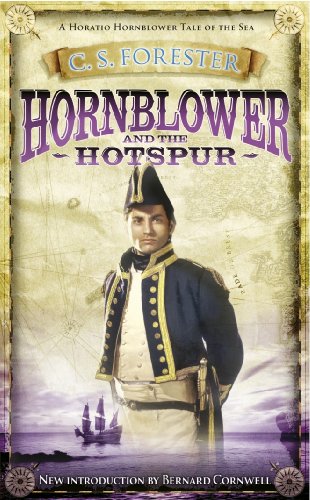
Hornblower and the Hotspur
by C. S. Forester
- Author:
- C. S. Forester
- Status:
- Done
- Format:
- eBook
- Reading Time:
- 7:15
- Genres:
- Historical Fiction , Fiction , Adventure , Historical , Classics , War , Nautical
- Pages:
- 432
- Highlights:
- 11
Highlights
Page 16
‘But remember this. You’ll find it hard to perform your duty unless you risk your ship. There’s folly and there’s foolhardiness on one side, and there’s daring and calculation on the other. Make the right choice and I’ll see you through any trouble that may ensue.’
Page 47
‘Yes. We’ll take the No. 3 guns. That should be exactly right.’ ‘And leave a gap, sir?’ asked Bush in faint protest. It certainly would, as conspicuous as a missing front tooth. It would break into the two ordered rows of cannon, conveying a makeshift appearance to the ship. ‘I’d rather have an ugly ship afloat,’ said Hornblower, ‘than a good-looking one on the rocks of a lee shore.’ ‘Yes, sir,’ said Bush, swallowing this near-heresy.
Page 98
‘That will be the Loire,’ commented Hornblower to Bush. ‘You know about her, sir?’ asked Bush. ‘I know she’s there,’ answered Hornblower. He would gladly have explained further, but Bush was going on with his report, and Hornblower was content to have something more added to his reputation for omniscience.
Page 102
‘You’re not going to trust ’em, sir?’ This was from Bush, back on the quarterdeck and in a state of some anxiety; the anxiety was not displayed by any change in Bush’s imperturbable manner, but by the very fact that he volunteered advice in this positive form. Hornblower did not want to run away. He had the weather gauge, and in a moment he could set all sail and come to the wind and stand out to sea, but he did not want to. He could be quite sure that if he were to do so the frigate would follow his example and chase him, ignominiously, out into the Atlantic with his tail between his legs. A bold move would stimulate his crew, would impress the French and – this was the point – would subdue his own doubts about himself. This was a test. His instinct was to be cautious; but he told himself that his caution was probably an excuse for cowardice. His judgment told him that there was no need for caution; his fears told him that the French frigate was planning to lure him within range of her guns and then overwhelm him. He must act according to his judgement and he must abhor the counsel of his fears, but he wished his heart would not beat so feverishly, he wished his palms would not sweat nor his legs experience these pins-and-needles feelings. He wished Bush were not crowding him at the hammock netting, so that he might take a few paces up and down the quarterdeck, and then he told himself that he could not possibly at this moment pace up and down and reveal to the world that he was in a state of indecision.
Page 117
‘She went about the moment she was sure who we were, sir. She’s still playing hide-and-seek with us.’ ‘Hide-and-seek? Mr Bush, I believe we are at war.’ It was hard to make that momentous statement in the quiet conversational tone that a man of iron nerve would employ; Hornblower did his best. Bush had no such inhibitions. He stared at Hornblower and whistled. But he could follow now the same lines of thought as Hornblower had already traced. ‘I think you’re right, sir.’ ‘Thank you, Mr Bush.’ Hornblower said that spitefully, to his instant regret. It was not fair to make Bush pay for the tensions his captain had been experiencing; nor was it in accord with Hornblower’s ideal of imperturbability to reveal that such tensions had existed. It was well that the next order to be given would most certainly distract Bush from any hurt he might feel.
Page 167
Grimly he applied himself to his task. Partly it was a literary exercise, an Essay on Unbounded Affection, and yet – and yet – he found himself smiling as he wrote; he felt tenderness within him, welling out perhaps along his arm and down his pen. He was even on the verge of admitting to himself that he was not entirely the cold-hearted and unscrupulous individual he believed himself to be.
Page 195
Yet there was one source of self-congratulation. He had held his tongue when the subject of prize money had come up in the conversation. He had been about to burst out condemning the whole system as pernicious, but he had managed to refrain. Bush thought him a queer character in any case, and if he had divulged his opinion of prize money – of the system by which it was earned and paid – Bush would have thought him more than merely eccentric. Bush would think him actually insane, and liberal-minded, revolutionary, subversive and dangerous as well.
Page 251
‘Thank you, sir,’ said Cargill again, and, after a pause, ‘I wish you had let me come with you, sir.’ Some people had queer tastes, thought Hornblower bitterly to himself, having regard to Côtard lying unconscious with a shattered arm at their feet, but he had to smooth down ruffled feelings in these touchy young men thirsting for honour and for the promotion that honour might bring. ‘Use your wits, man,’ he said, bracing himself once more to think logically. ‘Someone had to be in charge on the jetty, and you were the best man for the job.’ ‘Thank you, sir,’ said Cargill all over again, but still wistfully, and therefore still idiotically.
Page 324
The place of the watering barges was taken by the dry victualling barge, with bags of biscuit, sacks of dried peas, kegs of butter, cases of cheese, sacks of oatmeal, but conspicuous on top of all this were half a dozen nets full of fresh bread. Two hundred four-pound loaves – Hornblower could taste the crustiness of them in his watering mouth when he merely looked at them. A beneficent government, under the firm guidance of Cornwallis, was sending these luxuries aboard; the hardships of a life at sea were the result of natural circumstances quite as much as of ministerial ineptitude.
Page 389
To Hornblower’s mind Bonaparte – the Emperor Napoleon, as he was beginning to call himself – was displaying a certain confusion of ideas in adopting this course of action. Seamen and shipbuilding materials were scarce enough in France; it was absurd to waste them on invasion craft when invasion was impossible without a covering fleet, and when the French navy was too small to provide such a fleet. Lord St Vincent had raised an appreciative smile throughout the Royal Navy when he had said in the House of Lords regarding the French army, ‘I do not say they cannot come. I only say they cannot come by sea.’
Page 390
It was only by the time summer was far advanced that Hornblower fully understood Bonaparte’s quandary. Bonaparte had to persist in this ridiculous venture, wasting the substance of his empire on ships and landing-craft even though a sensible man might well write off the whole project and devote his resources to some more profitable scheme. But to do so would be an admission that England was impregnable, could never be conquered, and such an admission would not only hearten his potential Continental enemies but would have a most unsettling effect on the French people themselves. He was simply compelled to continue along this road, to go on building his ships and his gun-boats to make the world believe there was a likelihood that England would soon be overthrown, leaving him dominant everywhere on earth, lord of the whole human race. And there was always chance, even if it were not one chance in ten or one chance in a hundred, but one in a million. Some extraordinary, unpredictable combination of good fortune, of British mismanagement, of weather, and of political circumstances might give him the week he needed to get his army across. If the odds were enormous at least the stakes were fantastic. In itself that might appeal to a gambler like Bonaparte even without the force of circumstance to drive him on. So the flat-bottomed boats were built at every little fishing village along the coast of France, and they crept from their places of origin towards the great military camp of Boulogne, keeping to the shallows, moving by oar more than by sail, sheltering when necessary under the coastal batteries, each boat manned by fifty soldiers and a couple of seamen. And because Bonaparte was moving these craft, the Royal Navy felt bound to interfere with the movement as far as possible.