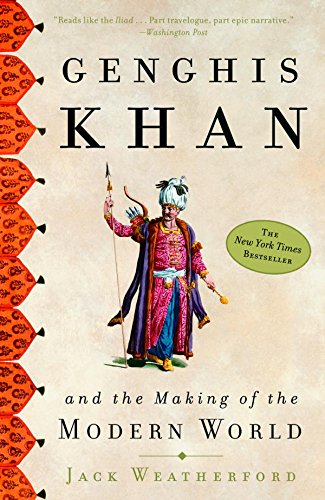
Genghis Khan and the Making of the Modern World
by Jack Weatherford
- Author:
- Jack Weatherford
- Status:
- Done
- Format:
- eBook
- Genres:
- History , Nonfiction , Biography , Asia , Historical , World History
- Pages:
- 312
- Highlights:
- 127
Highlights
Page 91
In conquest after conquest, the Mongol army transformed warfare into an intercontinental affair fought on multiple fronts stretching across thousands of miles. Genghis Khan’s innovative fighting techniques made the heavily armored knights of medieval Europe obsolete, replacing them with disciplined cavalry moving in coordinated units. Rather than relying on defensive fortifications, he made brilliant use of speed and surprise on the battlefield, as well as perfecting siege warfare to such a degree that he ended the era of walled cities. Genghis Khan taught his people not only to fight across incredible distances but to sustain their campaign over years, decades, and, eventually, more than three generations of constant fighting. In twenty-five years, the Mongol army subjugated more lands and people than the Romans had conquered in four hundred years. Genghis Khan, together with his sons and grandsons, conquered the most densely populated civilizations of the thirteenth century. Whether measured by the total number of people defeated, the sum of the countries annexed, or by the total area occupied, Genghis Khan conquered more than twice as much as any other man in history. The hooves of the Mongol warriors’ horses splashed in the waters of every river and lake from the Pacific Ocean to the Mediterranean Sea. At its zenith, the empire covered between 11 and 12 million contiguous square miles, an area about the size of the African continent and considerably larger than North America, including the United States, Canada, Mexico, Central America, and the islands of the Caribbean combined. It stretched from the snowy tundra of Siberia to the hot plains of India, from the rice paddies of Vietnam to the wheat fields of Hungary, and from Korea to the Balkans.
Page 112
As Genghis Khan’s cavalry charged across the thirteenth century, he redrew the boundaries of the world. His architecture was not in stone but in nations. Unsatisfied with the vast number of little kingdoms, Genghis Khan consolidated smaller countries into larger ones. In eastern Europe, the Mongols united a dozen Slavic principalities and cities into one large Russian state. In eastern Asia, over a span of three generations, they created the country of China by weaving together the remnants of the Sung dynasty in the south with the lands of the Jurched in Manchuria, Tibet in the west, the Tangut Kingdom adjacent to the Gobi, and the Uighur lands of eastern Turkistan. As the Mongols expanded their rule, they created countries such as Korea and India that have survived to modern times in approximately the same borders fashioned by their Mongol conquerors.
Note: Bad sign. China existed before. India didn’t exist till the British or existed earlier. Either way, the Mughals didn’t create it.
Page 118
Genghis Khan’s empire connected and amalgamated the many civilizations around him into a new world order. At the time of his birth in 1162, the Old World consisted of a series of regional civilizations each of which could claim virtually no knowledge of any civilization beyond its closest neighbor. No one in China had heard of Europe, and no one in Europe had heard of China, and, so far as is known, no person had made the journey from one to the other. By the time of his death in 1227, he had connected them with diplomatic and commercial contacts that still remain unbroken.
Note: Need to verify with Silk Roads
Page 122
As he smashed the feudal system of aristocratic privilege and birth, he built a new and unique system based on individual merit, loyalty, and achievement. He took the disjointed and languorous trading towns along the Silk Route and organized them into history’s largest free-trade zone. He lowered taxes for everyone, and abolished them altogether for doctors, teachers, priests, and educational institutions. He established a regular census and created the first international postal system. His was not an empire that hoarded wealth and treasure; instead, he widely distributed the goods acquired in combat so that they could make their way back into commercial circulation. He created an international law and recognized the ultimate supreme law of the Eternal Blue Sky over all people. At a time when most rulers considered themselves to be above the law, Genghis Khan insisted on laws holding rulers as equally accountable as the lowest herder. He granted religious freedom within his realms, though he demanded total loyalty from conquered subjects of all religions. He insisted on the rule of law and abolished torture, but he mounted major campaigns to seek out and kill raiding bandits and terrorist assassins. He refused to hold hostages and, instead, instituted the novel practice of granting diplomatic immunity for all ambassadors and envoys, including those from hostile nations with whom he was at war.
Note: Safe passage for ambassadors wasn’t new, surely.
Page 143
In the summer of 1227, during a campaign against the Tangut nation along the upper reaches of the Yellow River, Genghis Khan died—or, in the words of the Mongols, who have an abhorrence of mentioning death or illness, he “ascended into heaven.” In the years after his death, the sustained secrecy about the cause of death invited speculation, and later inspired legends that with the veneer of time often appeared as historic fact. Plano di Carpini, the first European envoy to the Mongols, wrote that Genghis Khan died when he was struck by lightning. Marco Polo, who traveled extensively in the Mongol Empire during the reign of Genghis Khan’s grandson Khubilai, reported that Genghis Khan succumbed from an arrow wound to the knee. Some claimed that unknown enemies had poisoned him. Another account asserted that he had been killed by a magic spell of the Tangut king against whom he was fighting. One of the stories circulated by his detractors asserted that the captured Tangut queen inserted a contraption into her vagina so that when Genghis Khan had sex with her, it tore off his sex organs and he died in hideous pain.
Note: Didn’t know Genghis suffered the same issue that was common in Skyrim.
Page 175
The Mongols made no technological breakthroughs, founded no new religions, wrote few books or dramas, and gave the world no new crops or methods of agriculture. Their own craftsmen could not weave cloth, cast metal, make pottery, or even bake bread. They manufactured neither porcelain nor pottery, painted no pictures, and built no buildings. Yet, as their army conquered culture after culture, they collected and passed all of these skills from one civilization to the next.
Note: The next two paragraphs have fascinating examples
Page 196
The Mongols refined and combined calendars to create a ten-thousand year calendar more accurate than any previous one,
Note: Seems like this would be easy to verify
Page 198
In nearly every country touched by the Mongols, the initial destruction and shock of conquest by an unknown and barbaric tribe yielded quickly to an unprecedented rise in cultural communication, expanded trade, and improved civilization. In Europe, the Mongols slaughtered the aristocratic knighthood of the continent, but, disappointed with the general poverty of the area compared with the Chinese and Muslim countries, turned away and did not bother to conquer the cities, loot the countries, or incorporate them into the expanding empire. In the end, Europe suffered the least yet acquired all the advantages of contact through merchants such as the Polo family of Venice and envoys exchanged between the Mongol khans and the popes and kings of Europe. The new technology, knowledge, and commercial wealth created the Renaissance in which Europe rediscovered some of its prior culture, but more importantly, absorbed the technology for printing, firearms, the compass, and the abacus from the East. As English scientist Roger Bacon observed in the thirteenth century, the Mongols succeeded not merely from martial superiority; rather, “they have succeeded by means of science.” Although the Mongols “are eager for war,” they have advanced so far because they “devote their leisure to the principles of philosophy.”
Page 212
With so many accomplishments by the Mongols, it hardly seems surprising that Geoffrey Chaucer, the first author in the English language, devoted the longest story in The Canterbury Tales to the Asian conqueror Genghis Khan of the Mongols. He wrote in undisguised awe of him and his accomplishments. Yet, in fact, we are surprised that the learned men of the Renaissance could make such comments about the Mongols, whom the rest of the world now view as the quintessential, bloodthirsty barbarians. The portrait of the Mongols left by Chaucer or Bacon bears little resemblance to the images we know from later books or films that portray Genghis Khan and his army as savage hordes lusting after gold, women, and blood.
Page 235
Just as the imaginative painters of various countries portrayed him differently, the scholars did likewise. From Korea to Armenia, they composed all manner of myths and fanciful stories about Genghis Khan’s life. In the absence of reliable information, they projected their own fears and phobias onto these accounts. With the passage of centuries, scholars weighed the atrocities and aggression committed by men such as Alexander, Caesar, Charlemagne, or Napoleon against their accomplishments or their special mission in history. For Genghis Khan and the Mongols, however, their achievements lay forgotten, while their alleged crimes and brutality became magnified. Genghis Khan became the stereotype of the barbarian, the bloody savage, the ruthless conqueror who enjoyed destruction for its own sake. Genghis Khan, his Mongol horde, and to a large extent the Asian people in general became unidimensional caricatures, the symbol of all that lay beyond the civilized pale.
Page 242
By the time of the Enlightenment, at the end of the eighteenth century, this menacing image appeared in Voltaire’s The Orphan of China, a play about Genghis Khan’s conquest of China: “He is called the king of kings, the fiery Genghis Khan, who lays the fertile fields of Asia waste.” In contrast to Chaucer’s praise for Genghis Khan, Voltaire described him as “this destructive tyrant … who proudly … treads on the necks of kings,” but “is yet no more than a wild Scythian soldier bred to arms and practiced in the trade of blood” (Act I, scene I). Voltaire portrayed Genghis Khan as a man resentful of the superior virtues of the civilization around him and motivated by the basic barbarian desire to ravish civilized women and destroy what he could not understand.
Page 253
In due course, the Mongols became scapegoats for other nations’ failures and shortcomings. When Russia could not keep up with the technology of the West or the military power of imperial Japan, it was because of the terrible Tatar Yoke put on her by Genghis Khan. When Persia fell behind its neighbors, it was because the Mongols had destroyed its irrigation system. When China lagged behind Japan and Europe, the cause was the cruel exploitation and repression by its Mongol and Manchu overlords. When India could not resist British colonization, it was because of the rapacious greed of Moghul rule. In the twentieth century, Arab politicians even assured their followers that Muslims would have invented the atomic bomb before the Americans if only the Mongols had not burned the Arabs’ magnificent libraries and leveled their cities. When American bombs and missiles drove the Taliban from power in Afghanistan in 2002, the Taliban soldiers equated the American invasion with that of the Mongols, and therefore, in angry revenge, massacred thousands of Hazara, the descendants of the Mongol army who had lived in Afghanistan for eight centuries. During the following year, in one of his final addresses to the Iraqi people, dictator Saddam Hussein made similar charges against the Mongols as the Americans moved to invade his country and remove him from power.
Page 333
As a cultural anthropologist, I worked closely with the archaeologist Dr. Kh. Lkhagvasuren, who had access to much of the information collected by his professor and mentor Dr. Kh. Perlee, the most prominent archaeologist of twentieth-century Mongolia. Gradually, through Lkhagvasuren, I met other researchers who had spent many years working secretly and, almost always, alone on studies they could never write down or publish.
Note: He’s not a historian. I got that feeling from the introduction, where he editorialises. It feels pop history rather than history.
Page 394
This information in turn greatly influenced our understanding of Genghis Khan’s field methods and how he treated hostile civilians as animals to be herded but hostile soldiers as game to be hunted.
Note: This is a massive leap. I hope the rest of the book isn’t pop psychology like this.
Page 479
From the time of his central Asian conquests, we have one of the few written descriptions of Genghis Khan, who was about sixty years old. The Persian chronicler Minhaj al-Siraj Juzjani, who was far less kindly disposed toward the Mongols than the chronicler Juvaini, described him as “a man of tall stature, of vigorous build, robust in body, the hair on his face scanty and turned white, with cats’ eyes, possessed of dedicated energy, discernment, genius, and understanding, awe-striking, a butcher, just, resolute, an overthrower of enemies, intrepid, sanguinary, and cruel.” Because of his uncanny ability to destroy cities and conquer armies many times the size of his own, the chronicler also goes on to declare that Genghis Khan was “adept at magic and deception, and some of the devils were his friends.”
Note: Press X to doubt
Page 527
Genghis Khan recognized that warfare was not a sporting contest or a mere match between rivals; it was a total commitment of one people against another. Victory did not come to the one who played by the rules; it came to the one who made the rules and imposed them on his enemy. Triumph could not be partial. It was complete, total, and undeniable—or it was nothing. In battle, this meant the unbridled use of terror and surprise. In peace, it meant the steadfast adherence to a few basic but unwavering principles that created loyalty among the common people. Resistance would be met with death, loyalty with security.
Page 537
Genghis Khan’s ability to manipulate people and technology represented the experienced knowledge of more than four decades of nearly constant warfare. At no single, crucial moment in his life did he suddenly acquire his genius at warfare, his ability to inspire the loyalty of his followers, or his unprecedented skill for organizing on a global scale. These derived not from epiphanic enlightenment or formal schooling but from a persistent cycle of pragmatic learning, experimental adaptation, and constant revision driven by his uniquely disciplined mind and focused will. His fighting career began long before most of his warriors at Bukhara had been born, and in every battle he learned something new. In every skirmish, he acquired more followers and additional fighting techniques. In each struggle, he combined the new ideas into a constantly changing set of military tactics, strategies, and weapons. He never fought the same war twice.
Page 545
According to legend, the Mongols originated in the mountain forest when Blue-Gray Wolf mated with Beautiful Red Doe on the shores of a great lake.
Note: Reminds me of Age of Empires
Page 629
The Mongols themselves claim a distinct identity from the Turkic and Tatar groups. They asserted, then and now, a direct descent from the Huns, who founded the first empire on the high steppe in the third century. Hun is the Mongolian word for human being, and they called their Hun ancestors Hun-nu, the people of the sun. In the fourth and fifth centuries, the Huns spread out from the Mongolian steppes to conquer countries from India to Rome, but they were unable to sustain contact among the various clans and were quickly assimilated into the cultures they conquered.
Note: Interesting. Didn’t know this.
Page 658
The Mongols survived on the most northern edge of this world, just at the juncture of the steppe and the northern Siberian forest. They lived as much through hunting in the forest as by herding animals on the steppe, and they exemplified the most extreme characteristics of both groups. They clung to the frayed ends of thin, delicate threads of trade connecting the northern tundra and the steppe with the agricultural fields and workshops of the south. So few goods penetrated the far north that it was said that among the Mongols the man with a pair of iron stirrups ranked as the highest lord.
Note: Huh. I thought they invented the stirrup
Page 712
By steppe tradition, one of Yesugei’s brothers, who helped to kidnap Hoelun, should have taken her as a wife. Under the Mongol system of marriage, even one of Yesugei’s sons by his other wife, Sochigel, would have been an appropriate husband for her if he had been old enough to support the family. Mongol women often married much younger men in their deceased husband’s family because it gave the younger man the opportunity to have an experienced wife without having to pay an elaborate set of gifts to her family or to put in the years of hard bride-service. Although still a young woman, probably in her mid-twenties, Hoelun already had too many children for most men to support. As a captive wife far from her homeland, she offered a potential husband neither family wealth nor beneficial family ties.
Page 848
For a poor family to risk their lives to help him and to give him such valuable resources, Temujin must have had some special attraction or ability. Meanwhile, this humble family impressed him as well. The Tayichiud, with whom he shared a close kinship tie, had once put his family out to die and now appeared eager to kill him. This other family, which had no kinship tie to him, proved willing to risk their lives to help him. This episode seems to have instilled in him not only a distrust of higher-ranking people, but also the conviction that some people, even those outside his clan, could indeed be trusted as if they were family. In later life, he would judge others primarily by their actions toward him and not according to their kinship bonds, a revolutionary concept in steppe society.
Page 854
Mongol traditions and sources acknowledge only this one brief period of capture and enslavement of Temujin, but a contemporary Chinese chronicler wrote that Temujin endured more than ten years in slavery. He may have been repeatedly enslaved, or this episode may have lasted much longer than the Secret History suggests. Some scholars suspect that such a long period of enslavement accounts for the glaring absence of detailed information on his childhood. In later years, the time of enslavement would have been an episode of shame for Genghis Khan, but even more importantly would have been a tremendous danger to the descendants of the families that had enslaved him. Virtually everyone associated with the slavery episode had good reason to keep silent about that connection, and to make it seem briefer would be in keeping with Mongol sensibilities that would dictate only barely mentioning the bad while emphasizing instead the heroic nature of the escape.
Note: Acknowledges limitations of his sources
Page 887
The Kereyid, and the Naiman to the west, represented not just larger political units but more developed cultures tied, ever so tentatively, into the commercial and religious networks of central Asia via their conversion to Christianity several centuries earlier by missionaries of the Assyrian Church of the East. Without churches or monasteries among the nomads, the tribal branch of Christianity claimed descent from the Apostle Thomas and relied on wandering monks. They practiced their religion in sanctuaries located in gers, and de-emphasized theology and rigidity of belief in favor of a varied reading of the Scriptures combined with general medical care. Jesus exercised a strong fascination for the nomads because he healed the sick and survived death. As the only human to triumph over death, Jesus was considered an important and powerful shaman, and the cross was sacred as the symbol of the four directions of the world. As a pastoral people, the steppe tribes felt very comfortable with the pastoral customs and beliefs of the ancient Hebrew tribes as illustrated in the Bible. Perhaps above all, the Christians ate meat, unlike the vegetarian Buddhists; and in contrast to the abstemious Muslims, the Christians not only enjoyed drinking alcohol, they even prescribed it as a mandatory part of their worship service.
Note: Interesting that some tribes were attached to Christianity
Page 936
Hiding in the forest of Mount Burkhan Khaldun, Temujin faced the pivotal decision of his life: deciding what to do about the kidnapping of his wife. He could have chosen to abandon any hope of recapturing Borte, and that would surely have been the expected course, as his small group could not possibly take on the much more powerful Merkid. In due time, Temujin could find another wife, but he would have to kidnap her, as his father had done to his mother, because no family would voluntarily bestow their daughter on a man who had already lost one wife to more powerful men.
Note: So many small incidents could have gone another way. If Borte hadn’t been kidnapped he might have just relaxed at home for decades. If he didn’t have Ong Khans protection he would have had to go home alone.
Page 004
After the decisive victory over the Merkid and Borte’s emotional reunion with Temujin, the newly reunited couple, still well under twenty years of age, might have hoped to live joyously together, at least for awhile. But as happens in life, the solution to one problem can create another. Temujin found that Borte was pregnant. Rather than describing the tremendous happiness for the couple at being together again, the Secret History falls silent about Borte and their life together for the duration of her pregnancy. This silence would reverberate through Mongol politics for the next century in a long debate over who had fathered Borte’s eldest child. Borte gave birth to her first son in 1179, and Temujin named the boy Jochi, which means “visitor” or “guest.” Many scholars accept that as evidence that Temujin did not believe the child was his own, but he may just as easily have given that name to signify that they were all the guests of Jamuka’s band at the time of the baby’s birth.
Page 070
He summoned his followers to a steppe beside the Blue Lake at the foot of the Heart-Shaped Mountain where they held the traditional council called a khuriltai. Families, lineages, and clans voted merely by showing up. Their presence served as an official endorsement of Temujin as khan; not appearing counted as voting against him. Merely attracting a quorum constituted a victory. On such an occasion, a list would usually be made and memorized as a form of election verification, but no tally survives, possibly indicating a modest turnout. A large number of the steppe lineages, perhaps even a majority, still supported Jamuka.
Note: Sad trombone
Page 080
Having received the support he deemed sufficient to function as the khan of a minor group, Temujin began a radical process of erecting a novel power structure within his tribe, calling on the lessons of his youth for guidance. A chief’s complex of gers that served as his tribal center or his chiefly court was called an ordu, or horde. In most steppe tribes, the khan’s ordu consisted of his relatives and served as a sort of aristocracy over the tribe, managing it and leading it. Temujin, however, assigned some dozen responsibilities to various followers according to the ability and loyalty of the individual without regard to kinship. He gave the highest positions as his personal assistants to his first two followers, Boorchu and Jelme, who had shown persistent loyalty to him for more than a decade. Temujin Khan exercised a decisive ability to assess a man’s talents and assign him to precisely the right task based on his ability rather than his genealogy.
Note: That’s how you get Subotai.
Page 122
Temujin saw clearly how the powerful Jurched kingdom used one border tribe to fight another. One year, they might ally with the Tatars against the Kereyid, but the next year with the Kereyid and Mongols against the Tatars. Today’s allies could be tomorrow’s enemies, as in the case of Jamuka, and a tribe conquered today would have to be conquered again and again in a ceaseless cycle of warfare and feuding. No victory was ever decisive, no peace permanent. This lesson would eventually have a profound effect on the new world Temujin would fashion out of this havoc, but for now the vicissitudes of this particular war had brought an unprecedented number of goods to his people and had improved his standing among them.
Note: India, basically
Page 149
At this point, Temujin instituted the second radical change in ruling style—the first being the appointment of loyal allies as opposed to family members to key positions in his entourage—that would mark his rise to power. In the long history of steppe warfare, a defeated tribe was looted, some members taken prisoner, and the rest left again to their own devices. Defeated groups regularly reorganized and counterattacked, or broke away and joined rival tribes. In his defeat of the Jurkin, however, Temujin followed a radical new policy that revealed his ambition to fundamentally alter the cycle of attack and counterattack and of making and breaking alliances. He summoned a khuriltai of his followers to conduct a public trial of the Jurkin’s aristocratic leaders for having failed to fulfill their promise to join him in war and for having, instead, raided his camp in his absence. Finding them guilty, he had them executed as a lesson about the value of loyalty to allies, but also as a clear warning to the aristocrats of all lineages that they would no longer be entitled to special treatment. He then took the unprecedented step of occupying the Jurkin lands and redistributing the remaining members of their group among the households of his own clan. Though some among both clans apparently interpreted this as the Jurkin being taken as slaves, as would have been more in keeping with steppe custom, according to the account in the Secret History, Temujin took them into his tribe not as slaves but as members of the tribe in good standing. He symbolized this by adopting an orphan boy from the Jurkin camp and presenting him to Hoelun to raise in her ger not as a slave but as her son. By having his mother adopt the Jurkin boy, as he had her previously adopt one each from the defeated Merkid, Tayichiud, and Tatars, Temujin was accepting the boys as his younger brothers. Whether these adoptions began for sentimental reasons or for political ones, Temujin displayed a keen appreciation of the symbolic significance and practical benefit of such acts in uniting his followers through this usage of fictive kinship. In the same way that he took these children into his own family, he accepted the conquered people into his tribe with the possibility that they would share fairly in the future conquests and prosperity of his army. In a final display of his new power, Temujin ended the Jurkin episode with a feast for both the victorious Mongols and their newly adopted relatives. For the feast, he summoned Buri the Wrestler, who had cut Belgutei at the feast the year before, and ordered a wrestling match between the two men. No one had ever defeated Buri, but in his fear of Temujin’s wrath, he allowed Belgutei to throw him. Normally, at this point the match would have been finished, but Temujin and Belgutei apparently worked out a different plan. Belgutei seized Buri’s shoulders and mounted his rump like a horse, and upon receiving a signal from Temujin, he plunged his knee…
Page 240
Despite the apparent lack of gratitude, Temujin never forgot how Jelme saved him from the Tayichiud, and he later entrusted Jelme with some of the most important expeditions of the Mongol conquests. The episode of the neck wound is emblematic of the deep bonds of loyalty that Temujin seemed to have a gift of inspiring. Though the steppe tribes of his time changed sides at the least provocation and soldiers might desert their leaders, none of Temujin’s generals deserted him throughout his six decades as a warrior. In turn, Temujin never punished or harmed one of his generals. Among the great kings and conquerors of history, this record of fidelity is unique.
Page 253
In this campaign against the Tatars, Temujin would institute yet another set of radical changes to the rules that had long governed steppe life, and these changes would both antagonize some of his followers, those of the aristocratic lineages, and deepen the loyalty felt for him by many others, those of the lower lineages whose lives he enriched with his reforms and distribution of goods. While conducting raid after raid, Temujin had realized that the rush to loot the gers of the defeated served as an impediment to more complete victory. Rather than chasing down the warriors of the raided camps, attackers generally allowed them to flee and focused instead on immediately looting their camps. This system allowed many defeated warriors to escape and eventually return for a counterattack. So on this raid, his second conquest of the Tatars, Temujin decided to order that all looting would wait until after a complete victory had been won over the Tatar forces; the looting could then be carried out in a more organized fashion, with all the goods being brought under his central control and then redistributed among his followers as he determined fit. He distributed the goods along the same lines by which the hunting men of the forest traditionally distributed the kill at the end of a group hunt.
Page 280
The members of the khuriltai agreed to the plan, determining to kill Tatar males taller than the linchpin holding the wheels on a cart, which was not only a measure of adulthood but a symbolic designation of the nation itself, in much the same way that maritime people often use the ship as a symbol of their state. Once again, as a counter to the killing, Temujin wanted the surviving Tatars taken in as full members of his tribe, not as slaves. To stress this, he not only adopted another Tatar child for his mother, but also encouraged intermarriage. Until this time he had only one official wife, Borte, who bore him four sons and an unknown number of daughters, but he now took the aristocratic Tatar Yesugen and her elder sister Yesui as additional wives. The Tatars had had a much greater reputation than the Mongols, and after this battle, the Mongols took in so many Tatars, many of whom rose to high office and great prominence in the Mongol Empire, that the name Tatar became synonymous with, and in many cases better known, than the name Mongol, leading to much historic confusion through the centuries.
Page 288
Intermarriage and adoption would not suffice, however, to achieve Temujin’s goal of merging the two large groups into one people. If kin groups were allowed to remain essentially intact, the larger group would eventually fragment. In 1203, therefore, the year after the Tatar conquest, Temujin ordered yet another, and even more radical, reformation of the Mongol army and tribe. He organized his warriors into squads, or arban, of ten who were to be brothers to one another. No matter what their kin group or tribal origin, they were ordered to live and fight together as loyally as brothers; in the ultimate affirmation of kinship, no one of them could ever leave the other behind in battle as a captive. Like any family of brothers in which the eldest had total control, the eldest man took the leadership position in the Mongol arban, but the men could also decide to chose another to hold this position. Ten of the squads formed a company, or zagun, of one hundred men, one of whom they selected as their leader. And just as extended families united to form lineages, ten Mongol companies formed a battalion, or mingan, of one thousand men. Ten mingan were then organized into a tumen, an army of ten thousand; the leader of each tumen was chosen by Temujin, who knew the qualities needed in such a leadership position. He allowed fathers and sons and brothers and cousins to stay together when practical, but by forcing them into new units that no man could desert or change, under penalty of death, he broke the power of the old-system lineages, clans, tribes, and ethnic identities. At the time of his reorganization, he reportedly had ninety-five mingan, units of a thousand, but since some of the units were not staffed to capacity, the total number of troops may have been as low as eighty thousand.
Page 310
Temujin’s solution was quite similar to that of the Athenian lawgiver Cleisthenes nearly two thousand years earlier, though there is no reason to believe that Temujin had ever heard of this piece of history. In order to cut through traditional rivalries and feuds in Athens, Cleisthenes abolished the tribes and reassigned everyone to ten units of ten, thereby transforming a tribal city into a city-state that grew into the strongest military, commercial, artistic, and intellectual power along the eastern shore of the Mediterranean Sea. Virtually the same reform would produce even more astonishing results for the Mongols on the steppes of Inner Asia.
Note: Loyalty to the greater collective, rather than family.
Page 384
The event acquired a symbolic representation of the diversity of the Mongol people based on mutual commitment and loyalty that transcended kinship, ethnicity, and religion. The nineteen men with Temujin Khan came from nine different tribes; probably only Temujin and his brother Khasar were actually from the Mongol clans. The others included Merkid, Khitan, and Kereyid. Whereas Temujin was a devout shamanist who worshiped the Eternal Blue Sky and the God Mountain of Burkhan Khaldun, the nineteen included several Christians, three Muslims, and several Buddhists. They were united only in their devotion to Temujin and their oath to him and each other. The oaths sworn at Baljuna created a type of brotherhood, and in transcending kinship, ethnicity, and religion, it came close to being a type of modern civic citizenship based upon personal choice and commitment. This connection became a metaphor for the new type of community among Temujin’s followers that would eventually dominate as the basis of unity within the Mongol Empire.
Page 437
The final battle for control of Mongolia came in 1204, the Year of the Rat, about three hundred miles west of Burkhan Khaldun. In the days leading up to the battle, Temujin tested his new military organization based on squads of ten. Rather than committing to an all-out battle, which he might easily lose because of his smaller numbers, Temujin picked at the Naiman with small and unpredictable hit-and-run skirmishes. In the first episode, Temujin ordered his men to advance in what was called the Moving Bush or Tumbleweed Formation just before daylight. Rather than large units racing in to attack, the dispersed squads of ten advanced severally and silently from different directions while keeping their profiles low in the predawn darkness. This prevented the enemy from seeing how many there were or from preparing for an attack from a single direction. After attacking, the squads fled in different directions, leaving the enemy wounded but unable to retaliate before the attackers disappeared. Temujin followed the sporadic attacks of the Moving Bush with the Lake Formation, in which a long line of troops advanced, fired its arrows, and then was replaced by the next line. Like waves, they struck and then disappeared as quickly as they had appeared, each wave, in turn, returning to the rear and forming another wave. The use of the Lake Formation caused the Naiman to spread out in a long, thin line to meet the long line of attacking men. Once the Naiman spread out, Temujin switched to his third tactic. He regrouped his squads one behind the other in the Chisel Formation, which was narrow across the front but extremely deep, allowing the attackers to channel maximum force to one point on the now thinned Naiman lines and chisel through them. The tactics seemed to be, at least in part, an amalgamation of older fighting techniques and hunting strategies; yet the consistent inability of the perplexed enemy to respond effectively to this form of warfare indicated that Temujin had introduced enough innovation to make these strategies uniquely his own. Temujin had produced a new type of steppe army based on a greater variety of tactics and, most important, close cooperation among the men and complete obedience to their commanders. They were no longer an attacking swarm of individuals; they were now a united formation. Temujin used a set of maneuvers that each man had to know and to which each responded precisely and without hesitation. The Mongols had a saying: “If he sends me into fire or water I go. I go for him.” The saying reflected not just an ideal, but the reality, of the new Mongol warfare, and it made short order of the Naiman.
Page 490
Jamuka had been Temujin’s first rival, and now he ended his life as the last of the Mongol aristocrats opposing him. In Temujin’s long quest for control of the Mongol clans, Temujin had defeated every tribe on the steppe and removed the threat of every aristocratic lineage by killing off their men and marrying their women to his sons and other followers. He chafed under the authority of anyone who stood above him. He killed Begter to rule over his family. He destroyed the Merkid because they took his wife. He killed off the Tatars who had killed his father and looked down on the Mongols as little more than steppe rats. He overthrew the nobles of his own Mongol people and eliminated one by one the higher-ranking Mongol clans of the Tayichiud and the Jurkin. When his own ally and father figure refused to allow a marriage between their respective families, Temujin destroyed him and his tribe. When the Naiman queen mocked the Mongols as her inferiors, he attacked the tribe, killed her husband, and gave her to one of his men as a wife. Finally, he killed Jamuka, one of the people whom he most loved in life, and thereby destroyed the aristocratic Jadaran clan.
Page 512
Temujin controlled a vast territory roughly the size of modern western Europe, but with a population of about a million people of the different nomadic tribes under his control and probably some 15 to 20 million animals. He ruled not merely as the khan of the Tatars, the Kereyid, or the Naiman. He was to be the ruler of all the People of the Felt Walls, and for this new empire, he chose a new official name derived from his own tribe. He named his people Yeke Mongol Ulus, the Great Mongol Nation. After uniting all the people, he abolished inherited aristocratic titles in their lineages, clans, and tribes. All such offices belonged to the state, not to the individual or his family, and they would be distributed at the will of the new ruler. For himself, Temujin rejected the older tribal titles such as Gur-Khan or Tayang Khan and chose instead the title that his own followers probably already used for him, Chinggis Khan, a name that later became known in the West through the Persian spelling as Genghis Khan. The Mongolian word chin means strong, firm, unshakable, and fearless, and it is close to the Mongolian word for wolf, chino, the ancestor from whom they claimed descent. It was a simple, but fitting, title for the new khan.
Page 541
For his nation-state to survive, he needed to build strong institutions, and for Genghis Khan this began with the army that brought him to power; he made it even stronger and more central to government. Under Genghis Khan, cowherds, shepherds, and camel boys advanced to become generals and rode at the front of armies of a thousand or ten thousand warriors. Every healthy male aged fifteen to seventy was an active member of the army. Just as he had done when first elected tribal khan, he appointed his most loyal followers as the heads of groups of one thousand soldiers and their households, and his oldest followers, such as Boorchu, took charge of units of ten thousand. He rewarded men who came from lowly black-boned lineages and placed them in the highest positions based on their achievements and proven loyalty to him on and off the battlefield.
Note: Same as Napoleon. Mobilise the whole nation, abolish existing aristocracy and then hand out titles and responsibility to those who have earned it
Page 558
The Great Law, however, did not represent a single codification of the law so much as an ongoing body of legal work that he continued to develop throughout the remaining two decades of his life. Genghis Khan’s law did not delve into all aspects of daily life; instead, he used it to regulate the most troublesome aspects. As long as men kidnapped women, there would be feuding on the steppes. Genghis Khan’s first new law reportedly forbade the kidnapping of women, almost certainly a reaction to the kidnapping of his wife Borte. The persistent potential for strife originating in such kidnappings still plagued Genghis Khan within his own family in the uncertainty of whether his eldest son had been fathered by him or by Borte’s kidnapper, and the uncertainty would cause increasingly more severe problems as Genghis Khan grew older. Concomitant with an end to kidnapping, he forbade the abduction and enslavement of any Mongol. From his own capture and enslavement by the Tayichiud, he knew the individual and personal anguish of being abducted and forced to work as a slave, but he also recognized how detrimental the practice was to the entire social fabric and what strong animosities and violence it perpetrated throughout the tribes of the steppe. Genghis Khan sought to remove every source of internal dissension within the ranks of his followers. Based upon his own experiences over the disruptions that surrounded questions of the legitimacy of children, he declared all children legitimate, whether born to a wife or a concubine. Because haggling over the value of a wife as though she were a camel could provoke lingering dissension among his men, he forbade the selling of women into marriage. For the same reasons, he outlawed adultery, an act that the Mongols’ defined differently than most people. It did not include sexual relations between a woman and her husband’s close relatives, nor those between a man and female servants or the wives of other men in his household. In keeping with Genghis Khan’s dictum that matters of the ger should be decided within the ger and matters of the steppe decided on the steppe, adultery applied to relations between married people of separate households. As long as it did not cause a public strife between families, it did not rank as a crime. Theft of animals had always been considered wrong, but it had been commonplace in the raiding culture of the steppes, and had also been the cause of lingering animosity and discord. Perhaps remembering the great harm caused to his family when their eight geldings were stolen, Genghis Khan made animal rustling a capital offense. Additionally, he required anyone finding a lost animal to return it to the rightful owner. For this purpose, he instituted a massive lost-and-found system that continued to grow as his empire spread. Any person who found such goods, money, or animals and did not turn them in to the appropriate supervisor would be treated as a thief; the penalty for theft was…
Page 594
Mongol law, as codified by Genghis Khan, recognized group responsibility and group guilt. The solitary individual had no legal existence outside the context of the family and the larger units to which it belonged; therefore, the family carried the responsibility of ensuring the correct behavior of its members. A crime by one could bring punishment to all. Similarly, a tribe or a squad of soldiers bore the same liability for one another’s actions, and thereby the entire nation, not just the army or just the civil administration, bore responsibility for upholding and enforcing the law. To be a just Mongol, one had to live in a just community.
Note: Fascinating
Page 599
Enforcement of the law and the responsibility to abide by it began at the highest level, with the khan himself. In this manner, Genghis Khan had proclaimed the supremacy of the rule of law over any individual, even the sovereign. By subjugating the ruler to the law, he achieved something that no other civilization had yet accomplished. Unlike many civilizations—and most particularly western Europe, where monarchs ruled by the will of God and reigned above the law—Genghis Khan made it clear that his Great Law applied as strictly to the rulers as to everyone else. His descendants proved able to abide by this rule for only about fifty years after his death before they discarded it.
Note: Should look into how they discarded it.
Page 612
To keep track of his laws, Genghis Khan created the position of supreme judge for his adopted brother Shigi-Khutukhu, the Tatar boy with the golden earrings and nose ring whom he had found and given to his mother to raise. Genghis Khan charged him to “punish the thieves and put right the lies,” as well as to keep a record of his decisions on white paper bound in blue books, the sacred color of the Eternal Sky. This close association between writing and the keeping of the law in Genghis Khan’s administration probably accounts for why the Mongolian word for book, nom, was derived from the Greek nomos, meaning “law.” In the Mongol world of the thirteenth century, the law and the written word were one and the same.
Note: Love me some etymology
Page 618
In maintaining loyalty and cohesion in the vast apparatus of his state, Genghis Khan innovated on an ancient political practice of hostage taking. He demanded that each of the commanders of the units of one thousand and ten thousand send their own sons and their sons’ best friends to him personally to make his own unit of ten thousand. Instead of threatening to kill them if their relatives misbehaved, Genghis Khan introduced a far more effective strategy. Genghis Khan trained the would-be hostages as administrators and kept them as a ready reserve to replace any ineffective or disloyal official. The threat of such potential replacement probably did much more to ensure loyalty in the field than the threat that the relative might be killed. Genghis Khan thus changed the status of hostages, transforming them into an integral part of his government that gave almost every family a direct and personal connection to the imperial court.
Note: Genius
Page 698
With all the nomadic tribes united and Genghis Khan securely ensconced as their ruler, it seemed uncertain what should happen next. He had spent so many years locked into the drama with Jamuka and Ong Khan that without them, his large tribe seemed to lack an objective or purpose. Without enemies, they lacked a reason to hold together. Genghis Khan seemed to be searching for new ones, but he found no tribe worthy of the distinction.
Page 710
In the extension of kinship to the Siberian tribes and the Uighur, Genghis Khan was not merely making alliances between his family and their ruling families. He was accepting the entire tribe or nation into his empire as familial members, since, in the political idiom of the tribes, granting kinship to the khan was tantamount to recognizing family ties with the whole nation. In this way, the idiom of kinship had expanded into a type of citizenship. As Genghis Khan continued to utilize and expand that idiom in the coming years, it came to be a form of universal citizenship based not on a common religion, as among Christian and Muslim people, or just on biology, as in traditional tribal culture. It was based simply on allegiance, acceptance, and loyalty. In time, all the non-Mongol kingdoms in the Mongol Empire became known as Khari, derived from the word for black and connoting in-laws. Thus, select nations such as the Uighur and the Koreans, as well as select Turkic groups, would have the honor of being in-laws to the Mongols, whereas intermarriage outside of the “black-kin” would not be permitted.
Page 794
In the thirteenth century, the area south of Mongolia now occupied by China consisted of many independent states and kingdoms containing perhaps a third of the world population. With some 50 million people, the Jurched kingdom was only the second largest of the many kingdoms occupying the territory now included in modern China. The largest and most important territory was under the administration of the Sung dynasty, heir to centuries of Chinese civilization, based in Hangzhou and ruling some 60 million people in southern China. A string of nomadic buffer states separated the Mongolian plateau from the Sung, each buffer state consisting of a hybrid of agricultural and grazing regions ruled over by a former nomadic tribe that had conquered and settled among its subjects in order to more efficiently exploit them. Frequently, a new tribe emerged from the steppes to displace the older tribe that had grown weak and dissipated from several generations of soft city life. In a long-established cycle, a nomadic army swept down from the steppe, conquered the peasants and cities to the south, created a new dynasty, and, after a few years, fell to the attack of another marauding tribe. Although the identities of the ruling tribe changed from century to century, the system had already been in place for thousands of years.
Note: Sounds about right. Except they went from the Steppe in all directions.
Page 842
The Chinese noted with surprise and disgust the ability of the Mongol warriors to survive on little food and water for long periods; according to one, the entire army could camp without a single puff of smoke since they needed no fires to cook. Compared to the Jurched soldiers, the Mongols were much healthier and stronger. The Mongols consumed a steady diet of meat, milk, yogurt, and other dairy products, and they fought men who lived on gruel made from various grains. The grain diet of the peasant warriors stunted their bones, rotted their teeth, and left them weak and prone to disease. In contrast, the poorest Mongol soldier ate mostly protein, thereby giving him strong teeth and bones. Unlike the Jurched soldiers, who were dependent on a heavy carbohydrate diet, the Mongols could more easily go a day or two without food.
Page 866
With his men spread out over such a large area, communications became more important, yet more difficult. Conventional armies moved and camped in massive columns, and the commanders could easily communicate with one another through written messages. For the Mongols, the troops were more spread out, and even the officers were illiterate. All communication at every level had to be oral, not written. Orders moved by word of mouth from man to man. The problem with an oral system of communication lay in the accuracy of the message; the message had to be repeated precisely each time to each person and then remembered exactly as spoken. To ensure accurate memorization, the officers composed their orders in rhyme, using a standardized system known to every soldier. The Mongol warriors used a set of fixed melodies and poetic styles into which various words could be improvised according to the meaning of the message. For a soldier, hearing the message was like learning a new verse to a song that he already knew. The soldiers, like bands of riders on the steppe still do today, frequently sang as they rode in their small groups. In addition to singing about what soldiers always sing about—home, women, and fighting—the Mongol soldiers sang their laws and rules of conduct, which had also been set to music so that every man might know them. By memorizing the laws and constantly practicing the format of their message-songs, every man was ready, at any moment’s notice, to learn a new message, in the form of a new verse to these well-rehearsed songs, and take it where ordered.
Page 904
The Mongol way of fighting was a refinement of the traditional steppe system that had been developed in Mongolia over many thousands of years. Superior weapons, in the end, did not account for the Mongol success. Weapon technology does not remain secret for long, and whatever works for one side can be readily adopted for use by the enemy after just a few battles. The Mongol’s success arose from their cohesion and discipline, bred over millennia as nomads working in small groups, and from their steadfast loyalty to their leader. Warriors everywhere have been taught to die for their leader, but Genghis Khan never asked his men to die for him. Above all else, he waged war with this strategic purpose in mind: to preserve Mongol life. Unlike other generals and emperors in history who easily ordered hundreds of thousands of soldiers to their death, Genghis Khan would never willingly sacrifice a single one. The most important rules that he created for his army concerned the loss of soldiers. On and off the battlefield, the Mongol warrior was forbidden to speak of death, injury, or defeat. Just to think of it might make it happen. Even mentioning the name of a fallen comrade or other dead warrior constituted a serious taboo. Every Mongol soldier had to live his life as a warrior with the assumption that he was immortal, that no one could defeat him or harm him, that nothing could kill him. At the last moment of life, when all had failed and no hope remained, the Mongol warrior was supposed to look upward and beckon his fate by calling out the name of the Eternal Blue Sky as his final earthly words. In fighting on the steppe, the nomads left the corpses of fallen soldiers and their possessions on the field to be disposed of by animals and to decompose naturally.
Page 926
Nowhere did Mongol ingenuity show itself more clearly than in their ability to transform the Jurched’s greatest asset, their large population, into their greatest liability. Before attacking a city, the Mongols typically cleared out all the surrounding villages. They forcefully conscripted the local labor through an extension of their decimal organization of the military. Each Mongol warrior had to round up ten local men to work under his command; if any of them died, he had to replace the worker so that he always had ten men at his disposal. As an extension of the army, these captives performed the daily tasks of getting food and water for the animals and soldiers, as well as gathering needed material, such as stones and dirt, to fill in the moat in the upcoming siege. These conscripted men would also maneuver and operate the siege engines that pounded the walls with wooden or stone missiles and would push the movable towers built to breach the city walls. For the Mongols, the lifestyle of the peasant seemed incomprehensible. The Jurched territory was filled with so many people and yet so few animals; this was a stark contrast to Mongolia, where there were normally five to ten animals for each human. To the Mongols, the farmers’ fields were just grasslands, as were the gardens, and the peasants were like grazing animals rather than real humans who ate meat. The Mongols referred to these grass-eating people with the same terminology that they used for cows and goats. The masses of peasants were just so many herds, and when the soldiers went out to round up their people or to drive them away, they did so with the same terminology, precision, and emotion used in rounding up yaks. Traditional armies of the era treated villages as resources to be looted and the peasants as a nuisance to be raped, killed, or disposed of in any convenient way. By contrast, the Mongols, who were always low in numbers compared with the place they invaded, put the massive number of people to strategic uses. The Mongol warriors modified the traditional steppe strategy of rounding up the enemy’s herds and stampeding them toward their owners’ battle lines or homes, thereby creating great confusion before the soldiers raced in to attack. In the Jurched campaign, the Mongols adapted this tactic to the herds of the peasant farmers. The Mongol army divided into small units that attacked undefended villages, set them afire, and chased out the residents. The frightened peasants fled in all directions. They clogged the highways and made it difficult for the Jurched supply convoys to move. In the Jurched campaign, more than a million refugees fled the countryside in desperation and poured into the cities; they ate up huge stores of food, and caused chaos wherever they went. Instead of being followed by mobs of refugees as was typical for the armies of the time, the Mongols were preceded by them, and the Mongols also used the displaced peasants in a more direct way as shields and as…
Note: They dehumanised the peasants and treated them like livestock or worse. That’s ingenuity from a certain point of view
Page 964
After all the reconnaissance, organization, and propaganda, when the attack finally came, the Mongol army sought to create as much confusion and havoc for the enemy as possible. One of the most common forms of attack, similar to the Bush Formation, was the Crow Swarm or Falling Stars attack. At the signal of a drum, or by fire at night, the horsemen came galloping from all directions at once. In the words of a Chinese observer of the time, “they come as though the sky were falling, and they disappear like the flash of lightning.” The enemy was shaken and unnerved by the sudden assault and equally sudden disappearance, the roaring wave of noise followed by a greater silence. Before they could respond properly to the attack, the Mongols were gone and left the enemy bleeding and confused.
Page 969
Beginning with the Tangut campaigns, Genghis Khan had discovered that Chinese engineers knew how to build siege machines that could batter city walls with massive stones from far away. The Chinese had already developed a number of those devices: the catapult hurled stones, flaming liquids, and other harmful substances at or across city walls; and the trebuchet, a catapult powered by the drop of a heavy counterweight, threw objects even faster than the torsion catapult. The ballista was a mechanical device that shot large arrows that could damage buildings and structures and kill any person or animal in its path. Although quite old in the military history of siege warfare, the weapons were new to the Mongols, but they soon became a permanent part of the arsenal of Genghis Khan, who appreciated the efficiency and ingenuity behind them. More than merely using the weapons, Genghis Khan acquired the engineering intelligence needed to create them. The Mongols eagerly rewarded engineers who defected to them and, after each battle, carefully selected engineers from among the captives and impressed them into Mongol service. Genghis Khan made engineering units a permanent part of the Mongol army, and with each new battle and each conquest, his war machinery grew in complexity and efficiency.
Note: Trebuchet is the superior siege weapon
Page 031
Genghis Khan and his newly incorporated allies easily took the city. This time, however, he presented no opportunity for the defeated Jurched to submit tribute; the city would be punished and looted. The Mongols would take everything. Once it became clear that the city would soon fall, Genghis Khan turned over the final assault to his subordinates. Irritated by the increasing summer heat and disgusted by the filth of sedentary life, Genghis Khan left Zhongdu to return to the higher, drier, and more open lands of Inner Mongolia. He delegated the looting of the city to Khada, a Khitan commander, and his troops since they were more accustomed to managing cities and would know best how to extract the wealth. Mongol officials would wait outside the city some distance away for the loot to be brought to them and recorded. Genghis Khan expected the sacking to be executed in the usual and efficient Mongol manner that he had insisted upon since the defeat of the Tatars. In the Mongol way, soldiers treated the collection of loot as they did the harvesting of animals on the group hunt, distributing it among all the Mongols according to their rank. Down to the last brass button or final grain of silver, all of it was allocated according to a precise formula, from the 10 percent for the khan to the specified share for orphans and widows. The new Mongol allies, however, either did not understand the system or simply refused to abide by it. Many of them, particularly the Khitan and the Chinese, who had suffered great repression and had many complaints against the Jurched, lusted after revenge and destruction. They felt that each soldier had the right to keep what he seized. They stripped gold from the walls of palaces, pried precious stones out of their settings, and seized chests filled with gold and silver coins. They loaded the precious metals into oxcarts and tied bundles of silk on their camels’ backs. Genghis Khan considered plunder to be an important matter of state, and as such he sent the chief Mongol judge, Shigi-Khutukhu, to the city to oversee the methodical looting and compile a meticulous inventory. Instead of an orderly process, Shigi-Khutukhu encountered chaos. Mongol officials outside the city, including the royal cook, had accepted silk embroidered with gold as bribes to allow the chaotic looting by the allied soldiers to continue; and when Shigi-Khutukhu arrived, he, too, was offered a personal share of the goods. He refused and returned to Genghis Khan to report the misconduct. Genghis Khan became angry, rebuked the Khitan, and confiscated the goods, but no record of the punishment survives.
Note: The author goes to great lengths to absolve the Khan of blame. Perhaps the Secret History does the same
Page 075
Long lines of clerks laboriously cataloged, checked, and rechecked the goods of each caravan of camels and oxcarts. Musicians played and sang to delight their captors as the caravan moved. Whenever the caravan paused, acrobats, contortionists, and jugglers performed while young girls gathered dried dung for the fire, milked the animals, cooked a meal, and offered whatever else might be asked of them. Boys tended the animals and lifted the heavy loads. Behind the animals came the endless lines of marching captives—thousands upon thousands. Princes and priests. Tailors and pharmacists. Translators and scribes. Astrologers and jewelers. Artists and soothsayers. Magicians and goldsmiths. Anyone evidencing a skill had been rounded up, together with those who merely attracted the attention of one of the Mongols for whatever reason or fancy.
Note: This is slavery but the author is reluctant to call out such
Page 081
In all the centuries of raiding and trading, no leader had brought back to his homeland nearly the amount of goods as Genghis Khan. But vast as the quantities were, the appetites of his own people were insatiable. As he returned from his campaigns, his caravans were laden with valuable goods, but each load created the desire for yet more. Every Mongol could sit in his ger on lacquered furniture draped in silk; every maiden was perfumed, painted with makeup, and bejeweled. Every riding horse was fixed with metal fittings, and every warrior with bronze and iron weapons. To work their crafts, the thousands of new craftsmen needed more raw materials—everything from wood, clay, and cloth to bronze, gold, and silver. To feed these workers, constant supplies of barley, wheat, and other food commodities had to be hauled across the vast wasteland separating the herders’ pastures and the agricultural fields of the south; and the more captives Genghis Khan brought home, the more food and equipment he had to obtain to supply them. Novelties became necessities, and each caravan of cargo stimulated a craving for more. The more he conquered, the more he had to conquer. The steppes could no longer be isolated. Genghis Khan had to organize supply lines, maintain production, and coordinate the movement of goods and people on an unprecedented scale. What began as a quick raid on cities south of the Gobi for silks and baubles had turned into three decades of the most extensive war in world history. Genghis Khan would spend the next fifteen years of his life fighting across the face of Asia, and at his death, he bequeathed the war to his descendants to expand into new countries and against new people for two more generations.
Page 142
Because the Mongols conducted the campaign at the request of the Uighur Muslims, they did not allow plunder, destroy property, or endanger the lives of civilians. Instead, Jebe’s army defeated the army of Guchlug and, in a punishment befitting his crimes, had him beheaded on a plain near the modern borders of Afghanistan, Pakistan, and China. Following the execution, the Mongols sent a herald to Kashgar to proclaim the end of religious persecution and the restoration of religious freedom in each community. According to the Persian historian Juvaini, the people of Kashgar proclaimed the Mongols “to be one of the mercies of the Lord and one of the bounties of divine grace.” Although Persian and other Muslim chroniclers recorded the episode in tremendous detail, the Secret History summed up the entire campaign in one simple sentence. “Jebe pursued Guchlug Khan of the Naiman, overtook him at the Yellow Cliff, destroyed him, and came home.” From the Mongol perspective, that is probably all that mattered. Jebe had done his duty: He killed the enemy and returned home safely.
Page 204
By riding against Khwarizm, Genghis Khan attacked a newly formed kingdom only twelve years older than his own Mongol nation, but he attacked not just an empire, but an entire ancient civilization. The Muslim lands of the thirteenth century, combining Arabic, Turkic, and Persian civilizations, were the richest countries in the world and the most sophisticated in virtually every branch of learning from astronomy and mathematics to agronomy and linguistics, and possessed the world’s highest levels of literacy among the general population. Compared with Europe and India, where only priests could read, or China, where only government bureaucrats could, nearly every village in the Muslim world had at least some men who could read the Koran and interpret Muslim law. While Europe, China, and India had only attained the level of regional civilizations, the Muslims came closest to having a world-class civilization with more sophisticated commerce, technology, and general learning, but because they ranked so high above the rest of the world, they had the farthest to fall. The Mongol invasion caused more damage here than anywhere else their horses would tread.
Page 212
Just as in northern China, where the formerly nomadic Khitan, Jurched, and Tangut tribes ruled over peasant populations, across the Middle East the formerly nomadic Turkic tribes such as the Seljuks and the Turkoman had conquered and ruled various kingdoms populated mostly by farmers. A series of Turkic states dominated the political landscape from the territories of modern-day India, Pakistan, and Afghanistan, across Persia, and into the heart of the Anatolia region of modern Turkey along the Mediterranean. The civilization of the area rested on an ancient bed of Persian cultures, heavily augmented by influences from the Arab world and from earlier classical civilizations from Rome to India. The cultural mosaic of the Middle East included sizable minority populations of Jews, Christians, and other religious and linguistic groups. Overall, however, the scholars, judges, and religious leaders spoke Arabic and quoted the Koran. The soldiers spoke the Turkic dialects of their warrior tribe. The peasants spoke and sang in the many dialects of Persian.
Note: That’s an interesting split of languages by social strata
Page 219
Despite the wealth of the area at the time of Genghis Khan’s sudden appearance, the complexity of its social life left its many kingdoms riven with political rivalries, religious tensions, and cultural hatreds. As an upstart Turk, the sultan of Khwarizm could scarcely claim any allies among his fellow Muslims, mostly Arabs and Persians, who looked upon him as little more than a barbarian conqueror himself. Relations between the sultan of Khwarizm and the Arab Caliph in Baghdad were so strained that according to several chronicles, the Caliph supposedly petitioned Genghis Khan to attack the sultan by sending him a secret message tattooed onto a man’s head, who then passed undetected through Khwarizm territory to reach the Mongols. Although apocryphal, the story of the tattooed messenger circulated widely in the Muslim world and conferred a certain legitimacy on Genghis Khan’s war against the sultan for those Muslims looking for a religious reason to side with the infidel against a Muslim sultan. According to a possibly true story, the Caliph further aided the Mongol…
Page 229
In addition to the strains with his Muslim neighbors, the sultan of Khwarizm faced numerous divisions within his own lands and family. The sultan quarreled constantly with his mother, who held virtually as much power as he did, and the threat of a Mongol invasion heightened their disagreement on everything from how to run the empire to how to prepare for war. It was her brother who had seized the first Mongol caravan that precipitated the war, but in refusing to allow her son to punish him and thereby avoid war, she exacerbated the tensions with the Mongols. If the stresses within the ruling family were not menacing enough, the masses of Persian and Tajik subjects showed little connection to their rulers and even less to the Turkic soldiers who were stationed in their cities to exploit them rather than…
Page 239
The Mongols promised justice to those who surrendered, but they swore destruction to those who resisted. If the people accepted and acted as relatives should by reciprocating the offer of kinship by offering food, then the Mongols would treat them as family members with a guarantee of protection and certain basic familial rights; if they refused, they would be treated as enemies. Genghis Khan’s offer to the besieged was as simple as it was horrifying, as when he sent this message to the citizens of Nishapur: “Commanders, elders, and commonality, know that God has given me the empire of the earth from the east to the west, whoever submits shall be spared, but those who resist, they shall be destroyed with their wives, children, and dependents.” The same sentiment found expression in many documents of the era, one of the clearest in the Armenian chronicle that quotes Genghis Khan as saying that “it is the will of God that we…
Page 247
Some cities surrendered without fighting. Others fought for a few days or weeks, and only the hardiest of defenders held out for more than a few months. Genghis Khan had learned much from his campaigns against the Jurched cities: not only how to capture heavily fortified cities, but how to treat them afterward, in particular how to most efficiently plunder them. He did not want to repeat the mistakes of the chaotic plunder of Zhongdu. In Khwarizm, he introduced the new and more efficient system of first…
Note: Humane, organised plundering
Page 252
Before the plundering began, the Mongol warriors followed a similar procedure toward the enemy population in each hostile city. First, they killed the soldiers. The Mongols, dependent on cavalry, had little use for an infantry trained to defend fortress walls, and, more important, they did not want to leave a large army of former enemies blocking the route between them and their homeland in Mongolia. They always wanted a clear, open way home. After executing the soldiers, the Mongol officers sent clerks to divide the civilian population by profession. Professional people included anyone who could read and write in any language—clerks, doctors, astronomers, judges, soothsayers, engineers, teachers, imams, rabbis, or priests. The Mongols particularly needed merchants, cameleers, and people who spoke multiple languages, as well as craftsmen. These workers would be put to use by the Mongols, who themselves practiced no crafts other than war, herding, and hunting. Their growing empire needed skilled workers in almost every service imaginable, including smiths, potters, carpenters, furniture makers, weavers, leather workers, dyers, miners, papermakers, glassblowers, tailors, jewelers, musicians, barbers, singers, entertainers, apothecaries, and cooks. People without…
Note: That’s pretty harsh for soldiers and those lacking skills. Why would they surrender?
Page 263
In Genghis Khan’s conquest of central Asia, one group suffered the worst fate of those captured. The Mongol captors slaughtered the rich and powerful. Under the chivalrous rules of warfare as practiced in Europe and the Middle East during the Crusades, enemy aristocrats displayed superficial, and often pompous, respect for one another while freely slaughtering common soldiers. Rather than kill their aristocratic enemy on the battlefield, they preferred to capture him as a hostage whom they could ransom back to his family or country. The Mongols did not share this code. To the contrary, they sought to kill all the aristocrats as quickly as possible in order to prevent future wars against them, and Genghis Khan never accepted enemy aristocrats into his army and rarely into his service in any capacity. Genghis Khan had not always pursued this policy. In the first conquests of the cities of the Jurched, the Tangut, and the Black Khitan, Genghis Khan had often protected the rich and even allowed rulers to stay in office after he defeated them. But the Jurched and the Tangut had betrayed him as soon as his army withdrew. By the time Genghis Khan arrived in the Muslim countries of central Asia, he had learned his lesson about the loyalty, dependability, and usefulness of the rich and powerful. In his keen awareness of public attitudes and opinions, he also recognized that the common people cared little about what befell the idle rich. By killing the aristocrats, the Mongols essentially decapitated the social system of their enemies and minimized future resistance. Some of the cities never recovered enough to rebuild after the loss of aristocrats on the battlefield or from the annihilation of their families. Genghis Khan wanted officeholders who were loyal and indebted to the Mongols alone for their positions of power and prestige, and for this reason he recognized no titles other than those granted by him. Even an allied prince or king who wished to retain an older title had to have it reconferred on him by the Mongol authorities. In his report on his trip to Mongolia from 1245 to 1247, the papal envoy Giovanni Di Plano Carpini complained frequently about the lack of respect that Mongols showed the aristocratic people. The lowest-ranking Mongol could walk in front of visiting kings and queens and speak rudely to them. The fate of the sultan’s mother, who had been the most powerful woman in the empire, showed the Mongol attitude toward aristocratic women. They captured her and killed most members of her court and some two dozen members of her family. Then they sent her off to live the remaining decade of her life in ignominious servitude in Mongolia, where she disappeared from history. Such a woman earned no prestige or consideration by virtue of her birth; she, like a captured man, was only as good as her skills, work, and service.
Note: The policy makes sense.
Page 287
Genghis Khan epitomized ruthlessness in the eyes of the Muslims. Chroniclers of the era attribute to Genghis Khan the highly unlikely statement that “the greatest joy a man can know is to conquer his enemies and drive them before him. To ride their horses and take away their possessions. To see the faces of those who were dear to them bedewed with tears, and to clasp their wives and daughters in his arms.” Rather than finding such apocalyptic descriptions derogatory, Genghis Khan seemed to have encouraged them. With his penchant for finding a use for everything he encountered, he devised a powerful way to exploit the high literacy rate of the Muslim people, and turned his unsuspecting enemies into a potent weapon for shaping public opinion. Terror, he realized, was best spread not by the acts of warriors, but by the pens of scribes and scholars. In an era before newspapers, the letters of the intelligentsia played a primary role in shaping public opinion, and in the conquest of central Asia, they played their role quite well on Genghis Khan’s behalf. The Mongols operated a virtual propaganda machine that consistently inflated the number of people killed in battle and spread fear wherever its words carried.
Page 300
From every conquered city, the Mongols sent forth delegations to the other cities to tell them of the unprecedented horrors inflicted by the nearly supernatural abilities of Genghis Khan’s warriors. The power of those words can still be felt in the accounts of eyewitnesses recorded by chroniclers such as the historian Ibn al-Athir, who lived through the era of the conquest in Mosul, a city now located in Iraq, but at that time close to but slightly beyond the Mongol campaign. He recorded the accounts of refugees in his book al-Kamil fi at-tarikh, known in English as The Perfect History or The Complete History. At first, Ibn al-Athir seemed disinclined to believe the accounts: “Stories have been related to me, which the hearer can scarcely credit, as to the terror of the Tatars.” But he quickly warmed to the retelling. “It is said that a single one of them would enter a village or a quarter wherein were many people, and would continue to slay them one after another, none daring to stretch forth his hand against this horseman.” From another account, he heard that “one of them took a man captive, but had not with him any weapon wherewith to kill him; and he said to his prisoner, ‘Lay your head on the ground and do not move,’ and he did so, and the Tatar went and fetched his sword and slew him therewith.” Each victory released a flood of new propaganda, and the belief in Genghis Khan’s invincibility spread. As absurd as the stories appear from a reasoned distance and safety in time, they had a tremendous impact across central Asia. Ibn al-Athir lamented the Mongol conquests as “the announcement of the death-blow of Islam and the Muslims.” With a touch of the dramatic, he added, “O would that my mother had not born me or that I had died and become a forgotten thing ere this befell!” He agreed to write out the gory details only because “a number of my friends urged me to set it down in writing.” He declared the invasion as the “greatest catastrophe and the most dire calamity … which befell all men generally, and the Muslims in particular … since God Almighty created Adam until now.” By comparison, he noted that the worst slaughters in pre-Mongol history had been unleashed upon the Jews, but the attack of the Mongols on the Muslims was worse because of the toll of Muslims whom “they massacred in a single city exceeded all the children of Israel.” Lest the reader prove too suspicious, Ibn al-Athir promised details about the Mongol “deeds which horrify all who hear of them, and which you shall, please God, see set forth in full detail in their proper connection.” The impassioned rhetoric, however, seems to have been more an effort to arouse his fellow Muslims than to accurately chronicle their conquest.
Note: Very compelling. People believe this even today.
Page 319
Although the army of Genghis Khan killed at an unprecedented rate and used death almost as a matter of policy and certainly as a calculated means of creating terror, they deviated from standard practices of the time in an important and surprising way. The Mongols did not torture, mutilate, or maim. War during that time was often a form of combat in terror, and other contemporary rulers used the simple and barbaric tactic of instilling terror and horror into people through public torture or gruesome mutilation. In an August 1228 battle with Jalal al-Din, the son of the sultan, four hundred Mongol prisoners fell into enemy hands, and they knew well that they would die. The victors took the Mongol warriors to nearby Isfahan, tied them behind horses, and dragged them through the streets of the city to entertain the city’s residents. All the Mongol prisoners were thus killed as public sport and then fed to dogs. Because of this public torture, the Mongols never forgave the civilized people of that city, and it, too, would eventually pay a price. In another case where a Mongol army lost a battle, the Persian victors killed the captives by driving nails into their heads, the seat of their souls according to Mongol belief. This episode was echoed a century later in 1305, when the sultan of Delhi turned the deaths of other Mongol prisoners into public entertainment by having them crushed by elephants. He then built a tower from the severed heads of the Mongols who had been killed or captured in battle. Civilized rulers and religious leaders from China to Europe depended upon these gruesome displays to control their own people through fear and to discourage potential enemies through horror. When the Byzantine Christian emperor Basil defeated the Bulgarians in 1014, he had fifteen thousand Bulgarian war captives blinded. He left one man out of each hundred with one eye in order that he might lead the other ninety-nine homeward and thereby spread the terror. When the Christian Crusaders took cities such as Antioch in 1098 and Jerusalem in 1099, they slaughtered the Jews and Muslims without regard for age or gender, but merely because of their religion. Holy Roman Emperor Frederick Barbarossa, who ranks as one of Germany’s greatest historical and cultural heroes, best exemplified the use of terror in the West. When he tried to conquer the Lombard city of Cremona in the north of modern Italy in 1160, he instituted an escalating series of violent acts of terror. His men beheaded their prisoners and played with the heads outside the city walls, kicking them like balls. The defenders of Cremona then brought out their German prisoners on the city walls and pulled their limbs off in front of their comrades. The Germans gathered more prisoners and executed them in a mass hanging. The city officials responded by hanging the remainder of their prisoners on top of the city walls. Instead of fighting each other directly, the two armies continued their escalation of…
Note: Good comparison with contemporaries
Page 345
Those cities that surrendered to the Mongols at first found their treatment so mild and benign, in comparison with the horrific stories that circulated, that they naively doubted the abilities of the Mongols in other areas as well. After surrendering, a large number of the cities waited obediently until the Mongols had passed well beyond their country, and then revolted. Since the Mongols left only a few officials in charge and stationed no military detachment to guard a city, the inhabitants misinterpreted the Mongol withdrawal as weakness and presumed that the main Mongol army would never return that way.…
Note: Can’t think what else could have been done.
Page 367
While the destruction of many cities was complete, the numbers given by historians over the years were not merely exaggerated or fanciful—they were preposterous. The Persian chronicles reported that at the battle of Nishapur, the Mongols slaughtered the staggeringly precise number of 1,747,000. This surpassed the 1,600,000 listed as killed in the city of Herat. In more outrageous claims, Juzjani, a respectable but vehemently anti-Mongol historian, puts the total for Herat at 2,400,000. Later, more conservative scholars place the number of dead from Genghis Khan’s invasion of central Asia at 15 million within five years. Even this more modest total, however, would require that each Mongol kill more than a hundred people; the inflated tallies for other cities required a slaughter of 350 people by every Mongol soldier. Had so many people lived in the cities of central Asia at the time, they could have easily overwhelmed the invading Mongols. Although accepted as fact and repeated through the generations, the numbers have no basis in reality. It would be physically difficult to slaughter that many cows or pigs, which wait passively for their turn. Overall, those who were supposedly slaughtered outnumbered the Mongols by ratios of up to fifty to one. The people could have merely run away, and the Mongols would not have been able to stop them. Inspection of the ruins of the cities conquered by the Mongols show that rarely did they surpass a tenth of the population enumerated as casualties. The dry desert soils of these areas preserve bones for hundreds and sometimes thousands of years, yet none of them has yielded any trace of the millions said to have been slaughtered by the Mongols. Genghis Khan would be more accurately described as a destroyer of cities than a slayer of people, because he often razed entire cities for strategic reasons in addition to revenge or to provoke fear. In a massive and highly successful effort to reshape the flow of trade across Eurasia, he destroyed cities on the less-important or more inaccessible routes to funnel commerce into more routes that his army could more easily supervise and control. To stop trade through an area, he demolished the cities down to their very foundations. In addition to the organized destruction of some cities, he depopulated expansive areas of land by the laborious destruction of the irrigation system. Without irrigation, the villagers and farmers left, and the fields reverted to grazing land. This allowed large areas to be set aside for the herds that accompanied the army and were kept as reserves for future campaigns. Just as when he churned up the agricultural land when he left northern China to return to Mongolia, Genghis Khan always wanted a clear area of retreat or advancement where his army could always find adequate pasturage for the horses and for the other animals on which their success depended.
Page 446
The Muslim scholars serving at the Mongol court evidenced a tortured difficulty in recording this event, since for them a man’s honor rested on his control of the sexuality of the women around him. It was almost inconceivable that a man as powerful as Genghis Khan might have had a son sired by another man, or even be accused of such a thing by his own sons. Unlike the Secret History, written by a Mongol and including a full account of the family fight, the first Persian chronicler, Juvaini, wrote the conflict out of his history completely by making the family khuriltai into a gathering of serene decorum and complete unanimity. In his version of events, Genghis Khan delivered a beautiful speech on the admirable qualities of Ogodei, and all of his sons agreed. The sons obediently “laid the knee of courtesy upon the group of fealty and submission and answered with the tongue of obedience, saying ‘Who hath the power to oppose the word of Genghis Khan and who the ability to reject it?’ … All Ogodei’s brothers obeyed his commandment and made a statement in writing.” With a little more distance from the original events, Rashid al-Din offered a slightly more honest account, but his manuscript has blanks in crucial places that would impugn the honor of Genghis Khan or his wife. He wrote that “because of , the path of unity was trodden upon both sides between them,” but the good members of the family “never uttered that taunt but regarded his as genuine.” Whether the blanks were entered into the original work by Rashid al-Din or made by later scribes copying it, they show the symbolic and political importance of the issue of Jochi’s paternity for generations to come.
Page 481
Angry with the quarreling between his sons, Genghis Khan summoned them, momentarily ostracized them by refusing to admit them to the court, then, when he finally admitted them, alternately berated, scolded, and pleaded with them. More conversations and quotes survive from this phase of Genghis Khan’s life than any other, and they show a growing concern but lessening power to control his family. After too long a neglect of their education, he tried to teach his sons everything at once, and in doing so he struggled to articulate lessons he had learned and ideas he had but had not verbalized clearly. He was accustomed to giving orders, not making explanations.
Page 499
In one of his most important lessons, he told his sons that conquering an army is not the same as conquering a nation. You may conquer an army with superior tactics and men, but you can conquer a nation only by conquering the hearts of the people. As idealistic as that sounded, he followed with the even more practical advice that even though the Mongol Empire should be one, the subject people should never be allowed to unite as one: “People conquered on different sides of the lake should be ruled on different sides of the lake.” Like so many of his teachings, this, too, would be ignored by his sons and their successors.
Page 504
The Mongol conquest stopped at the city of Multan, in the center of modern-day Pakistan, in the summer of 1222, the Year of the Horse. After descending from the mountains of Afghanistan onto the plains of the Indus River earlier that year, Genghis Khan had considered conquering all of northern India, circling around south of the Himalayas, and heading north across the Sung territory of China. Such a plan well suited the Mongol sensibility that one should never return by exactly the same route that one came. However, the geography and climate stopped him. As soon as the Mongols left the dry and colder region of the mountains, both warriors and horses weakened and grew sick. Even more alarming, the Mongol bows that were so well adapted to the extreme cold and heat of the steppe homeland also weakened in the damp air and seemed to lose the powerful accuracy that made the Mongol warrior such a dreaded shot. Facing these obstacles, Genghis Khan headed back into the mountains in February, and despite the tremendous loss of lives among the prisoners who cleared the snow-filled passes, he took his army to more comfortable and colder terrain. He left behind two tumen, some twenty thousand men, to continue the India campaign, but by summer illness and heat had so depleted their ranks that the survivors withdrew and limped back to the benign and healthful environment of Afghanistan.
Page 536
Although Genghis Khan was once again in the land that he loved, he could hardly stop to rest before setting out on another campaign. Perhaps knowing that he was nearing the end of his life, he did not have time to stop, or perhaps he realized that his empire depended upon constant conquest. If he paused, factionalism within his own family threatened to rip the empire apart. Probably even more pressing, his followers had grown dependent on a steady flow of goods. They would not willingly return to the simple goods that he had known as a child. In order to feed this voracious appetite, he had to move on to new conquests.
Page 626
Since the old homeland on the Onon and Kherlen Rivers now belonged, as was the Mongol custom, to Tolui, the youngest son, Ogodei decided to build his capital on his own territory farther west. He chose an area in the middle of the Mongol lands on the Orkhon River in the territory that had earlier belonged to Ong Khan’s Kereyid tribe and before that had been the capital of the early Turkic kingdoms. He chose the site according to the nomadic standards for a good camp. It was on an open steppe, with good wind to keep down mosquitoes, with ample water far enough away that it would not be polluted by the people living in the city, and with mountains nearby as a winter sanctuary for the herds. In all these regards the site of Karakorum, as it came to be known, was perfect, the only problem being that a city with a permanent population has much different requirements than a good, but temporary, camp. They needed a constant supply of food throughout the year, and without any way of producing it, the city would be constantly dependent on goods brought at great expense from hundreds of miles south of the Gobi. Its location on the open steppe provided no shelter from the extremely bitter winter wind. Unlike the herds that could withdraw to the protection of the mountains, the city could not be so easily relocated each season. These problems would plague, and ultimately doom, this Mongol capital.
Page 662
To encourage trade caravans to seek out his new capital, Ogodei paid extremely high prices for all manner of goods whether he needed them or not and whether they were of high or low quality. Rashid al-Din wrote that Ogodei “would sit, every day, after he had finished his meal, on a chair outside his Court, where every kind of merchandise that is to be found in the world was heaped up in piles. These wares he used to give away to all classes of Mongols and Muslims, and it would often happen that he would command persons of great size to take as many of the wares they wanted as they could lift up.” In addition to animals and a variety of foods, merchants arrived with loads of textiles, ivory tusks, pearls, hunting falcons, golden goblets, jeweled belts, willow whip handles, cheetahs, bows and arrows, garments, hats, and exotic animal horns. People also came to entertain, including actors and musicians from China, wrestlers from Persia, and a jester from Byzantium. Ogodei Khan frequently paid twice the asking price for imported goods as a show of appreciation for the effort the merchant made in reaching his realm and as an inducement for other merchants to do the same. Ogodei also decreed that whatever price the merchants asked should be paid to them plus a 10 percent bonus. The Mongols also provided the capital backing to finance caravans when needed. In an effort to improve trade, Ogodei introduced a standardized system of weights and measures to replace the various types used in different countries and cities. Because bullion and coins proved so bulky to transport, the Mongols created a system of paper money exchanges that made trade much easier and safer. Ogodei’s army managed to reassert Mongol rule in central Asia and, under the able leadership of old general Subodei, allied with the Sung dynasty to pick apart the remaining wealth and land of the Jurched. His father had kept a steady supply of goods coming by living in the field at war and shipping home the loot; Ogodei, however, increasingly used the might of his army to make the routes safe for merchants to bring in more goods. He stationed permanent garrisons to protect the roads and merchants, and he abolished the complex system of local taxes and extortion that had added to the difficulty and expense of trade. The Mongols planted trees along the sides of roads to shade the travelers in summer and to mark the road during winter snows. In areas where trees would not grow, they erected stone pillars to mark the way. Juvaini stated that the Mongol roads were to ensure “that wherever profit or gain was displayed, in the uttermost West or the farthermost East, thither merchants would bend their steps.” The dismounting of Ogodei at Karakorum, and the building of stone walls so hated by his father, marked a major step away from the policies of Genghis Khan. Thereby began a process of co-optation that over the next four decades transformed the Mongols from a nation of mounted warriors to a…
Page 684
By 1235, Ogodei had squandered most of his father’s wealth. Ogodei’s city was expensive to build and operate, and his habits expensive to meet. Tribute still poured in from across the empire, but it did not come in quite the volume of his father’s day. No matter what he did to build a capital or reform the administration, in the end the Mongol Empire rested on conquest. He desperately needed an infusion of wealth to continue in the lifestyle to which he and the Mongols had become accustomed. The Mongol people grew no crops and manufactured no products, and they were loath to trade away the horses that they bred in such copious numbers. If the Mongol Empire were to survive, Ogodei had to take them to war against a new target, one that had not yet been looted. But which, and where?
Note: Horses are weapons of war, so this is understandable
Page 694
One man, however, had a different proposal. Subodei, fresh from his victory over the Jurched, had been the greatest general in Genghis Khan’s army, and with his shrewd knowledge of siege warfare and the use of large attack machines, he had played a major role in every important campaign the Mongols had fought. He was now sixty years old, probably blind in one eye, and according to some reports so fat that he could no longer ride a horse and had to be hauled around in an iron chariot. Despite these physical limitations, his mind was sharp and vigorous, and he was eager to return to war. Rather than returning to fight against the Muslim or Chinese armies over which he had many victories, Subodei favored a break with the policies of Genghis Khan by organizing a massive campaign to the west, toward Europe, a previously unknown civilization that he had recently discovered quite by accident. He insisted that like China, India, and the Muslim countries, Europe also held the promise of great wealth. Subodei had tested the European armies, and he knew how they fought and how easily they could be defeated.
Page 706
Jebe led the probe of their defenses. After centuries of warfare with the Muslims around it, Georgia boasted a highly skilled and professional army, and operating on their home territory, the defenders moved out to meet the attacking Mongols as they had met numerous Turkic and Muslim armies before them. Jebe’s Mongols charged the Georgians, fired a few volleys, and then turned to flee in what appeared to the Georgians to be a panicked rout; but, of course, it was no more than the Dog Fight strategy of the feigned retreat. The overconfident Georgian forces broke ranks and began to eagerly chase the Mongols, who barely managed to stay ahead of their pursuers. The Georgian horses gradually began to tire under their heavy loads and the strain of the long pursuit; they began to thin out as the weaker ones fell farther behind. Then, suddenly, with the Georgian forces spread out and beginning to tire, Jebe’s retreating warriors led them straight into the ranks of the other Mongol regiment waiting under Subodei’s command. While Subodei’s men began to pick off the Georgians, Jebe’s soldiers mounted fresh horses and struck out to rejoin the fight. Within hours, the Mongols had completely destroyed the Georgian army and the small nation’s aristocracy. Subodei made the country a vassal state, the first in Europe, and it proved to be one of the most loyal and supportive Mongol vassals in the generations ahead.
Page 725
The Christian cities of the plain managed to unite enough against the heathen invaders to send out their armies. Hastily assembled troops set out from all the small kingdoms and city-states of the area—Smolensk, Galich, Chernigov, Kiev, Volhynia, Kursk, Suzdal, and some of the Kipchak. Three of the armies—from Galich, Chernigov, and Kiev—came under the command of princes, all of whom were named Mstislav. The most impressive of the three Mstislavs was Prince Mstislav Romanovitch of Kiev, the largest and richest of all the cities, who arrived with the most impressive army, including his two sons-in-law. As the Russian armies gradually trickled in, the Mongols sent an envoy of ten ambassadors to negotiate a surrender or alliance. The Russians haughtily executed them all without any awareness of what a serious breach of Mongol diplomatic etiquette they had committed and what a high price their princes, and all Russians, would soon pay for their crime. The Mongols began the confrontation with a small skirmish, after which they immediately began to fall back toward the east, from whence they had come, as though they might have been afraid to fight such a large and powerful foe. The Russian troops and some of their Kipchak allies gleefully followed them, but day after day the Mongols remained a little beyond the reach of the pursing Russians. While some of the regiments had not yet arrived to join the pursuit, the slower regiments fell behind, and the faster ones raced on nipping at the heels of the fleeing Mongols. The Russians feared that the Mongols might escape and thereby deprive the Russians of the large number of horses and other booty they carried from their earlier raids across Persia, Georgia, and Azerbaijan. In the competition for glory and loot, the Russian princes began pushing their soldiers on to get the glory of being the first to attack the Mongols; but in a crucial mistake, they made no plans for an organized retreat, regrouping, or withdrawal. After nearly two weeks of chase, the vanguard of the Russian army finally caught up with the Mongols on the Kalka River, which empties into the Sea of Azov, and here at last they would force the invaders to fight, at the place Jebe and Subodei had selected as most advantageous to the Mongols. Without pausing to allow their men to recover from the long forced march, and in fear that the Mongols might escape once again, the confident Russian princes drew up the battle lines for attack. The later chronicles varied greatly on the number of Russian soldiers present, but somewhere between forty and eighty thousand men fought on the Russian side; the Russians fielded at least twice as many soldiers as the Mongols. But the Russian soldiers had been recruited mostly from the grainfields and small villages of the countryside. They were peasants who, when healthy and properly nourished, were quite strong and experienced in episodic campaigns, but they could scarcely be considered a professional army,…
Note: Fascinating battle. I should find out the name. The Russians displayed some shocking ignorance and greed but maybe I shouldn’t judge them. I only know about instances where cavalry archers have successfully destroyed an army (Carrhae 50BC, Manzikert 1071AD) but not ones where an infantry force successfully defeated cavalry. They might have known something I don’t.
And of course religious people will spin anything as a punishment from God.
Page 826
The five-year European campaign marked the zenith of Mongol military ability, and almost everything went according to plan on the battlefield. The army for the invasion of Europe consisted of some fifty thousand Mongols and another one hundred thousand allies. Subodei embodied the accumulated knowledge of the old steppe hunter and warrior who had followed Genghis Khan closely and knew how he thought and fought. In addition, Mongke and Batu, the two smartest and most capable grandsons of Genghis Khan, helped to command the European war effort. By the start of the campaign, the Mongol army had absorbed the best of Chinese and Muslim technology and military knowledge, making it an incredible fighting force that probably surpassed the army commanded by Genghis Khan himself.
Page 861
Instead of attacking the walls of Riazan, the Mongols used their massive number of conscripted laborers in a project that confused and terrified the citizens even more. The workers cut down trees, hauled them to the Mongol lines outside the city, and rapidly began building a wall completely surrounding the already walled city. The Mongol wall formed a strong stockade that surrounded the city completely, sealed off the gates, and prevented the city’s defenders from sending out forays of troops to attack the Mongols or to destroy their siege machines. The wall was a wooden form of the traditional line, the nerge, used to enclose the animals in a group hunt. The Mongol wall cut off routes for reinforcements to arrive in the city or to bring food or supplies. Probably the most psychologically horrifying effect of the wall was that it sealed the people into their own city without hope of escape. Behind their wall, the Mongols remained out of range of the bows fired from the city wall, and they could set up their siege engines and other equipment without being seen. From the safety of catwalks behind their own newly built wall, the Mongol warriors now looked down upon the city of Riazan exactly as generations of Mongol hunters had looked down at their tightly bunched hunting prey from behind the safety of their ropes strung from trees and hung with felt blankets. Already accustomed to attackers using catapults and battering rams, the city dwellers had not experienced the innovations in bombardment that the Mongols had developed into a new form of warfare. Their catapults rained down rocks, chunks of wood, flaming pots of naphtha, gunpowder, and other unknown substances. The Mongols used these as incendiaries to spread fires, but also as smoke bombs and to create terrible smells, which, at that time in Europe, were thought to be both acts of evil magic and the source of disease. In addition to shooting fire, the firelances could launch a small incendiary rocket or hurl exploding grenades over enemy walls. The mysterious devices provoked such terror that the victims later reported that the Mongols traveled not only with horses but with trained attack dragons as well. In the bombardment of the city, the fire, smoke, and confusion caused by these unknown substances from an unseen invader demoralized the people as much as it destroyed their defenses. After five terrorizing and highly destructive days of bombardment, the Mongols finally emerged from behind their wall and attacked the damaged city walls with scaling ladders and battering rams. Within the day, they had taken the city. The civilians sought refuge in their church, where many of them died in the conflagration ignited by the Mongol attack. The victors rounded up the ruling aristocrats and executed them all. As a contemporary Russian chronicler wrote of the carnage, after the Mongol army passed “no eye remained open to cry for the dead.” The Mongols culled the captives to be kept for labor and…
Page 884
While the new prisoners dismantled the stockade wall and began transporting the logs on toward the next targeted city, a cadre of Mongol census takers followed the army to record the number of people, animals, and products seized. They divided the goods and the captives into lots according to the laws of shares for everyone from orphans and widows to the Golden Family. Then they sent thousands of prisoners to transport the goods back to Karakorum.
Note: The author uses “prisoners” instead of “slaves” always.
Page 887
The refugees spread information about the Mongols across Europe, as can be seen from the chronicle written by Matthew Paris, a monk of the Benedictine abbey at St. Albans in Hertfordshire, England. In 1240 he recorded the oldest known mention of the Mongols in western Europe, calling them “an immense horde of that detestable race of Satan” and “like demons loosed from Tartarus.” He wrote, incorrectly, that “they are called Tartars, from a river called Tartar, which runs through their mountains.” Tartarus was the Greek name for Hell, the lowest cavern beneath Hades, where the Titans had been condemned after creating a war among the gods. Paris wrote that the Mongols “ravaged the eastern countries with lamentable destruction, spreading fire and slaughter wherever they went.” He then described in specific detail the horror of these invaders who “razed cities to the ground, burnt woods, pulled down castles, tore up the vine-trees, destroyed gardens, and massacred the citizens and husbandmen; if by chance they did spare any who begged their lives, they compelled them, as slaves of the lowest condition, to fight in front of them against their own kindred. And if they merely pretended to fight, or perhaps warned their countrymen to flee, the Tartars following in their rear, slew them; and if they fought bravely and conquered, they gained no thanks by way of recompense, and thus these savages ill-treated their captives as though they were horses.” Matthew Paris’s diatribe against the Mongol invaders escalated from frenzied alarm to hysterical loathing: “The men are inhuman and of the nature of beasts, rather to be called monsters than men, thirsting after and drinking blood, and tearing and devouring the flesh of dogs and human beings.” Interspersed in the contemptuous vitriol, he did relay some important and accurate information: “They clothe themselves in the skins of bulls, and are armed with iron lances; they are short in stature and thickset, compact in their bodies, and of great strength; invincible in battle, indefatigable in labour; they wear no armour on the back part of their bodies, but are protected by it in front; they drink the blood which flows from their flocks, and consider it a delicacy; they have large powerful horses, which eat leaves and even…
Note: Probably inspired future historians
Page 956
Subodei dispatched a three-pronged army of fifty thousand toward Hungary in the south and a smaller, diversionary force of twenty thousand across Poland toward Germany in the north. The Mongol armies swept across some four thousand miles from their home base in Mongolia, on across the plains of eastern Europe, and into Poland and Hungary—right up to the walls of Vienna and the German cities of the Teutonic Knights and the Hanseatic League. In the north, they jumped across Poland like a stone skipping across an icy pond. One city after another fell as the Mongols ripped through the country. Duke Henry II of Silesia assembled an army of thirty thousand, including knights from throughout Germany, France, and Poland; in his panicked conscription of all potential soldiers, he even drafted a contingent of gold miners to fight the invaders. On April 9, 1241, the two armies met at Liegnitz, near the modern German-Polish border. The Mongols chose an open area for the fighting about six miles from the city, and the battlefield became thereafter known in German as Wahlstatt, the Chosen Place. Duke Henry ordered his cavalry to charge the Mongol ranks. The Mongols repulsed the first wave, but they seemed to yield to the second and then suddenly turned in flight. With cries of victory, the European knights broke ranks and began chasing the Mongols, who retreated slowly, only a short distance beyond the weapons of the knights. Then, precisely when the European horses began to tire under the heavy armor of their riders, thundering explosive noises erupted around them and heavy smoke engulfed them, causing great confusion. As described by chronicler Jan Dlugosz, the Mongols used on the battlefield a device resembling a “great head, from which there suddenly bursts a cloud with a foul smell that envelops the Poles and makes them all but faint, so that they are incapable of fighting.” The smoke and noise cut off the European knights from the archers and infantry far behind them. Once again, the Mongols had made their enemies overconfident and then lured them into a fatal trap. Spread out, disorganized, confused, and tiring quickly, the knights and their horses posed easy targets for the Mongols, who turned and began shooting them down. The Mongols crushed the Germans. European records document the deaths of twenty-five thousand of Duke Henry’s thirty thousand men, but Mongols took many of those captive, particularly the miners, an occupation little understood but much appreciated by the Mongols, who constantly sought out people with novel skills and talents. The victors marched thousands of the miners east to begin mining the rich mineral deposits in Dzungaria, the western Mongolian area that was the personal property of Ogodei.
Note: Literally the same battle over and over.
Page 982
Within days, the Mongol tactics used to defeat and massacre the German knights were replayed in Hungary on a larger field with many times more casualties. After Subodei’s army of fifty thousand had pillaged much of Hungary, they began to retreat when King Bela and his army came after them. Subodei retreated for several days until he arrived at the topography best suited to Mongol victory on the Plain of Mohi. There, the Hungarians gathered into a densely packed camp that was fortified with a circle of wagons and heavy iron chains where the king kept them cooped up for several days. For Batu, accustomed to having his men spread out to sleep in small groups, the Hungarian decision to mass in such a tight formation with a chain around them was identical to the circle of rope and felt blankets with which the Mongols engulfed their prey on large group hunts. The Mongols pulled up catapults and began hurling their mysterious assortment of naphtha, gunpowder, flaming oil, and other substances. Unable to tolerate the smoke and fire, the Hungarians moved out of their camp. They found themselves virtually surrounded by the Mongols, but in one area, it seemed that the Mongols had forgotten to station their horsemen. In what must have seemed a near miracle to the Christian Hungarians, the gap lay precisely in the direction of their capital of Pest, three days flight away. The Hungarians moved out toward home. As the Hungarians fled, their panic grew. They raced on foot and on horseback, broke ranks, spread out, and dropped their equipment in order to flee more quickly. Of course, the Mongols had not left the gap open by accident; they already had stationed horsemen to wait for the fleeing, frightened Hungarians. The Mongols chased many of the men into bogs and marshes to drown them. The chronicler Thomas of Spalato, archdeacon of what is now the city of Split in Croatia, described the Mongols as de Peste Tartorum, the Tartar Plague, and he wrote the most vivid account of their slaughter of the Hungarians: “The dead fell to the right and to left; like leaves in winter, the slain bodies of these miserable men were strewn along the whole route; blood flowed like torrents of rain.” Their knights having failed to defeat the Mongols on the battlefield, the clergy now tried to subdue them through supernatural devices. Perhaps in the knowledge that many of the Mongols were Christian, but not knowing how much the Mongols detested and feared exposure to the remains of the dead, Christian priests attempted to keep the Mongols out of Pest by parading the bones and other relics of their saints before the approaching army. The exposure to pieces of dead bodies enraged the Mongols, for whom such acts were ritually contaminating as well as disgusting. The fearful and angry Mongols not only slew the clerics, but burned the relics and the churches as well to purify themselves from the pollution. For Europe, the encounter had proven as much a religious setback as a military…
Note: Another repeat. I guess it’s difficult to learn from mistakes when you don’t know about them
Page 029
When the Mongols veered south from Hungary toward the Balkans and thereby failed to ride on Cologne, the clerics deduced that if the Mongols were not searching for the bones of the Three Kings, perhaps the invaders were exiled Jews who had failed to return home from the Babylonian captivity. They had been shut up and sealed off by a river that ran beyond Persia. Christian chroniclers reported that the year 1241 corresponded to the year 5000 in the Jewish calendar, and that year, many Jews were expecting the coming of the Messiah or a reappearance of King David. Matthew Paris initially seemed skeptical of this claim since the Mongols did not speak Hebrew and had no law, which clearly contradicted the biblical account of God’s giving the law to Moses. With no other better explanation, however, Paris soon found a way to justify the link between the Mongols and the Jews and the parallels between the time of Moses and his own era. These new people could be missing Hebrew tribes since “in the time of the government of Moses their rebellious hearts were perverted to an evil way of thinking, so that they followed after strange gods and unknown customs, so now in a more wonderful manner, owing to the vengeance of God, they were unknown to every other nation, and their heart and language was confused, and their life changed to that of the cruel and irrational wild beast.” Because of “the enormous wickedness of the Jews,” the Christians accused them of bringing the wrath of the Mongols on innocent Christians. According to Paris’s highly unlikely report, the European Jewish leaders “assembled on a general summons in a secret place.” The “wisest and most influential amongst them” spoke, explaining that their “brethren of the tribes of Israel, who were formerly shut up, have gone forth to bring the whole world to subjection to them and to us. And the more severe and the more lasting that our former suffering has been, the greater will be the glory that will ensue to us.” The speaker supposedly wanted the other Jews to greet the Mongols “with valuable gifts, and receive them with the highest honour: they are in need of corn, wine, and arms.” Accordingly, the Jews collected “all the swords, daggers, and armour, they could find for sale anywhere, and, in order to conceal their treachery, securely, stowed them away in casks.” With no better explanation forthcoming, the Christians accepted this story as proof of “the hidden treachery and extraordinary deceit of the Jews.” They were therefore at once handed over to the executioners, to be either consigned to perpetual imprisonment, or to be slain with their own swords.
Note: Of course Jews were responsible for the Mongols
Page 063
The capture of the unnamed Englishman coincided with the end of Mongol penetration into Europe. They had followed the grass steppes across central Asia, Russia, Ukraine, Poland, and Hungary; but where the pastures ended, the Mongols stopped. With five horses per warrior, they needed that pasture to function. Their marked advantages of speed, mobility, and surprise were all lost when they had to pick their way through forests, rivers, and plowed fields with crops and ditches, hedges, and wooden fences. The soft furrows of the peasant’s field offered an insecure foothold for the horses. The place where fields began also marked the transition from the dry steppe to the humid climate of the coastal zones, where the dampness caused the Mongol bows to lose strength and accuracy.
Note: Peasants saved Europe haha
Page 078
Disappointed with the material reward of their invasion and eager to show some profit, the Mongol officers struck a deal with the Italian merchants stationed in the Crimea. In exchange for large amounts of trade goods, the Mongols allowed the Italians to take many of their European prisoners, especially the young ones, to sell as slaves around the Mediterranean. This began a long and lucrative relationship between the Mongols and the merchants of Venice and Genoa, who set up trading posts in the Black Sea to tap this new market. The Italians supplied the Mongols with manufactured goods in return for the right to sell the Slavs in the Mediterranean markets. This decision to sell the young people would create a major future problem for the Mongols, because the Italians sold most of their slaves to the sultan of Egypt, who used them in his slave army. In another twenty years, the Mongols were destined to meet this army composed mostly of Slavs and Kipchaks who had plenty of experience fighting the Mongols, and in many cases had even learned the Mongol language before being transported away. That future meeting along the Sea of Galilee in modern Israel would prove to have a far different outcome than the first meeting on the plains of Russia.
Note: Ain Jalut 1260. But the sale of Kipchak slaves predates the Mongol victories here
Page 213
The celebration marked the culmination of Sorkhokhtani’s lifework, and, in one sense, the celebration was more of an honor for her than anyone else. Whereas Genghis Khan himself had produced sons who were relatively weak, prone to drink, and self-centered, she had produced and trained four sons destined to make a major mark in history. Each of her sons was a khan. In the coming years Mongke, Arik Boke, and Khubilai would all carry the title of Great Khan for various lengths of time, and her other son, Hulegu, would become the Il Khan of Persia and the founder of his own dynasty there. Her sons would push the empire to its maximum size by conquering all of Persia, Baghdad, Syria, and Turkey. They would conquer the Chinese Sung dynasty in the south and push into Vietnam, Laos, and Burma. They would destroy the dreaded sect of the Assassins and execute the Muslim caliph.
Page 239
Power had clearly passed into the lineage of Tolui. Sorkhokhtani had smashed the last obstacles to power for her sons, and she died knowing that her four sons faced no further threat from any branch of the Golden Family. The best description made of her accomplishment came from the writer Bar Hebraeus, who wrote that “if I were to see among the race of women another woman like this, I should say that the race of women was far superior to men.” No one in the history of the world had been given so large and rich an empire as Sokhokhtani gave to her sons, but within a few years of her death, her four sons would begin to tear it apart.
Page 332
While the clerics debated at Karakorum, their religious brethren were hacking at each other and burning one another alive in other parts of the world outside the Mongol Empire. At almost the same time of Rubruck’s debate in Mongolia, his sponsor, King Louis IX, was busy rounding up all Talmudic texts and other books of the Jews. The devout king had the Hebrew manuscripts heaped into great piles and set afire. During Rubruck’s absence from France, his fellow countrymen burned some twelve thousand handwritten and illuminated Jewish books. For these and other great services to the furtherance of the Gospel of Jesus Christ, his church canonized him as Saint Louis, thereby making him a figure of veneration that good Christians could emulate and to whom they could pray as an intermediary between humans and God.
Page 362
To renew the war campaigns, Mongke needed to stabilize the economy, control government spending, and confront the massive debts accumulated by Guyuk and other administrators over the prior decade. In his short and disastrous reign, Guyuk had purchased vast amounts of goods and paid for them with paper drafts on the promise that the paper could be converted into gold or silver by the merchant when needed. With Guyuk dead, many local officials and advisers no longer wanted to pay off these bills issued by the late khan. Mongke, however, astutely recognized that if he did not meet the financial obligations of Guyuk, it would make merchants and other foreigners reluctant to continue business with the Mongols. Mongke Khan’s decision to pay those debts prompted Juvaini to ask, “And from what book of history has it been read or heard … that a king paid the debt of another king?”
Page 369
In a commercial world not yet accustomed to dealing with paper currency, Mongke grasped the importance of sustaining faith and purity in the monetary system. Genghis Khan had authorized the use of paper money backed by precious metals and silk shortly before his death in 1227. The practice grew erratically in the coming years, but by the time of Mongke Khan’s reign, it became necessary to limit the paper money supply in ways that it was not necessary to do with gold and silver coins. Mongke recognized the dangers incurred by earlier administrations that issued paper money and debt on an ad hoc basis, and in 1253 he created a Department of Monetary Affairs to control and standardize the issuance of paper money. The superintendent of the agency centralized control to prevent the overissue of paper money and the erosion of its value through inflation. The Mongols allowed each nation under its control to continue minting coins in the denominations and weight they had traditionally used, but they established a universal measure based on the sukhe, a silver ingot divided into five hundred parts, to which each of the local currencies was tied. This standardization of varied currencies relative to the sukhe eased problems in accounting and currency exchange for both merchants and government administrators. Thus, standardization of currency allowed Mongke Khan to monetize taxes, rather then accepting payment in local goods. In turn, the monetization allowed for standardized budgeting procedures for his imperial administration, since instead of accepting taxes in goods, the Mongols increasingly accepted them in money. Rather than relying on government officials to collect and reallocate tribute of grain, arrows, silk, fur, oil, and other commodities, the government increasingly moved money rather than goods. For the first time, a standardized unit of account could be used from China to Persia. So long as the Mongols maintained control of money, they could let merchants assume responsibility for the movement of goods without any loss of government power.
Page 389
Despite his fondness for European contraptions and design, Mongke showed no interest in launching another campaign in that direction. He returned to the dual campaigns of Genghis Khan against the Sung dynasty of South China and the Muslim civilization of the Arabs and Persians. Mongke assigned Hulegu, the brother with the best military training, to take the Army of the Right with the plan to attack the Arab cities of Baghdad, Damascus, and Cairo. Mongke assigned Khubilai, who despite his lack of military experience had a deep knowledge of Chinese culture, to lead the Army of the Left to conquer the Sung dynasty. As Great Khan, Mongke remained at the center in Mongolia, while Arik Boke, their youngest brother and therefore the Prince of the Hearth for their family, stayed behind to assist him in managing the empire. In May 1253, Hulegu and Khubilai headed off to complete the two conquests ordered by their grandfather and now reaffirmed by their eldest brother.
Page 405
For Hulegu, the ultimate prize was to conquer the Arab cultural and financial capital of Baghdad, but to get there, he had to reassert Mongol authority over several rebellious areas en route. The most difficult of these was to conquer the strongholds of the Nizari Ismailis, a heretical Muslim sect of Shiites more commonly known in the West as the Assassins. They were holed up in perhaps as many as a hundred unconquered mountain fortresses stretching from Afghanistan to Syria, the most important of which was Alamut, the Eagle’s Nest, in northern Persia. Members followed without question the orders of their hereditary leader, who was known by many titles, such as Imam, the Grand Master, or Old Man of the Mountain. Because they believed that God chose the Imam, he was therefore infallible; he needed no education since everything he did, no matter how odd it might appear to mortals, was considered divinely inspired. His followers accepted seemingly irrational acts, frequent changes of the law, and even the reversal of the most sacred precepts as evidence of God’s plan for humanity. Despite the lack of a conventional army, the Ismaili sect exercised tremendous political power through a highly sophisticated system of terror and assassination, and the secrecy and success of the group bred many myths, making it, still today, difficult to factor out the truth. The cult apparently had one simple and effective political strategy: kill anyone, particularly leaders or powerful people, who opposed them in any way. The cult recruited young men who were willing to die in their attacks with the assurance that they would achieve instant entry into paradise as martyrs of Islam. The Chinese, Persian, and Arabic sources all relate the same account of how young men were lured by ample quantities of hashish and other earthly delights that awaited them in the special gardens of the cult’s castles and fortresses. This was the foretaste of the paradise that awaited them if they died in the Grand Master’s service. He then trained them and controlled them with a steady supply of hashish to keep them obedient and make them fearless. Supposedly, because of the importance of narcotics for the Ismailis, the people around them called them hashshashin, meaning “the hashish users.” Over time, this name became modified into the word assassin. Whether the killers had actually used hashish to inspire them or not, the name spread into many languages as the word for the murderer of high officials.
Page 440
With the extermination of the Assassins, Hulegu’s army had an open route to Baghdad, the largest and richest city in the Muslim world. Whereas the Ismailis occupied the terrorist fringe of the Muslim world, the grand metropolis of Baghdad on the Tigris River reigned as its center, the Mother of Cities. Mecca, in the middle of Arabia, remained Islam’s sacred city, but it was too isolated from the centers of population to function as an important political or commercial center. With the founding of Baghdad in 762, a little more than a century after the foundation of Islam, the Arab world found its metropolitan focus under the Abbasid dynasty of caliphs, who ruled as the titular head of the entire Muslim world. The present Abbasid leader ruled as the Caliph, the thirty-seventh successor to the Prophet Muhammad, and therefore in addition to being the most powerful secular ruler in the Muslim world, he had the position as the symbolic leader of all Muslims. He served as virtually a combination emperor and pope.
Note: Was the caliph the Muslim ruler?
Page 452
In classic Mongol diplomacy, before mounting an attack on the Caliph, Hulegu sent envoys with a list of legal grievances against him. Hulegu accused the Caliph of not sending an army to assist in the suppression of the Ismaili Assassin sect, even though he had once sworn allegiance to Genghis Khan. In Mongol eyes, the Caliph was as much a rebellious vassal as the Imam, and he possibly faced the same fate. If the Caliph did not immediately atone for his misdeeds by surrendering to Mongol rule, Hulegu threatened to conquer his city and capture him. The Caliph seemed as incapable of understanding the danger of the Mongols as the Imam had been, and scoffed at what he felt were the Mongols’ preposterous demands. He defiantly announced that the entire Muslim world would rise up to defend the independence of the Caliph and that they would not permit an infidel nation to occupy the Arab capital of Baghdad. He swore that Muslims as far away as the Maghreb along the Atlantic coast of Morocco, would rush to kill the Mongol invaders if they continued in their campaign. Neither God nor the Muslim people, he defiantly claimed, would allow Baghdad to fall into the hands of nonbelievers. In November 1257, unconvinced of the Caliph’s power to speak for either God or the entire Muslim population, Hulegu began to march toward Baghdad.
Page 517
The Mongol army had accomplished in a mere two years what the European Crusaders from the West and the Seljuk Turks from the East had failed to do in two centuries of sustained effort. They had conquered the heart of the Arab world. No other non-Muslim troops would conquer Baghdad or Iraq again until the arrival of the American and British forces in 2003.
Page 611
No matter how untraditional his selection may have been by Mongol standards, Khubilai exercised strong control over the Chinese army as well as his own detachment of Mongols; more important, he controlled the flow of food that Karakorum needed to survive. The population of the Mongol steppe city had swollen too much to survive on the local herds alone, and the land around Karakorum, despite sustained efforts to encourage foreign farmers, proved inhospitable to agriculture. Without substantial and continual food shipments from the farmlands controlled by Khubilai, Karakorum had to be evacuated or face starvation. Khubilai cut off the food and then sent his army to capture Karakorum. Arik Boke fought hard but withdrew steadily against the overwhelming size of his brother’s Chinese army. Karakorum fell quickly to Khubilai, but in 1261 Arik Boke temporarily took it again. The armies of the dueling khans met two more times, but gradually Arik Boke Khan’s army weakened and began to atrophy as it faced desertions of allies who saw that the younger khan would never prevail against his older, better-equipped, and probably more intelligent elder brother. Arik Boke also faced the worst threat to the Mongols: zud, or animal famine. From 1250 to 1270, Mongolia suffered a lowering of temperatures. In a fragile ecological zone such as Mongolia, a change of only a few degrees in annual temperature severely reduces the small amount of precipitation, restricts the growth of the grass, and thereby weakens or kills the animals. Without strong horses or ample food, the supporters of Arik Boke, already cut off from the agricultural largesse of Khubilai Khan’s territory, proved too weak to mount a sustained war. The winter of 1263 proved particularly cruel, and by the following spring, Arik Boke no longer had a viable power base. Unable to feed his followers, Arik Boke proceeded to Shangdu, where he surrendered to Khubilai in 1264. When the brothers met at the end of the protracted struggle, Khubilai forced Arik Boke to perform a public ceremony of obeisance. Before the assembled court, Khubilai interrogated his brother, demanding to know which of the two sides in the struggle for the office of Great Khan was the correct one. Arik Boke’s answer showed the strength of his pride even in the face of defeat. “We were then, and you are today.” Other members of the family, including the distant brother, Hulegu, reacted so bitterly to Khubilai’s public shaming of his younger brother that they complained to him. Khubilai summoned another khuriltai on Mongolian territory to decide the fate of Arik Boke and to ratify himself as the legitimate khan without the taint of his earlier election on Chinese soil. Despite the overwhelming military might of Khubilai’s army, the Golden Family refused to attend. They recognized the reality of Khubilai’s rule, but none of them proved willing to participate in a criminal trial of Arik Boke, whom they had supported as Great Khan. None of them…
Page 726
Ultimately, at the heart of the city, however, Khubilai created a Mongol haven where few foreigners, including Chinese, could enter. Behind high walls and guarded by Mongol warriors, the royal family and court continued to live as Mongols. The large open areas for animals in the middle of the city had no precedent in Chinese culture. This Forbidden City constituted a miniature steppe created in the middle of the Mongol capital. During the Mongol era, the whole complex of the Forbidden City was filled with gers, where members of the court often preferred to live, eat, and sleep. Pregnant wives of the khan made sure that their children were born in a ger, and the children received their school lessons in the ger as they grew up. While Khubilai and his successors maintained public lives as Chinese emperors, behind the high walls of their Forbidden City, they continued to live as steppe Mongols.
Page 764
Overall, he installed a more consistent system of laws and punishments as well as one that was substantially milder and more humanitarian than the Sung’s. Where practical, he substituted fines for physical punishment, and he installed procedures to grant amnesty to criminals who repented of their wrongdoings. In a similar way, Mongol authorities sought to eradicate torture or, at least, to severely curtail its use. Mongol law specified that before torture could be applied to elicit a confession, the officials had to already have substantial evidence, not mere suspicion, that the person had committed a particular crime. The Mongol legal code of 1291 specified that officials must “first use reason to analyze and surmise, and shall not impose abruptly any torture.” By comparison, at the same time that the Mongols were moving to limit the use of torture, both church and state in Europe passed laws to expand its usage to an ever greater variety of crimes for which there need be no evidence. Unlike the variety of bloody forms of torture, such as stretching on the rack, being crushed by a great wheel, being impaled on spikes, or various forms of burning, in other countries, Mongols limited it to beating with a cane. The mildness of Mongol law and the customs of steppe culture showed up in some odd ways. Chinese authorities frequently tattooed a criminal’s crimes on his forehead so that he was permanently marked by his crime. Because Mongols considered the forehead the abode of the soul, they maintained that even a criminal’s head could not be thus abused. The Mongol authorities allowed the tattooing to continue, where it was already in practice, but specified that the tattoos be placed on the upper arms for the first two offenses and on the neck for the third, but never on the forehead. The Mongols did not allow the punishment to be extended into new areas or to ethnic minorities who did not already have the practice. Rather than writing the crime on the body, Mongol authorities preferred to write the offense on a wall erected in front of a criminal’s home so that the entire community could watch him carefully. They also used a system of parole in which freed prisoners had to report twice a month to local officials to have their behavior reviewed. In keeping with the Mongol principle of group culpability and responsibility, the freedom of a prisoner depended, in part, on his willingness to join an auxiliary law enforcement agency in order to apply his knowledge or crime to the apprehension of other prisoners. Criminals, and often their entire families, had to sign documents acknowledging receipt of their sentence and to register their disagreement or complaint with the process. To preserve the record of the event, fingerprints were taken and attached to the document. Whenever practical, Mongol administrators preferred to have as many issues as possible settled at the lowest level without the intervention of officials. Crimes within a family could be…
Page 809
Without the rigid hierarchy of the ranked mandarins to administer local areas, Khubilai Khan imposed Genghis Khan’s system of decisions made through large meetings and councils and constant deliberation. Wherever possible and at whatever level, the Mongols replaced the bureaucracy with councils modeled on the small khuriltai of the steppes. The local councils had to meet daily, and any new measure had to come with the seal of approval of at least two officials. The council had to debate the issues and reach a consensus; the decision had to be made by the group, not by a single official. By Chinese standards, this was an extremely inefficient and impractical system that took too much time and energy compared with simply having one official make the decision and the people follow it. The Mongols promoted the use of other small councils, in a variety of ways. Patients displeased with medical service could seek redress from a council composed of representatives of the medical profession and nonmedical officials. Similar groups were formed to settle disputes involving a great variety of professions, from soldiers to musicians.
Note: Politburos?
Page 817
Whereas the old administrative system relied on unpaid scholarly officials who made a living by extorting money from people who needed their services or stamp of approval, the Mongols hired salaried employees for the lower levels of routine administration. They standardized the salaries throughout Mongol territory with a few regional differentials for the varying cost of living. The move toward consensual councils and paid civil servants did not take deep root in China, and it failed to outlive the Mongols. As soon as the Ming came to power, they reverted to the traditional institutions of bureaucratic offices and abandoned the council form in favor of rule from above. This experiment in participatory administration was not tried again in Chinese history until the twentieth century, when the founders of the republic and the founders of Communism struggled to reintroduce some of the local councils, debates, salaried administrators, and citizen participation in government.
Page 883
In their patronage of popular culture to entertain themselves and the masses, the Mongols adhered to their cultural abhorrence of bloodshed. Although they enjoyed wrestling and archery, they developed no counterpart to the gladiatorial games and public slaughter that fascinated the Romans, nor any of the traditional European sports of pitting animals against each other, as in bear baiting and dogfights, or animals against humans, as in bullfighting. Mongols did not permit the execution of criminals to become a public sport, as in the beheadings and hangings common in European cities. The Mongols offered no counterpart to the common public entertainment of burning people alive that occurred so frequently in western Europe wherever the Christian church had the power to do so.
Page 910
Khubilai Khan realized what a jewel he had acquired in his conquest of the Sung capital and officials. They represented the height of Chinese civilization, and in the years ahead, he strove to preserve their achievements while reforming and expanding their empire. As the Japanese scholar Hidehiro Okada wrote, “The greatest legacy of the Mongol Empire bequeathed to the Chinese is the Chinese nation itself.” The Mongols united not only all of the areas speaking various Chinese dialects, but they combined with it the adjacent kingdoms of the Tibetans, Manchurians, Uighurs, and dozens of smaller kingdoms and tribal nations. The new country under their administration was about five times as large as the civilization where people spoke the Chinese languages. The official Chinese state culture that emerged was certainly not Mongol; nor was it Chinese. Khubilai Khan had created a hybrid, and, through his efforts, the culture would have a worldwide impact of unanticipated dimensions and importance.
Page 040
Only a few generations earlier, Khubilai’s ancestors had used the hunt as the primary means of acquiring food. His great-grandfather Yesugei had been out hunting with his gyrfalcon when he saw the bride Hoelun, whom he seized to make his own wife. Khubilai’s grandfather Genghis Khan fed his family by hunting after his father’s death, and he had killed his half brother Begter in an argument ostensibly following a hunting quarrel about a bird and a fish. Later in life, Genghis Khan, with the aid of Subodei and other good hunters, adapted the extensive hunting strategies, techniques, and weapons to the task of warfare by treating his enemies as objects of prey to be trapped and stalked, and he thereby conquered his vast empire. The hunt combined a recreational pastime enjoyed by Khubilai with the imperial needs of ceremonial pomp and wasteful spectacle. Khubilai still participated in some of the traditional features of the Mongol hunt and lifestyle—the emphasis on archery, trained raptors, enjoyment of mare’s milk, sleeping in tents, and organization of the Armies of the Left and the Right. But he turned it into a decadent and luxurious recreation that provided costly, if vapid, amusements for the Mongol elite and himself. His great procession was more show than substance. Its meaning came from the public spectacle that it made and the impression it created on his subjects and foreign visitors. Like the frequent relocation of camp on the Mongol steppe, Khubilai’s caravan followed a rider carrying his Spirit Banner before him. The Spirit Banner led him on a frivolous round of entertainments that ultimately meant nothing and ended nowhere. The Mongol Empire would continue on for another century, but already, only three generations after its founding, it had lost its way. It was clear to anyone that the Spirit Banner of Genghis Khan no longer led his descendants and the people who claimed to be his followers.
Note: That meant nothing and ended nowhere
Page 091
Instead of sending mounted warriors and fearsome siege engines, the Mongols now dispatched humble priests, scholars, and ambassadors. The time of Mongol conquests had ended, but the era of the Mongol Peace was only beginning. In recognition of the phenomenal changes of expanding peace and prosperity on the international scene, Western scholars later designated the fourteenth century as the Pax Mongolica or Pax Tatarica. The Mongol Khans now sought to bring about through peaceful commerce and diplomacy the commercial and diplomatic connections that they had not been able to create through force of arms. The Mongols continued, by a different means, to pursue their compulsive goal of uniting all people under the Eternal Blue Sky.
Page 183
The traditional Chinese kingdoms operated under centuries of constraints on commerce. The building of walls on their borders had been a way of limiting such trade and literally keeping the wealth of the nation intact and inside the walls. For such administrators, giving up trade goods was the same as paying tribute to their neighbors, and they sought to avoid it as much as they could. The Mongols directly attacked the Chinese cultural prejudice that ranked merchants as merely a step above robbers by officially elevating their status ahead of all religions and professions, second only to government officials. In a further degradation of Confucian scholars, the Mongols reduced them from the highest level of traditional Chinese society to the ninth level, just below prostitutes but above beggars.
Page 188
Since the time of Genghis Khan, the Mongols realized that items that were commonplace and taken for granted in one place were exotic and potentially marketable in another. The latter decades of the thirteenth century became a time of nearly frenetic search for new commodities that could be marketed somewhere in the expanding network of Mongol commerce or for old commodities that could be marketed in a new way. It must have seemed that every item, from dyes, paper, and drugs to pistachios, firecrackers, and poison, had a potential buyer, and the Mongol officials seemed determined to find who and where that buyer might be. By responding to the needs of a universal market, the Mongol workshops in China eventually were producing not merely traditional Chinese crafts of porcelains and silks for the world market, but adding entirely new items for specialized markets, including the manufacture of images of the Madonna and the Christ Child carved in ivory and exported to Europe. The Mongol promotion of trade introduced a variety of new fabrics by taking local products and finding an international market for them. The origins of such textiles can still be seen in the etymology of many of their names. A particularly smooth and glossy type of silk became known in the West as satin, taking its name from the Mongol port of Zaytun from which Marco Polo sailed on his return to Europe. A style of highly ornate cloth became known as damask silk, derived from the name of Damascus, the city through which most of the trade from the Ilkhanate of Persia passed en route to Europe. Marco Polo mentioned another type of fine, delicate cloth made in Mosul, and it became known as mouslin in Old French and then as muslin in English. Even the most trivial items might yield a great profit, as when the new commerce sparked a rapid spread of card playing because merchants and soldiers found the light and easily transported game an entertaining and novel pastime. Compared to the more cumbersome objects needed for chess and other board games, any soldier or camel driver could carry a pack of cards in his gear. This new market stimulated the need to make card production faster and cheaper, and the solution for that process was found in printing them from carved blocks normally used for printing religious scripture. The market for printed cards proved much greater than that for scripture.
Page 214
Skilled at moving large numbers of people and utilizing new technology for purposes of war, the Mongols continued the same practices during the Mongol Peace and applied itinerant principles of the nomadic society to very conservative areas of life and culture. The Mongol armies rounded up translators, scribes, doctors, astronomers, and mathematicians to be parceled out among the families in the same shares that they parceled out musicians, cooks, goldsmiths, acrobats, and painters. The authorities divided these knowledge workers, together with all the other craftsmen, the animals, and other goods for transportation via a long caravan trek or sea journey to the various parts of the family. Traditional empires accumulated wealth in a single city. All routes led to the capital city, and the best of everything ended up there. One place so dominated such empires that the name of cities like Rome or Babylon became the names of the empires themselves. The Mongol Empire never had a single major city, and within the empire goods and people constantly traveled from one place to another.
Note: This sounds uncomfortable like slavery
Page 257
The Mongols established a House of Healing near Tabriz to serve as a combination hospital, research center, and training facility in the medical knowledge of both East and West. In Mongol-occupied Persia in 1313, Rashid al-Din published the first known book on Chinese medicine to be published outside of China, including illustrations actually made in China. Chinese acupuncture did not prove popular in the Middle East because it required, according to Muslim values, too much physical contact and manipulation in placing the needles around the body. On the other hand, the Chinese practice of pulse diagnosis proved very popular in the Middle East and India with Muslims because it merely required the physician to touch the patient’s wrist before rendering a diagnosis and prescribing treatment. Using this novel method, doctors could treat female patients without violating the honor of her family.
Page 322
Whether in their policy of religious tolerance, devising a universal alphabet, maintaining relay stations, playing games, or printing almanacs, money, or astronomy charts, the rulers of the Mongol Empire displayed a persistent universalism. Because they had no system of their own to impose upon their subjects, they were willing to adopt and combine systems from everywhere. Without deep cultural preferences in these areas, the Mongols implemented pragmatic rather than ideological solutions. They searched for what worked best; and when they found it, they spread it to other countries. They did not have to worry whether their astronomy agreed with the precepts of the Bible, that their standards of writing followed the classical principles taught by the mandarins of China, or that Muslim imams disapproved of their printing and painting. The Mongols had the power, at least temporarily, to impose new international systems of technology, agriculture, and knowledge that superseded the predilections or prejudices of any single civilization; and in so doing, they broke the monopoly on thought exercised by local elites. In conquering their empire, not only had the Mongols revolutionized warfare, they also created the nucleus of a universal culture and world system. This new global culture continued to grow long after the demise of the Mongol Empire, and through continued development over the coming centuries, it became the foundation for the modern world system with the original Mongol emphases on free commerce, open communication, shared knowledge, secular politics, religious coexistence, international law, and diplomatic immunity.
Page 334
Although never ruled by the Mongols, in many ways Europe gained the most from their world system. The Europeans received all the benefits of trade, technology transfer, and the Global Awakening without paying the cost of Mongol conquest. The Mongols had killed off the knights in Hungary and Germany, but they had not destroyed or occupied the cities. The Europeans, who had been cut off from the mainstream of civilization since the fall of Rome, eagerly drank in the new knowledge, put on the new clothes, listened to the new music, ate the new foods, and enjoyed a rapidly escalating standard of living in almost every regard. The Europeans easily forgot the hysterical commentary of chroniclers such as Matthew Paris and Thomas of Spalato, who wrote about the Mongol invasions back in 1240. Across the intervening century, the Mongols had come to represent sumptuous trade goods and luxurious rarities to the Europeans. The word Tartar no longer signified unbridled terror; instead, the Italian writers Dante and Boccaccio and the English writer Chaucer used the phrase Panni Tartarici, “Tartar cloth,” or “Tartar satin,” as terms for the finest cloth in the world. When King Edward III of England ordered 150 garters to be made for his Knights of the Garters, he specified that they be in Tartar blue. Such terms obviously did not apply to textiles or dyes made by the Mongols, but to ones traded by them or originating in their territory.
Page 374
As early as 1620, the English scientist Francis Bacon recognized the impact that changing technology had produced in Europe. He designated printing, gunpowder, and the compass as three technological innovations on which the modern world was built. Although they were “unknown to the ancients … these three have changed the appearance and state of the whole world; first in literature, then in warfare, and lastly in navigation.” More important than the innovations themselves, from them “innumerable changes have been thence derived.” In a clear recognition of their importance he wrote “that no empire, sect, or star, appears to have exercised a greater power and influence on human affairs than these mechanical discoveries.” All of them had been spread to the West during the era of the Mongol Empire.
Page 462
According to the most plausible, but not completely verifiable, accounts, the disease originated in the south of China, and Mongol warriors brought it north with them. The plague bacterium lives in fleas, which traveled on rats transported in shipments of food or other tribute taken from the south. Although the fleas do not normally infect humans and the smell of horses repels them, they can live in sacks of grain, human clothing, and other places in the vicinity of humans while awaiting their chance to jump on them. Once the infected fleas arrived in the Gobi, they easily found hospitable new homes in marmot burrows and the extensive rodent colonies, where they have lived ever since. On the open steppe of Mongolia, the plague remained just as virulent, but it posed less danger in the sparsely inhabited environment. Even today, it kills a handful of victims every year in the summer, but the small population living among so many horses and the lack of fleas in the Mongol dwellings tend to keep the disease from becoming an epidemic. By contrast, in the densely inhabited urban areas of China, and later in other urban areas, the disease found its perfect environment in the rat populations that had lived in close proximity with humans for so long that no one suspected them as sources for the disease.
Note: I don’t know about rats.
Page 487
When plague broke out in the Mongol army, it forced Yanibeg to lift the siege and retreat, but the disease readily spread from the Mongol camp to the adjacent port. According to a single European report, Yanibeg had the bodies of plague victims catapulted over the walls and into the city, and though the Genovese tried to dispose of the bodies by throwing them in the sea, the disease erupted. Though often repeated, the story was not based on eyewitness accounts; the only known source for it comes from the papers of a lawyer, Gabriele de Mussis, who worked near Genoa in the town of Piacenza. He claimed, in turn, to have heard the story from some sailors. Since the dead bodies could not breathe on their intended targets and spread the disease in the common manner, they would have needed to carry living fleas to infect the city. The story seems doubtful, not because the Mongols were unwilling to spread the disease in that manner, but because it probably would not have been a strategy likely to succeed.
Note: The Silk Roads was presenting this story as fact
Page 534
Diplomatic delegations and letters ceased to flow. Without the Mongol transportation system, the Catholic church lost touch with its missions in China. Frightened people everywhere blamed foreigners for bringing the disease, further threatening international commerce. In Europe, the Christians once again turned on the Jews, who had a close association with commerce and with the east, from whence the plague came. Some Jews were shut up in their homes and burned; others were taken out and tortured on the rack until they confessed their crimes. Despite a papal bull from Pope Clement VI in July 1348 protecting the Jews and ordering the Christians to stop their persecutions, the campaign against them escalated. On Valentine’s Day in 1349, the authorities of Strasbourg herded two thousand Jews to the Jewish cemetery outside of the city to begin a mass burning. Some Jews were allowed to save themselves by confessing their crimes and converting to Christianity, and some children were forcefully converted. More than a thousand perished over the six days that it took to burn them all, and the city outlawed the presence of any Jew in the city. City after city picked up the practice of publicly burning Jews to thwart the epidemic. According to the boasts of one chronicler, between November 1348 and September 1349, all the Jews between Cologne and Austria had been burned. In the Christian parts of Spain, the people initiated similar persecutions against the resident Muslim minority, driving many of them to seek refuge in Granada and Morocco.
Note: The Jews were once more responsible
Page 560
As the different members of the Mongol royal family aligned themselves with particular religious factions within their subject populations, the rifts between the royal lineages increased. When the Golden Horde in Russia became Muslim, before their cousins in Iraq and Iran converted, they allied themselves with Egypt against the Mongol Ilkhanate. Then, when the Mongol rulers of the Ilkhanate converted to Islam, they moved back and forth between Sunni and Shiite versions as it suited the political moment. During the reign of Oljeitu, the most committed of the Shiites, a severe persecution of minority groups such as Buddhists and Jews was unleashed. The universal principles of Genghis Khan’s empire disappeared like ashes in the wind.
Page 608
After the overthrow of Mongol rule, the triumphant Ming rulers issued edicts forbidding the Chinese from wearing Mongol dress, giving their children Mongol names, and following other foreign habits. In an effort to revitalize the Chinese principles of government and social life, the Ming rulers systematically rejected many of the Mongol policies and institutions. They expelled the Muslim, Christian, and Jewish traders whom the Mongols had encouraged to settle in China, and in a major blow to the commercial system of the Mongols, Ming authorities abolished the failing paper money entirely and returned to metal. They rejected the Tibetan Lamaist Buddhism that the Mongols had sponsored, and replaced it with traditional Taoist and Confucian thought and traditions. After an abortive effort to revitalize the Mongol trade system, the new rulers burned their ocean vessels, banned foreign travel for Chinese, and spent a large portion of the gross national product on building massive new walls to lock foreigners out and the Chinese in. In so doing, the new Chinese authorities stranded thousands of their citizens living in the ports of Southeast Asia.
Page 621
In one country after another, indigenous rebellions expelled the Mongols and local elites took the reins of government. While Korea, Russia, and China returned to the hands of native dynasties, the Muslim territories experienced a more complex transition from Mongol rule. Instead of returning to the control of Arabs who had been the traders, the intermediaries, the bankers, the shippers, and the caravan drivers who connected Asia and Europe, a new cultural hybrid emerged that combined a Turco-Mongol military system with the legal institutions of Islam and the ancient cultural traditions of Persia. The eastern part of the Muslim world had found a new cultural freedom in which they could still be Muslims but without the domination of Arabs, whom they never allowed to regain power. New dynasties, such as the Ottoman of Turkey, the Safavid of Persia, and the Moghul of India, sometimes called Gunpowder Empires, relied primarily on the vast innovations in Mongol weaponry, a military organization based on both a cavalry and an armed infantry, and the use of firearms, to fight foreign enemies and, perhaps more important, to maintain domestic power over their ethnically varied subjects.
Page 637
At the heart of central Asia, the descendants of Genghis Khan continued in power in the area known as Moghulistan, the Persian name for the Mongol territory. By the end of the fourteenth century, the Mongol holdings in central Asia had fallen under the control of Timur, also known as Timur the Lame or Tamerlane, a Turkic warrior who claimed, with flimsy evidence, descent from Genghis Khan. He sought to revive the Mongol Empire, and he conquered much of its former territory from India to the Mediterranean. In an effort to closely associate himself with Genghis Khan, Timur sponsored a variety of books that linked them. To ensure that his lineage would acquire the blood of Genghis Khan and the Mongols, his family intermarried with some of Genghis Khan’s true descendants. Despite all that Emir Timur sought to do in restoring the Mongol Empire, he did not follow the ways of Genghis Khan. He slaughtered without reason and seemed to find a perverse but persistent pleasure in torturing and humiliating his prisoners. When he seized the sultan of the Ottoman kingdom of Turkey, he forced him to watch as his wives and daughters served Timur naked at dinner and, in some reports, satisfied his sexual demands. It was said that Timur harnessed the sultan like an animal and made him pull the royal chariot, and then exhibited him in a cage. Because Timur claimed to be a Mongol, and was legitimately a son-in-law to the dynasty of Genghis Khan, his deeds became inextricably intertwined with those of the original Mongols in the minds of the people who had been conquered by both. One Mongol was hard to distinguish from another. When Timur delighted in public torture or piled up pyramids of heads outside his conquered cities, it was assumed that he was carrying on the traditions of his Mongol people. The practices of Timur were anachronistically assigned back to Genghis Khan. The descendants of Timur became known in history as the Moghuls of India. Babur, the founder of the new dynasty in 1519, was thirteen generations descended from Genghis Khan’s second son, Chaghatai. The Moghul Empire reached its zenith under Babur’s grandson Akbar, who ruled from 1556 until 1608. He had Genghis Khan’s genius for administration as well as his appreciation of trade. He abolished the hated jizya tax, the tax on non-Muslims. Akbar organized his cavalry along the traditional Mongol units of ten (up to five thousand) and instituted a civil service based on merit. Just as the Mongols made China into the most productive manufacturing and trading center of their era, the Moghuls made India into the world’s greatest manufacturing and trading nation and—contrary to both Muslim and Hindu traditions—raised the status of women. He continued the universalist attitude toward religion and tried to amalgamate all religion into one Divine Faith, Din-i-Illah, with one God in Heaven and one emperor on earth.
Page 711
European scientists sought to classify everything from the breeds of dogs and horses to the types of roses and dandelions. German zoologist Johann Friedrich Blumenbach, a professor of medicine at Göttingen University from 1776 until 1835, created zoological classifications for human beings based on comparative anatomy, particularly on skin pigmentation, hair and eye color, skull type, and facial features such as size and form of the nose, cheeks, and lips. According to his study, humans divided naturally into three primary races corresponding to Africa, Asia, and Europe, and to two less important subcategories of American and Malay. On the theory that Asians originated in Mongolia, he classified all of them under the rubric Mongols. European scientists rapidly accepted his theory, making it scientific gospel. The categories, of course, also implied an evolutionary ranking of the different races as articulated by Scottish scientist Robert Chambers in his bestselling book of 1844, Vestiges of the Natural History of Creation. “The leading characters,” he explained, “of the various races of mankind, are simply representatives of particular stages in the development of the highest or Caucasian type.” By comparison to the white race, the “Mongolian is an arrested infant newly born.” Soon it became clear to these theorists that the Mongoloid race exhibited a close relationship to the orangutan, the Asian ape. The similarity showed not only in facial traits but in postures. Asians, like orangutans, sat with folded legs in the “Mongolian” or “Buddha” position. The category of Mongoloid expanded steadily to include all American Indians and Eskimos, as well as “the northern Chinese, the southern Chinese, the Tibetans, the tribal peoples of southern China, the Mongols, some of the Turks, and the Tungus, Koreans, Japanese, and Paleo-Asiatic peoples.” Once in place and widely accepted in Western science, the system of Mongoloid classification inspired new applications. Based on the physical description of some retarded children as marked by Asian facial features, it became apparent to the scientists of the era that they must also belong to the Mongoloid race. The first recorded link between retarded children and the “Mongoloid race” occurred in the 1844 study by Robert Chambers, who associated the malady with incest: “Parents too nearly related tend to produce offspring of the Mongolian type—that is, persons who in maturity still are a kind of children.” In 1867, Dr. John Langdon Haydon Down, Medical Superintendent of the Earlswood Asylum for Idiots in Surrey, England, formalized the new system of categories in “Observations on the Ethnic Classification of Idiots” in the British Journal of Mental Science. In addition to incest and other forms of deviant behavior posited as the cause of the Mongoloid condition, medical doctors also suggested dietary deficiencies, maternal anxiety, excessive use of perfume, paternal alcoholism, and two-headed sperm.
Page 733
In the search for a more directly historical explanation for why these children bore Asian physical characteristics, scientists found a precise biological connection by looking back at the Mongol invasions of Europe in the thirteenth century. According to their new explanation, through the ages, marauding tribes of Huns, Avars, and Mongols had left their genetic impact on Europe when they supposedly raped the white women. The descendants of these genes occasionally erupted in the modern era, when apparently “normal” European women gave birth to a child that was a throwback to the Mongols. Dr. Down’s son refined his father’s theory by revealing that in his research as a medical doctor, he found that these imbeciles derived from an earlier form of the Mongol stock and should be considered more “pre-human, rather than human.”
Note: Dear God
Page 822
From the mixture of the absurd and the serious, the Soviets followed their own version of Mongol strategy in World War II. In a large-scale adaptation of the tactics Subodei used to defeat the Russians at the Kalka River in 1223, the Soviets lured the Germans ever deeper into Russia until they were hopelessly spread out over a large area, and then the Russians began to counterattack and pick them off one by one.
Note: Very tall claim