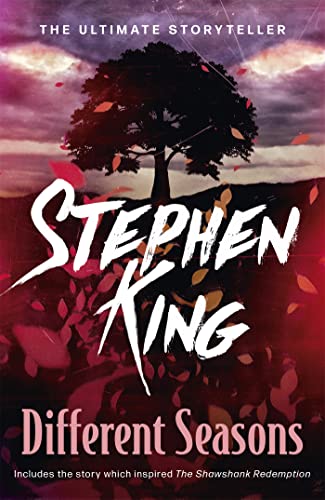
Different Seasons
by Stephen King
- Author:
- Stephen King
- Status:
- Done
- Format:
- eBook
- Reading Time:
- 14:40
- Pages:
- 688
- Highlights:
- 28
Highlights
Page 32
He always fought back, and as a result, he did his time in solitary. But I don’t think solitary was the hardship for Andy that it was for some men. He got along with himself.
Page 37
Now what the hell was this, I was wondering as I slipped the cover from the box. There was a lot of white cotton inside, and below that … I looked for a long time. For a few minutes it was like I didn’t even dare touch them, they were so pretty. There’s a crying shortage of pretty things in the slam, and the real pity of it is that a lot of men don’t even seem to miss them. There were two pieces of quartz in that box, both of them carefully polished. They had been chipped into driftwood shapes. There were little sparkles of iron pyrities in them like flecks of gold. If they hadn’t been so heavy, they would have served as a fine pair of men’s cufflinks – they were that close to being a matched set.
Page 40
I have seen some screws that I thought were almost saintly, and I think I know why that happens – they are able to see the difference between their own lives, poor and struggling as they might be, and the lives of the men they are paid by the state to watch over. These guards are able to formulate a comparison concerning pain. Others can’t, or won’t. For Byron Hadley there was no basis of comparison. He could sit there, cool and at his ease under the warm May sun and find the gall to mourn his own good luck while less than ten feet away a bunch of men were working and sweating and burning their hands on great big buckets filled with bubbling tar, men who had to work so hard in their ordinary round of days that this looked like a respite. You may remember the old question, the one that’s supposed to define your outlook on life when you answer it. For Byron Hadley the answer would always be half empty, the glass is half empty.
Page 50
In 1952 Brooksie, who had killed his wife and daughter after a losing streak at poker back when Coolidge was President, was paroled. As usual, the state in all its wisdom had let him go long after any chance he might have had to become a useful part of society was gone. He was sixty-eight and arthritic when he tottered out of the main gate in his Polish suit and his French shoes, his parole papers in one hand and a Greyhound bus ticket in the other. He was crying when he left. Shawshank was his world. What lay beyond its walls was as terrible to Brooks as the Western Seas had been to superstitious 13th-century sailors. In prison, Brooksie had been a person of some importance. He was the head librarian, an educated man. If he went to the Kittery library and asked for a job, they wouldn’t give him a library card. I heard he died in a home for indigent old folks up Freeport way in 1952, and at that he lasted about six months longer than I thought he would. Yeah, I guess the state got its own back on Brooksie, all right. They trained him to like it inside the shithouse and then they threw him out.
Page 81
‘Why?’ Andy repeated. ‘Can’t you tell me why you did it? You knew I wasn’t going to talk about … about anything you might have had going. You knew that. So why?’ ‘Because people like you make me sick,’ Norton said deliberately. ‘I like you right where you are, Mr Dufresne, and as long as I am warden here at Shawshank, you are going to be right here. You see, you used to think that you were better than anyone else. I have gotten pretty good at seeing that on a man’s face. I marked it on yours the first time I walked into the library. It might as well have been written on your forehead in capital letters. That look is gone now, and I like that just fine. It is not just that you are a useful vessel, never think that. It is simply that men like you need to learn humility. Why, you used to walk around that exercise yard as if it was a living room and you were at one of those cocktail parties where the hellbound walk around coveting each others’ wives and husbands and getting swinishly drunk. But you don’t walk around that way anymore. And I’ll be watching to see if you should start to walk that way again. Over a period of years, I’ll be watching you with great pleasure. Now get the hell out of here.’ ‘Okay. But all the extracurricular activities stop now, Norton. The investment counselling, the scams, the free tax advice. It all stops. Get H & R Block to tell you how to declare your extortionate income.’ Warden Norton’s face first went brick-red … and then all the colour fell out of it. ‘You’re going back into solitary for that. Thirty days. Bread and water. Another black mark. And while you’re in, think about this: if anything that’s been going on should stop, the library goes. I will make it my personal business to see that it goes back to what it was before you came here. And I will make your life … very hard. Very difficult. You’ll do the hardest time it’s possible to do. You’ll lose that one-bunk Hilton down in Cellblock 5, for starters, and you’ll lose those rocks on the windowsill, and you’ll lose any protection the guards have given you against the sodomites. You will … lose everything. Clear?’ I guess it was clear enough.
Page 83
Andy would give his stones and his rock-sculptures away from time to time in order to make room for new ones. He gave me the greatest number, I think – counting the stones that looked like matched cufflinks, I had five. There was one of the mica sculptures I told you about, carefully crafted to look like a man throwing a javelin, and two of the sedimentary conglomerates, all the levels showing in smoothly polished cross-section. I’ve still got them, and I take them down every so often and think about what a man can do, if he has time enough and the will to use it, a drop at a time.
Note: the will to use the time
Page 121
So I think – wild guess or not – that Andy just froze in place for a while. After all, you can’t lose if you don’t bet. What did he have to lose, you ask? His library, for one thing. The poison peace of institutional life, for another. Any future chance to grab his safe identity.
Page 123
There are others here like me, others who remember Andy. We’re glad he’s gone, but a little sad, too. Some birds are not meant to be caged, that’s all. Their feathers are too bright, their songs too sweet and wild. So you let them go, or when you open the cage to feed them they somehow fly out past you. And the part of you that knows it was wrong to imprison them in the first place rejoices, but still, the place where you live is that much more drab and empty for their departure.
Page 131
Get busy living or get busy dying.
Page 132
Sure I remember the name. Zihuatanejo. A name like that is just too pretty to forget. I find I am excited, so excited I can hardly hold the pencil in my trembling hand. I think it is the excitement that only a free man can feel, a free man starting a long journey whose conclusion is uncertain. I hope Andy is down there. I hope I can make it across the border. I hope to see my friend and shake his hand. I hope the Pacific is as blue as it has been in my dreams. I hope.
Page 161
‘Oh, I know how the Americans have distorted that,’ Dussander muttered. ‘But your own politicians make our Dr Goebbels look like a child playing with picture books in a kindergarten. They speak of morality while they douse screaming children and old women in burning napalm. Your draft-resisters are called cowards and “peaceniks”. For refusing to follow orders they are either put in jails or scourged from the country. Those who demonstrate against this country’s unfortunate Asian adventure are clubbed down in the streets. The GI soldiers who kill the innocent are decorated by Presidents, welcomed home from the bayoneting of children and the burning of hospitals with parades and bunting. They are given dinners, Keys to the City, free tickets to pro football games.’ He toasted his glass in Todd’s direction. ‘Only those who lose are tried as war criminals for following orders and directives.’ He drank and then had a coughing fit that brought thin colour to his cheeks.
Page 188
He crushed out his cigarette, lay looking at the ceiling for a moment, and then swung his feet out onto the floor. He and the boy were loathesome, he supposed, feeding off each other … eating each other. If his own belly was sometimes sour with the dark but rich food they partook of in his afternoon kitchen, what was the boy’s like? Did he sleep well? Perhaps not. Lately Dussander thought the boy looked rather pale, and thinner than when he had first come into Dussander’s life.
Note: nice analogy
Page 226
Todd stared at him – only for a moment before dropping his eyes and fumbling his algebra text out of his bookbag – and Dussander saw murder in the boy’s eyes. Not figurative murder; literal murder. It had been years since he had seen that dark, burning, speculative glance, but one never forgot it. He supposed he would have seen it in his own eyes if there had been a mirror at hand on the day he had looked at the white and defenceless nape of the boy’s neck. I must protect myself, he thought with some amazement. One underestimates at one’s own risk.
Page 230
‘And if you can’t find a suitable home for them within sixty days, they are destroyed?’ ‘We put them to sleep, yes.’ ‘Put them to … ? I’m sorry, my English –’ ‘It’s a city ordinance,’ Dave said. ‘Can’t have dog-packs running the streets.’ ‘You shoot them.’ ‘No, we give them gas. It’s very humane. They don’t feel a thing.’ ‘No,’ Mr Denker said. ‘I am sure they don’t.’
Page 343
He could have forged his mother or father’s name to the Flunk Cards he had been issued during his bad patch. Lots of kids discovered a latent forging ability when they got Flunk Cards.
Note: warning slip lol
Page 385
The most important things are the hardest things to say. They are the things you get ashamed of, because words diminish them – words shrink things that seemed limitless when they were in your head to no more than living size when they’re brought out. But it’s more than that, isn’t it? The most important things lie too close to wherever your secret heart is buried, like landmarks to a treasure your enemies would love to steal away. And you may make revelations that cost you dearly only to have people look at you in a funny way, not understanding what you’ve said at all, or why you thought it was so important that you almost cried while you were saying it. That’s the worst, I think. When the secret stays locked within not for want of a teller but for want of an understanding ear.
Note: Poetic
Page 402
I picked up the Bikes to have something to do with my hands and started box-shuffling them. That and how to play cribbage was about all I got for older brother stuff from Dennis. The other kids envied that shuffle, and I guess everyone I knew had asked me to show them how it went … everyone except Chris. I guess only Chris knew that showing someone would be like giving away a piece of Dennis, and I just didn’t have so much of him that I could afford to pass pieces around.
Page 403
Chris was smart, really smart, but he played truant a lot, and Mr Halliburton, the town truant officer, was always showing up at Chris’s house, driving his old black Chevrolet with the NO RIDERS sticker in the corner of the windshield. If Chris was being truant and Bertie (as we called him – always behind his back, of course) caught him, he would haul him back to school and see that Chris got detention for a week. But if Bertie found out that Chris was home because his father had beaten the shit out of him, Bertie just went away and didn’t say boo to a cuckoo-bird. It never occurred to me to question this set of priorities until about twenty years later.
Page 464
‘Hey, man …’ Vern said in a very thin voice. Chris and I looked at Vern hopefully. ‘Hey, man’ was always a good start. But Vern couldn’t follow it up.
Page 484
Nowadays writing is my work and the pleasure has diminished a little, and more and more often that guilty, masturbatory pleasure has become associated in my head with the coldly clinical images of artificial insemination: I come according to the rules and regs laid down in my publishing contract. And although no one is ever going to call me the Thomas Wolfe of my generation, I rarely feel like a cheat: I get it off as hard as I can every fucking time. Doing less would, in an odd way, be like going faggot – or what that meant to us back then. What scares me is how often it hurts these days. Back then I was sometimes disgusted by how damned good it felt to write. These days I sometimes look at this typewriter and wonder when it’s going to run out of good words. I don’t want that to happen. I guess I can bear the pain as long as I don’t run out of good words, you know?
Page 496
But if Travis had redoubled, Lard Ass had trebled. Blueberries flew from his second pie-dish, staining the tablecloth around him like a Jackson Pollock painting. There were blueberries in his hair, blueberries in his bib, blueberries standing out on his forehead as if, in an agony of concentration, he had actually begun to sweat blueberries.
Note: Pure Poetry
Page 509
‘They decide all of that in the office. And in their smart little conferences. The teachers, they sit around in this big circle-jerk and all they say is Yeah, Yeah, Right, Right. All they give a fuck about is whether you behaved yourself in grammar school and what the town thinks of your family. All they’re deciding is whether or not you’ll contaminate all those precious college-course dootchbags. But maybe I’ll try to work myself up. I don’t know if I could do it, but I might try. Because I want to get out of Castle Rock and go to college and never see my old man or any of my brothers again. I want to go someplace where nobody knows me and I don’t have any black marks against me before I start. But I don’t know if I can do it.’ ‘Why not?’ ‘People. People drag you down.’ ‘Who?’ I asked, thinking he must mean the teachers, or adult monsters like Miss Simons, who had wanted a new skirt, or maybe his brother Eyeball who hung around with Ace and Billy and Charlie and the rest, or maybe his own Mom and Dad. But he said: ‘Your friends drag you down, Gordie. Don’t you know that?’ He pointed at Vern and Teddy, who were standing and waiting for us to catch up. They were laughing about something; in fact, Vern was just about busting a gut. ‘Your friends do. They’re like drowning guys that are holding on to your legs. You can’t save them. You can only drown with them.’
Page 522
It was on the tip of my tongue to tell them about the deer, but I ended up not doing it. That was one thing I kept to myself. I’ve never spoken or written of it until just now, today. And I have to tell you that it seems a lesser thing written down, damn near inconsequential. But for me it was the best part of that trip, the cleanest part, and it was a moment I found myself returning to, almost helplessly, when there was trouble in my life – my first day in the bush in Viet Nam, and this fellow walked into the clearing where we were with his hand over his nose and when he took his hand away there was no nose there because it had been shot off; the time the doctor told us our youngest son might be hydrocephalic (he turned out just to have an oversized head, thank God); the long, crazy weeks before my mother died. I would find my thoughts turning back to that morning, the scuffed suede of her ears, the white flash of her tail. But five hundred million Red Chinese don’t give a shit, right? The most important things are the hardest to say, because words diminish them. It’s hard to make strangers care about the good things in your life.
Page 529
I only shook my head, wanting to tell him not to apologize, wanting to tell him that you didn’t have to come to the Apple and ride the ferry to see used rubbers, wanting to say: The only reason anyone writes stories is so they can understand the past and get ready for some future mortality; that’s why all the verbs in stories have -ed endings, Keith my good man, even the ones that sell millions of paperbacks. The only two useful artforms are religion and stories.
Page 580
I was out of school when I read about it in the paper – Chris had been finishing his second year of graduate studies. Me, I had been married a year and a half and was teaching high school English. My wife was pregnant and I was trying to write a book. When I read the news item – STUDENT FATALLY STABBED IN PORTLAND RESTAURANT – I told my wife I was going out for a milkshake. I drove out of town, parked, and cried for him. Cried for damn near half an hour, I guess. I couldn’t have done that in front of my wife, much as I love her. It would have been pussy.
Page 673
None of them has been published previous to this book; none has even been submitted for publication. Why? Because each of them comes out to 25,000 to 35,000 words – not exactly, maybe, but that’s close enough to be in the ballpark. I’ve got to tell you: 25,000 to 35,000 words are numbers apt to make even the most stout-hearted writer of fiction shake and shiver in his boots. There is no hard-and-fast definition of what either a novel or a short story is – at least not in terms of word-count – nor should there be. But when a writer approaches the 20,000-word mark, he knows he is edging out of the country of the short story. Likewise, when he passes the 40,000-word mark, he is edging into the country of the novel. The borders of the country between these two more orderly regions are ill-defined, but at some point the writer wakes up with alarm and realizes that he’s come or is coming to a really terrible place, an anarchy-ridden literary banana republic called the ‘novella’ (or, rather too cutesy for my taste, the ‘novelette’). Now, artistically speaking, there’s nothing at all wrong with the novella. Of course, there’s nothing wrong with circus freaks, either, except that you rarely see them outside of the circus. The point is that there are great novellas, but they traditionally only sell to the ‘genre markets’ (that’s the polite term; the impolite but more accurate one is ‘ghetto markets’).
Page 675
There are still magazines that publish long fiction – Atlantic Monthly and The New Yorker are two which have been particularly sympathetic to the publication problems of a writer who has delivered (we won’t say ‘gotten’; that’s too close to ‘misbegotten’) a 30,000-word novella. But neither of these magazines has been particularly receptive to my stuff, which is fairly plain, not very literary, and sometimes (although it hurts like hell to admit it) downright clumsy.
Note: self deprecating honesty
Page 676
To some degree or other, I would guess that those very qualities – unadmirable though they may be – have been responsible for the success of my novels. Most of them have been plain fiction for plain folks, the literary equivalent of a Big Mac and a large fries from McDonald’s. I am able to recognize elegant prose and to respond to it, but have found it difficult or impossible to write it myself
Note: Self aware