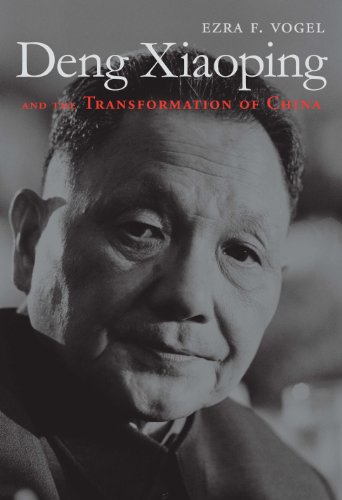
Deng Xiaoping and the Transformation of China
by Ezra Vogel
- Author:
- Ezra Vogel
- Status:
- Done
- Format:
- eBook
- Reading Time:
- 37:29
- Pages:
- 928
- Highlights:
- 183
Review
Deng was the paramount leader of China from 1978 to 1989, overseeing huge internal changes and setting the direction for the next 25 years. Many of the decisions the Chinese government has taken since then make sense when viewed from the lens of Deng’s philosophy. Since I’ve never read any other book about Chinese history, I found this eye opening.
Highlights
Page 2
Some officials were bold enough to suggest that the real cause of the problems China was facing was Mao Zedong himself, but Deng believed that a single person should not be held responsible for the failures of the previous two decades. “We are all to blame,” he said. Mao had made huge mistakes, certainly, but in Deng’s view the larger problem was the faulty system that had given rise to those mistakes. The effort to gain control of the political system down to the household had overreached, creating fear and lack of initiative. The effort to gain control of the economic system had also overreached, causing rigidities that stymied dynamism. How could China’s leaders loosen things up while keeping the country stable?
Note: people dont make mistakes, faulty systems do. deng understood this, clearly
Page 2
In 1978, Deng did not have a clear blueprint about how to bring wealth to the people and power to the country; instead, as he confessed, repeating a widely used saying—he “groped for the stepping stones as he crossed the river.”3 But he did have a framework for thinking about how to proceed.
Page 4
Once Mao was no longer alive to look over his shoulder, Deng was sufficiently sure of himself and his authority that with guests he could be relaxed, spontaneous, direct, witty, and disarmingly frank. At a state banquet in Washington in January 1979, when told by Shirley MacLaine about a Chinese intellectual who was so grateful for what he had learned about life after being sent to the countryside to raise tomatoes during the Cultural Revolution, Deng’s patience was soon exhausted. He interrupted her to say, “He was lying” and went on to tell her how horrible the Cultural Revolution had been.
Page 5
From his five years in France and one year in the Soviet Union, Deng acquired a far better understanding of developments around the world and far more perspective on China than Mao had garnered. Deng had a chance to see industry and commerce in a modern country, and his year in the Soviet Union gave him a chance to see how the first Communist country had tackled modernization.
Page 8
Deng had been hardened by seeing comrades die in battle and in intra-party purges. He had seen friends become enemies, and enemies become friends. Three times Deng had been purged, in the Jiangxi Soviet, in 1966 in the Cultural Revolution when he was subjected to blistering criticism, and in 1976. Deng had developed a steely determination. He had disciplined himself not to display raw anger and frustration and not to base his decisions on feelings but on careful analysis of what the party and country needed. Mao once described Deng as a needle inside a cotton ball, tough on the inside, soft on the outside, but many of Deng’s colleagues rarely sensed a ball of cotton.4 His colleagues did not believe he was unfair: unlike Chairman Mao, Deng was not vindictive—though when he judged that it was in the interest of the party, he would remove even those who had dedicated themselves to him and his mission.
Note: disciplined. i need to learn that control over emotions.
Page 13
Mao Zedong, a charismatic visionary, brilliant strategist, and shrewd but devious political manipulator, led the Communists to victory in the civil war and in 1949 unified the nation and eliminated most of the foreign-held territories. The military forces he had accumulated during the civil war were sufficiently strong that with the Communist Party’s organizational discipline and propaganda, he was able to establish in the early 1950s a structure that penetrated far more deeply into the countryside and into urban society than had the imperial system. He built up a unified national governing structure led by the Communist Party and, with Soviet help, began to introduce modern industry. By 1956, with both peace and stability at hand, Mao might have brought wealth and power to China. But instead he plunged the country into an ill-advised utopian debacle that led to massive food shortages and millions of unnatural deaths. In his twenty-seven years of rule, Mao destroyed not only capitalists and landlords, but also intellectuals and many senior officials who had served under him. By the time he died in 1976, the country was in chaos and still mired in poverty.
Note: if he had died in 1956 his legacy would hve been immense and wholly positive
Page 14
While hosting a delegation of U.S. university presidents in 1974, Deng said, “I have never attended a university, but I have always considered that since the day I was born, I have been in the university of life. There is no graduation date except when I go to meet God.”6 Throughout his life, Deng kept learning and solving problems. In the process, stepping stone by stepping stone, he guided the transformation of China into a country that was scarcely recognizable from the one he had inherited in 1978.
Note: never stop learning
Page 17
Xiaoping, a precocious teenager, joined the movement and with other students demonstrated on the streets of Guang’an. He also paraded in the anti-Japanese boycotts in Chongqing in the fall of 1919. The birth of Deng Xiaoping’s personal awareness of the broader world coincided precisely with the birth of national awareness among educated youth. From this moment on, Deng’s personal identity was inseparable from the national effort to rid China of the humiliation it had suffered at the hands of other countries and to restore it to a position of greatness, to make it rich and
Note: he personifies chinas rise
Page 28
Jiangxi, Deng developed an enormous admiration for Mao Zedong, who led a small band of followers as they fled from warlords in his native Hunan eastward across the mountainous area into the neighboring province of Jiangxi. As someone who had struggled to build and maintain a Communist base in Guangxi and failed, Deng understood the scope of Mao’s achievement in building a base. Not only did Mao need to find adequate provisions, he also had to keep the enemy at bay and win the support of the local population.
Note: mao was agood leader, a great commander
Page 29
In what would later be called “Deng’s first fall,” he was removed from his post as head of Hui-chang county, and, along with three other officials (Mao’s brother, Mao Zetan, and Gu Bo), subjected to severe criticism, then sent away for punishment. Indeed Deng was bitterly attacked for being the leader of a “Mao faction.” Moreover, Deng’s second wife, Ah Jin, joined in the attack, left Deng, and married one of his accusers, Li Weihan, whom Deng had known in France. Fortunately, another acquaintance from France, Li Fuchun, then Jiangxi provincial party secretary, brought Deng back from his several months of punishment to work as the head of Jiangxi province’s propaganda department. Deng Rong reports that friends of her father regarded him as a cheerful, fun-loving extrovert before the heavy blows of 1930–1931: the death of his first wife and child, serious criticism and demotion in the party, and divorce by his second wife. After the string of tragedies and setbacks, he became more subdued, less talkative. He couldn’t know then that in the long run, being attacked and punished as the head of a “Mao faction” would prove to be a blessing for his career, because it gave Mao lasting confidence in Deng’s loyalty. Even when Mao directed the radicals to attack Deng in later years, he never allowed Deng to be expelled from the party.
Page 38
While playing the central role in leading the daily work of the party, Deng could see firsthand how Mao weighed the issues facing China and how he made decisions affecting the country. In his later years Mao was to commit devastating errors, yet he remained a brilliant political leader with deep insight and bold strategies. In addition, as Kissinger was later to consider Premier Zhou Enlai one of the greatest leaders he ever encountered, Deng could see how this great master, whom he had known well in Paris and Shanghai, dealt with foreign relations and with managing overall government activity. By taking part in top-level meetings with both Mao and Zhou, Deng had an opportunity to learn how China’s two greatest leaders of their generation assessed the major issues facing the country. Further, as a participant in the building of new organizations, Deng had the chance to see the logic of major decisions and to consider the broader framework of fundamental changes, experiences that would serve him well as he endeavored to rebuild China’s economic and political framework in the 1980s.
Note: he got first hand exerience as an apprentice so he didnt repeat thd same mistakes
Page 39
In February 1956, for instance, he was the political leader of the Chinese delegation to Moscow for the 20th Soviet Party Congress, when Khrushchev denounced Stalin. Like other foreign comrades attending the congress, Deng was not allowed to attend the session in which Khrushchev made his speech, but he was allowed to read the text of that speech the next day. Deng, who was shrewd enough to recognize immediately that the speech had not just domestic but also international implications, assigned two interpreters to work all night to translate the speech, even as he also carefully avoided addressing the content of the speech until Mao decided how to respond. He therefore returned to Beijing and reported on the speech to Mao (who was vulnerable to many of the same criticisms made of Stalin), and Mao made the decisions about how to proceed.28 Deng was immediately aware that the massive criticism of Stalin would affect those who worked with Stalin and weaken the authority of the Soviet Communist Party.
Note: consequences of the speech
Page 40
Beginning in the spring of 1957, many intellectuals and leaders of the minority parties, who had been encouraged to speak out in the campaign to “let a hundred flowers bloom and a hundred schools of thought contend,” surprised Mao with the depth of their criticism. Mao lashed back at those “bourgeois intellectuals” who could not erase their class origins even though capitalism had already been eliminated. In the summer of 1957, Mao launched the “anti-rightist campaign” to discredit all those who had been so critical of the party. During the campaign, which Mao tapped Deng to manage, Mao led a vicious attack on some 550,000 intellectual critics branded as rightists. Deng, who during the Hundred Flowers period had told local party officials to listen to criticism and not to fight back, was disturbed that some intellectuals had arrogantly and unfairly criticized officials who were trying to cope with their complex and difficult assignments. During the anti-rightist campaign, Deng strongly supported Mao in defending the authority of the party and in attacking the outspoken intellectuals. These attacks, and Deng’s role in them, would not be forgotten by China’s intellectual elite. The anti-rightist campaign destroyed many of China’s best scientific and technical minds and alienated many others. Critics who might have restrained Mao from launching his Great Leap Forward, a utopian ill-conceived and brutally implemented effort to transform the economy and society of China within only a few years, were too frightened to speak out. Beginning with the Great Leap Forward, Mao consulted his officials less often than previously. Many loyal Maoists were also silenced.
Note: beginning of the end for mao
Page 41
Deng, like many other party loyalists, aware of Mao’s unwillingness to tolerate dissent during the Great Leap Forward, restrained himself from criticizing Mao. Furthermore, he and others believed that Mao’s decisions during the civil war and during the unification of the country had so often proved correct that they should suspend their doubts and just carry out his orders. Deng Xiaoping later told his daughter Deng Rong that he regretted not doing more to stop Mao from making such grievous errors.
Page 42
And in 1960–1961 Deng played an active role in making realistic adjustments in industry, agriculture, education, and other sectors to retrench from the excesses of the Great Leap. At the time, Mao did not criticize these realistic adjustments, but later he complained that when he was talking, Deng would sit in the back of the room and not listen. Mao grumbled that the officials under him were treating him like a departed ancestor, offering respect but not listening to what he said.
Note: what a metaphor lmao
Page 50
After lunch, Deng and Zhuo Lin took naps, then read from among the books they had brought with them—some classic Chinese history books, novels like Dream of the Red Chamber and Water Margin, and translations of Russian and French literature.
Note: i see he is a man of culture
Page 51
Whatever Mao intended for Deng in Jiangxi, it proved to be an opportunity for Deng to gain distance from the intense political turmoil in Beijing when those under suspicion were preoccupied with how to defend against the next unpredictable and potentially devastating attack. Like Churchill, de Gaulle, Lincoln, and other national leaders who fell from high positions and then spent time in the wilderness before returning to high office, Deng found that the time away from daily politics enabled him to achieve clarity about major, long-term national goals. It is hard to imagine that after 1977 Deng could have moved so deftly and forcefully had he not had a considerable length of time to ponder the nature of the reforms that China needed and how to achieve them. Just as Mao drew on his time in isolated Yan’an to consider overall strategies to pursue when the Communists took over the country, so Deng used his time in Jiangxi to consider directions he would pursue to achieve reform. But Mao in Yan’an, in formulating his policies, held daily discussions with his comrades and his assistants and with their help wrote essays. Deng in Jiangxi thought through things alone and kept his ideas to himself.
Note: fruit of solitude
Page 53
In mid-1969 when Deng Nan was allowed to visit her parents while they were still in Beijing, she told them what had happened to Pufang. Deng Rong reports that when her parents learned of their son’s permanent paralysis, Zhuo Lin cried for three days and nights while Deng sat in silence, smoking cigarettes one after
Page 54
Having been in Moscow in 1956 when Khrushchev denounced Stalin, Deng was fully aware that Khrushchev’s emotional attack had devastated the Soviet Communist Party and all those who had worked with Stalin. Although the Chinese press was filled with criticisms of Deng that portrayed him as China’s Khrushchev, long before he was sent to Jiangxi Deng had already decided that he would not be China’s Khrushchev. The question was how to manage the awe and respect that Mao evoked from the masses, the fury of those whose careers and lives had been ruined by Mao, and the awareness among many party officials of the severity of Mao’s errors. How could Deng preserve the party’s aura of providing correct leadership and avoid tainting those who had worked with Mao, even as he changed Mao’s economic and social policies? All evidence points to Deng’s having resolved in his own mind by the time he returned from Jiangxi the basic approach he would take for dealing with the problem. Chinese leaders should praise Mao and keep him on a pedestal. But they also should interpret Mao’s teachings not as a rigid ideology, but as a successful adaptation to the conditions of the time—an interpretation that would give Mao’s successors the leeway to adapt to new conditions.
Note: till date, the ccp maintains praise of mao. its the opiate that engenders support of the ccp
Page 55
By 1969 other Asian countries were also beginning to take off economically, including not only South Korea, but also places with ethnic Chinese populations—Taiwan, Hong Kong, and Singapore. Some Chinese, seeing how far China had fallen behind Europe, expressed doubts that the Chinese tradition was compatible with modernization. But if people who were ethnically and culturally Chinese could modernize, why couldn’t China grow just as quickly?
Note: fair point
Page 60
The revelations about Lin Biao were very sudden. I was shocked and angered to learn of the despicable crimes… Had it not been for the brilliant leadership of the Chairman and the Central Committee and the early exposure and quick disposition, the plot might have succeeded… In keeping with your instructions I have been reforming myself through labor and study… I have no requests for myself, only that some day I may be able to do a little work for the Party. Naturally, it would be some sort of technical job… I am longing for a chance to pay back by hard work a bit of what I
Note: perfect
Page 73
Mao also ranked high among world leaders in paranoid suspicions of others plotting to usurp power, but it was not unreasonable to worry that if Zhou Enlai were to survive him, he might abandon Mao’s commitment to class struggle and the continuing revolution and reduce the glorification of Mao in the official history of the era.61 For his extraordinary skills and prodigious memory in managing government activities and foreign relations, Zhou was by then almost indispensable, especially to China’s emerging relationship with the United States and other Western countries. It was well known in high circles that Mao did not like Zhou, but he needed him. Zhou Enlai had developed a large number of internal spies who worked under him in Shanghai in the 1930s and whose identity remained secret; they remained intensely loyal to Zhou, and Mao was cautious about removing someone who commanded such a large secret network of supporters. Zhou Enlai, unlike Liu Shaoqi and Lin Biao, had taken extraordinary care over the years not to threaten Mao’s power. Nonetheless, by 1973, although it could not be said publicly, it was not difficult for Mao to discern that among many high-level officials, Zhou was thought of as the good leader—the one who struggled to keep order, show consideration for others, and rein in the wild schemes of the bad leader.
Page 73
Mao’s problem with Zhou was less a concern that Zhou might try to seize power, and more that Zhou’s reputation might rise at the expense of his own and that Zhou might be too soft on the United States. These problems would be especially severe if Zhou were to survive him. Consequently, when Nancy Tang and Wang Hairong reported to Mao the lavish praise that the foreign press was heaping on “Zhou Enlai’s foreign policy” for improving U.S.-China relations, Mao was livid.62 It should be known as Mao’s foreign policy, not Zhou’s. Starting around this time, then, Mao began finding ways to weaken Zhou’s reputation and to ensure that the person who took over Zhou’s work as his cancer advanced would be loyal to Mao, not to Zhou.
Page 79
Deng knew very well that what he said at the meetings to criticize Zhou would be reported to Mao by the two ladies. Near the end of the meetings, Deng said to Zhou, “You are only one step away from the Chairman. Others could hope for such a position, but it would be unattainable; for you it is attainable. I hope you will take this as an adequate warning.”84 On the surface Deng’s words may not have seemed vicious, but in the context they were damning. In effect, Deng had implied that there was a danger Zhou might try to upstage Mao and usurp his role. When the two ladies reported Deng’s comments to Mao, Mao was thrilled, and immediately invited Deng in for a talk.
Note: i dont understand or appreciate the meaning of that
Page 83
Mao’s decision to send Deng to the United Nations was made at the last minute. Foreign Minister Qiao Guanhua was given scarcely a week to prepare the speech. When Qiao, who was thoroughly familiar with Mao’s views, completed a draft of the speech, he sent it to Mao, who wrote, “Good. Approved.”95 Qiao’s speech, which Deng read to the United Nations, basically represented Mao’s new view of the world as one in which nations were allied not by their commitment to the Communist revolution, but by their economic development: he described them as first-world, second-world, and third-world countries. Against this background, Mao, through Qiao and Deng, described how although he had hoped the United States would join China to oppose the Soviet Union, recent setbacks—notably, the Brezhnev visit to Washington—convinced him that the United States and the Soviet Union were scheming together. Mao was now hoping to unite the developed countries of the second world and the developing countries of the third world against the two superpowers.
Page 84
Deng’s speech to the United Nations was received with an unusually long period of applause. Because of its size and potential, China was seen as a rallying force among the developing countries. The delegates of the developing countries were especially pleased with Deng’s statement that China would never become a tyrant and that if it were to ever oppress or exploit others, then the rest of the world, especially the developing countries, should expose China as a “social imperialist” country and, in cooperation with the Chinese people, overthrow the government.
Page 85
Kissinger later compared Deng’s direct style with the subtle, polished, and urbane manner of Zhou Enlai. Noting Deng’s unfamiliarity with some of the global issues raised in the discussion, his frequent references to Mao, and his passing questions on to Qiao Guanhua, Kissinger said that Deng seemed to be on a “training mission.” Deng’s cautious manner in 1974 was to be in striking contrast to his confidence in meetings with foreigners beginning in mid-1978 after he was more experienced in meeting foreign leaders and Mao was no longer alive to receive reports of Deng’s comments.
Page 85
Zhou’s name was never mentioned by any member of the Chinese delegation to the United Nations. In fact, several friendly references from Kissinger to Deng concerning Zhou went unacknowledged. When Deng said that Confucius was conservative and that to emancipate people’s thinking, Confucius needed to be criticized, Kissinger asked if that view had any practical relevance for contemporary individuals. Deng replied that criticism of a conservative ideology does in fact have implications for those individuals who represent those ideologies.103 The message, though indirect, was loud and clear. Deng was not assisting Zhou but replacing
Page 92
Wang Hongwen and Deng Xiaoping would formally carry on the work as top leaders in the party and government, but they remained in effect apprentices to Mao and Zhou, who retained the titles of chairman and premier until their deaths. Wang and Deng would continue to receive directions from the two senior leaders, and Mao retained the power to replace them at any time if he was dissatisfied with their performance.
Note: very lucky that the illnesses allowed long slow transitions
Page 96
The key to organizing an effective national government, Deng believed, was not changing laws and rules but locating and empowering a team of leaders in every administrative unit. To provide capable direction based on good grassroots information, it was essential that, at each level, officials would choose able and reliable leaders for the next level below. In Deng’s view, for organizational reliability, a team of leaders was better than a single leader, no matter how able. Something might happen to one leader, but if there were a small team, then others would be ready to take over if problems arose. Ideally, these leadership team members would not only be able to provide overall leadership when needed but would also develop specialized knowledge in the areas to which they were assigned—for example, industry, culture, or political-legal work. In larger units as many as seven or eight leaders might constitute the team, in smaller units perhaps only two or three. The leaders would be given great leeway in how they went about their work as long as they met the goals set by the next higher-level units.
Page 100
After the new tables were completed, the units were responsible for managing the concrete reductions within their units, selecting who was to be retained and who was to be discharged.21 As always when dealing with controversial issues, Deng not only issued directives but also presented his rationale: he explained that with a limited national budget, the only way China could find money to invest in modern weapon systems was to cut personnel costs. Even those who worried that they themselves might be retired found it difficult to disagree with Deng’s logic.
Note: always give the rationale. it gets people on board
Page 105
Deng Xiaoping’s speech at the end of the conference of provincial secretaries38 was brief and to the point. It showed his firmness of purpose and was presented in a way that made it difficult for Mao to disagree even though Deng was constraining some revolutionaries. He quoted Mao by saying it was necessary “to make revolution, promote production, and other work and to ensure preparedness in the event of war.” If there were a war, transportation would be essential and at present the system did not function properly. To reassure those leaders who feared that they would continue to be attacked for paying too much attention to the economy, as they had been during the Cultural Revolution, Deng said, “Some comrades nowadays only dare to make revolution but not to promote production. They say that the former is safe but the latter is dangerous. This is utterly wrong.” He made it clear that Mao now supported the focus on the economy: “How can we give a boost to the economy? Analysis shows that the weak link at the moment is the railways.”39 Since railways were to be the model for civilian consolidation, Deng personally plunged into the details of the national railway problem. He stated that the estimated loading capacity nationally was 55,000 rail cars per day, but only a little more than 40,000 cars were being loaded daily. “The present number of railway accidents is alarming. There were 755 major ones last year, some of them extremely serious.” (By comparison, in 1964 there had been only eighty-eight accidents.) Discipline was poor and rules and regulations were not enforced: “Train conductors go off to eat whenever they like, and therefore the trains frequently run behind schedule,” for instance, and rules against consuming alcohol on duty were not strictly observed. In addition, “if we don’t take action now [against bad elements who speculate, engage in profiteering, grab power and money] … how much longer are we going to wait? … Persons engaging in factionalism should be reeducated and their leaders opposed.” To those participating in factions but who correct their mistakes, Deng said, “[We can] let bygones be bygones, but if they refuse to mend their ways, they will be sternly dealt with.” Meanwhile, “active factionalists must be transferred to other posts,” and if a factional ringleader refuses to be transferred, “stop paying his wages until he submits.” Switching to a more positive tone, Deng proclaimed, “I think the overwhelming majority” supports the decision. Railway workers are “among the most advanced and best organized sections of the Chinese working class… If the pros and cons are clearly explained to them, the overwhelming majority of railway personnel will naturally give their support… [and] the experience gained in handling the problems in railway work will be useful to the other industrial units.”40 This was vintage Deng. Paint the broad picture, tell why something needed to be done, focus on the task, cover the ideological…
Page 109
Deng could not spend as much time on other cases as he did on resolving the Xuzhou railway blockages, but the case illustrates Deng’s approach to overcoming chaos and the example others were to follow: he did what he could to make sure Mao remained on his side; he relied on officials with a proven record of success; he provided documents, held large mass meetings, and assigned troops to assure local people that there would be no easy return to Cultural Revolution policies; he arrested those who blocked progress; and he supervised the establishment of new leadership teams. Further, he did all this quickly and with a firm hand.
Note: deng provides direction. he implements in xuzhou, selects wan li and passes the reins to him
Page 110
During this time, improvements were also made in the production of fertilizer, light industrial goods, and electric power. Steel manufacturing, however, continued to lag. Steel production had peaked in 1973 at 25.3 million tons, but fell to 21.1 million tons in 1974, as a result of the disruptive campaign to criticize Lin Biao and Confucius.
Note: how did the campaign affect productivity?
Page 111
In early May, Vice Premier Li Xiannian assembled the party secretaries of twelve leading steel plants and of the local governments supervising these plants for a forum on the steel industry.59 There the leaders of steel plants that did not meet their targets had to explain to a critical audience why they were still underperforming. They explained that the officials who had been criticized during the campaign against Lin Biao and Confucius feared making political errors. They were afraid that there would be a reversion to Mao’s policies and that they would be punished for promoting economic expansion and productivity rather than emphasizing politics.
Page 112
Deng explained that it didn’t matter if they were forty-or even fifty-year veterans. “If there is a faction, we don’t care if it’s at a tiger’s rear end or a lion’s rear end. We aren’t afraid of stroking it… If people transferred out because of factionalism form factions again, they will be transferred again. If necessary we will transfer them 360 days a year. We will give you until July 1… If necessary, we will transfer you to Urumqi [in the far West where most officials dreaded being sent]. If the wife threatens divorce, maybe then he will
Note: haha
Page 113
In 1975, China produced 23.9 million tons of steel—a significant increase over the 21.1 million tons produced in 1974, but still short of the goal of 26 million tons. Deng accepted the improvement and declared victory. But from December 15 to December 23, 1975, when criticism of Deng was already beginning in small circles at the top, Gu Mu chaired a meeting of provincial-level officials responsible for steel production to discuss the problems. Despite the bravado at the meeting, top officials already knew that in the new political atmosphere, with Deng Xiaoping under siege, local officials had become more cautious about continuing their single-minded efforts to increase production. Indeed, in 1976—after Deng fell from power for the third time and was removed from all his positions—production fell to 20.5 million tons.
Page 116
The first clear hint that Mao intended to give Deng even more responsibilities came on April 18, 1975, when Mao invited Deng to join his meeting with Kim Il Sung. Mao said to Kim, “I won’t speak to you about political matters. I will let him talk to you about that. That person is named Deng Xiaoping. He can wage war, he can oppose revisionism. Red Guards attacked him, but now there are no problems. At that time, he was knocked down for some years, but now he is back again. We need
Page 116
Fearful about Deng’s growing influence with Mao due to his success in bringing order and economic progress, they had begun attacking him for paying too much attention to economic matters and too little attention to underlying principles, an argument that had previously appealed to Mao. But in April 1975, Mao reassuringly told Deng that these criticisms were excessive, noting that “in our party not many people understand Marxism-Leninism. Some people believe they understand it, but actually they don’t understand it… This issue should be discussed by the
Note: some people think they understand agile
Page 126
Some years after Mao’s death, Deng could boldly explain that China must borrow ideas from capitalist countries, and that doing so would not threaten its sovereignty or rule by the Communist Party. But Deng had been criticized during the Cultural Revolution for being too bourgeois, and in 1975 there was not yet a consensus about opening markets and learning from capitalist countries. So he did what he could to push at the margins. He promoted an expansion of foreign technology imports. He accepted the view of fellow officials that China should not borrow money from foreigners, but the country could make “delayed payments” when foreigners sent goods or capital to China.13 In addition, Deng supported giving material incentives to workers by offering to pay not according to need, but “according to work.” Even these modest efforts to modify the old system, however, frightened some conservative officials, who continued to argue fiercely about the need to adhere strictly to the principles of Mao Zedong.
Note: sounds like islamic banking. trying to do the modern fhing while paying lip service to the prophet
Page 139
Meanwhile, with Deng’s encouragement, Zhou Rongxin began drawing up a document to guide educational policy. A third draft was completed on November 12, after the criticism of Deng had begun. Yet the essential core of the document remained unchanged: persons trained from 1949 to 1966 would have the value of their educations affirmed (they would not be disparaged as “bourgeois intellectuals”); high-level specialized training was to be resumed; the amount of time spent in high school and university training would be increased; and overall educational standards were to be raised. Two days later, on November 14, Zhou Rongxin was summoned to a Politburo meeting where he was bitterly attacked for his proposals.56 The criticism of Zhou Rongxin was even more severe than the criticism of Deng. In December 1975 Zhou Rongxin was subject to continuous criticism until he fell ill and had to be taken to the hospital. Even so, he was taken from the hospital and subjected to more than fifty additional criticism sessions. Finally, at a criticism meeting on the morning of April 12, 1976, Zhou Rongxin fainted and before dawn the next day, at age fifty-nine, he passed away.57 For a time, Chinese educational reform also died.
Page 143
It was at this point that Mao took up the quotation in the fifth draft of the ten-year vision for the development of science under the CAS that he had objected to. It had quoted Mao as saying that “science and technology constitute a force of production.” After Mao looked it over, he said that he had not said that. To say that, he argued, would make science and technology as important as class struggle, an idea he could not accept. In Mao’s view, “class struggle is the key link.” After being called to task by Mao, Deng told Hu Qiaomu, who had been responsible for the draft document, to go back to the sources. When Hu Qiaomu checked, he found that Mao was correct—he had never uttered that expression. Hu Qiaomu had simply come across a similar idea in Mao’s works, and, as an editor, made slight alterations in the wording.69 Mao had allowed Deng to undo much of the damage done by the Cultural Revolution while clinging to the fig leaf of a belief that the Cultural Revolution was good. Now Deng was attacking the fig leaf. If while Mao was alive, Deng was already altering what Mao said and attacking Mao’s favorites at Tsinghua University, what might Deng do after Mao died?
Page 150
Mao and Deng both drew a line in the sand, but in preparing for a large meeting to be held on November 24, 1975, each still acted with some restraint. Mao was aware of the great progress that had been achieved during the year under Deng’s leadership, and he approved of much of what Deng had done. He knew that no one else could have provided as much stability as Deng, and that he had no good replacement for him. Furthermore, President Gerald Ford was expected to visit China between December 1 and December 5. Because Zhou Enlai was gravely ill, the previous month Deng had worked with Henry Kissinger to prepare for the Ford visit, and Mao knew of no other party leader versed in foreign policy who could so forcefully and skillfully present China’s views on sensitive issues such as U.S. support for Taiwan, the U.S. delay in recognizing China, and U.S. détente with the Soviet Union.
Page 164
Mao Yuanxin took the lead in organizing a conference sponsored by the Central Committee, at which provincial-level leaders and leaders of the large military regions joined in criticizing Deng. During this conference, held from late February to early March, many regional leaders first heard about Mao’s criticisms of Deng Xiaoping, based on materials collected by Mao Yuanxin. Mao had complained to his nephew that Deng’s linking of Mao’s “three directives” (to resist revisionism, encourage unity and stability, and boost the national economy) had neither been cleared by the Politburo nor reported to Mao. Mao had also protested that Deng’s use of the “white cat, black cat theory” (“it doesn’t matter if the cat is black or white as long as it catches the mouse”) did not make any distinction between imperialism and Marxism-Leninism; it reflected bourgeois thinking. Zhang Chunqiao chimed in that Deng was a representative of the monopoly capitalist class and that he was a revisionist at home and a capitulationist abroad.
Page 166
Just four days later, on March 30, the first wreaths honoring Zhou in Beijing began to appear at the Monument to the People’s Heroes in Tiananmen Square. Poems and essays honoring Zhou Enlai were posted, and speeches praising Zhou and attacking the Gang of Four began to attract crowds. Other posters expressed support for Deng Xiaoping, and some people placed little bottles on the street, because the Chinese word for “little bottle” is pronounced “xiao ping.”
Note: hahaha
Page 167
Roger Garside, a British embassy official who personally observed these developments, commented, As a memorial for Zhou, this people’s ceremony was more moving than any state funeral I have seen. As a political demonstration, it was utterly unlike anything I had ever seen in China … the crowds were acting out of conviction … expressing thoughts and feelings that had been flowing underground for years… There was … anger at what had been done to the legacy of Zhou … a spirit of revolt against Mao…apprehension for the future of China and defiance of those who would certainly seek to punish the demonstrators… The Mandate had been removed from
Page 175
Jiang Qing told her Western biographer Roxane Witke, “Sex is engaging in the first rounds, but what sustains interest in the long run is power.”58 She proudly announced after Mao’s death that she had been his most faithful dog, but she might have added “attack” before “dog” to indicate her specialty: she was unrivaled in her fearlessness in destroying targets that Mao identified. The educated public, aware of her origins, privately derided her as a courtesan and a second-class actress who had risen improperly. She lacked the confidence and grace of someone who had risen to power naturally; instead she displayed the haughtiness of one who had elbowed her way to the top. She was regarded as rude and inconsiderate even by people who worked for her. She displayed the elemental anger of someone who had been shunned by senior party officials since the 1940s; by serving Mao, she acquired the power to deliver payback, and she did so ruthlessly.
Page 176
Jiang Qing never acquired the vision, the organizational skills, or the ability to get the positive cooperation from other power holders that was needed to be a real contender for power. She had burned too many bridges, destroyed too many high officials, and alienated too many colleagues. She lacked the self-restraint to be part of a loyal opposition. She lacked support among senior party officials, who were far more skilled in organizing; within the military she had virtually no support outside the Political Department.
Page 182
The scholar Joseph Levenson describes the fate of Confucianism in the late imperial period: when it lost its vitality, Confucianism was still celebrated in the temples and museums, which people visited to pay homage, but it had lost its connection to people’s daily lives. Similarly, after Mao’s death and the arrest of the Gang of Four, Mao was still enshrined, and multitudes continued to visit the Mao Mausoleum in the center of Tiananmen Square. But radical Maoism, with its mass movements and class warfare, was no longer a part of the daily experience of the Chinese people. This process of separating radical Maoism from the people’s daily lives had in fact already begun under Mao when in 1974 he announced his support for national stability and unity. It continued under the leadership of Deng in 1975 and under Hua in early 1976. With the arrest of the Gang of Four, radical Maoism finally lost its last powerful advocates. The spontaneous celebrations after the announcement of the arrest of the Gang of Four, in addition to the outpouring on April 5, 1976, were powerful, visible symbols of the public’s s animus against the radical Maoism that had brought such chaos and destruction.
Page 183
The trial of the Gang of Four took shape as a giant national rite in which radical Maoism was blamed not on Mao but on the Gang of Four. In truth, many people, including some of the officials who were now celebrating the arrest and trial of the gang, had once shared the vision of radical Maoism and had even taken part in the efforts to realize the vision. Even so, the demise of the Gang of Four marked the end of an era, of hopes to reshape the world through continuing revolution and class struggle. The relief and excitement of the Chinese people at this turn of events was to translate into a deep base of support for pragmatic policies underlying reform and opening.
Page 184
Shortly after Hua was named premier and first vice chairman of the party in April 1976, Thomas Gates, head of the U.S. Liaison Office in Beijing, met with him for an hour and forty-five minutes. Gates’s staff wrote an assessment of Hua based on that meeting, which Gates signed, that proved remarkably prescient. It concluded that Hua was “an intelligent, colorless individual whose hallmark is caution. He handles his material well enough, but he gave off no sparks of unusual intellect or charisma. Hua came across as an ideal transition figure who is unlikely to take any dramatic steps in either internal or external affairs… I doubt Hua has the vision or the leadership qualities necessary to…
Note: goddamn oracle
Page 184
In keeping with a long-standing tradition in Chinese political history writing, which glorifies the victor and denigrates the vanquished, Deng has been credited with launching opening and reform, and Hua has been blamed for following everything Mao decided and directed. It is true that Hua’s rise to the highest level of leadership was a stretch for someone who had spent his career in a province and had little experience in Beijing, had no experience in foreign affairs, and had only limited experience in military affairs. In his first year of meetings with foreign leaders, Hua, cautious about making mistakes, understandably fell back on general statements of policy, vague platitudes, and safe slogans. Hua was bright and had been a good official, but he could not compare to Deng in overall ability and leadership qualities. In addition, he did not support the full-scale return of senior officials who had been brought back to work under Deng’s leadership, and he could not have provided the sure-footed bold leadership and achieved the good relations with foreign countries that Deng achieved. But many underestimated Hua and his commitment to reform. Later official histories understate Hua’s willingness to depart from the ways of Mao, as well as his support for the policy of opening China to the West. During his interregnum, which lasted from Mao’s death in September 1976 until the Third Plenum in December 1978, Hua in fact not only arrested the Gang of Four but abandoned radical Maoism, reduced the roles of ideology and political campaigns, focused on modernization more than class struggle, and regularized the scheduling of party meetings that had been held irregularly under Mao. Hua also sent delegation after delegation abroad to learn about modern technology. He—not Deng—launched…
Note: good balanced take
Page 188
Ever since Mao’s death, Hua had asserted that he was following Mao’s legacy and continuing his policies. But some ideologues and hardcore followers of Mao continued to criticize him for straying from Mao’s party line. To answer such critiques, Hua directed his supporters to prepare a theoretical article to show his commitment to the Maoist legacy. The resulting article appeared on February 7, 1977, as an editorial in the People’s Daily, Red Flag, and the PLA newspaper Jiefangjun bao. The editorial declared that whatever policies Mao supported, and whatever instructions Mao gave, should still be followed. The editorial became known as the “two whatevers,” Hua’s banner for showing that he was fully committed to Mao’s legacy.6 Hua apparently had not anticipated that it would become a target for those who believed that China needed to distance itself from the policies that Mao had pursued during the last two decades of his life.
Note: catch 22. his authority is derived from mao so he needs to display that bond in public. and then he gets criticised
Page 195
In response to the widespread support at the work conference for Deng’s return, Hua said, “When the rain falls, a channel for transporting the water is formed automatically” (shuidao qucheng), and “when the gourd is ripe, it falls off the vine” (guashu diluo). His meaning was clear: when nature was ready, a way for Deng to return to work would become apparent, but they shouldn’t try to rush it.
Note: clear as mud for someone who doesnt speak chinese
Page 195
Deng made it clear, meanwhile, that he would not support Hua’s “two whatevers.” On April 10, in a letter to Hua Guofeng, Marshal Ye, and the rest of the Central Committee, Deng laid out his views on the controversial editorial. He said that from generation to generation we should use a “correct” and “comprehensive” understanding of Mao’s thought to guide the Chinese party, army, and people.23 By using this clever formulation, Deng accepted the authority of Mao, while asserting, in effect, that Hua Guofeng was not the only one who had the authority to interpret Mao’s views; rather, any particular issue had to be seen in a broader context, and those senior party leaders who had worked with Mao far longer and more closely than Hua had were in a better position to judge Mao’s views in this “broader context.” Deng then thanked the Central Committee for clearing his name from involvement in the Tiananmen incident. He wrote that as for his personal work assignment, “what I do and when it is appropriate for me to start work, I will completely follow the considerations and the arrangements decided by the Party Center.” Deng suggested that his letter, as well as his October 10, 1976, letter to Hua Guofeng supporting Hua’s leadership, be circulated within the
Page 201
In 1957 Deng had been Mao’s right-hand man in implementing the attack on intellectuals, but he did not instinctively dislike them as Mao did. Mao, who denigrated them as “bourgeois intellectuals,” time and again found ways to humiliate them and to send them to be educated by performing physical labor. Deng never had an opportunity to study at a university, but he had once been on track to receive a higher education and made his best effort to enter a French university.
Page 204
Deng added that the ministry needed some twenty to forty people “about the age of forty whose duty it is to make the rounds of the schools… Like commanders going down to the companies, they should sit in on classes as pupils, familiarize themselves with the real situation, supervise the implementation of plans and policies, and then report back … we can’t afford to be satisfied with idle
Note: go see theeffects on the ground
Page 205
Deng, arguing that class background was no longer an issue since the bourgeois and landlord classes no longer existed, felt strongly that the sooner entrance examinations were reintroduced at every level from elementary school through higher education,
Note: haha. mission accomplished - we have eliminated class
Page 206
Some 5,780,000 people who had reached college age within the last decade, many of whom were still working in the countryside, took the test that fall, but there were then only 273,000 slots at the universities. In 1977 and 1978, then, only some 5.8 percent of those who took the examinations could actually be enrolled.61 For the first time since the Communists ruled China, class background was not a factor in selecting those to be admitted to university. Enrollment was entirely based on merit as measured by examination scores.
Page 219
From April to May 1978, officials from the State Planning Commission and the Ministry of Foreign Trade visited Hong Kong to evaluate its potential for assisting Chinese developments in finance, industry, and management. The officials explored the possibility of setting up in Bao’an county, Guangdong province, across the border from Hong Kong, an export processing zone—a place where materials could be brought from abroad to be manufactured by Chinese laborers and then exported without any tariffs or other restrictions. Within a few months, the State Council formally approved the establishment of such an area, which later would become the Shenzhen Special Economic Zone (SEZ). At the time, Guangdong was suffering from a real security problem: tens of thousands of young people each year were escaping to Hong Kong. When told of the problem during a visit to Guangdong in 1977, Deng explained that the solution lay not in tightening border security with more fencing and more border patrols but in improving the economy of Guangdong so young people would not feel that they had to flee to Hong Kong to find jobs.
Note: as usual deng is right
Page 223
The members of the group had expected to see evidence of exploitation of laborers, so they were stunned by the high standard of living of ordinary workers. Wang Quanguo, head of the State Planning Commission of Guangdong province, summarized their impressions as follows: “In a little over one month of inspection, our eyes were opened… . Everything we saw and heard startled every one of us. We were enormously stimulated… . We thought capitalist countries were backward and decadent. When we left our country and took a look, we realized things were completely different.”17 Delegation members were also taken aback by the willingness of Europeans to lend them money and to offer them modern technology. At one banquet alone, a group of Europeans announced they were prepared to lend as much as US$20 billion.18 The group was surprised as well by how the European countries gave local governments the freedom to handle their own finances, to collect their own taxes, and to make decisions about their own affairs. The group returned from abroad believing that Chinese finance was far too centralized, with not enough leeway given to more locally based party
Page 243
To praise Mao while still giving himself room to depart from some of his policies, Deng said, “Without [Mao’s] outstanding leadership, [we] would still not have triumphed even today… . Chairman Mao was not infallible or free from shortcomings … at an appropriate time they should be summed up and lessons should be drawn from them … however, there is no need to do so hastily.” He repeated his view that Mao had committed errors, that he himself had made errors, and that any leader who tries to accomplish things makes errors. Deng expressed the prevailing view at high levels that China’s two huge disasters, the Great Leap and the Cultural Revolution, were caused by a system that allows one person to dominate without any input from other voices. China therefore needed to develop a legal system so that a single individual, no matter how able, will not dominate. If laws are initially imperfect and incomplete, they can be made fair and just, step by step, over time.
Note: xi jinping disagrees
Page 244
Deng tried to anticipate some of the problems that would arise with the new policies and to diffuse the hard feelings of those who would be unhappy about them. He knew that inequalities would increase—that given the speed of change that was to come, and the many needs of the Chinese, “some will get rich first.” But, he said, others will have their opportunity later, and those who get rich first should help those who are initially left behind. He warned that problems would probably emerge that would be unfamiliar to him and other party leaders, but that the overall interests of the party and the state had to remain the priority: they must all “keep on
Page 244
To prepare for the many changes to come, Deng recommended that the party officials study three subjects in particular: economics, science and technology, and management. And he specified how officials would be evaluated: the party committee in an economic unit would be judged mainly by the unit’s adoption of advanced methods of management; by its progress in making technical innovations; by increases in productivity; and by its profits, measured in part by the personal income of its workers and the collective benefits it provides. The participants were eager for more specific guidance in this new environment. Although members ordinarily dispersed after the last major speech of a work conference, after Deng’s speech, the attendees agreed to extend the conference for two more days so that the small groups from the various regions could continue to discuss how they could implement the new directions Deng had
Page 247
In the annals of world political history, it would be difficult to find another case where a person became top leader of a major nation without formal public recognition of the succession. Before the work conference, Deng was vice chairman of the party, vice premier, and vice chairman of the CMC. After he became the preeminent leader at the Third Plenum, he was still vice chairman of the party, vice premier, and vice chairman of the CMC. Not only was Deng not given a coronation or an inauguration, there was not even a public announcement that he had risen to the top position. What peculiar combination of circumstances had created such an unusual situation and what were the consequences? At the time of the Third Plenum, Chinese leaders wanted to avoid giving the impression to the Chinese public and to the rest of the world that China was undergoing a power struggle. Hua Guofeng had just come to power in 1976, and the top leaders feared that an abrupt change of leadership could lead to domestic instability and hamper China’s efforts to attract foreign capital and technologies. Over the next thirty months, Deng did in fact push Hua Guofeng aside and become the unrivaled top leader, but he did so step by step, in a relatively orderly process that did not upset the Chinese public and the world at large. High-level officials who chose not to give Deng any new titles were also concerned about the dangers of concentrating the nation’s power in the hands of one person. They believed that the disasters of the Great Leap Forward and the Cultural Revolution had resulted from the arbitrary exercise of such unchecked power by Mao, who had held all formal positions. Had Hua Guofeng remained leader, this would not have been a worry. While Hua was in charge, Marshal Ye and others had been concerned not that he had too much power, but that he had too little power to govern effectively. With Deng Xiaoping, however, there was reason to be concerned. He was so confident, so decisive, so sure-footed that they worried he might become too much like his mentor, Mao Zedong. They decided, then, not to give him all the titles and to balance his power with that of an equal, Chen Yun. The strange arrangement of giving Deng authority without formal recognition worked because everyone knew what was going on, and because Deng himself was more interested in real power than in any formal job title. He readily accepted his responsibilities on an informal basis, without demanding public display.
Page 248
well. Hua also enjoyed the support of two senior counselors, Marshal Ye and Li Xiannian, who wanted a collective leadership and feared a dictatorship. In 1979 Hua was, in Western terms, a weak chairman of the board who could not dominate, but who still had allies and whose views could not be ignored. Deng did not then tower above Hua as the preeminent leader, and he had not yet put in place his personal team and his own governing structure. But Deng had the power, the leverage, and the political skill to weaken Hua’s power base. By mid-1979, Deng, who sought tighter control and a more effective governing structure, began to move step by step to weaken Hua and then push him aside. While the Third Plenum was elevating Deng, within a few hundred yards of Zhongnanhai demonstrators were putting up wall posters that both directly and indirectly supported Deng Xiaoping by criticizing Lin Biao and the Gang of Four; some even dared to criticize Mao himself. Before long, some wall posters were even criticizing the Communist Party and Deng Xiaoping. These wall posters were not just a thorn in Deng’s side; they also forced him to deal with an issue that was to plague him throughout his years as the top leader: How much freedom should be allowed? Where and how should party and government set the limits on public expressions of dissent?
Note: hard questions
Page 254
On December 13, shortly before the Central Party Work Conference ended, Deng took aside Yu Guangyuan, a staff member in his Political Research Office and one of the drafters of Deng’s speech for the Third Plenum, and asked him to prepare a speech supporting Xidan Democracy Wall. He said to Yu: “What is the harm of a little opposition?”10 Although People’s Daily did not report the events at Xidan, staff members at the newspapers who supported the wall published a bold editorial on January 3, 1979. It declared, “Let the people say what they wish. The heavens will not fall… . If people become unwilling to say anything, that would be too bad … the suffocation of democracy produces bad results.”11 By mid-January the comments on the wall were becoming increasingly political. On January 14, a column of people held banners that announced that they were “persecuted people from all over China.” Declaring “We want democracy and human rights,” they marched from Tiananmen Square to the gates of Zhongnanhai, where the most powerful party officials lived and worked. The marchers tried to enter the gates, but were stopped by armed soldiers. Roger Garside, a British diplomat who observed the protestors, described them as “the angriest group of people I have ever met.”
Note: we want feedback but not too much of it
Page 256
By then Democracy Wall had proved to be of great value to Deng politically: it had allowed people to give vent to their objections to the “two whatevers,” to the handling of the April 5 demonstrations, and to the errors of Chairman Mao, thus providing Deng more political room to follow a new path without having to take part in the attacks himself. In theory, Deng may have found democracy attractive as he was just taking over the reins of power; he encouraged more democratic discussion within the party. But when protestors attracted huge crowds and resisted basic rule by the Communist leadership, Deng moved decisively to suppress the challenge. As one provincial first party secretary later said, Deng’s view of democracy was like Lord Ye’s view of dragons. “Lord Ye loved looking at a book with pretty pictures of dragons (Yegong haolong), but when a real dragon appeared, he was terrified.” Although Hua was chairman of the party and premier, it was Deng who decided to curb the criticisms.
Page 256
Yu Guangyuan reported that Hu Yaobang, as an obedient official, publicly supported Deng’s decision, but officials who attended the opening sessions of the Theory Work Conference could see that Hu Yaobang personally believed that granting more freedoms would not endanger public order. When the wall was closed down, few among the general public dared to protest.19 Although many in the party firmly supported Deng’s action as necessary to prevent the chaos that had characterized the Cultural Revolution, other party officials, including many intellectuals, were deeply disturbed by Deng’s decision.20 In Yu Guangyuan’s view, Deng’s change from approving of the wall in mid-December to closing it down three months later was one of the key turning points in China after the death of
Page 262
In his influential major address, Deng laid out the four cardinal principles (jiben yuanze) to draw the line between what was acceptable and what was unacceptable. Writings should not challenge: (1) the socialist path, (2) the dictatorship of the proletariat, (3) the leadership of the Communist Party, and (4) Marxism-Leninism and Mao Zedong Thought. Deng continued to acknowledge that in some areas China could learn from the capitalist countries. He also recognized that a socialist country can make serious errors and suffer setbacks, such as those caused by Lin Biao and the Gang of Four. But he denied that China’s problems stemmed from socialism; in his view, they resulted instead from the long pre-Communist history of feudalism and imperialism. China’s socialist revolution had already narrowed the gap with the capitalist countries and would continue to do so. Moreover, a dictatorship of the proletariat would continue to be needed to counter forces hostile to socialism and to socialist public order—including counter-revolutionaries, enemy agents, and criminals—even as China allowed the practice of “socialist democracy,” which remained essential for modernization. Like modernization, Deng said, democratization could advance step by
Page 262
If anything was sacred for Deng, it was the Chinese Communist Party. He instinctively bristled at criticism of the party and emphasized that public criticism of the party would not be tolerated. He acknowledged that “Comrade Mao, like any other man, had his defects and made errors” but he argued that Mao Zedong Thought is the “crystallization of the experience of the Chinese people’s revolutionary struggle for over half a century.”
Page 282
Even if Vietnam penetrated deeply into Cambodia, China would not respond favorably to Pol Pot’s request to send troops to Cambodia as it had during the Korean War to help North Korea. Deng feared getting bogged down. Instead Deng decided China should “teach Vietnam a lesson” by invading, taking several county capitals to show that it could penetrate further, and then withdrawing quickly. This would also reduce the chance that the Soviet Union might send in troops to assist Vietnam. The Vietnamese would learn that the Soviet Union would not always come to its aid and that Vietnam should reduce its ambitions in the region. And by attacking Vietnam, not the Soviet Union, China would show the Soviet Union that any effort to build up its forces in the area would be very costly. Deng displayed confidence that Chinese troops, despite the toll the Cultural Revolution had taken on military training and discipline and despite their lack of battle experience, would be adequate to achieve his political goals against a more experienced and better-equipped enemy. Once Chinese troops had withdrawn, they would continue to harass Vietnamese forces along the border.
Note: its a bold move cotton
Page 283
Thailand, Malaysia, and Indonesia each had about five million ethnic Chinese, and leaders in all three countries feared that their ethnic Chinese populations might be more loyal to China than to their own country. The fear intensified during the Cultural Revolution when China began sending radio messages into those countries to encourage the local people to carry out revolution. At the time of Deng’s visit, these radio appeals had not yet stopped. The problem was most acute in Indonesia, where local Chinese had joined in the resistance to Sukarno that had nearly toppled his government. (Indonesia, furious, did not normalize relations with China until 1990.)
Note: madness. some of maos shit made no sense
Page 285
After Malaysian independence was achieved in 1963, the Malays were afraid that the ethnic Chinese, who had a strong political party, would dominate their government. To avoid this, Singapore, 75 percent ethnic Chinese and a part of Malaya, was cast out in 1965 and forced to become independent. Thereafter the Malays were a clear majority, even though ethnic Chinese still dominated the economy and the universities, and even though their powerful political party remained a constant thorn in Hussein Onn’s side.
Note: yep finally get an explanation for why singapore was cast oht
Page 289
To allay Deng’s worries about Singapore’s willingness to welcome the Soviets to the region, Lee explained that Singapore traded mainly with Japan, the United States, Malaysia, and the European Union: only 0.3 percent of its trade was with the Soviet Union. (At the time, Singapore’s trade with China constituted only 1.8 percent of its total trade.) Lee explained that the ASEAN countries sought economic development, political stability, and national integrity. To Deng’s surprise, Lee told him that the Southeast Asian countries were more worried about China than about Vietnam. Lee then described how the Southeast Asian countries worried about Chinese broadcasts encouraging revolution, especially among the ethnic Chinese, echoing the concern Deng had heard from the Thai and Malaysian leaders. Lee said that Southeast Asians were also aware that Vietnamese Prime Minister Pham Van Dong had placed a wreath on the memorial to Malaysians who had fought against the Communist insurgents, but Deng had not. To Lee’s surprise, Deng then asked, “What do you and the ASEAN countries want us to do?” Lee replied, “Stop the radio broadcasts.” Deng said he needed time to think about it. Lee was surprised that Deng, unlike virtually all other leaders whom he had met, was willing to change his mind when confronted with an unpleasant truth.64 But Deng was not willing to consider laying a wreath in Malaysia for those who had killed Communists. Pham, he said, was selling his soul. Deng went on to say that the Chinese leaders have spoken honestly and if China promises something, it will carry it out. By the time Deng left Singapore on November 14, the two leaders had developed a special relationship that, like that between Zhou Enlai and Kissinger, enabled them to communicate with mutual respect on a common wavelength.
Note: deng was flexible, capable of changing his mind
Page 303
Deng apologized for not having time to visit each one of them personally and said that, like Zhou Enlai (who had lived in Japan from 1917 to 1919), he wanted to say to his Japanese friends that “when we drink water, we cannot forget those who dug the well.”
Note: what a cool phrase
Page 304
At this point, Deng opened the floor for questions. When a reporter asked about ownership of the Senkaku Islands, the audience became tense, but Deng replied that the Chinese and Japanese held different views, used different names for the islands, and should put the issue aside so that later generations, who would be wiser than those present, could solve the problem. The audience was visibly relieved and impressed with Deng’s wise answer.
Note: what a master
Page 331
Deng agreed to Woodcock’s urgent request to meet again. When they met, at 4 p.m. on December 15, Beijing time, Woodcock thanked Deng for his willingness to meet on such short notice. He explained that in the spirit of total frankness, President Carter “wants to be absolutely sure that there is no misunderstanding.” He then read the statement sent from the White House that explained that politics in the United States required that arms sales to Taiwan would continue. Deng, furious but controlled, said that was totally unacceptable and he raged for ten minutes. Then he bellowed, “Why has this question of the sale of arms been raised again?” Woodcock explained that they did not want the president to say something in his announcement that would surprise the Chinese. Deng continued, “Does that mean that the President, in answering questions from correspondents, will say that after January 1, 1980 the United States will continue to sell arms to Taiwan?” Woodcock answered, “We will continue to keep alive that possibility, yes.” Deng said, “If that is the case, we cannot agree to it because this actually would prevent China from taking any rational formula to have a dialogue with Taiwan to solve the problem of unification of the country.” Deng explained that Chiang Ching-kuo could be extremely cocky. “A peaceful solution of the Taiwan issue would be impossible and the last alternative would be the use of force.”60 At this point in the discussion, Woodcock assured Deng that the United States would approach the problem with utmost caution. Deng countered that the Chinese side had made it clear that China would not accept continued arms sales to Taiwan and that he had raised the issue the previous day. Woodcock took responsibility, saying that perhaps he had misunderstood. Deng became so upset that Woodcock and Roy had serious doubts as to whether Deng would agree to proceed with normalization. After almost an hour of discussion and his torrent of objections, Deng said that the problem of Taiwan was the one problem remaining unresolved: “What shall we do about it?” Woodcock responded that he thought that after normalization, with the passage of time, the American people would accept that Taiwan was part of China and they would support unification—which at the time, many American officials as well as Chinese officials expected would occur within several years. The important first task, Woodcock said, was to accomplish normalization. Deng then replied, “hao” (okay). With that word, the impasse was overcome. As the meeting was ending, Deng cautioned that if President Carter called public attention to U.S. arms sales to Taiwan, the Chinese side would have to respond, and that any public quarrel over the issue would reduce the significance of normalization. Woodcock reassured Deng that the U.S. government would do everything possible to make the world realize that normalization was as significant as the two sides believed it to be. Deng then remarked, “OK…
Note: pragmatic
Page 342
Deng did not fully understand the process involved in gradually upgrading technologies nor did he fully grasp the calculations of private companies in using patents and copyrights to recoup their research and development expenses. Deng, just beginning to become aware of these complexities and filled with vaulting ambitions, simply declared that he did not want 1970s technology, but rather technology that was cutting
Note: understandable that he would not know.
Page 347
Mao had talked of how a single spark could set off a prairie fire of revolution, but China after 1979 underwent a revolution far greater and longer lasting than the one Mao began. This massive revolution ignited from many sources, but no single spark spread more rapidly than the one resulting from Deng’s visit to the United States.
Page 347
At the end of his trip to the United States in February 1979, Deng told one of his interpreters, Shi Yanhua, that with this trip, he had fulfilled his responsibility. At first, she did not understand what he meant. It was clear to his Chinese companions as well as to foreigners whom he met that he enjoyed these trips—he seemed to relish the opportunity to see the world and to receive the adulation of the crowds. But that is not why he traveled. He traveled because he had a job to do for his country. He saw it as his responsibility to improve relations with neighboring countries and to open far wider the doors to Japan and the United States, both to curb the Soviet Union and to receive assistance for China’s modernization. Now, having completed his mission and fulfilled his responsibility, he could move on to other important tasks. Deng had traveled abroad five times in just fifteen months. Although he lived another eighteen years, he never again traveled outside of
Note: im impressed that he didnt get addicted to the adulation and success of these trips. he set a goal, accomplished it and quit
Page 355
In July 1979 Deng directed that the organization departments throughout the country, with the active participation of the top leaders at each level, aim to cultivate new talent within two or three years.7 From September 5 to October 7, a national forum on organizational work held in Beijing was designed to follow up on Deng’s efforts to cultivate talented successors. The major address at the forum was given by Hu Yaobang, who conveyed Deng’s view that succession was the most pressing issue facing the country. Deng, like other Chinese Communist leaders, talked frequently about “cultivating” (peiyang) successors, by which they meant, in addition to selecting and providing formal training, personal mentoring. High officials in any unit were expected to oversee the overall development of the younger people placed under them by encouraging them to read certain works, display their loyalty to the party, and accomplish something through their work.
Page 362
On February 29, the last day of the Fifth Plenum, Deng spelled out what he expected from the party—efficient administration. Sounding like a factory manager with a military background, he said, “Meetings should be small and short, and they should not be held at all unless the participants have prepared… . If you don’t have anything to say, save your breath… . The only reason to hold meetings and to speak at them is to solve problems… . There should be collective leadership in settling major issues. But when it comes to particular jobs or to decisions affecting a particular sphere, individual responsibility must be clearly defined and each person should be held responsible for the work entrusted to
Note: i think im in love
Page 362
Deng explained what he meant by inner-party democracy: party members should speak out when they have something to say to help solve problems. Once top party leaders had listened to various views and made their decisions, the party members were to carry them out. Deng made it clear how party members who did not respond to his directives would be treated: “incompetent party members” would be removed.32 By 1980 his views had jelled; this speech remained a cogent summary of Deng’s policies throughout his time at the helm.
Note: disagree and commit
Page 364
Signals from the top were studied very carefully by those below. When a provincial party secretary went to Beijing, it was common for him to talk first with a reliable acquaintance in the party Secretariat who kept abreast of Deng’s current concerns. Each ministry and each province also had a small political research group, and one of its key assignments was to be fully conversant with the latest thinking of the top leaders and with the implications for their ministry or province. So many documents flowed down from above that it was impossible for lower-level officials to read every word carefully. Within each unit, the political research group worked to keep the unit’s higher-level officials informed about which directives were most important, and to anticipate what Deng, General Secretary Hu Yaobang, and Premier Zhao Ziyang might do next. The leadership core in the unit then had a sense of what it had to do to stay out of trouble and how to appeal to the party center for resources.
Note: people devoted full time to interpreting and propagating signals from the top. maybe this should be feedback for those people to pursue brevity
Page 366
Deng offered this guidance to the drafters: “When we write about his mistakes, we should not exaggerate, for otherwise we shall be discrediting Comrade Mao Zedong and this would mean discrediting our party and state.”37 The final document displayed enough overall respect for Mao that the authority of those who had worked closely with him, including Deng, was not endangered. Yet the resolution also had to show why those officials criticized by Mao now deserved to return to work, and to legitimatize the undoing of the high levels of collectivization and class struggle of the Mao era.
Page 377
Deng would not tolerate the cult of personality that Mao happily indulged in.1 In sharp contrast to the Mao era, virtually no statues of Deng were placed in public buildings and virtually no pictures of him hung in homes. Few songs and plays were composed to celebrate his triumphs. Deng never even became chairman of the party or premier. Students did learn about his policies and they could cite his best-known aphorisms, but they did not spend time memorizing quotations from his writings.
Page 377
And yet, even without a cult or august titles—merely the positions of vice chairman of the party, vice premier, and chairman of the Central Military Commission (CMC)—Deng acquired effective control over the important levers of power. How did he accomplish this amazing feat? By fully using his reputation and moving boldly to create a well-run system capable of building a strong, prosperous country. If Mao were like an emperor above the clouds, reading history and novels and issuing edicts, Deng was more like a commanding general, checking carefully to see that his battle plans were properly staffed and implemented.
Page 383
Outside his immediate family, who considered him lovable, benign, and fun, Deng was not an intimate person. Colleagues and others had enormous respect for him, but they did not love him as they loved Hu Yaobang or as some loved Zhou Enlai. They knew that in a crunch Deng would do what he thought was best for the country, not necessarily what was good for those who served him. Indeed, some felt that in contrast to Zhou Enlai or Hu Yaobang, Deng treated people as useful tools. By never returning to his home village after he left at age sixteen, Deng made it clear that his personal commitment was to China as a nation, not to any locality, faction, or friend. Unlike Mao, Deng was not devious or, with only rare exceptions, vindictive. Underlings saw him as a stern, impatient, demanding but reasonable taskmaster, and they maintained a respectful distance. He was a comrade for the overall cause, not a friend whose loyalty went beyond organizational needs.8 Mao had mercurial changes of mood, but Deng, as paramount leader, maintained a steady demeanor and consistent approach to governance.
Page 383
As a military leader during twelve years of warfare, Deng valued authority and discipline. Later, as a high civilian official participating in governing the country, Deng valued national authority because he knew how difficult it had been for Chinese leaders in the century after the Opium War to maintain the authority necessary to rule the country. As a leader in the 1950s Deng had experienced the godlike power of Mao Zedong, and he had seen what such authority could achieve. But Deng also saw how difficult it was to accomplish anything when authority dissipated as it had during the Cultural Revolution. As preeminent leader, he knew that rules alone would not make people follow him. China was not yet a country in which citizens had internalized a general respect for the law, in part because they had long seen leaders change laws at will. Deng, like his fellow Communist leaders, believed that citizens needed to be “educated” in schools and in lifelong propaganda to understand why they were expected to behave in certain ways. But the “education” needed to be supplemented by a certain awe toward the highest leaders and a vague fear of what might happen to them and their families should they dare to flout that authority.
Note: he felt he faced a problem that leaders with long traditions of democratic authority and respect for the rule of law did not.
Page 395
When Xi Zhongxun first arrived in Guangdong, he had a great deal to learn. Newly appointed after being under a political cloud, Xi began by following the official political line of the time—that is, pursuing class struggle. In one of his first meetings with local officials, he expressed Beijing’s official line: the Chinese fleeing to Hong Kong were pursuing a bourgeois line and should be punished. A brave local party secretary spoke up, telling Xi that people on the Guangdong side of the border worked day and night and still did not have enough to eat, but after fleeing to Hong Kong, within a year they had all they needed. On the spot, Xi announced that the official was fired, to which the man retorted that there was no need: he had already quit. After the meeting, Xi listened to others explain the situation; they also told him about Deng’s approach while visiting Guangdong the previous November. The next day at a meeting with other officials, Xi undertook a self-criticism at his own initiative and he apologized to the local official, asked him to stay on, and pledged to work to enrich the economy on the Chinese side of the border. From that moment, Xi Zhongxun became a great supporter of the province and worked tirelessly to enlist Beijing’s help in improving the local economy and boosting exports.7 Xi Zhongxun was originally from Shaanxi province, but after he retired in 1989, he chose to live in Guangdong. His son, Xi Jinping, born in 1953, was selected in 2011 to become the president of China beginning in 2012. (For more on Xi Zhongxun, see Key People in the Deng Era, p. 739.)
Note: remarkable man.
Page 403
Once Deng allowed Guangdong to open its doors, Hong Kong became a source of investment capital, entrepreneurial dynamism, and knowledge about the outside world. Hong Kong was full of entrepreneurs, including tens of thousands who had fled there after 1948 when the Chinese Communist armies began taking over the mainland. Until 1949, Hong Kong had remained a trading center linking China and the outside world, and its economy suffered greatly when the border to China was closed after the Communist takeover. When the Communists took over China, some industrialists from Shanghai and Ningbo fled to Hong Kong where they helped build up the Hong Kong textile industry and global shipping sector. By the 1960s Hong Kong was becoming a leading international financial center. And in the 1970s talented youth who had spent their early years in Hong Kong and then gone abroad to study in England, the United States, Canada, and Australia began returning to the colony with a sophisticated understanding of modern finance, high technology, and international markets. Hong Kong in the late 1970s thus offered China something that the Soviet Union sorely lacked—a treasure trove of entrepreneurs thoroughly knowledgeable about the latest developments in the West who shared the same language and culture as their motherland, and stood ready to help.
Note: no gratitude in 2019
Page 406
By the late 1980s, as China opened further, the flow extended to many other parts of China, including Beijing. The changing pattern of relationships was reflected in the dialect which Hong Kong businesspeople used in dealings with the mainland. During the early years after 1978, if there was a lingua franca between Hong Kong and Guangdong, it was Cantonese, the street language in Hong Kong and most of Guangdong. By the late 1980s, however, as other parts of China opened more widely to the outside world, Mandarin was becoming the new common language. Many Chinese settling in Shenzhen and Zhuhai were from the north and spoke Mandarin, not Cantonese. Hong Kong continued to play an important role and Cantonese continued to be used, but as Hong Kong businesspeople started interacting with partners throughout China, they began improving their Mandarin. The change in language reflected the transition from regional experimentation in Guangdong to national implementation.
Note: so they speak mandarin in shenzhen now
Page 408
In Guangdong and Fujian, local officials learned that to attract foreign factories, they had to set up “one-stop” decision centers. Early foreign investors had been frustrated by having to deal with different government bureaucracies to arrange for electricity, transportation connections, construction materials, labor supplies, and various permits. By the mid-1980s, the areas that were attracting the most foreign companies were those that had been able to reorganize and centralize decision-making so that officials could make all key decisions from one office.
Note: will india ever learn
Page 410
As Akio Morita, a cofounder of Sony, noted as he built factories around the world, countries without modern industry tend to preserve inefficient bureaucracies—but once modern industry introduces new standards of efficiency, those standards begin to spill over into governments. By global standards, government offices in China were still inefficient and vastly overstaffed, but once Chinese businesses became more efficient, some party leaders, including Deng, began to demand that party and government officials follow the same standards of efficiency.
Note: if this is true then indian industry remains inefficient
Page 419
In saying that the “basic policies of the SEZs” were correct, Deng did not defend local officials. In effect, his message was that smuggling, bribery, and corruption were not a consequence of the policy but of its implementation, and should be stopped. Conservatives attacked the leaders in Hainan, Guangdong, and Fujian who were promoting Deng’s policies, but they succeeded only in toppling the targets of their attacks, not in changing policy. Deng’s concern was not with the fate of individual officials but with the plan to extend the opening to fourteen coastal cities and other areas along the coast. On this he was both vocal and successful.
Note: Smart. Protect the policy, not the people
Page 421
Ordinary people had learned about Dazhai from the classroom and the work unit, as well as from books, propaganda classes, wall posters, loudspeakers, and visits to Dazhai. They learned about developments in Guangdong and Shenzhen mostly in their own homes from television sets that had been coming off Chinese assembly lines, mostly in Guangdong. Ordinary people went to Dazhai because they were encouraged to do so. They studied Guangdong, however, not to show that they were ideologically correct, but because they were eager to learn about what was happening there. If anything, the model was too powerful, raising hopes elsewhere long before other areas could afford to copy the Guangdong and Fujian experiments. Consequently, Beijing did not promote the study of Guangdong, but rather tried to dampen expectations that it could be immediately copied elsewhere.
Page 423
In his pursuit of economic modernization, Deng liked to say that he was groping for stones as he crossed the river. But in fact, from his five decades of experience, he had developed some strong convictions about how to get across that particular river. One was that the Communist Party should be in charge. “My father,” Deng’s younger son, Deng Zhifang, told an American acquaintance, “thinks Gorbachev is an idiot.” Gorbachev, his father had explained, set out to change the political system first. That was a misguided policy because “he won’t have the power to fix the economic problems and the people will remove him.”
Page 432
In November 1980 China’s economic growth rate targets for 1981 were set at a much lower rate, 3.7 percent, and capital construction allocations were reduced from 55 billion yuan to 30 billion yuan. When there were complaints that such restraints would waste valuable time, Chen retorted, “How much time have we wasted since the Opium War? Over a hundred years. Why is it such a big thing to wait three years to move ahead?” What had most delayed China’s advances since 1949, he said, was leftist errors made while rashly pushing ahead.26 Chen Yun was allowed to take firm control over guiding the drafts for the Sixth Five-Year Plan (1981–1985) and over bringing the budget and deficit under control.27
Note: Well said
Page 434
Many Japanese firms swallowed the losses so as not to endanger their future business relations with China. Moreover, the Japanese government extended new loans to help continue the projects that had already begun. One central and innovative example of such support occurred when Okita Saburo became head of Japan’s Overseas Economic Cooperation Fund (OECF), the government agency that gives financial aid to promote Japanese exports. In the first arrangement of its kind, whereby OECF gave funding to a second country so it could give aid to a third country, Okita arranged to lend money to Australia so it could ship iron ore and high-grade coal to Baoshan, thus resolving the key stumbling block in allowing the project to go forward. The first phase of the Baoshan project was resumed on a modest scale in the fall of 1981, and by the fall of 1982 the Baoshan construction site was buzzing with new activity.36 When it was completed in May 1985 it became the first large modern steel plant in China, and the model for future plants.37 Before it was built China produced less than one-quarter of the steel that Japan produced. Within thirty years, the Baoshan plant and those built in its likeness had helped China produce almost 500 million tons of steel per year, roughly five times the amount of steel produced in either Japan or the United States.38
Note: The role of Japan in modernising China is evidently huge
Page 438
Chen Yonggui, still vice premier in charge of agricultural affairs, accused Wan Li of secretly promoting individual household farming. Newspaper articles, too, denounced Wan Li for opposing Dazhai and for restoring capitalism. But Wan Li had gained confidence from the successful harvests in the areas that had tried decentralized work assignments and he was rapidly winning support within the party. In November 1978, when criticized by Chen Yonggui, Wan Li, living up to his reputation for bravery, replied: “You say you are speaking from the Dazhai experience; I say Dazhai is an ultra-leftist model… . You go your way and I’ll go mine… . Don’t impose your views on me and I won’t impose mine on you. As for who is right and who is wrong, let’s see which way works best.”56
Note: Balls of steel
Page 448
But how should one draw the line between heads of household enterprises and capitalists? In volume 4 of Das Kapital, Marx describes the case of an employer who had eight employees and was exploiting the labor of others. Practical Beijing politicians, then, suggested that as long as the household had no more than seven employees and the household head himself (or herself) worked, the leader of the household enterprise would be classified as a “worker.”
Note: hilarious. religiously following marx
Page 453
In a more general sense, too, Chen Yun appreciated Zhao’s efforts to “speak with a Beijing accent,” to give up his years of thinking like a provincial leader and focus on the national economy as a whole.
Note: Interesting phraseology
Page 456
In China’s effort to study foreign economic experiences, no institution played a role that could compare in importance with that played by the World Bank, and in no other country did the World Bank play a role as large as it did in
Page 458
Given Deng’s emphasis on training, it is not surprising that the first grant China negotiated with the World Bank after becoming a member was for assistance in higher education. In addition, the World Bank set up specific programs to help train Chinese specialists who would work on various economic issues. In this, China cooperated with the bank’s Economic Development Institute, which sponsored courses each year to train personnel. The bank also helped establish, with funding by UNDP (United Nations Development Programme) and later the Ford Foundation, a program to train Chinese economists for one year at Oxford University. Between 1985 and 1995 nearly seventy economists were trained in the program, most of whom later held key positions guiding the Chinese economy; the Ford Foundation also supported study in the United States by Chinese economists. As a further aid to China, the World Bank used its incomparable network of contacts with economists around the world to respond to Chinese requests to meet with specialists in various areas.
Note: wasnt just money
Page 459
The discussions and post-meeting visits by foreign consultants to local areas in China greatly strengthened doubts about the suitability of the Eastern European reforms as models for China. The Eastern Europeans had concluded that if they only carried out partial reforms it would build up resistance to future reforms; therefore, they had to leap to full-scale reforms all at once. In China the rural reforms were already having a positive, seemingly irreversible effect so it was not necessary to try to leap to full-scale reforms all at once. After the conference, as the Eastern Europeans traveled to various localities in China, they came to agree with their Chinese hosts that the Eastern European model of introducing bold reforms all at once would not work in China because of its huge size and great variations in conditions. The only realistic way for China to proceed was to open markets and decontrol prices step by step, and then to allow gradual adjustments. The views of the conference participants were passed on to Zhao Ziyang, who agreed with their conclusions, and then on to Deng, who supported Zhao’s views about reforming step by step rather than all at once.
Note: maybe big bang reforms are necessary in some places. kudos to the chinese for recognising the right path
Page 461
In the early 1980s, while Chinese leaders were exploring the experiences of Eastern Europe and making use of World Bank advisers, they were also studying Japanese experiences. Although Japan was a member of World Bank, Japanese efforts to work with China were generally done bilaterally and were conducted on a larger scale than China’s relations with any other country. Although China was also interested in the Taiwan and South Korea experiences in modernization, mainland China did not have direct relations with them until the late 1980s so their experiences in the early 1980s did not play a major role in shaping Chinese views.
Note: chinese have short memories. no gratitude towards japan and hong kong
Page 463
In the 1980s, Japanese gave more aid and built more industrial plants in China than did citizens from any other country. The Japanese factories built in China set standards by which China measured its progress in achieving efficient industrial production. For the study of modern science, the Chinese looked overwhelmingly to the United States. But more new machinery to build assembly lines in Chinese factories came from Japan than from anywhere else. Prime Minister Ikeda’s income-doubling plan for the 1960s became the inspiration for Deng’s goal of quadrupling the gross value of industrial and agricultural output in the 1980s and 1990s. And from 1974 on, Deng met more delegations from Japan than from any other nation.
Page 465
In June 1984 Deng began using the term “socialism with Chinese characteristics,” a grand but marvelously vague expression that perfectly fit Deng’s basic approach: stretch the acceptable ideological framework to allow the country to pursue policies that worked. Deng used the term to promote his goal of expanding markets and launching comprehensive reforms in the areas of industry, commerce, science, and education.29 Following the 1984 Moganshan conference of economists (held September 3 to September 10), the state enterprises, using the dual-track price system, were allowed to expand the use of market prices. Consequently executives increasingly focused their energies on markets, which offered their firms more profits, and in this way learned about markets even while the planning system still provided a measure of stable output for the economy.30 In the ongoing tug-of-war between reformers and conservatives, the reformers who wanted to expand the role of the market were making progress.
Note: chinese characteristics
Page 467
The expansion of markets also required some adjustment to the government’s system for collecting revenue. In October 1984 the Chinese government, after trying some experiments, introduced a new nationwide system of taxes to replace the prior reliance on profit remittances for taxation (ligaishui). Under the old system, the government assigned factories overall production targets and taxes; there was no economic incentive to increase efficiency. Under the new system, by contrast, each enterprise was completely responsible for its own profits and losses; after remitting its taxes, managers could retain the after-tax profit, thus providing local enterprises with incentives to become more efficient. Both private and state firms, as well as joint ventures with foreign firms, were eligible. Initially, however, the managers lacked sufficient experience to make the system work smoothly. During the first several years, there was no increase in central government revenues.36
Page 469
At its meeting later that month (May 30 to June 1), the Politburo, under strong pressure from Deng, endorsed a comprehensive plan for price and wage reforms. Deng, who had been briefed for years on the importance of price reform, realized that market prices were critical for achieving a market-led economy. He explained to his colleagues that “it is better to endure short-term pain than to endure long-term pain.” Deng had been told over the years that if prices were to rise, they would do so only temporarily: market forces would cause other suppliers to enter the market and the prices would come down. Deng was also concerned with growing corruption, and one of the main structural causes of the corruption was the dual-price system that enabled some officials to acquire goods at low state prices and sell them at much higher market prices. Ending state prices would eliminate that cause of corruption.50 Thus the bold warrior Deng charged ahead to decontrol prices, declaring that price reforms should be completed within three to five years. In July, price controls were removed from alcohol and tobacco, causing prices to rise more than 200 percent.51 But this did not stop Deng from barging ahead.
Page 479
The U.S. Congress further complicated the situation when, on April 10, 1979, it passed the Taiwan Relations Act, which gave encouragement to Chiang Ching-kuo. The act was designed in part to adjust a variety of agreements with Taiwan on trade, exchanges, and other fields, steps that were needed since officially Taiwan no longer represented the government of all of China. Yet the content and spirit of the Taiwan Relations Act went beyond these updates to reflect the sentiment of many in Congress who were critical of normalization with the mainland. In normalization discussions, Congress had been kept in the dark, and Kissinger and Brzezinski, preoccupied with relations with China, had given little consideration to the security of Taiwan nor had they fully anticipated the strength of political support in the United States for Taiwan.8 The insulting way that Chiang Ching-kuo in December 1978 had been awakened in the middle of the night to be told that normalization was to be announced a few hours later added to Congressional determination to help Taiwan. Members of Congress, some of whom had received generous financial contributions from Taiwan sources or had connections with American companies selling arms to Taiwan, complained that the normalization process had been no way to treat loyal friends in Taiwan. The act sought to rectify these slights by committing the United States to supply the necessary military weapons for Taiwan to defend itself, and it stated that any effort to resolve the Taiwan Strait issue by other than peaceful means would be a matter of grave concern to the United States.
Note: I feel like the author’s bias shows here - it’s as if there is no possible reason to support Taiwan other than being bribed directly or indirectly
Page 490
From 1949 to 1978, the Communists had maintained organizations within Hong Kong and had a small following of ordinary citizens.39 Suspicions abounded between the Communists and all others, including the Guomindang, British, and Americans, but most Hong Kong residents, frightened of possible consequences, avoided all politics like the plague. The branch of the Communists’ New China News Agency (NCNA) in Hong Kong published newspapers, magazines, and books; sent back secret as well as public reports on Hong Kong and the outside world; and housed officials assigned from the Ministry of Foreign Affairs. The Hong Kong branch of the Bank of China handled mainland financial interests. China Resources conducted business on behalf of China’s Ministry of Foreign Trade and Chinese regional governments. China also had its own retail outlets, its own intelligence organizations, left-wing schools, and labor unions in Hong Kong. In reports to Beijing, all these organizations exaggerated the support for communism in Hong Kong, thus causing Deng and other officials to underestimate the extent to which ethnic Chinese residents in Hong Kong were in fact content with British rule. In fact, most residents feared what China, having just undergone the Cultural Revolution, might do to Hong Kong.40
Note: Similar problem as during the GLF
Page 493
Deng, like other Chinese officials, worried that in the years between 1979 and 1997 Britain might leave behind “poison pills” that would complicate the problems of governing after China resumed sovereignty in 1997. Britain might try to drain Hong Kong’s assets by allowing British companies to engage in large public works projects, leaving the government in debt. It might lease so much of the land that it would leave little for the Chinese to earn income from after 1997. The British might increase the salaries of government officials, which would make it difficult for China to balance the budget after 1997. At the time, Deng did not anticipate what he and others would later consider another poison pill, the weakening of government power by “democratic” reforms.
Note: Hahaha, democracy as a poison pill
Page 501
After his first three months in Hong Kong, Xu went to Beijing to report to Zhao Ziyang and Li Xiannian on the mood in Hong Kong, the local economy, and the quality of Communist officials there. His observations surprised the leadership in Beijing. The local Communists in Hong Kong, long accustomed to passing on what Beijing wanted to hear, had been repeating the mantra that the residents of Hong Kong were opposed to the imperialists and were eagerly awaiting liberation by the mainland. Even Hong Kong businesspeople, who were always eager to win Beijing’s favor, would report how enthusiastic the people of Hong Kong were about the prospect of Communist leadership. Xu, however, bravely relayed the unpleasant truth: he reported that the people of Hong Kong had a deep mistrust of the Communist Party and sometimes felt doomed.74 He also described the dominant view of Chinese businesspeople in Hong Kong, which was that they respected British administration and the rule of law and doubted that Beijing would be able to provide good leadership. Moreover, many businesspeople in Hong Kong who had fled the mainland soon after 1949 felt they could never again trust the Communists. They had seen how the Communists in the 1950s had betrayed their promises to work with businesspeople who had cooperated with them, by attacking them and appropriating their businesses.75 Disturbed by Xu’s reports, Li Xiannian responded by saying that Beijing’s top priority should be to win over the Hong Kong public.76
Page 506
Many Hong Kong Chinese businesspeople proved no more eager for Western-style democracy than were party leaders in Beijing. But the Hong Kong public was concerned enough about what the Communists might do that many Hong Kong drafters supported Martin Lee, an outspoken Hong Kong lawyer, who sought more legal guarantees. In particular, the Hong Kong representatives wanted assurances that the decisions of the Hong Kong High Court, which enjoyed a high reputation for integrity, could not be overturned by political leaders in Beijing.
Page 508
Only four months after the signing, however, the optimism in Hong Kong was destroyed by the news of the tragedy in Tiananmen Square. To Hong Kong people, the specter that they would soon be ruled by a regime that could shoot its own people on the streets was terrifying. On June 4, 1989, out of sympathy for the students protesting for freedom in Beijing and out of concern for their own future, an estimated one million of Hong Kong’s five million people took to the streets. The demonstrations were far larger than any in the history of Hong Kong. After June 4, thousands of Hong Kong people who could afford it purchased foreign property, sent their children abroad to study, and took out foreign citizenship. Sino-British relations, which had been proceeding smoothly prior to June 4, deteriorated rapidly.97 Even those working for China’s NCNA in Hong Kong were swept up in the protests, and Xu Jiatun did nothing to punish the protestors.98 When Hong Kong’s leading businessmen, Y. K. Pao and Li Ka-shing, visited a resolute Deng in Beijing shortly after June 4, Deng did not make any concessions. He said China had to meet the toughness of the British government with its own toughness.
Note: Author refers to it as the Tiananmen tragedy. It’s always referred to as the massacre by western authors. Not saying it’s wrong, just interesting
Page 510
Chris Patten took an entirely different approach.101 He chose not to pay a visit to China before taking up his post and as governor was an outspoken advocate for increasing freedom and the number of popularly elected officials. He did not accept the views of senior foreign office officials like Percy Cradock, who believed that Patten was overlooking some of the understandings between China and Great Britain. He had highly adversarial relationships with Chinese officials throughout his tenure. In 1997, when the Chinese took charge, they undid Patten’s reforms, charging that through Patten Britain had introduced democratic reforms at the end of British rule, hoping to force China to follow rules that Britain itself had not followed during its 150 years of governing Hong Kong. Patten’s admirers claimed that he did his best to express the desires of the Hong Kong people and to fight valiantly for more freedoms, and that in the process he gave them an experience in democracy that continued to serve as a beacon after 1997. Critics in both Hong Kong and Beijing, however, charged that Patten had been self-serving; that he returned to Britain as a popular politician who had gained stature fighting for freedom, whereas those who stayed in Hong Kong had to deal with the turmoil that he had created between Hong Kong and China.
Page 511
In the 1950s Mao had achieved relatively good relations with the Tibetans by allowing the Dalai Lama, who turned sixteen in 1951, to have a remarkable degree of freedom in ruling Tibet. In minority areas, with some 7 percent of the population, Mao had been willing to go slower in gaining control than in the rest of the country, where the Han majority lived. He was willing to be even more patient with the Tibetans than with other minority groups in the hopes of gaining the positive cooperation of the Dalai Lama and other Tibetan leaders in eventually establishing a socialist structure. Even when the Dalai Lama fled with his followers in 1959, Mao ordered Chinese troops not to fire on them, in the hopes of eventually gaining the Dalai Lama’s cooperation. In May 1950, after Chinese troops had taken over the eastern portion of Tibet proper (later known as the Tibetan Autonomous Region), Mao had invited Tibetan leaders to Beijing where, with Han officials, they arrived at a seventeen-point agreement that accepted Chinese political control over Tibet, but allowed a measure of autonomy for Tibetans to practice their own religion, keep their monasteries, use their own language, and maintain their own customs.104 The agreement had established a framework whereby Tibetans accepted Chinese sovereignty but the Chinese granted for an unspecified period of time the right of the Tibetan government of the Dalai Lama to continue administrating Tibet proper, where roughly half of the four million Tibetans in China lived. Mao had agreed that in Tibet proper changes to Tibetan society and religion would come only when the Tibetan religious and aristocratic elite and masses agreed that it was time to implement them. After the seventeen-point agreement, the Tibetans, led by the Dalai Lama, were still able to collect taxes, adjudicate disputes, use their own currency, and even maintain their own army; the Communists had control of foreign affairs, military affairs, and border controls. Until a socialist structure would be introduced, the system in the 1950s had many features of that which had existed from 1720 to 1910 when under Chinese suzerainty, the Tibetans essentially ruled Tibet while the Chinese government was responsible for foreign affairs.
Note: That’s real generous of Mao. But sounds like BS to me. They make a big song and dance about ruling all areas where Chinese folks live but what’s the justification for ruling over Tibetans?
Page 515
In promoting reconciliation, Deng relied on reports of Communist officials in Tibet, and was unaware of the seriousness of the Tibetan resistance and the powerful influence of the Dalai Lama around the world. When Deng met Vice President Walter Mondale in August 1979, he told him, “As for the matter of the Dalai Lama this is a small matter… . It is not a very important question because the Dalai Lama is an insignificant character.” Deng went on to say that it was an illusion for the Dalai Lama to think of having an independent state.110
Note: Again and again Deng is fooled by Party reports. They tell him what he wants to hear. He didn’t know how much HK people hated and feared communists, he didn’t know what a serious issue inflation was, he didn’t know how much people respected the DL.
How can a person make decisions when they rely on the reports from yes men? That’s why a free press is important. Else you end up deluded like Indira Gandhi.
Page 515
It turned out that the Chinese officials advising Deng had vastly underestimated the alienation of the Tibetans against the Han and the resistance that would be stimulated by the visit of Tibetans from Dharamsala. When one of the Tibetan exile delegations visiting Qinghai province was greeted by exuberant crowds of Tibetans expressing support for the Dalai Lama, Beijing officials were shocked and embarrassed. Hoping to avoid further unpleasant surprises, the Chinese officials immediately asked the first party secretary of Tibet, the Han former general Ren Rong, what they might expect when the delegation visited Lhasa. Ren Rong predicted there would be no problem. But in Lhasa there was an even larger outpouring of support for the Dalai Lama.
Note: Easy to be popular when you’re not ruling. Like ASSK
Page 516
In his speech, “Strive to Build a United, Prosperous and Civilized New Tibet,” Hu said, “Our party has let the Tibetan people down. We feel very bad … the life of the Tibetan people has not notably improved. Are we not to blame?” Hu then spelled out six tasks: (1) let Tibetans be the masters of their own lives, (2) relieve and reduce their economic burdens, exempting Tibetans from agricultural and livestock taxes for three to five years, (3) contract responsibility for agricultural production down to the small group, (4) make great efforts to develop agriculture and animal husbandry, (5) promote education and begin planning for a university in Tibet, and (6) strengthen the unity of the Tibetan and Han people by sending most of the Han officials in Tibet to other parts of China and by cultivating more local Tibetan officials.111 Hu’s speech represented a bold effort to change the relationship between Beijing and Tibetans. After Hu’s speech, there were rounds of enthusiastic applause for Tibet’s new hero, Hu Yaobang. Hu was obviously sincere: he was honest about the damages done to Tibet, he accepted responsibility on behalf of the party for the suffering inflicted on Tibetans, and he outlined ways to do better in the future. Until he was dismissed in 1987, Hu continued to believe in a conciliatory policy toward Tibet.
Note: A man after my own heart. What a guy
Page 518
In the 1980s, the Communists granted Tibetans far more autonomy than in the 1950s. Local people were permitted to use their local language, local dress, and send substantial numbers of delegates to people’s congresses. The Communists allowed local people to have more children than the Han majority. Locals could enter high schools and universities with a lower cutoff score than that required of the Han majority. But real power over important decisions was placed in the hands of Han Communist officials in Lhasa, who received their directions from Beijing. The second irreconcilable difference stemmed from the Tibetan demand that the boundaries of Tibet be extended to include the Tibetan minority areas in other provinces. In the seventh century, Tibetans had controlled an area almost as large as China, and ever since there had been small communities of Tibetans in the provinces of Sichuan, Qinghai, Gansu, and Yunnan. Even the most lenient Chinese refused to consider yielding such a large expanse of territory to the Tibetans.
Note: I don’t think an agreement was possible then or now. The Tibetans wouldn’t have been happy unless they got complete autonomy and the Party isn’t set up to allow that level of autonomy. Any time local officials would have been overruled it would have chafed unbearably.
The greater Tibet thing is asking for too much though. They have to compromise.
Page 520
With the failure of these talks, the Dalai Lama tried to break the stalemate with Beijing by appealing for support in the West, which would put pressure on Beijing. He sent responsible young Tibetans abroad to make the case for Tibet. Lodi Gyari, for example, was sent to Washington where he was to spend several decades promoting the Tibetan cause. But none of these young emissaries compared in influence with the Dalai Lama himself. The Dalai Lama had learned English and could inspire a Western audience with his deep spirituality, a quality that many Westerners felt was missing from their own materialistic daily lives. They saw him as a man of peace fighting for the freedom of his people against oppressive Chinese. No other Asian leader had developed such a dedicated following of Westerners. The Dalai Lama’s prominence enabled Tibetans, who constituted only 0.3 percent of the total population of China, to attract great attention from the Western world, far more than any other minority group in China, including those far more numerous. But despite widespread foreign support for the Dalai Lama, no foreign government formally recognized Tibet. Meanwhile, the Chinese regarded him as someone who made occasional high-sounding promises about being ready to accept Chinese sovereignty but was unwilling to make agreements that he would follow. They came to believe he had no negotiating room, given the constraints of the unruly extremist band of 80,000 exiles in India. The Han Chinese public, informed about Tibet through the Communist propaganda apparatus, believed that the Tibetans were ungrateful despite generous financial assistance from the Chinese government. As tensions grew and Han officials in Tibet tightened controls, Tibetans regarded the Han as oppressive and anti-Tibetan.
Note: We don’t really care about the Uighurs because they don’t have a charismatic leader like the DL
Page 520
On September 27, 1987, less than one week after the Dalai Lama’s first speech to the U.S. Congressional Human Rights Caucus on September 21, a demonstration of monks in Lhasa turned into a riot. Many Tibetans had become overly optimistic that, with Western support, they could force the Chinese government to back down. On the contrary, Beijing officials tightened their controls. In June 1988, in a speech to the European Parliament at Strasbourg, the Dalai Lama repeated his view that Tibetans should be able to decide on all affairs relating to Tibet—within months, in December 1988, another serious riot occurred in Lhasa. And the awarding of the Nobel Peace Prize in 1989 to the Dalai Lama emboldened monks within Tibet to revive their resistance activities, which again led Communist Party leaders to tighten their controls.
Page 522
By the middle of the 1980s a tragic cycle had emerged that continues to this day: The Dalai Lama’s popularity abroad emboldens local Tibetans to resist, leading to a crackdown by Beijing. When foreigners learn of the crackdown, they complain, emboldening Tibetans to resist, and the cycle continues. But the Tibetans and Han Chinese both recognize there is a long-term change that began with the opening of Tibet to outside markets in the mid1980s and the input of economic aid to Tibet: an improvement in the standard of living and a decline of economic autonomy. In the 1950s outsiders settling in Tibet were mostly Han party officials and troops sent in by Beijing. After the mid-1980s settlers from the outside were overwhelmingly merchants who went to take advantage of economic opportunities generated by inputs of Chinese economic assistance to Tibet; many were members of Hui or other minorities from nearby poor provinces. Almost no outsiders settled in Tibetan villages but by the late 1990s, outsiders were already threatening to outnumber Tibetans in Lhasa.116 With more Tibetan youth learning Mandarin and receiving a Chinese education to further their careers, both Tibetans and Chinese see that the long-term trend is toward Tibetans absorbing many aspects of Chinese culture, and becoming integrated into the outside economy, while not giving up their Tibetan identity and loyalty.
Note: Make them the minority.
Page 527
Cambodian leader Pol Pot, who by the summer of 1978 had begun to realize the seriousness of the Vietnamese threat, asked Deng to send Chinese “volunteers” to Cambodia to resist the invasion of the Vietnamese, as Mao had done in Korea to resist the invasion of the South Koreans and the Americans. Deng was ready to cooperate with Pol Pot despite the atrocities he had committed against his own people and the vehement opposition these acts had caused in the West because Deng judged him to be the only Cambodian leader capable of offering significant resistance to Vietnam. But Deng chose not to send troops to Cambodia; he was convinced that China would get bogged down in an expensive campaign and lose control over events in the region. Deng preferred a “quick decisive campaign,” like the one China had successfully conducted along the Indian border in 1962. With a brief thrust into Vietnam he would demonstrate that the costs to Vietnam and the Soviet Union for continued expansion would be unacceptably high.
Note: It’s fucked up that he cooperated with Pol Pot. But I can’t think of a different viable choice
Page 528
Deng encountered widespread opposition from other members of the CMC who felt that Chinese troops were not prepared for the war. The PLA had not yet recovered from the Cultural Revolution disruptions; discipline was poor and training inadequate. Except for the more than 1,100 border skirmishes by 1978 with Vietnam, no Chinese had fought in a war since the Indian border clashes of 1962. The Vietnamese troops, in contrast, were battle hardened from decades of war against the French, the South Vietnamese, and the Americans. They also possessed modern Soviet military equipment, and the Soviets had been providing Vietnam with significant economic aid for construction since the Americans were defeated in Vietnam in 1975.16 In the end, Deng’s authority and his conviction about the need for a strong response to the Soviet-Vietnamese threat won out over those who had doubts about attacking Vietnam. Some officials in Beijing are convinced that Deng launched the attack and provided detailed direction during the war so he could personally gain tight control over the military as he was coming to power. Others believe that Deng, aware that the United States had supplied technology freely to Japan and South Korea because they were allies, wanted to show the United States that in invading Vietnam, China had drawn a sharp line against the Soviets and was in no danger of restoring close relations with the Soviets. Although there is no firm evidence to prove exactly how Deng weighted these various considerations, Deng was clearly passionately upset at Vietnamese ambitions and deeply concerned about the risks of Soviet expansion in the region.
Page 534
Meanwhile, China used these continuing border skirmishes—and occasional larger conflicts involving entire Chinese divisions—to train its troops. By the 1980s units from most of the infantry armies in China had been rotated to the Vietnam border to take part in the border skirmishes. As military analysts noted, assigning Chinese troops to fight against some of the most experienced ground troops in the world provided excellent combat training.
Note: WeSmart
Page 534
Vietnam’s threat to the weaker Southeast Asian countries reinforced their willingness to cooperate with China to reduce the threat. Vietnamese aggressive behavior led Southeast Asian countries to strengthen the Association of Southeast Asian Nations (ASEAN).38 In 1984 when the Vietnamese seized a critical pass leading from Cambodia into Thailand that could have endangered Thailand, the Chinese launched their biggest attack since 1979 and the Vietnamese retreated.39 Deng’s thrust into Vietnam in 1979 and his continuing harassment of Vietnamese along their common border gave other Southeast Asian countries greater confidence to resist Vietnam’s ambitions, knowing that the Chinese would help them as they had helped Cambodia and Thailand.
Page 540
When Deng believed that the likelihood of war with the Soviet Union was reduced, he directed China’s resources not toward military modernization but toward the other three modernizations, and, in particular, toward the priorities Chen Yun advocated—agriculture and light industry. Modernizing the military could wait. As he explained on March 19, 1979, three days after Chinese troops returned from Vietnam, to a meeting of the Military Commission on Science and Technology (Kexue jishu zhuangbei weiyuanhui), “It appears that at least for ten years there will not be a large-scale war in the world. We don’t need to be in such a hurry. Now the number of troops is too large. We have to cut back… . We don’t need to prepare all things. We need to pick a small number of projects and focus on them.”57 Deng took a long-term perspective, but perhaps he underestimated how long it would take China, despite its rapid growth, to modernize. He spoke of achieving modernization by 2000. High-level military officials were less patient. Many had been waiting since the 1950s to acquire modern military equipment, and had been frustrated first by the Great Leap and the Cultural Revolution, and now because of Deng’s new focus on the civilian economy. Deng had to explain over and over again to disappointed officers why it was in the national interest first to develop the civilian economy and then to modernize the military. Given his extensive military background, Deng was probably the only leader of his time with the authority, determination, and political skill to keep these officers from launching serious protests against this policy.
Page 542
In selecting high officials for party and government posts, Deng sought the best person for the job, regardless of where they were from, whom they knew, or who recommended them. For high military positions, he wanted able people, but personal loyalty was also critical. In the military, the strongest bonds of loyalty were among those who had served in the same field army during the civil war. Just as Lin Biao had chosen for the highest military positions many officers from his Fourth Field Army, in 1980, when Deng was able to select his own officials in various military sectors, five of the eleven military-region commanders were comrades from his Second Field Army, including Qin Jiwei in the critical Beijing region.
Page 551
In 1995, however, Deng’s successors, confronted with a real possibility that President Lee Teng-hui might declare an independent Taiwan, decided the risk was sufficiently great that China must be prepared militarily not only to attack Taiwan but also to deter the United States from supporting Taiwan in the event of a conflict. China would raise the cost of U.S. involvement by endeavoring to deny American ships, planes, and troops the access they would need to defend Taiwan. Since 1995, under Jiang Zemin’s concerted drive for military modernization, the increase in the military budget has been far greater than the increase in GNP. Chinese military modernization was soon extended beyond denying Americans access to Taiwan; because China was dependent on sea lanes for its energy, it began to develop a navy and to aim to become a top military power overall. Deng did not begin that process nor did he plan for his successors to build up a modern military. But he left his successors with a smaller, better-educated military force; a better understanding of the requirements for modern warfare; and a stronger civilian economic and technical base that his successors could build on to modernize China’s military.
Page 554
A long letter from Hu Qiaomu to General Secretary Hu Yaobang, written scarcely a month after Deng’s speech, helped crystallize support for a firmer response to disorder. Hu Qiaomu’s letter also reflected the views of Chen Yun, the former union leader who had helped organize demonstrations in Shanghai but had told workers in the Jiangxi Soviet that because the proletariat was in charge, one of the major responsibilities of the labor union was to increase production. In his letter, Hu Qiaomu warned that an independent labor union could enable dissidents to unite and cause great difficulties.
Note: “Because the proletariat is in charge” lmaaaao
Page 557
After they retired, Zhao Ziyang recorded that during the 1980s he and Hu Yaobang were like secretary generals, in effect office managers, since power throughout the decade was still in the hands of Deng, Chen Yun, Li Xiannian, and “the six-person small group” (Bo Yibo, Peng Zhen, Deng Yingchao, Song Renqiong, Yang Shangkun, and Wang Zhen).
Note: Interesting that Karen’s dad didn’t recognise Chen Yun’s name but he did recognise Hu Yaobang’s and Zhao Zhiyang’s names. I guess they were the heads on paper and who the public thought were in charge.
Page 558
But among the endless number of stories that were written about the past, it was impossible to draw a sharp line between those that were permissible and those that were not. Disagreements continued to rage. Less than two weeks after Deng’s attack on Unrequited Love, at a Forum on Problems on the Ideological Battlefront called by the Propaganda Department, Deng Liqun and Hu Qiaomu tried to build on the momentum created by Deng’s decision on Unrequited Love to build a stronger bulwark against literature criticizing communism and the Communist Party. At that same meeting, however, Zhou Yang, who had been cultural czar in the 1950s, gave a rousing speech in favor of literary diversity that was enthusiastically received by the audience. After his personal suffering in the Cultural Revolution, Zhou Yang was now emerging as the champion of a literature that, as cultural czar, he would have criticized twenty-five years earlier. At this forum, Zhou Yang rhetorically asked whether it was better for culture to be like a stagnant pond or the roaring Yangtze. His answer: better to have the roaring Yangtze, even if it did carry a little sediment.
Note: Haha haha fucking hypocrite. Only when he was attacked he understood
Page 563
Zhou Yang added his voice, arguing that alienation can exist not only in capitalist society but even in socialist society, when officials abuse their power and there is a lack of democracy and rule of law. Both Hu Qiaomu and Deng Liqun tried unsuccessfully to block Zhou Yang’s speech from publication, but it was printed in the People’s Daily on March 16 and had an enormous impact.28 The idea that humanism and alienation were universal principles represented to Deng and other Chinese leaders a fundamental challenge to the ultimate authority of the party. Western notions of a transcendental God that could criticize the earthly rulers were not part of Chinese tradition.
Note: Humanism not a fundamental principle
Page 575
In his talk with President Paul Biya of Cameroon in March 1987, Deng said a political system was sound if it contributed to political stability, national unity, and higher living standards, and continued development of the productive forces.71 There was no mention of expanding freedoms or seeking to hear the voices of the public.
Page 576
The 1986 demonstrations were the first large student demonstrations in China since April 1976, when students had taken to the streets to honor Zhou Enlai and support Deng Xiaoping. On May 29, 1987, some weeks after these Chinese student demonstrations subsided, Zhao Ziyang explained to Singapore’s Deputy Prime Minister Goh Chok Tong that when China opened up, its students, who had had no previous contact with the outside world, could not judge what was good or bad. When they saw that the United States and Japan were more advanced, some came to the wrong conclusion, advocating total Westernization for China, without understanding that this was not possible in China where conditions were so different. Zhao admitted that it was not surprising some students had come to this conclusion, because the socialist system before 1978 did have its failures. But Zhao blamed the loosening of party controls for the demonstrations.
Note: Poor misguided students
Page 577
When launching his four modernizations, Deng had warned that some would get rich first, but in the view of most students, the people getting rich first were the least deserving—greedy individual entrepreneurs and corrupt officials—not the morally upright government employees working in the national interest after years of hard study. Students often lived in poor conditions, crowded eight to a small room. Able students who had sacrificed for years to be among the very small percentage to pass the examinations to enter good schools were outraged that the children of high officials received better opportunities and lived in a grander style because of their connections.75 Furthermore, university graduates were then not yet free to choose jobs; they were assigned jobs by the state based in part on reports compiled by the political guides who lived with the students. Many students felt they had no choice but to ingratiate themselves to these political guides, who often appeared to them to be arbitrary, arrogant, and poorly educated.76
Note: Seems fair to protest
Page 584
In the opinion of many liberal officials, it was a tragic injustice that Hu Yaobang, who had worked so hard for the country, who was so selfless, and whose policies could have worked, ended his service humiliated by people whom he had served with such dedication.99 Other officials who had worked with Deng, however, believed that if Hu had remained in office, public order would have collapsed, for Hu lacked the firmness necessary to maintain the authority of the state and the party. They were thankful that Deng had managed and orchestrated the removal of Hu Yaobang without damaging the party, which remained unified at the top and which continued on with Deng’s reforms. After Hu Yaobang’s death two years later, the wide differences between these two views would emerge again, with more tragic results.
Page 585
At the memorial service for Hu Yaobang in April 1989, Deng would extend his hand to Hu’s widow, Li Zhao, but she refused to shake it, saying instead, “It’s all because of you people.”
Page 586
Assured that Deng Xiaoping was behind him, on May 13, 1987, Zhao Ziyang gave a speech that both implicitly criticized Deng Liqun and in effect marked the end of the campaign against bourgeois liberalization. A few weeks later, on July 7, Deng Xiaoping also did not object when Zhao abolished the Research Office of the party Secretariat that Deng Liqun had earlier used as his base to support party orthodoxy. This change in the political atmosphere that strengthened Zhao and weakened Deng Liqun paved the way for Zhao to prepare for a more enlightened agenda at the 13th Party Congress.107
Note: What a horrible place to work
Page 596
Before June 4, no one—party leaders, intellectuals, or student leaders—proved able to stop the mounting chaos. Party leaders’ efforts to gain control were frustrated by splits in their own leadership, disagreements about how much freedom China could then manage, the differing perspectives between senior officials who had fought in the Chinese revolution and students accustomed to more comfortable lives, the insecurity of the urban residents who were worried about inflation and jobs, the massive scale of the demonstrations, the inability of the student leaders to control their own movement, the sympathy of the Chinese public and foreigners for the demonstrators, and Chinese troops’ lack of experience in crowd control.
Page 596
In 1989 the students who came together did not have any experience in organizing. Articulate orators emerged as leaders, but, lacking organization, an agenda, and procedures for ensuring compliance, they had no basis for negotiating with political leaders on behalf of other students.
Page 597
The shock was universal. Hu’s death had been completely unexpected and attracted enormous sympathy, even among hardliners.2 Deng Liqun, Hu’s most vocal critic and the one who had led the attack on Hu in January 1987, now praised him. He later wrote that Hu had not engaged in plots and that he had been completely aboveboard and bore no grudges. Deng Liqun later claimed that, in contrast, Zhao Ziyang had engaged in plots and attacked people.3
Note: What a fucking snake. Says a lot about the CCP that a POS like him is at the top
Page 599
in 1989, with a shortage of trained graduates in key industries and government offices, government policy still mandated that graduates be assigned their jobs. Since one’s job assignment was based in part on what the political guides who lived with the students wrote in the “little reports” in each student’s secret records, the political guides became the symbol of government surveillance. The political guides were rarely as well educated as the students on whom they were reporting; some were suspected of favoritism and flaunted their authority to influence a student’s future. Many cosmopolitan, independent-minded students detested the constant worry about pleasing them. “Freedom,” to them, meant eliminating these political guides and being able to choose their jobs and careers on their own. The students actually spent little time discussing election systems.
Note: The author always shows protestors in the worst possible light. Of course they didn’t know the intricacies of democracy, they had no exposure. Does he think the aam aadmi in India before 1947 could read or write his own name let alone articulate the case for democracy? Independence meant more food on the table, most likely.
Page 610
Most hunger strikers did drink liquids and some pretended to fast but in fact ate solid food. Others took no food or water and before long, fainted. Their readiness to die elevated their struggle above practical politics and gave them a moral superiority with the public. The pictures of hunger strikers on television evoked sympathy both at home and abroad. Some viewers who had blamed the students for interrupting Beijing traffic began to sympathize with those who were ready to sacrifice their lives, seeing them not as troublemakers but as heroic victims. Government officials, aware that any deaths from hunger could inflame the public, were restrained in dealing with the strikers. None of the students were attacked or arrested, and the government supplied buses to shelter them when it rained, provided toilet facilities, and assigned government workers to help clean up the square. Sympathetic medical workers treated those who were fainting and moved the more serious cases to nearby hospitals. According to official statistics, between May 13 and May 24, some 8,205 hunger strikers were taken to hospitals.35 With such good medical attention, none of the students died, but the risk of death added drama to the demonstrations.
Note: “Pretended to”. He always presents opponents of Deng in the worst possible light
Page 611
The hunger strike caught party leaders completely by surprise. On May 13, the day the hunger strike began, a worried Deng Xiaoping met with Zhao Ziyang and Yang Shangkun. Deng declared that the movement had dragged on for too long; he wanted the square cleared before Gorbachev’s arrival. When Deng inquired about the mood of the public, Zhao replied that the vast majority of students were aware that the honor of their nation was at stake and would be unlikely to disrupt the welcoming ceremony. The pressure was on Zhao to ensure that Beijing would remain quiet during Gorbachev’s visit, and he was given considerable leeway to do whatever he thought necessary to clear the square. On May 14, several well-known Chinese intellectuals, aware of how important it was to empty the square before Gorbachev arrived and fearing a violent confrontation, did their best to mediate the dispute. Twelve of China’s most famous writers and commentators, including Dai Qing, Liu Zaifu, and Yan Jiaqui, issued an announcement criticizing the government’s treatment of the students and failure to publish the truth about the movement. In an attempt to reach a reconciliation, they advocated that the government recognize the independent student organizations. But they also urged the students remaining in the square to return to their universities.36 They pleaded with the students: “Democracy is erected gradually … we must be completely clear-headed … we beg that you make full use of the most valuable spirit of the student movement, the spirit of reason, and temporarily leave the Square.”37 Instead of personally appearing in front of the students, Zhao sent Yan Mingfu in his stead. Yan, head of the United Front Work Department, met with the students on May 16. As one of the party secretaries in the Secretariat, Yan was sympathetic to the students’ demands. Desperate to reach an agreement, Yan spoke frankly with them about the split within the party; he urged them to leave the square to protect Zhao. He promised to meet them again the next day and assured them that if they returned to their campuses, they would not be punished. Yan Mingfu went so far as to offer himself as a hostage to guarantee their protection.38 His efforts, however, failed. Although the hunger-striking students were demonstrating for democracy, they did not practice majority rule among themselves. As Wuer Kaixi, a bold student leader, explained, they had made a pact that if any one student wanted to stay in the square, the movement would continue.39 The students remained well-behaved, and when the Chinese flag was raised, they stood up in respect and sang the national anthem. But the enormous outpouring of sympathy from the citizenry had strengthened their determination not to yield. When it became obvious that the students were not going to leave, Yan Mingfu, who understood what this would mean for Zhao’s career and had some intimations of what it could mean for the country, was seen in tears…
Note: Again the author derides the protestors for not practising democracy. However, I find I have no sympathy for the protestors because the hindsight of the last 30 years. In 1989 Deng looked like a butcher, now he looks like a visionary. At that time the students looked like martyrs, now they look like children out of their depth. Surprising how 30 years of explosive economic growth changes the narrative
Page 614
Deng made a thorough and forward-looking presentation to Gorbachev, but at the time he seemed uncharacteristically tense. While on camera during the banquet honoring Gorbachev, Deng, hands shaking, let a piece of dumpling drop from his chopsticks.46 That same day, some two hundred hunger strikers had been rushed to Beijing hospitals for emergency care and there were still some 3,100 hunger strikers left in the square.47 Deng could not easily forget the worsening situation.
Note: The chopstick dropping was censored in China
Page 616
The Tiananmen Tragedy
Note: Only this author calls it a Tragedy, like it’s a natural disaster no one could have prepared for. It was a Massacre.
Page 617
After listening to others’ opinions, Deng said that a solution to the nation’s problems had to begin in Beijing because any turmoil in the capital would have an influence on the whole country. They needed to be firm. In Hungary, for example, national leaders had made concessions that had only led to further demands. If Chinese leaders were to yield again, China would be finished. In Shanghai, Deng added, Jiang Zemin had successfully restored order in 1986 by taking a tough, top-down approach, closing down the World Economic Herald for failing to follow directions (which had helped calm student demonstrations there). Deng believed that a similar steely resolve was needed now. But at present, Deng concluded, the police in Beijing were insufficient to restore order: troops were needed. These troops would have to be moved in quickly and decisively, and for the time being, plans for their deployment needed to remain secret.4 When some in the room expressed worries that foreigners would react negatively to any use of force, Deng replied that swift action was required and the “Westerners would forget.”5
Note: They will forget … because they want iPhones. And let’s be real, for every person killed, a 1000 more we’re lifted from poverty to middle class.
Page 619
The procedures for making a formal case against Zhao, however, took place after June 4. Having observed the results of Hu Yaobang’s confession in 1987, Zhao refused to confess, saying he had done nothing wrong. Under house arrest, he was given comfortable living conditions, but his visitors were strictly limited and his own visits outside were tightly controlled until his death in 2005.11
Page 619
Neither the students in the square nor the high officials anticipated what happened next: the people of Beijing overwhelmed and completely stalled the 50,000 troops coming in from the north, east, south, and west, on six major and several minor routes. In his May 20 diary entry Li Peng simply noted: “We had not expected great resistance” and he then went on to record that troops everywhere had been stopped. Some troops had tried to enter Tiananmen Square by subway, but the subway entrances were blocked. Some had attempted to come in by suburban trains, but people lay on the tracks. In one instance, two thousand troops coming from some distance managed to arrive at the train station, but as soon as they got off the train, they were surrounded and unable to move.15 Cell phones were not yet available, but people used regular phones to call acquaintances, and those with walkie-talkies set themselves up at key crossings to warn of the arrival of troops so that people could swarm to attempt to stop them. People organized motorcycle corps to speed ahead and carry news of the troops’ movements as they entered Beijing. Some officials blame Zhao Ziyang’s assistant Bao Tong for leaking to the student protesters the plans for how and where the troops would arrive, but even if Bao Tong were a brilliant organizer, he could not have been able to alert or organize the vast throngs that took to the streets.
Note: Holy shit. The people.
Page 624
In selecting their successors, top Chinese leaders were partial to those who came from families of party revolutionaries, especially martyrs, for in a crunch they could be counted on to remain absolutely dedicated to the party.
Note: Nepotism
Page 625
On the night of May 29, the Goddess of Democracy, a huge styrofoam statue modeled after the American Statue of Liberty, was placed facing the portrait of Mao and unveiled in a ceremony that attracted enormous attention at home and abroad.31 The statue had been made by students from the Central Academy of Fine Arts in three rushed days and carted on pedicabs, piece by piece, to Tiananmen Square. Intended to provide a lasting reminder of the cause of Chinese democracy, it would be smashed to pieces in the cleaning up of the square after June 4.
Page 625
There is no evidence to suggest that Deng showed any hesitation in deciding to send armed troops to Tiananmen Square. At 2:50 p.m. on June 3, he gave the order to Chi Haotian to do whatever was necessary (yong yiqie de shouduan) to restore order. Melanie Manion, a perceptive Western scholar who was there at the time, explained Deng’s rationale. In her view, it was “highly probable that even had riot control measures cleared the streets on June 3, they would not have ended the protest movement… . The protestors would have retreated only temporarily, to rally in even greater force at a later date … the force used on June 4 promised to end the movement immediately, certainly, and once and for all.”34 Deng’s family reported that despite all the criticism he received, he never once doubted that he had made the right decision.35 Many observers who saw the dwindling numbers in Tiananmen Square toward the end of May believe it may have been possible to clear it without violence. But Deng was concerned not only about the students in the square but also about the general loosening of authority throughout the country, and he concluded that strong action was necessary to restore the government’s authority.36
Note: Do whatever is necessary to maintain the authority of the government. No hesitation, no regret.
Page 631
Timothy Brook, a Canadian scholar then in Beijing, drawing on estimates by foreign military attachés and data from all eleven major Beijing hospitals, reported that at those hospitals there were at least 478 dead and 920 wounded.56 Some believe that the number of deaths may have been higher than the numbers documented at these hospitals, however, because some families, fearing long-lasting political punishment for the wounded or themselves, would have sought treatment for their loved one, or disposed of his or her body, outside of regular channels.57
Page 632
The students and older intellectuals who took part in the 1989 demonstrations—like intellectuals throughout Chinese history—felt a deep sense of responsibility for the fate of their country. They were, however, a hothouse generation, with little experience outside their schools and universities. Unlike the students of the late 1940s, they had not spent years building an organization to attain power. Unlike the students of the early 1980s, they had not been tempered by political campaigns, struggles during the Cultural Revolution, or work in the countryside. They were the ablest students of their generation, but they had been tested by examinations instead of experiences—they were the sheltered beneficiaries of academic reform in the best middle schools and universities of the country. Moreover, these students had grown up at a time in Chinese history that offered no space for independent political activists to organize and test their ideas. The demonstrators were not members of political organizations, but a part of crowds with changing leaders and loosely affiliated participants. Those who rose to take high positions in the movement did so not by displaying superior judgment and strategic planning, but through their spontaneous oratory and bravado. Those who remained in the square harbored the illusion that their national leaders would recognize their patriotism and their high morals, talk with them, take their concerns as legitimate, and deal with the issues they were raising.58 This hothouse student generation resembled Sun Yat-sen’s description of China in the 1920s: like a sheet of loose sand. Zhao Ziyang’s opponents blamed him for inciting the students and directing their spears at Deng. Zhao’s supporters, in turn, blamed his rivals for provoking the students to embarrass Zhao. Both Zhao’s supporters and his opponents may have tried to direct the student protestors, but in fact they had little ability to do so. The Chinese students marched to their own drummers. Even the students’ own leaders could only incite the protesters gathered in the square, not control them. After June 4, students and their families mourned those who had been killed or injured. They also mourned the loss of hope that a more open, moral China would emerge in the near future. Student leaders, considering what to do after June 4, acknowledged to one another that they had been naïve in challenging the nation’s leaders and in expecting them to give up their power. Students of this generation, as well as the following generations, took away from their tragic experience the lesson that direct confrontation with the leadership would likely cause a reaction so forceful that it was not worth the costs. The Chinese students after June 4, then, unlike their counterparts in the Soviet Union and Eastern Europe, stopped attacking the Communist Party. Many students came to believe that progress could only be achieved by slowly building a base, by improving the economic…
Note: I can’t think of a rebuttal to this. Yes, the students were likely misguided and disorganised. But would the Communist party have been weakened by agreeing to some of their demands? Deng thought so, but it is hard to know for sure.
Page 633
Many intellectuals and even some high-level party officials believed that the decision to fire on innocent people was unforgivable and that sooner or later the party would have to reverse its evaluation of the movement. Although such a change seems unlikely while those who played an active role in deciding to use force are still alive, there has been a softening of the government’s position. Within two decades after the crackdown, many of those imprisoned were released and the opprobrium of having taken part was gradually reduced as the events first called a “counterrevolutionary rebellion” (fangeming baoluan), became a “riot” (baoluan), then “political turmoil” (zhengzhi dongluan), and finally, the “1989 storm” (1989 fengbo).
Note: Glacial pace, but still progress I guess
Page 634
In his comparative analysis of these incidents, American scholar Richard Madsen tackles this question of why Western audiences became so emotionally involved in the Tiananmen tragedy and suggests that the answer has to do with the way the events unfolded dramatically in real time on television, as well as how the students came to be identified with Western ideals. In short, Madsen concludes that the crackdown in Beijing struck a nerve because it was interpreted as an assault on the American myth that economic, intellectual, and political freedoms will always triumph. Many foreigners came to see Deng as a villainous enemy of freedom who crushed the heroic students who were standing up for what they believed in.
Note: Hard to accept that these values don’t always triumph
Page 635
By the end of May, Western TV viewers and newspaper readers had so thoroughly identified with the students fighting for democracy that the bloody finale was perceived as a crackdown on “our” students, who stood for what “we” stand for. The Goddess of Democracy statue brought home to Americans in particular the apparent yearning for all that the Statue of Liberty represents. In the eyes of Western viewers, heroic young demonstrators were being gunned down by brutal dictators. And when the reporters saw the students they had come to know being battered and killed, they were so viscerally moved that they tended to exaggerate the horrors. Some reported that as many as five thousand or ten thousand demonstrators were killed. After June 4, the story that China was on the brink of civil war continued in the Western press even though by June 9, when Deng had met with the leaders from all the military regions, it was clear to objective observers that the situation had stabilized.61
Note: “Our”. Yes, that’s the difference. We can identify with young idealists yearning for freedom
Page 643
Deng displayed confidence that China, which had experienced nearly complete isolation during the 1950s and 1960s, could withstand the foreign sanctions after 1989. Politics change quickly in democratic countries, he said, and the strict sanctions would not last longer than several years. He believed that foreign businesspeople would pressure their governments to improve relations so that they could once again have access to the Chinese market, and that foreign governments too would again recognize the need for China’s cooperation. China should remain firm, encourage its foreign friends to lift sanctions, and be prepared to make good use of every future opportunity.
Page 649
Bush sent Deng a handwritten note: I write this letter with a heavy heart. I wish there were some way to discuss this matter in person, but regrettably this is not the case. First, I write in a spirit of genuine friendship, this letter coming as I’m sure you know from one who believes with a passion that good relations between the United States and China are in the fundamental interests of both countries… . I write you asking for your help in preserving this relationship that we both think is very important… . I ask you … to remember the principles on which my young country was founded. Those principles are democracy and freedom… . Those principles inevitably affect the way Americans view and react to events in other countries. It is not a reaction of arrogance or of a desire to force others to our beliefs but of simple faith in the enduring value of those principles and their universal applicability.27
Page 658
In attempting to explain what had gone wrong in the Soviet Union, Deng asserted that the Soviet Union had failed to institute economic reforms in a timely manner and that the top Soviet leaders had not firmly supported the Communist Party. Instead, Soviet leaders had become caught up in an arms race with the United States, a contest that had led to wasteful spending that did not improve the lives of ordinary people. Soviet leaders had enjoyed a good life, but the Soviet people had not. During the difficult period after the Tiananmen tragedy and through the period of the collapse of the Soviet Union, Deng continually repeated the mantra “observe calmly, hold one’s ground, respond soberly, and get some things done” (lengjing guancha, wenzhu zhenjiao, chenzhuo yingfu, yousuo zuowei).59
Page 661
What should replace Marxism-Leninism and Maoist ideology to win the hearts and minds of China’s youth? The answer seemed obvious: patriotism.67 Patriotic education that emphasized the history of the century of humiliation by foreign imperialists had been the main theme of propaganda in the 1940s, and it had never disappeared. It had, however, played only a secondary role as China had built up socialism beginning in the 1950s, and it had languished in the 1980s as Deng tried to build closer relations with the West. Yet after 1989, when Western countries were imposing sanctions, there was a widespread patriotic reaction against foreign sanctions. To many Westerners, sanctions on China were a way of attacking Chinese leaders who used force on June 4, but to Chinese people the sanctions hurt all Chinese. Patriotic “education” linked nationalism to the Communist Party, as the Communists in World War II appealed to patriotism and nationalism to rally support against the Japanese. Conversely, criticism of the Communist Party was ipso facto unpatriotic.
Note: This is the other reason China is a poor neighbour. The Chinese patriotism is only done by American belief in “exceptionalism”
Page 662
The sanctions imposed by foreign countries and the criticism of foreigners that followed June 4 provided Deng and his colleagues with a useful vehicle for enhancing this patriotism. Within weeks after the Tiananmen tragedy, Deng began emphasizing his patriotic message. The Propaganda Department skillfully publicized anti-Chinese statements by foreigners that caused many Chinese, even students who advocated democracy, to feel outraged. The efforts by foreign countries to keep China out of the GATT (General Agreement on Tariffs and Trade, which in 1994 was replaced by the World Trade Organization) were publicized so as to focus Chinese anger on the prejudices of foreigners toward China. The refusal by foreign countries to supply modern technology was framed as an effort to unfairly prevent the Chinese from sharing in the fruits of modernization. Foreign criticism of China for its treatment of Tibetans, Uighurs, and other minority groups was presented to the Chinese public as part of an organized effort by foreign powers to weaken China. The West’s support for Taiwan and resistance to China’s claims to the islands in the South China Sea and the East China Sea were also offered up to the public as examples of efforts to keep China down. These stories and others had their intended effect. In the years after 1989, students who had shouted slogans against the government for corruption and for not granting more democracy and freedom began supporting the government and the party by shouting slogans against foreigners, who they felt were unfairly criticizing China.
Note: And this “patriotism” lead to a breakdown of relations with Japan
Page 663
Among these efforts to teach patriotism, nothing was more effective than the revival of anti-Japanese propaganda that had promoted Chinese patriotism during World War II. When Japanese politicians visited the Yasukuni Shrine to Japanese fighters in World War II or when extreme right-wing politicians denied the Nanjing Massacre, even when these events received no publicity in Japan, their comments would receive play in Chinese media, stirring up strong anti-Japanese sentiments and support for Chinese political leaders.
Page 669
When at the Eighth Plenum (November 25–29, 1991) the conservatives still had the upper hand, Deng took his usual approach: instead of wasting time arguing, he chose to act to build support.
Page 670
Deng arrived at the Wuchang train station on the morning of January 18, 1992, where he was met by Hubei party secretary Guan Guangfu and Governor Guo Shuyan, as was fitting for Deng’s eminence, even if on a family vacation. Deng remained on the platform only twenty minutes, but that proved ample time for him to vent his spleen: “When I turn on the television, all I see is meetings. There are too many meetings, the reports are too long, the speeches are too long, the content is too repetitious… . You should do more and talk less… . For the 4th National People’s Congress [NPC] [1974], Zhou [Enlai] … ordered that there be no more than 5,000 characters in his speech. I got the speech down within those limits… . [now] there are more documents than there are hairs on a cow.” He told the story of the provincial secretary who returned from a week in the countryside only to find such a huge mountain of papers that he got a headache.18 Long opposed to empty talk, long reports, and meetings without careful preparation, Deng had once declared, “If you don’t have something to say, keep your mouth shut … the purpose of meetings and talks is to solve problems.”19 After his opening blast, Deng got to his main point: “Whoever is against reform must leave office.” Although he was talking to a local audience in Wuhan and his words were not recorded in the public press, Deng’s comments received quick attention from Jiang Zemin. Two days later, Jiang told fellow officials that China should quicken the pace of reform, revive the open-door policy, and reduce the number of meetings.20
Note: Reduce meetings 😍
Page 683
In considering his legacy, Deng said leaders should not exaggerate his personal role, but describe it as it was. The process of developing reform and opening was so large and complex that no single individual or small group of leaders could think of everything. No one had thought deeply beforehand about relying on township and village enterprises, for example, yet they had become essential to China’s development. China’s success since 1978 had come from the experiences of large numbers of people. His own role was simply to try to put developments into an overall package and present them to a broader audience.
Page 684
Jiang not only praised Deng Xiaoping as the architect of China’s reform and opening, he also elevated Deng’s views into what would become “Deng Xiaoping theory” (Deng Xiaoping lilun). The informed public knew that Deng was a pragmatist, not an ideologue; unlike many top leaders in the Communist world, he had not considered it necessary to be a theorist to make his claim to the highest office. But for Jiang Zemin, elevating Deng’s views to a theory strengthened their importance, making them comparable to “The Thought of Mao Zedong” and making it as easy to focus on the four modernizations as on making revolution. Deng was credited with promoting the concept of “socialism with Chinese characteristics” and using the phrase “primary stage of socialism.” Deng’s “theories” had accomplished exactly what Deng had hoped they would: they provided ideological justification for adopting pragmatic policies that supported the continued expansion of markets. Jiang also reiterated Deng’s view that it was not necessary to ask if something was called “capitalism” or “socialism.” Public ownership was to be the chief form of ownership, but efforts to allow state enterprises to become more independent economic units would continue. Shareholding was to be introduced on an experimental basis, and markets were to be expanded, not only for commodities but also for capital, technology, labor, information, and housing. Science and technology were to be considered not simply as a productive force but as the primary productive force.65 In short, the congress represented a ringing affirmation of Deng’s fundamental views. Mao’s fundamental beliefs—class struggle and continuing the revolution—had begun to weaken even before he had passed away and when he died, they died with him. By contrast, Deng’s basic policies, which resonated with the economic needs and wishes of the people, continued to guide policy-making for decades.
Page 695
Rarely did a Chinese emperor take any interest in extending China’s reach beyond the Asian mainland. For a brief time during the fifteenth century, Chinese emperors did allow the construction of oceangoing vessels, and Admiral Zheng He led seven voyages overseas that stretched as far as the Middle East and the east coast of Africa. But subsequent emperors not only prohibited such lengthy voyages; they also prevented the building of oceangoing vessels. For them it was difficult enough to manage affairs within China’s long borders without linking China to lands beyond its shores. In 1793, when the British envoy Lord McCartney arrived in China and proposed the opening of trade, Emperor Qianlong famously replied, “We possess all things. I … have no use for your manufactures.”2
Page 696
It was not until Deng’s era that government leaders had both the vision and the political strength to overcome the sour memories of the imperialist era and develop a lasting and positive new pattern of relations with other nations whereby China was a part of the new world order that had emerged after World War II.
Page 699
The U.S. system of separating the executive, legislative, and judicial branches of government was devised by leaders concerned about an excess concentration of power. The system devised by Mao, but fundamentally revised by Deng and his colleagues, was created to deal with the opposite problem—providing unified leadership in the midst of chaos, confusion, deadlocks, inaction, and widely varied local areas. Deng and his colleagues also believed, unlike the Americans, that basing final decisions on the overall political judgments of top leaders would serve the interests of the country better than basing them on the evaluations of an independent judiciary in which laws determine what actions are permitted. They believed that a system that allows a legislative body to make laws without having the responsibility for implementing them is not as effective as concentrating law-making and implementation in one body.
Note: I used to think this sort of thinking was heresy but I accept it as an alternative perspective now.
Page 701
Deng Xiaoping did not introduce the system of party leadership teams, but he stabilized it, professionalized the work the teams did, and changed the key criteria for judging officials from contributions to political campaigns to contributions to economic growth. This basic structure has been continued by his successors.
Page 708
As a popular saying goes, in Mao’s days, people were “xiang qian kan” (looking to the future), but since Deng’s time they are “xiang qian kan” (with the same pronunciation)—looking for money.
Page 709
Urban construction and the creation of public spaces in China are proceeding at a far faster pace than in most other countries. In cities like Guangzhou and Lanzhou, for example, within several years’ time the government has been able to remove all the old structures for tens of miles along the river to make way for parks. At the peak of subway building, some large cities like Guangzhou and Beijing constructed an average of one entirely new subway line per year for several successive years. In just five years, new campuses at universities like Nanchang University or East China Normal University have sprung up with facilities for ten thousand students, including administration buildings, classroom buildings, auditoriums, dormitories, apartment projects for faculty and administrators, athletic facilities, and park-like campus spaces. Given these dramatic success stories, it is perhaps no surprise that in the view of Deng and his successors, the legal rights of individuals who had formerly occupied the land should not stand in the way of what they consider to be good for the greatest number of people.
Note: Only the party holds the level controlling the trolley. Aam Aadmi on the track with fewer people has no voice. Is it better? Who can say.
Page 710
Why have so many businesspeople from abroad been flocking to a country where rules are not fully developed and where patents receive only limited legal protection? They have been attracted by the sheer dynamism of the place: the speed with which decisions can be made and implemented without the burden of complex legal procedures, and the quick pace of growth in markets of enormous scale. Although some foreign entrepreneurs have complained that they have been taken advantage of by their Chinese partners and by local Chinese government officials, others have found that the unusual combination of some legal protections, relationships with reliable problem-solving local officials, and the possibility of appealing to higher authorities has created sufficiently promising opportunities that they are willing to take on whatever risks are involved.
Page 712
CONTAINING CORRUPTION. During his tenure, Deng had advocated punishment for prominent cases of corruption, but he also was willing to look the other way when local officials quietly bent the rules in order to promote the four modernizations and accelerate economic growth. The problem for Deng’s successors is that officials at every level have found ways to receive incomes beyond their regular salaries. Public officials, medical doctors, and employers often receive “red envelopes” with money. Officials who grant permits for land acquisitions for new projects and for construction receive not only direct payments, but also shares in the company, property at below market price, lavish dinners, and luxurious cars. Officials, both in the military and civilian institutions, make payments to superiors who make promotion decisions. And young people pay the army recruiter to be allowed to join the military. The challenge for high-level officials is that such practices are now so widespread, and so many officials or members of officials’ families are involved, that tackling the problem is extremely difficult.
Note: I wonder if Xi managed to tackle this
Page 713
MAINTAINING THE GOVERNMENT’S LEGITIMACY TO RULE. Mao achieved his legitimacy to rule by winning the civil war, expelling the foreign imperialists, and unifying the country. Deng gained legitimacy by bringing about order after the chaos of the Cultural Revolution, by dealing pragmatically with the serious issues facing the country, and by achieving rapid economic growth. How will Deng’s successors establish their own legitimacy in this new age? Deng’s successors are under pressure for not being more successful in stopping China’s widespread corruption and for not doing more to resolve the problems of inequality. And it may be even harder in the future to combat these problems: given global economic fluctuations, China faces the potential of an economic slowdown before a substantial portion of the population has had the chance to enjoy the benefits of the earlier rapid growth period. To prepare for this possibility, Chinese leaders will have to look beyond fast economic growth for legitimacy and accelerate progress on some of the issues that the public is most concerned about: reducing corruption and inequality, providing a reasonable level of universal medical care and welfare, and finding a way to show that public opinion is being respected in the selection of officials.
Page 714
In the years after Deng, as China gained strength, some Chinese security specialists, as well as some of their American counterparts, debated whether once China became strong it should continue biding its time or take a more forceful stance. After some months of debate in 2010–2011, during which time some Chinese leaders were ready to behave more aggressively, the debate was resolved in favor of China continuing to maintain harmonious relations with other countries. One cannot predict how future generations of Chinese leaders will respond to the issue, but there is no question what Deng would say if he were still alive. He would say that China should never behave like a hegemon that interferes in the internal affairs of another nation. Rather, it should maintain harmonious relations with other countries and concentrate on peaceful development at home.
Note: It already behaves like a hegemon
Page 716
In crossing the river, Chen Yun and Deng both searched for stepping stones, but Chen Yun wanted to make sure each stepping stone was secure before putting any weight on it.