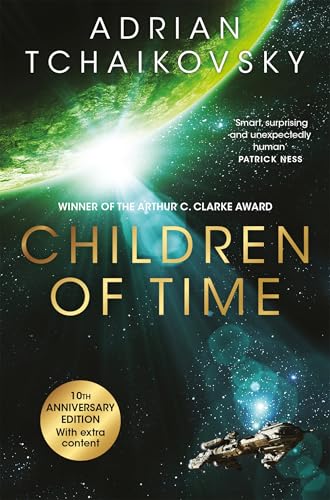
Children of Time
by Adrian Tchaikovsky
- Author:
- Adrian Tchaikovsky
- Status:
- Done
- Format:
- eBook
- Genres:
- Science Fiction , Fiction , Fantasy , Space Opera , Space , Science Fiction Fantasy
- Pages:
- 600
- Highlights:
- 72
Highlights
Page 368
Tabula rasa
Page 525
The three of them are out of their territory by fifty days. Theirs is a species given to curiosity. That same ability that allowed their tiny ancestors to create a mental map of their environs has become the ability to imagine, to ask what is beyond the forest. Portia’s people are born explorers. She raises her palps, white side out, and signals: Come here! No need to give him his name. Females do not refer to males by name. He catches the motion in his lateral eyes and twitches. He is always twitching, afraid of his own shadow – wretched creature. She has distinct opinions on him, and more complimentary ones concerning Bianca. Her world consists of over a hundred individuals – mostly females – with whom she enjoys carefully maintained relationships. The nanovirus has been driving her species hard towards a communal existence. Although her brain is decidedly smaller than a human’s, just as the original Portia could use her minuscule knot of neurons to accomplish remarkable things, this distant daughter has an impressive ability to solve problems: physical, spatial, theoretical, social. Her species has proved fertile ground for the virus’s attentions.
Note: The sexism makes sense. Pretty cool.
Page 548
Nobody considered the invertebrates, the complex ecosystem of tiny creeping things intended to be nothing more than a scaffolding by which the absent monkeys would ascend. In so many cases – as with the great tarantula-descendant below that Portia is considering – whilst the virus was able to provoke growth, the sought-for neural complexity never arose. Often the environmental pressure to select for such a facility was simply lacking. A sense of self and the ability to contemplate the universe are not necessarily survival traits in and of themselves. Portia is a rare exception – though not the only exception – where increased cognitive capacity granted an immediate and compelling advantage.
Page 572
The spitting spiders, the Scytodes, have marched in step with Portia’s kin all the way from their minuscule beginnings. They are somewhere between her and the ground-hunter in size; but size was not the key to dominance even in the ancient days before the virus. Now she sees them creep warily forwards, a whole troop of them: six – no, eight – individuals, spread out but watching, come down off their web to hunt. They hunt in packs, these uplifted Spitters, and Portia has an understanding that they are not beasts, whilst not having achieved whatever she has become. They are the big, shambling killers constantly on the edge of Portia’s world; brutal lurking primitives whose unseen, implicit presence keeps hatchlings from straying too far from the nest. If the numbers had been equal, then Portia and Bianca would have contested the kill – for they see that the Spitters have been following the path of the same prey. Eight is too many, though, even with the additional tricks the three travellers can utilize. The Scytodes will throw out their sprays of sticky, venomous webbing. Although their eyesight is weak, and Portia and her kind are smart enough to anticipate and agile enough to dodge, the sheer number of nets will make the odds of their escaping poor. Conversely, the Spitters are well aware of the danger that Portia’s kind poses. The two species have clashed over untold generations, each time with more understanding of the enemy. Now both recognize that the other is something less than kin but something more than prey.
Note: Fascinating
Page 595
By dark, they have brought down an orb-web builder, and the male jumps on an unwary mouse, neither of which makes a hearty meal. Portia’s active lifestyle and altered anatomy mean that she needs considerably more food than her predecessors, pound for pound. If they were to be forced to live by hunting alone, then their journey would take far longer than it should. Amongst her baggage, however, Bianca has a quartet of live aphids. She lets the little creatures out to suck sap, fending the male off in case he forgets that they are not for eating – or not yet. After dusk, when Portia has spun a makeshift tent in the canopy, complete with warning lines in all directions, the aphids produce glutinous honeydew, which the spiders can drink as though it was the nourishing liquidized innards of their prey. The domesticated creatures meekly return to Bianca’s webbing afterwards, understanding only that they are safe with her, not realizing that, in extremis, they themselves will become the meal. Portia is still hungry – honeydew is subsistence stuff, nourishing without the satisfaction of taking real prey. It is difficult for her to crouch there, knowing that there are aphids – and the male – within reach, but she can look ahead and see that her long-term plan will suffer if those are consumed now. Her lineage has always specialized in looking ahead.
Note: Incredible. They’re like sheep.
Page 760
The basic domestication of the aphids and their husbandry by the spiders has allowed the Great Nest to grow to unprecedented size, without the shortages that would prompt migration or expulsion.
Note: Agriculture moment
Page 787
We bring you greetings from the Great Nest on the Western Ocean, Portia begins, meaning: we are but three, but we have friends. We have travelled far and seen many things. For information is often a trade good in itself. The locals remain suspicious. They are spoken for by their largest female, who shudders upon the web and shifts her feet, saying: What is your purpose? This is no place for you. We do not seek to hunt, Portia states. We do not come to settle. We shall soon return to the Great Nest. Word has come to us – the concept is expressed very clearly, to their minds: vibrations twanging down a taut line. They are naturally equipped to think in terms of information transmitted at a distance. The land beyond your land is of interest. Unrest amongst the locals. It is not to be travelled, their leader says. If that is so, then that is what we have come to discover. Will you tell us what you know?
Note: Whole conversation is great
Page 823
Long ago in Portia’s evolutionary history, her species’ social development was greatly accelerated by a series of mutations in the reigning infection. The virus began to transcribe learned behaviour into the genome of sperm and egg, transforming acquired memes into genetically inheritable behaviour. The economic, force-evolved brains of Portia’s kind share more structural logic with each other than chance-derived human minds do. Mental pathways can be transcribed, reduced to genetic information, unpacked in the offspring and written as instinctive understanding – sometimes concrete skills and muscle memory, but more often whole tranches of knowledge, ragged-edged with loss of context, that the new-born will slowly come to terms with throughout its early life.
Note: The story doesn’t work without this
Page 211
On the other hand, Bianca has fought for her and probably considers playing with this new male her reward. Portia only hopes she can keep her desires in check. It would be more diplomatically advantageous if Fabian was not killed and eaten during the throes of passion.
Page 228
The western oceans that Portia’s Great Nest looks over are home to a type of stomatopod with which her people have cautious, ritualized relations. Their ancestors were fierce, inventive hunters, equipped with unparalleled eyesight and deadly natural weapons, and used to living in colonies where negotiations over living space were common. They, too, proved fertile ground for the virus, and have developed on parallel lines with Portia’s own kin. Perhaps because of their aquatic environment, perhaps because they are by nature prone to wait for prey, their society is simple and primitive by Portia’s standards, but the two species have nothing to compete over, and in the littoral zone they sometimes swap gifts, the fruits of the land in exchange for the fruits of the sea.
Page 237
They can be destroyed – her inherited Understandings include chronicles of such conflicts – but war with even a small colony is costly and wasteful. Alternatively, preferably, they can be accommodated and limited by careful manipulation of their decisions.
Note: This is what sets them apart. Every generation doesn’t need to learn this anew
Page 245
With ants, the nanovirus has simultaneously failed and succeeded. Amongst the ants’ network of reactive decision making it has inculcated a strategy of experimentation and investigation that approaches rigorous scientific method, but it has not led to intellect such as any human or spider would recognize. Ant colonies evolve and adapt, throw up new castes, investigate and make use of resources, devise new technologies, refine them and interrelate them, and all this without anything approaching a consciousness to direct it. There is no hive mind, but there is a vast and flexible biological difference engine, a self-perfecting machine dedicated to the continuance of itself. It does not understand how what it does functions, but it constantly expands its behavioural repertoire and builds upon those trial-and-error paths that prove fruitful.
Page 286
ineluctable
Page 292
Portia’s world – the underlying geology that existed before the terraforming – is rich in shallow deposits of metals, and the ants dig deep to build their nests. In this colony, centuries of burning has led to charcoal production, and occasional inadvertent smelting has been systematized into the forging of tools. The blind watchmaker has been busy.
Page 354
Her descendants will tell the story of how Portia entered the temple of the ants and stole the eye of their god.
Page 554
abseil
Page 583
Her people have solved the mathematical riddles posed by the orbiting satellite – the Messenger, as they think of it – learning the proofs first by rote and then in true comprehension, as a civic and religious duty. The intrusion of this signal has seized the attention of much of the species in a relatively short period of time, because of their inherent curiosity. Here is something demonstrably from beyond, and it fascinates them; it tells them that there is more to the world than they can grasp; it guides their thinking in new ways. The beauty of the maths promises a universe of wonders if they can but stretch out their minds that bit further: a jump they can almost, but not quite, make. Portia spins and unravels and spins, soothing away the trepidation consuming her, replacing it with the undeniable certainty that there is more. Whatever happens this day, even if she should fall beneath the iron-clad mandibles of her foes, there is a depth to life beyond the simple dimensions that she can perceive and calculate in, and so … who knows?
Page 821
Those of her peers who are currently in residence greet her warmly. Several of her closer friends are holding court there at the centre of a worshipful knot of younger females and fluttering, dancing males. Their dances are courtship rituals that they constantly almost, but not quite, consummate. Other than menial labour, this is the place of a male in Portia’s society: adornment, decoration, simply to add value to the lives of females. The larger, more notable or more important a female is, the more males will dance attendance on her. Hence, having a crowd of uselessly elegant males around one is a status symbol. If Portia – the great warrior – were to stay still long enough, then she would attract her own entourage of hopeful parasites; indeed, if she cast them off and refused their attentions she would be diminishing herself in the eyes of her peers and her culture.
Page 831
It is a mark of how far her species has come, that this is the only openly acceptable time when killing a male is considered appropriate. It is, however, quite true that packs of females – especially younger ones, perhaps newly formed peer groups seeking to strengthen their bonds – will descend to the lower reaches of the city and engage in hunting males. The practice is covertly overlooked – girls will be girls, after all – but overtly frowned upon. Killing a male, sanctioned or not, is a world apart from killing a beast. Even as the fang strikes, the killer and the slain know themselves to be part of a grander whole. The nanovirus speaks, each to each. Portia’s culture is strung between base spider nature and the new empathy the nanovirus has inflicted upon them.
Note: Societal progress! “Girls will be girls” - It’s equal parts funny and horrifying.
Page 848
It must be difficult for males, who presumably undergo the ordeal alone, but then males are smaller, and less sensitive, and Portia is honestly not sure how capable they are of finer levels of thought and feeling.
Note: Human racism mirrored in spider sexism
Page 145
The hard labour – forestry, agriculture and the like – is mostly undertaken by the domesticated ant colonies that the Great Nest spiders have manipulated into working with them. After all, the ants work by nature. They have no inclination or capacity to consider the wider philosophy of life, and so such opportunity would be wasted on them. From the point of view of the ant colonies, they prosper as best they can, given the peculiarly artificial environment they find themselves enmeshed in. Their colonies have no real concept of what is pulling their strings, or how their industry has been hijacked to serve Great Nest. It all works seamlessly.
Note: Slavery
Page 183
Portia gives the activity below a second glance, and is shocked. Your assistants are male. Indeed, Bianca agrees, with a stance that suggests this topic is not a new one. I would have thought they would prove insufficient for the complexity of such work, Portia assays. A common misunderstanding. If well coached and born with the pertinent Understandings, then they are quite able to deal with the more routine tasks. I did once employ females, but that results in so much jostling for status and having to defend my preeminence; too much measuring of legs against each other – and me – to get the work done. So I settled on this solution. But surely they must be constantly trying to court you, Portia replies perplexedly. After all, what else did males actually want out of life? You have spent too long in the peer houses of the idle, Bianca reproaches her. I choose my assistants for their dedication to the work. And if I do accept their reproductive material from time to time, it’s only to preserve the new Understandings we come up with here. After all, if they know it, and I know it, the chances are good that any offspring should inherit that Understanding as well. Portia’s discomfort with this line of reasoning is evident in her shifting stance, the rapid movement of her palps. But males do not— That males can transmit to their offspring knowledge that they learn during their lives is an established fact, as far as I am concerned. Bianca stamped harder to impose her words over Portia’s. The belief that they can only pass on their mothers’ Understandings is without foundation. Be glad for our peer group that I at least comprehend this – I try to choose mates who hatched from our own crèche, as they’re more likely to already possess worthwhile Understandings to pass on, and the cumulative effect is to compound and enrich our stock overall. I believe this will become common practice, before either of us pass on. When I have time, I will start trading on the Understanding of it to those few in other peer groups who are likely to appreciate the logic.
Note: Thus the discrimination begins to end
Page 473
The Messenger has come down to us, she tells them. In that moment – out of her fear and her hope – she has quite convinced herself, because what has just happened is from so far beyond her experience that only that quintessential mystery can account for it. Some are awestruck, others sceptical. What does that mean? one of them demands. It means you must be about your work! Bianca hammers out from behind them. You have little time! Go, go! And if the Messenger is here with you, then that means she favours you, but only if you succeed! If it is the Messenger, show her the strength and ingenuity of the Great Nest!
Note: She doesn’t believe it herself, she just thinks it will motivate them.
Page 793
The newly appointed leader of the colonists was not another Scoles, certainly. That intrepid woman listened to her orders with grim acceptance. Looking into her face, Holsten told himself that he could see a terrible, bleak despair hiding in her eyes. What was she being handed, after all? At the worst a death sentence, at the best a life sentence. An undeserved penal term that her children would inherit straight from the womb.
Page 844
The scholars of Portia’s kind had been keen not to reprogram the ant colony, as they had done with its various limbs and expeditionary forces, because in doing so its unique abilities would be lost, and the spiders were not blind to the advances that the colony’s development had unlocked. So it was that years of complex campaigning had been entered into – at some considerable cost in lives – until the ant colony was manoeuvred into a position where cooperation with its spider neighbours became the most beneficial course of action, whereupon the ant colony passed, without acrimony or resentment, from an implacable foe to an obliging ally.
Page 899
Discovering such a wealth of dead metal in orbit had hardly been a surprise, when all recorded history had been a progress over a desert of broken bones. There had been no innovation that the ancients had not already achieved, and done better. How many inventors had been relegated to historical obscurity because some later treasure-hunter had unearthed the older, superior method of achieving the same end? Weapons, engines, political systems, philosophies, sources of energy … Holsten’s people had thought themselves lucky that someone had built such a convenient flight of steps back up from the dark into the sunlight of civilization. They had never quite come to the realization that those steps led only to that one place. Who knows what we might have achieved, had we not been so keen to recreate all their follies, he thought now. Could we have saved the Earth? Would we be living there now on our own green planet?
Note: There was a story written by Ted Chiang with such a thought. If progress fell into society’s lap ready made, there’s no incentive to invent or discover.
Page 958
She does not quite understand why this disease has had such an impact. Aside from its highly contagious nature, and its ability to spread by contact – and somewhat less reliably through the air – the sheer concentration of bodies in the cities of Portia’s people have turned a minor, controllable infection into something more virulent than the Black Death. Such great concentrations of bodies have led to all manner of squalor and health problems; Portia’s people were only beginning to grasp the need for collective responsibility for such issues when the spread of the plague caught them unawares. Their casual, almost anarchic form of government is not well suited to taking the sort of harsh measures that might be effective.
Page 964
Another factor in the deadliness of the disease is the practice, increasingly common in the last century, of females choosing males born within their own peer group as mates, in an attempt to concentrate and control the spread of their Understandings. This practice – well meaning and enlightened in its way – has led to inbreeding that has weakened the immune systems of many powerful peer houses, meaning that those who might possess the power to take action are often first to come down with the plague when it erupts. Portia is aware of this pattern, though not the cause, and she is also aware that her own peer group fits that pattern all too well.
Note: I thought of this 15 minutes ago. Why would they let males go mate with other houses when it meant a loss of knowledge? Author is one step ahead
Page 971
Some even arrived at a theory of vaccination, but the immune system of Portia’s people is not the efficient and adaptive machine that humans and other mammals can boast. Exposure to a contagion simply does not prepare them for later, kindred infections in the same way.
Note: Didn’t know this
Page 993
Since the ravages of the plague began, the role of the male in spider society has changed subtly. Traditionally the best lot in life for a male was to hitch his star to a powerful female and hope to be looked after, or else – for those born with valuable Understandings – to end up a pampered commodity in a seraglio, ready to be traded away or mated off as part of the constantly shifting power games between peer houses. Other than that, the lot of a male came down to being a kind of underclass of urban scavengers constantly fighting each other over scraps of food, and always at risk without female patronage. However, from being a host of the useless and the unnecessary, decorative and fit for menial labour at best, a furtive meal at worst, they have become a desperate resource in time of need. Males are less independent, less able to fend for themselves out in the wilds, and so they tend to stay when females flee. That Great Nest and many other cities remain functioning at all is due to the number of males who have taken the chance to step into traditionally female roles. There are even male warriors, hunters and guards now, because someone must take up the sling and the shield and the incendiary grenade, and often there is nobody else to do so.
Note: I believe this mirrors changes in European society after The Black Death
Page 012
Conditions are worse than you thought. Also, I had difficulty re-entering Great Nest. Travellers suspected of coming from the north are being turned away if female, killed out of hand if male. His speech is a slow shuffle of feet, slurred and uneven. Is that what happened to your comrades? No. I am the only one to return. They’re all dead. Such a brief eulogy this, for those that he had spent most of his life with. But then it is well known in Portia’s society that males do not really feel with the same acuity as females, and certainly they cannot form the same bonds of attachment and respect.
Note: Breaks my heart
Page 025
Take them to my laboratory, she instructs him. Then, seeing his remaining limbs tremble, she continues: After that, the peer house is yours to roam. You will be rewarded for this great service. Merely ask for whatever you wish. He regards her, eye to eye, a bold move – but he was always a bold male, and why else would he have made such a useful tool? Once I have rested I would assist you in your work, if you would let me, he tells her. You know I have Understandings of the biochemical sciences, and I have studied also. The offer surprises Portia, who shows it in her posture. Great Nest is my home, too, Fabian reminds her. All I am is contained here. Do you truly believe that you can defeat the plague? I believe that I must try or we are all lost, anyway. A sombre thought, but the logic is undeniable.
Page 113
The plague is insidious at first, then tyrannous, and at last truly terrifying. Its symptoms are by now well recorded, reliably predictable – everything, in fact, except preventable. The first sure signs are a feeling of heat in the joints, a rawness at the eyes, mouthparts, spinnerets, anus and book-lungs. Muscle spasms, especially in the legs, follow; at first just a few, a stammering in speech, a nervous dance not quite accounted for, then more and more the victim’s limbs are not her own, leading her in babbling, staggering, whole frantic meaningless journeys. Around this time, from ten to forty days after the first involuntary twitch, the virus reaches the brain. The victim then relinquishes her grasp on who and where she is. She perceives those around her in irrational ways. Paranoia, aggression and fugue states are common during this phase. Death follows in another five to fifteen days, immediately preceded by an irresistible desire to climb as high as possible. Fabian has recounted in some detail the dead city that he has visited once more: the highest reaches of the trees and the decaying webbing were crowded with the rigid carapaces of the dead, glassy eyes fixed upwards on nothing.
Page 862
Portia’s society has come some way since the primitive days when the females ate their mates as often as not, but perhaps not so very far. The killing of males under the protection of another peer house is a crime that demands restitution; the needless killing of any male garners sufficient social disapprobation that it is seldom practised, and the culprits usually shunned as wasteful and lacking that golden virtue of self-control. However, to kill a male for a good reason, or after coitus, remains acceptable, despite occasional debates on the subject. This is simply the way things are, and the conservation of tradition is important in Great Nest these days.
Page 986
You are aware that I myself may be killed any day? Portia freezes. Who would dare so tempt my disapproval? I don’t know, but it may happen. If the meanest female is killed, that is a matter for investigation and punishment, just as if someone were to damage the common ground of the city or to speak out against the temple. If I am killed, then the only crime the perpetrator commits is to displease you. And I would be displeased greatly, and that is why it will not happen. You need not fear, Portia explains patiently, thinking: Males can be so highly strung!
Page 193
I could have been killed, he echoes, matching her stance, and therefore her intonation, perfectly. I could have lived my entire life there, and died without memory or achievement. What separates me from them? You are of value, Portia insists. You are a male of exceptional ability, one to be celebrated, to be protected and encouraged to prosper. What have you ever been denied that you have asked for? Only one thing. He walks forwards a few careful steps, as though he is feeling out the strands of a web that only he can see. His palps move lazily. His progress is almost a dance, something of the courtship but laced with bitterness. Theirs is a voiceless language of many subtle shades. They are like us, and you know it. You cannot know what they might have achieved if they had been allowed to live and to prosper. For a moment she does not even know what he means, but she sees his mind is still focused on that detritus of doomed males whose lives will take them no further than the foot of the trees. They are of no value or worth. But you cannot know that. There could be a dozen geniuses dying every day, who have never had an opportunity to demonstrate their aptitude. They think, as we do. They plan and hope and fear. Merely see them and that connection would strum between you. They are my brothers. No less so, they are yours. Portia disagrees vehemently. If they were of any quality or calibre, then they would ascend by their own virtues. Not if there was no structure that they could possibly climb. Not if all the structure that exists was designed to disenfranchise them. Portia, I could have been killed. You yourself said it. I could have been taken by some starving female, and nothing in that would be seen as wrong, save that it might anger you. He has stepped closer, and she feels the predator in her twitch, as if he were some blind insect blundering too close, inviting the strike. Portia’s rear legs close up, building muscle tension for the spring that she is fighting against. And still you are not grateful that I think enough of you that your life is preserved.
Page 214
That is the way things are. Following her argument with Bianca, Portia is finding this polemic too much to deal with. She feels as though her beloved Great Nest is under assault from all sides, and most from those who ought to be her allies. Things are the way we make them.
Note: The difference between conservatives and progressives
Page 510
All around Portia, there are those saying that more must be done to secure Great Nest from its new-minted enemies, and thereby to secure the will of their divine creator. They are performing that oldest of tricks: constructing a path by which to reach a destination, only in this case the destination is permanent security. With each step they take towards it, that security recedes. And, with each step they take, the cost of progressing towards such security grows, and the actions required to move forward become more and more extreme.
Page 692
‘I have to save the species,’ Guyen confirmed, as though that meant the same thing. ‘And we did it. We did it, all of us. All those lives weren’t wasted, after all. We have Empire tech defences, physical and electronic. There’s not a weak point left where Kern can sneak in and switch us all off. But by then I realized that I was old, and I realized how much the ship needed me, and so we got the upload facility and started work on that. I’ve given everything, Mason. I’ve given so many years to the Gilgamesh project. I want … I really want to just close my eyes and let go.’ The artificial voice fell to a static whisper. Holsten recognized this as a sacrosanct pause, and he didn’t try to insert any words.
Note: Lies. He started with the upload facility first. But I like the tale he spins, maybe he even believes it himself.
Page 839
Viola has sent a messenger to the peer houses of Great Nest, with a list of demands. The messenger was a male, therefore Fabian does not envy his chances. When he himself complained, Viola stated darkly that if Fabian truly wished all the freedoms of a female for his gender, then his fellow males must take the same risks.
Note: But it’s not the same risk. A male is in much greater danger than a female. Equality but not equity.
Page 921
I cannot hold you to our bargain, he says simply. I have asked more of you than the Messenger Herself. I have asked you to extend to me and my whole gender the freedoms that you yourselves live and breathe by. It is no small request. It will not be easily made real. Generations from now, there will still be those for whom these reforms rankle, and places where a matter of gender still determines whether one may be killed out of hand. The concepts themselves are hard to phrase, since gender is integral to so much of their language, so Fabian must tread the long way round to explain his meaning. All I can say is this: that city which extends to me and mine these basic rights will have my service and that of my peers, and will gain all the profit that ensues. If Seven Trees will not, then some other city, more desperate, shall. If you should kill me here, you will find some of my peers already outside the city, carrying my Understanding with them. We will go where we are made welcome. I would like you to make us welcome here. He leaves them arguing fiercely over his fate. The decision, he hears later, is close, almost as many against as for. Seven Trees nearly has its own schism there and then. Respected matriarchs resort to measuring legs against one another like juvenile brawlers. In the end, solid mercenary interest outweighs outraged traditional propriety – but only just. Fabian himself does not live to see the world he has helped create. Two years after Great Nest’s surrender, he is found dead in his laboratory, drained to a husk by parties unknown. Many believe that resentful traditionalists from Seven Trees are responsible. Others claim that Temple fanatics from some defeated city had tracked him down. By that time the war is won, though, and the spiders are not normally given to exacting vengeance for its own sake. Their nature tends towards the pragmatic and constructive, even in defeat. There are some who say that the perpetrator was Portia herself, whose name has since acquired a curious mystique – often spoken of but never seen, her final whereabouts and fate a mystery. By then, however, Fabian’s new architecture cannot be put back in its box. His extensive peer house, mostly but not uniformly male, has spread well beyond Seven Trees, the Understanding carefully guarded, but its advantages aggressively exported as stock in trade. A technological revolution is sweeping the globe.
Note: Best Fabian so far
Page 961
They do not even seem to have invented the wheel, yet they have radios.
Page 972
Hers is the name being drummed about the Great Nest district of Seven Trees.
Note: Seven Trees grew so large and successful that the biggest city became a district within it.
Page 997
She feels tremors from below, and sees someone climbing up towards her. It is Fabian – her Fabian, just one of countless males named after the great liberator. He is one of two males in her twelve-strong crew, and her personal assistant – chosen for his quick mind and agile body. It is overwhelming, is it not? He has a knack for saying the right things, and it doesn’t matter whether he means the performance below or the great lit-up tangle that is the city around them. Tomorrow, history will be made. Fabian dances for her, then, because he senses that she is unhappy, and a little flattery and attention tonight will help her on the morrow. Away from the crowd, he now performs for her the ancient courtship of their kind, and is received in turn. Monogamy – monandry, rather – is not a concept the spiders have much familiarity with, but some pairs grow used to each other. Fabian dances only for her, and she rebuffs the advances of any other. As always, at the height of his performance, when he has set down his offering before her, she feels that deep-buried jab to push the matter on to a fatal consummation. But this is all part of the experience, adding zest and immediacy before swiftly being overridden by her more civilized nature. These days such things hardly ever happen.
Page 013
Bianca is a born polymath, in this context meaning she is able to absorb far more Understandings than the average spider. Unlike Portia, she changes her mind regularly. The core of what she considers herself to be is simply her capacity and desire to learn, not any individual facility she might briefly take within her. Currently she is an expert radio operator, chemist, astronomer, artificer, theologian and mathematician, her mind crammed to bursting with a complex interlacing of knowledge.
Page 168
‘What is it about us that we cannot live together in this fucking eggshell ship without tearing at each other? That we have to try and control one another and lie to one another and hurt one another? Who are you that you’re telling me where I have to be and what to do? What are you doing to the poor Gilgamesh? Where did all you freaks come from?’ The last came out as a shriek that appalled Holsten, because something in him seemed to have snapped beyond any control or repair. For a moment he stared at his audience of the young and alien, with his mouth open, everyone including himself waiting to see if more words would be forthcoming. Instead he could feel the shape of his mouth deforming and twisting, and sobs starting to claw and suck at his chest. It was too much. It had been too much. He, who had translated the madness of a millennia-old guardian angel. He who had been abducted. He who had seen an alien world crawling with earthly horrors. He had feared. He had loved. He had met a man who wanted to be God. He had seen death. It had been a rough few weeks. The universe had been given centuries to absorb the shock, but not him. He had been woken and pounded, woken and pounded, and the rigid stasis of suspension offered him no capacity to recover his balance.
Page 242
The Messenger is patient enough to outlast generations of Bianca’s kind, and Her thoughts have a momentum that does not take note of developments on the world below – or so runs the theory. Bianca is not so sure. It is certainly a matter of fact that, despite the fall in Temple’s fortunes, the Messenger continues to exhort its congregation to work further on its machine. The demands have become all the more insistent since Bianca’s peers of a generation or so ago essentially ceased to make progress on any literal translation of the Messenger’s desires: neither faith nor ingenuity being able to bridge the gap between divine will and mortal comprehension. Bianca is well aware of the threats and imprecations that have come from on high. The Messenger has preached the coming of a terrible catastrophe. These days, Bianca’s peers believe that this is little more than a crude attempt to motivate them into throwing further resources at an impossible errand.
Note: It’s funny because the doomsayer is actually correct
Page 266
Bianca tries, and tries again. The Messenger can grasp that the information transmitted is intended to be a visual image, but decoding it seems insurmountable. In the end Bianca breaks down the task into its simplest elements, bringing the whole operation as close to that universal mathematics as she can, by sending out formulae to describe the spiral that is the blindingly obvious way the image should be read.
Note: Obviously a spiral
Page 318
Then the monkeys had answered, and everything changed. True, they were late. The projected few centuries had been and gone, and the Sentry Pod was long past the lifespan its creators had envisaged for it. Still, they built things to last, in those days. If the monkeys had needed their hundreds or even their thousands of years, Avrana and Eliza and their myriad support systems were ready for them. But they had been so dense, and their thinking had been so strange. She had tried and tried, and so often seemed to be getting somewhere, but the monkeys had their own ideas – and such strange ideas. Sometimes they could not understand her superior intellect. Sometimes she could not understand them. Monkeys were supposed to be the easy first step to a universe of uplift. Everyone had assured her they would be close enough to humans to understand, yet far enough to remain a valid and worthwhile subject. Why could she not see eye to eye with them? Now she sees their eyes. She sees all eight of them. The image sent to her is insane, fantastical, a vast, layered, tangled structure of lines and links and enclosed spaces that exist only because they have been pulled into temporary arrangements of tension. The spiders are all about it, caught in mid-creep. The words that heralded this image were simple, clear beyond mistaking: This is us.
Note: Not dumb, just different.
Page 349
senescence
Page 361
There are no aliens that her people ever met or heard from. Or, if there were, their signals were overlooked, passed by: alien in a way that meant no human could see them and recognize them as evidence of life from elsewhere. Kern’s faction and her ideology already knew this, which was why they intended to spread Earth life across the galaxy in as many varied forms as possible. Because it was the only life they had, they had a responsibility to help it survive.
Page 367
They are Earth. Their form does not matter. They are her children.
Page 370
She stops trying to tell them things, and starts listening.
Page 377
THINGS FALL APART
Note: Chinua Achebe fan?
Page 413
‘Friend, if you don’t know that, then I’m not explaining it to you,’ not-Terata told him acidly, and some of the kids smirked.
Note: Book has peaked.
Page 586
Portia, Fabian, go to your station, she orders. Portia questions her respectfully, signalling with terse passes of her palps that she feels the mission could be achieved single-handed as easily as it could with two. It is not a lack of faith in Fabian’s abilities that moves her, but a fear for him. Males are so frail, and she feels protective.
Page 610
And Portia cannot help wondering: Have we silenced Her by reaching as high as we are? Are we measuring legs with Her by simply doing so?
Page 671
Some of it is incomprehensible – just as so much of the Messenger’s message is – but this is clearer than most: God is really trying to be understood, this time. She asks the next question almost simultaneously with Bianca: So you are our creator? With all the baggage that comes with it: made why? For what purpose? And the Messenger responds: You are made of My will, and you are made of the technology of that other world, but all of this has been to speed you on a path you might have taken without me, given time and opportunity. You are Mine, but you also belong to the universe, and your purpose is whatever you choose. Your purpose is to survive and grow and prosper and to seek to understand, just as my people should have taken these things as their purpose, had they not fallen into foolishness, and perished.
Page 694
Kern and her people never considered this, but life on the green planet is young by geological standards – too young to have produced anything in the way of fossil fuels. Biotechnology and mechanical ingenuity have had to take up the slack.
Page 740
The Messenger is listening. Fabian feels a religious awe. He is the first male ever to speak with God. I understand your position, the Messenger tells him. I cannot help you. I am sorry. Fabian explains that he has a plan. He spells his scheme out carefully. Can you explain to them all? That I can do, the Messenger promises, and then, with a sudden access of old memory, When my ancestors reached for space, there were deaths among those pioneers too. It is worth it. The next phrase is alien to Fabian. He will never know what was meant by, I salute you.
Page 751
Later, Portia returns to consciousness aboard the Sky Nest, feeling gorged, damaged, strangely sensual. She has lost one rear leg entirely, and two sections of another limb, and one of her secondary eyes is out. She lives, though. When they tell her what Fabian did to secure her survival, she refuses to believe it for a long time. In the end, it is the Messenger Herself who brings her to an acceptance of what happened.
Page 755
For now that the Messenger has found the patience and perspective to properly understand Her children, She can finally communicate Her warning in a way they can understand.
Page 092
‘How do you even know how to fix the ship?’ Holsten asked of Alpash’s back. ‘It’s been … I don’t know how long it’s been. Since Guyen died, even, I don’t know. And you think you can still keep the ship running? Just by …? What do you …? You’re learning how to make a spaceship run by rote or …?’ Alpash looked back at him, frowning. ‘Don’t think I don’t know what the commander means, when he says “Tribe”. The chief scientist, too. It pleases them to think of us as primitives, inferiors. We, in turn, are bound to respect their – your – authority, as our precursors. That is what our grandmother laid down. That is one of our laws. But we do nothing “by rote”. We learn, all of us, from our youngest age. We have preserved manuals and lectures and tutorial modules. Our grandmother has provided for us. Do you think we could do all we have done if we did not understand?’ He stopped, clearly angry. Holsten had obviously touched a nerve already rubbed raw by the other Key Crew. ‘We are of the line of those who gave their lives – all of their lives – to preserve this vessel. That was and is our task, one to be undertaken without reward or hope of relief: an endless round of custodianship, until we reach the planet we were promised. My parents, their parents and theirs, all of them have done nothing but ensure that you and all the other cargo of this ship shall live, or as much of them as we could save. And it pleases you to call us “Tribe” and consider us children and savages, because we never saw Earth.’
Page 220
‘There was a tradition the Old Empire once had,’ Vitas stated slowly. ‘It was a choice they gave to their criminals, their prisoners. They would take two of them and ask them to spare or to accuse each other, each making the decision quite alone without a chance to confer.
Note: I love how this has been distorted from a hypothetical into a tradition. But I do wish they had introduced this concept before instead of expounding now.
Page 253
‘Take out the satellite,’ she decided at last, quietly. ‘We go in fighting. You’re right, there’s too much at stake. There’s everything at stake. Bring it down.’
Note: Sad, but I agree with the prisoner’s dilemma
Page 426
Uninhabitable, he sent. Doctor Kern, you are human. We are human. We are all the humans there are left. Please let us land. We have no other choice. We cannot turn back. Humanity is overrated, came Kern’s dark reply. And, besides, do you think that I am making the decisions? I’m only an advisor, and they didn’t like my preferred solution to the problem that is you. They have their own ways of dealing with trouble. Go away.
Note: This confused me, but it was the clue. Kern’s preferred solution is clearly destruction, but the spiders are taking a different approach?
Page 482
A curious sensation washes over her, like nothing she has experienced before, setting her tactile sense organs quivering. The nearest equivalent she could name would be that a wind had blown past her, but out here there is no air to move. Her fellows, and other peer groups currently engaged on the assault, have felt it too. In its wake, radio communications become patchy for a brief while. Portia cannot know that her adversaries inside the ship have improvised an electromagnetic pulse to attack the spiders’ electronics. The two technologies have passed each other in the night, barely touching. Even Portia’s radio is biological. What little the pulse can touch of it is instantly replaced; the technology is mortal, born to die, and so every component has replacements growing behind it like shark’s teeth.
Note: Beautiful.
Page 759
the spiders turned to the past for inspiration, seeking out learning buried since the early days of their history. But, for them, history could be remembered like yesterday. They had never suffered the problem with human records: that so much is lost forever as the grinding wheel of the years groans on. Their distant ancestors, in conjunction with the nanovirus, evolved the ability to pass on learning and experience genetically, direct to their offspring, a vital stepping stone in a species with next to no parental care. So it is that knowledge of far distant times is preserved in great detail, initially passed from parents to their brood, and later distilled and available for any spider to incorporate into mind and genes.
Note: The ability to pass on Understandings makes sense because the spiders could never learn from their parents without it. Without learning, they’d never progress technologically.
And yet, maybe it held back societal progress because tradition had a stronger hold. Hard to criticise eating males when you remember doing it for aeons.
Page 767
One of those giants was captured and held for many long years. The Understandings of the time did not include the belief that it was sentient, and scientists now twitch and skitter in frustration at what might have been learned had their forebears only tried a little harder to communicate.
Note: Twitch and skitter = cringe
Page 927
The spiders have been responsible for a few extinctions along the way, too, but their early history with the ants has led them down a different road. They have seen the way of destruction, but they have seen the way the ants made use of the world, too. Everything can be a tool. Everything is useful. They never did wipe out the Spitters, just as they never exterminated the ants themselves, a decision that later would become the basis of their burgeoning technology. Faced with the arrival of humanity, the creator-species, the giants of legend, the spiders’ thought was not How can we destroy them? but How can we trap them? How can we use them? What is the barrier between us that makes them want to destroy us? The spiders have equivalents of the Prisoners’ Dilemma, but they think in terms of intricate interconnectivity, of a world not just of sight but of constant vibration and scent. The idea of two prisoners incapable of communication would not be an acceptable status quo for them, but a problem to overcome: the Prisoners’ Dilemma as a Gordian knot, to be cut through rather than be bound by. They have long known that, within their own bodies and in other species across their planet, there is a message. In ancient times, when they fought the plague, they recognized this as something distinct from their own genetic code, and took it to be the work of the Messenger. In a manner of speaking they were correct. Long ago, they isolated the nanovirus in their systems.
Page 962
They step down among the tide of spiders, whose hard, bristly bodies bump against them. There is no evident revulsion, no sudden panic. The humans, to Kern’s reconfigured eyes, seem entirely at ease. One even puts her hand out, letting it brush across the thronging backs. The virus in them is telling them all, This is us; they are like us. It tells the spiders the same, that crippled fragment of virus calling out to its more complete cousins: We are like you. And Kern guesses, then, that the spiders’ meddling might go further than they had thought. If there had been some tiny bead present in the brain of all humans, that had told each other, They are like you; that had drawn some thin silk thread of empathy, person to person, in a planet-wide net – what might then have happened? Would there have been the same wars, massacres, persecutions and crusades?
Note: This whole book was very well done.
Every vignette directly led to this outcome
- The first story stressed that the change it made in the solitary spiders: they cooperated and moved in packs. Even spiders from different nests felt a kinship because of the virus.
- The war with the ants showed that spiders prefer co-opting an enemy to destruction
- The plague developed their biotechnology to the point where this was possible. They repeatedly transfer new genes to others, including the nanovirus.
- The ants + biotech led them to develop technology that is impossible to think of in human terms, so this tech they use in the end isn’t surprising.
- The spider civil war led to the decline of the Messenger dogma, which is why they didn’t follow Kern’s directives here.
- And one misdirection - the human captured by the spiders dying because they couldn’t communicate indicated the wide gap between the two species.
So the solution of them co-opting the humans with biotech makes sense. It didn’t come as a surprise.
All the while, society was developing. The status of males gradually increased. They created art. They fell in love. I genuinely cared about them and hoped nothing would happen to the spiders. I was sad when the spiders who attacked died.
The author made sense and made me care. Can’t ask for more than that.
Page 999
Life is not perfect, individuals will always be flawed, but empathy – the sheer inability to see those around them as anything other than people too – conquers all, in the end.