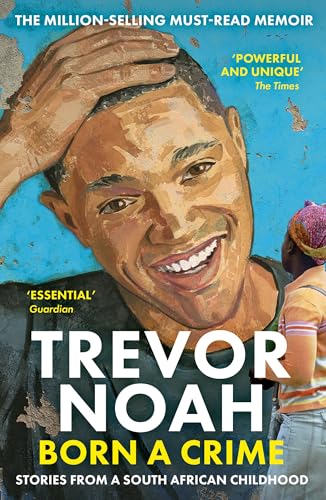
Born a Crime
by Trevor Noah
- Author:
- Trevor Noah
- Status:
- Done
- Format:
- eBook
- Genres:
- Nonfiction , Memoir , Biography , Book Club , Humor , Autobiography
- Pages:
- 288
- Highlights:
- 58
Review
In my opinion, the good books are the ones that engage you while you’re reading them. They might make you laugh out loud, or feel grief, or rile you up till there’s steam coming from your ears; they elicit visceral emotional responses. You can’t put these books down, because you can only do that if you’re still here, but you’re not. You’re in the author’s world right now. Noah manages this with ease. This book is about his childhood in South Africe, and you experience studying in an integrated school, playing in parks, hustling for money, trying (and failing) to get dates, avoiding the ire of his mother, DJ-ing at parties, shoplifting and hustling some more. Its a hilarious roller-coaster ride that you don’t want to get off of.
But the best books are the ones that can do that, but also make you think. They’ve shown you a facets of the world that you were unaware of, ideas you were unfamiliar with, perspectives that you hadn’t thought of. You wonder why you hadn’t thought about these things, and now that you know about it, you ponder the implications. Noah succeeds here as well, I think. What he says about money, race relations, privilege, crime and life choices provide a lot of food for thought. This book is littered with profound quotes that I’ve highlighted and reread twice.
So, the question really isn’t “should I read this book?”, it’s “should I read the book or listen to the audiobook?” I chose the former because it was £3 vs £25, but considering Noah’s talents as a comedian, that might be £25 well spent.
Highlights
Page 3
The genius of apartheid was convincing people who were the overwhelming majority to turn on each other. Apart hate, is what it was. You separate people into groups and make them hate one another so you can run them all. At the time, black South Africans outnumbered white South Africans nearly five to one, yet we were divided into different tribes with different languages: Zulu, Xhosa, Tswana, Sotho, Venda, Ndebele, Tsonga, Pedi, and more. Long before apartheid existed these tribal factions clashed and warred with one another. Then white rule used that animosity to divide and conquer. All nonwhites were systematically classified into various groups and subgroups. Then these groups were given differing levels of rights and privileges in order to keep them at odds.
Page 21
In any society built on institutionalized racism, race-mixing doesn’t merely challenge the system as unjust, it reveals the system as unsustainable and incoherent. Race-mixing proves that races can mix—and in a lot of cases, want to mix. Because a mixed person embodies that rebuke to the logic of the system, race-mixing becomes a crime worse than treason.
Page 30
Once Mandela was elected we could finally live freely. Exiles started to return. I met my first one when I was around seventeen. He told me his story, and I was like, “Wait, what? You mean we could have left? That was an option?” Imagine being thrown out of an airplane. You hit the ground and break all your bones, you go to the hospital and you heal and you move on and finally put the whole thing behind you—and then one day somebody tells you about parachutes. That’s how I felt. I couldn’t understand why we’d stayed. I went straight home and asked my mom. “Why? Why didn’t we just leave? Why didn’t we go to Switzerland?” “Because I am not Swiss,” she said, as stubborn as ever. “This is my country. Why should I leave?”
Page 43
It’s a powerful experience, shitting. There’s something magical about it, profound even.
Page 49
Language brings with it an identity and a culture, or at least the perception of it. A shared language says “We’re the same.” A language barrier says “We’re different.” The architects of apartheid understood this. Part of the effort to divide black people was to make sure we were separated not just physically but by language as well. In the Bantu schools, children were only taught in their home language. Zulu kids learned in Zulu. Tswana kids learned in Tswana. Because of this, we’d fall into the trap the government had set for us and fight among ourselves, believing that we were different.
Page 52
There were so many perks to being “white” in a black family, I can’t even front. I was having a great time. My own family basically did what the American justice system does: I was given more lenient treatment than the black kids. Misbehavior that my cousins would have been punished for, I was given a warning and let off. And I was way naughtier than either of my cousins. It wasn’t even close. If something got broken or if someone was stealing granny’s cookies, it was me. I was trouble. My mom was the only force I truly feared. She believed if you spare the rod, you spoil the child. But everyone else said, “No, he’s different,” and they gave me a pass. Growing up the way I did, I learned how easy it is for white people to get comfortable with a system that awards them all the perks. I knew my cousins were getting beaten for things that I’d done, but I wasn’t interested in changing my grandmother’s perspective, because that would mean I’d get beaten, too. Why would I do that? So that I’d feel better? Being beaten didn’t make me feel better. I had a choice. I could champion racial justice in our home, or I could enjoy granny’s cookies. I went with the cookies.
Page 55
One day as a young man I was walking down the street, and a group of Zulu guys was walking behind me, closing in on me, and I could hear them talking to one another about how they were going to mug me. “Asibambe le autie yomlungu. Phuma ngapha mina ngizoqhamuka ngemuva kwakhe.” “Let’s get this white guy. You go to his left, and I’ll come up behind him.” I didn’t know what to do. I couldn’t run, so I just spun around real quick and said, “Kodwa bafwethu yingani singavele sibambe umuntu inkunzi? Asenzeni. Mina ngikulindele.” “Yo, guys, why don’t we just mug someone together? I’m ready. Let’s do it.” They looked shocked for a moment, and then they started laughing. “Oh, sorry, dude. We thought you were something else. We weren’t trying to take anything from you. We were trying to steal from white people. Have a good day, man.” They were ready to do me violent harm, until they felt we were part of the same tribe, and then we were cool. That, and so many other smaller incidents in my life, made me realize that language, even more than color, defines who you are to people.
Page 58
In South Africa back then, it wasn’t common to find a white person or a colored person who spoke African languages; during apartheid white people were always taught that those languages were beneath them. So the fact that I did speak African languages immediately endeared me to the black kids.
Page 60
I decided I’d rather be held back with people I liked than move ahead with people I didn’t know.
Page 61
Before apartheid, any black South African who received a formal education was likely taught by European missionaries, foreign enthusiasts eager to Christianize and Westernize the natives. In the mission schools, black people learned English, European literature, medicine, the law. It’s no coincidence that nearly every major black leader of the anti-apartheid movement, from Nelson Mandela to Steve Biko, was educated by the missionaries—a knowledgeable man is a free man, or at least a man who longs for freedom.
Page 62
The difference between British racism and Afrikaner racism was that at least the British gave the natives something to aspire to. If they could learn to speak correct English and dress in proper clothes, if they could Anglicize and civilize themselves, one day they might be welcome in society. The Afrikaners never gave us that option. British racism said, “If the monkey can walk like a man and talk like a man, then perhaps he is a man.” Afrikaner racism said, “Why give a book to a monkey?”
Page 66
So many black families spend all of their time trying to fix the problems of the past. That is the curse of being black and poor, and it is a curse that follows you from generation to generation. My mother calls it “the black tax.” Because the generations who came before you have been pillaged, rather than being free to use your skills and education to move forward, you lose everything just trying to bring everyone behind you back up to zero.
Page 66
My mom told me these things so that I’d never take for granted how we got to where we were, but none of it ever came from a place of self-pity. “Learn from your past and be better because of your past,” she would say, “but don’t cry about your past. Life is full of pain. Let the pain sharpen you, but don’t hold on to it. Don’t be bitter.” And she never was. The deprivations of her youth, the betrayals of her parents, she never complained about any of it.
Page 68
My books were my prized possessions. I had a bookshelf where I put them, and I was so proud of it. I loved my books and kept them in pristine condition. I read them over and over, but I did not bend the pages or the spines. I treasured every single one. As I grew older I started buying my own books. I loved fantasy, loved to get lost in worlds that didn’t exist. I remember there was some book about white boys who solved mysteries or some shit. I had no time for that. Give me Roald Dahl. James and the Giant Peach, The BFG, Charlie and the Chocolate Factory, The Wonderful Story of Henry Sugar. That was my fix.
Page 71
My mom would find places with beautiful views for us to sit and have a picnic. There was none of the fanfare of a picnic basket or plates or anything like that, only baloney and brown bread and margarine sandwiches wrapped up in butcher paper. To this day, baloney and brown bread and margarine will instantly take me back. You can come with all the Michelin stars in the world, just give me baloney and brown bread and margarine and I’m in heaven.
Page 71
Food, or the access to food, was always the measure of how good or bad things were going in our lives. My mom would always say, “My job is to feed your body, feed your spirit, and feed your mind.” That’s exactly what she did, and the way she found money for food and books was to spend absolutely nothing on anything else.
Page 72
Sometimes the only meat we had was a packaged meat you could buy at the butcher called “sawdust.” It was literally the dust of the meat, the bits that fell off the cuts being packaged for the shop, the bits of fat and whatever’s left. They’d sweep it up and put it into bags. It was meant for dogs, but my mom bought it for us. There were many months where that was all we ate.
Page 73
My mom raised me as if there were no limitations on where I could go or what I could do. When I look back I realize she raised me like a white kid—not white culturally, but in the sense of believing that the world was my oyster, that I should speak up for myself, that my ideas and thoughts and decisions mattered.
Page 73
We tell people to follow their dreams, but you can only dream of what you can imagine, and, depending on where you come from, your imagination can be quite limited.
Note: wow
Page 73
Growing up in Soweto, our dream was to put another room on our house. Maybe have a driveway. Maybe, someday, a cast-iron gate at the end of the driveway. Because that is all we knew. But the highest rung of what’s possible is far beyond the world you can see. My mother showed me what was possible. The thing that always amazed me about her life was that no one showed her. No one chose her. She did it on her own. She found her way through sheer force of will.
Note: 2021: to be fair to my father he tried his best to show me this. He had me travel business class so he could show me what hard work could get me.
Page 74
People thought my mom was crazy. Ice rinks and drive-ins and suburbs, these things were izinto zabelungu—the things of white people. So many black people had internalized the logic of apartheid and made it their own. Why teach a black child white things? Neighbors and relatives used to pester my mom. “Why do all this? Why show him the world when he’s never going to leave the ghetto?” “Because,” she would say, “even if he never leaves the ghetto, he will know that the ghetto is not the world. If that is all I accomplish, I’ve done enough.”
Note: 2021.
Page 77
My mom thought having a child was going to be like having a partner, but every child is born the center of its own universe, incapable of understanding the world beyond its own wants and needs, and I was no different.
Page 79
And I couldn’t help it. There’s a condition kids suffer from, a compulsive disorder that makes them do things they themselves don’t understand. You can tell a child, “Whatever you do, don’t draw on the wall. You can draw on this paper. You can draw in this book. You can draw on any surface you want. But do not draw or write or color on the wall.” The child will look you dead in the eye and say, “Got it.” Ten minutes later the child is drawing on the wall. You start screaming. “Why the hell are you drawing on the wall?!” The child looks at you, and he genuinely has no idea why he drew on the wall.
Page 85
Whenever the principal would hit me, it was like he was afraid to do it too hard. One day I was getting a hiding and I thought, Man, if only my mom hit me like this, and I started laughing. I couldn’t help it. The principal was quite disturbed. “If you’re laughing while you’re getting beaten,” he said, “then something is definitely wrong with you.”
Page 88
Catholic school is similar to apartheid in that it’s ruthlessly authoritarian, and its authority rests on a bunch of rules that don’t make any sense.
Page 90
But I was blessed with another trait I inherited from my mother: her ability to forget the pain in life. I remember the thing that caused the trauma, but I don’t hold on to the trauma. I never let the memory of something painful prevent me from trying something new. If you think too much about the ass-kicking your mom gave you, or the ass-kicking that life gave you, you’ll stop pushing the boundaries
Note: preach it brother
Page 100
I believed that Fufi was my dog, but of course that wasn’t true. Fufi was a dog. I was a boy. We got along well. She happened to live in my house. That experience shaped what I’ve felt about relationships for the rest of my life: You do not own the thing that you love. I was lucky to learn that lesson at such a young age. I have so many friends who still, as adults, wrestle with feelings of betrayal. They’ll come to me angry and crying and talking about how they’ve been cheated on and lied to, and I feel for them. I understand what they’re going through. I sit with them and buy them a drink and I say, “Friend, let me tell you the story of Fufi.”
Page 104
One thing I do know about my dad is that he hates racism and homogeneity more than anything, and not because of any feelings of self-righteousness or moral superiority. He just never understood how white people could be racist in South Africa. “Africa is full of black people,” he would say. “So why would you come all the way to Africa if you hate black people? If you hate black people so much, why did you move into their house?” To him it was insane.
Page 106
The whole issue of Santa Claus is a rather contentious one when it comes to African Christmas, a matter of pride. When an African dad buys his kid a present, the last thing he’s going to do is give some fat white man credit for it. African Dad will tell you straight up, “No, no, no. I bought you that.”
Page 108
When a parent is absent, you’re left in the lurch of not knowing, and it’s so easy to fill that space with negative thoughts. “They don’t care.” “They’re selfish.” My one saving grace was that my mom never spoke ill of him. She would always compliment him. “You’re good with your money. You get that from your dad.” “You have your dad’s smile.” “You’re clean and tidy like your father.” I never turned to bitterness, because she made sure I knew his absence was because of circumstance and not a lack of love. She always told me the story of her coming home from the hospital and my dad saying, “Where’s my kid? I want that kid in my life.” She’d say to me, “Don’t ever forget: He chose you.”
Page 110
I walked out of his house that day an inch taller. Seeing him had reaffirmed his choosing of me. He chose to have me in his life. He chose to answer my letter. I was wanted. Being chosen is the greatest gift you can give to another human being.
Page 110
What I wanted was a relationship, and an interview is not a relationship. Relationships are built in the silences. You spend time with people, you observe them and interact with them, and you come to know them—and that is what apartheid stole from us: time. You can’t make up for that with an interview, but I had to figure that out for myself.
Page 116
The history of colored people in South Africa is, in this respect, worse than the history of black people in South Africa. For all that black people have suffered, they know who they are. Colored people don’t.
Page 117
The animosity I felt from the colored people I encountered growing up was one of the hardest things I’ve ever had to deal with. It taught me that it is easier to be an insider as an outsider than to be an outsider as an insider. If a white guy chooses to immerse himself in hip-hop culture and only hang out with black people, black people will say, “Cool, white guy. Do what you need to do.” If a black guy chooses to button up his blackness to live among white people and play lots of golf, white people will say, “Fine. I like Brian. He’s safe.” But try being a black person who immerses himself in white culture while still living in the black community. Try being a white person who adopts the trappings of black culture while still living in the white community. You will face more hate and ridicule and ostracism than you can even begin to fathom. People are willing to accept you if they see you as an outsider trying to assimilate into their world. But when they see you as a fellow tribe member attempting to disavow the tribe, that is something they will never forgive. That is what happened to me in Eden Park.
Page 119
The most common colored slur was boesman. “Bushman.” “Bushie.” Because it called out their blackness, their primitiveness. The worst way to insult a colored person was to infer that they were in some way black. One of the most sinister things about apartheid was that it taught colored people that it was black people who were holding them back.
Page 140
I was like a weed dealer, but of food. The weed guy is always welcome at the party. He’s not a part of the circle, but he’s invited into the circle temporarily because of what he can offer. That’s who I was. Always an outsider. As the outsider, you can retreat into a shell, be anonymous, be invisible. Or you can go the other way. You protect yourself by opening up. You don’t ask to be accepted for everything you are, just the one part of yourself that you’re willing to share. For me it was humor. I learned that even though I didn’t belong to one group, I could be a part of any group that was laughing. I’d drop in, pass out the snacks, tell a few jokes. I’d perform for them. I’d catch a bit of their conversation, learn more about their group, and then leave. I never overstayed my welcome. I wasn’t popular, but I wasn’t an outcast. I was everywhere with everybody, and at the same time I was all by myself.
Page 160
I kept waiting for it to be a trick, for them to turn and say, “It’s you!” They didn’t. At a certain point, I felt so invisible I almost wanted to take credit. I wanted to jump up and point at the TV and say, “Are you people blind?! That’s me! Can you not see that that’s me?!” But of course I didn’t. And they couldn’t. These people had been so fucked by their own construct of race that they could not see that the white person they were looking for was sitting right in front of them.
Page 188
The first thing I learned about having money was that it gives you choices. People don’t want to be rich. They want to be able to choose. The richer you are, the more choices you have. That is the freedom of money.
Page 190
Life was good, and none of it would have happened without Daniel. Without him, I would never have mastered the world of music piracy and lived a life of endless McDonald’s. What he did, on a small scale, showed me how important it is to empower the dispossessed and the disenfranchised in the wake of oppression. Daniel was white. His family had access to education, resources, computers. For generations, while his people were preparing to go to university, my people were crowded into thatched huts singing, “Two times two is four. Three times two is six. La la la la la.” My family had been denied the things his family had taken for granted. I had a natural talent for selling to people, but without knowledge and resources, where was that going to get me? People always lecture the poor: “Take responsibility for yourself! Make something of yourself!” But with what raw materials are the poor to make something of themselves? People love to say, “Give a man a fish, and he’ll eat for a day. Teach a man to fish, and he’ll eat for a lifetime.” What they don’t say is, “And it would be nice if you gave him a fishing rod.” That’s the part of the analogy that’s missing. Working with Daniel was the first time in my life I realized you need someone from the privileged world to come to you and say, “Okay, here’s what you need, and here’s how it works.” Talent alone would have gotten me nowhere without Daniel giving me the CD writer. People say, “Oh, that’s a handout.” No. I still have to work to profit by it. But I don’t stand a chance without it.
Page 195
There is also this to consider: The name Hitler does not offend a black South African because Hitler is not the worst thing a black South African can imagine. Every country thinks their history is the most important, and that’s especially true in the West. But if black South Africans could go back in time and kill one person, Cecil Rhodes would come up before Hitler. If people in the Congo could go back in time and kill one person, Belgium’s King Leopold would come way before Hitler. If Native Americans could go back in time and kill one person, it would probably be Christopher Columbus or Andrew Jackson.
Page 196
So in Europe and America, yes, Hitler is the Greatest Madman in History. In Africa he’s just another strongman from the history books. In all my time hanging out with Hitler, I never once asked myself, “Why is his name Hitler?” His name was Hitler because his mom named him Hitler.
Page 207
Another nice thing about the hood was that it’s super cheap. You can get by on next to nothing. There’s a meal you can get in the hood called a kota. It’s a quarter loaf of bread. You scrape out the bread, then you fill it with fried potatoes, a slice of baloney, and some pickled mango relish called achar.
Page 208
Cheese boys were in a uniquely fucked situation when apartheid ended. It is one thing to be born in the hood and know that you will never leave the hood. But the cheese boy has been shown the world outside. His family has done okay. They have a house. They’ve sent him to a decent school; maybe he’s even matriculated. He has been given more potential, but he has not been given more opportunity. He has been given an awareness of the world that is out there, but he has not been given the means to reach it.
Page 209
One of the first things I learned in the hood is that there is a very fine line between civilian and criminal. We like to believe we live in a world of good guys and bad guys, and in the suburbs it’s easy to believe that, because getting to know a career criminal in the suburbs is a difficult thing. But then you go to the hood and you see there are so many shades in between.
Page 211
the crackhead wants the money now. Crackheads don’t wait. There’s no layaway plan with a crackhead.
Page 212
It’s easy to be judgmental about crime when you live in a world wealthy enough to be removed from it. But the hood taught me that everyone has different notions of right and wrong, different definitions of what constitutes crime, and what level of crime they’re willing to participate in. If a crackhead comes through and he’s got a crate of Corn Flakes boxes he’s stolen out of the back of a supermarket, the poor mom isn’t thinking, I’m aiding and abetting a criminal by buying these Corn Flakes. No. She’s thinking, My family needs food and this guy has Corn Flakes, and she buys the Corn Flakes.
Page 214
Moms loved us. They were some of our best customers. Since moms run the household, they’re the ones looking to buy that box of soap that fell off the back of the truck, and they were more likely to buy it from us than from some crackhead. Dealing with crackheads is unpleasant. We were upstanding, well-spoken East Bank boys. We could even charge a premium because we added that layer of respectability to the transaction.
Page 217
Hustling is to work what surfing the Internet is to reading. If you add up how much you read in a year on the Internet—tweets, Facebook posts, lists—you’ve read the equivalent of a shit ton of books, but in fact you’ve read no books in a year. When I look back on it, that’s what hustling was. It’s maximal effort put into minimal gain. It’s a hamster wheel. If I’d put all that energy into studying I’d have earned an MBA. Instead I was majoring in hustling, something no university would give me a degree for.
Page 218
The hood is also a low-stress, comfortable life. All your mental energy goes into getting by, so you don’t have to ask yourself any of the big questions. Who am I? Who am I supposed to be? Am I doing enough? In the hood you can be a forty-year-old man living in your mom’s house asking people for money and it’s not looked down on. You never feel like a failure in the hood, because someone’s always worse off than you, and you don’t feel like you need to do more, because the biggest success isn’t that much higher than you, either. It allows you to exist in a state of suspended animation.
Note: Jesus this whole chapter is some deep shit
Page 219
The hood was strangely comforting, but comfort can be dangerous. Comfort provides a floor but also a ceiling.
Page 219
The hood has a gravitational pull. It never leaves you behind, but it also never lets you leave. Because by making the choice to leave, you’re insulting the place that raised you and made you and never turned you away. And that place fights you back.
Page 221
It’s just stuff people found. White people have insurance. Whatever rationalization was handy. In society, we do horrible things to one another because we don’t see the person it affects.
Page 221
We don’t see their face. We don’t see them as people. Which was the whole reason the hood was built in the first place, to keep the victims of apartheid out of sight and out of mind. Because if white people ever saw black people as human, they would see that slavery is unconscionable. We live in a world where we don’t see the ramifications of what we do to others, because we don’t live with them. It would be a whole lot harder for an investment banker to rip off people with subprime mortgages if he actually had to live with the people he was ripping off. If we could see one another’s pain and empathize with one another, it would never be worth it to us to commit the crimes in the first place.
Page 236
Nelson Mandela once said, “If you talk to a man in a language he understands, that goes to his head. If you talk to him in his language, that goes to his heart.” He was so right. When you make the effort to speak someone else’s language, even if it’s just basic phrases here and there, you are saying to them, “I understand that you have a culture and identity that exists beyond me. I see you as a human being.”
Page 237
No one else in the cell knew what to make of us, the ruthless colored gangster and his menacing, Hulk-like friend. He told me his story, a South African story that was all too familiar to me: The man grows up under apartheid, working on a farm, part of what’s essentially a slave labor force. It’s a living hell but it’s at least something. He’s paid a pittance but at least he’s paid. He’s told where to be and what to do every waking minute of his day. Then apartheid ends and he doesn’t even have that anymore. He finds his way to Johannesburg, looking for work, trying to feed his children back home. But he’s lost. He has no education. He has no skills. He doesn’t know what to do, doesn’t know where to be. The world has been taught to be scared of him, but the reality is that he is scared of the world because he has none of the tools necessary to cope with it. So what does he do? He takes shit. He becomes a petty thief. He’s in and out of jail. He gets lucky and finds some construction work, but then he gets laid off from that, and a few days later he’s in a shop and he sees some PlayStation games and he grabs them, but he doesn’t even know enough to know that he’s stolen something of no value.
Page 253
Abel wanted a traditional marriage with a traditional wife. For a long time I wondered why he ever married a woman like my mom in the first place, as she was the opposite of that in every way. If he wanted a woman to bow to him, there were plenty of girls back in Tzaneen being raised solely for that purpose. The way my mother always explained it, the traditional man wants a woman to be subservient, but he never falls in love with subservient women. He’s attracted to independent women. “He’s like an exotic bird collector,” she said. “He only wants a woman who is free because his dream is to put her in a cage.”
Page 279
I’m not going to lie to you: I paused. I paused hard. In that moment, what I heard the nurse saying was, “All of your money will be gone,” and then I started to think, Well … what is she, fifty? That’s pretty good, right? She’s lived a good life.
Note: Honesty
Page 285
“Trevor, I prayed. I told you I prayed. I don’t pray for nothing.” “You know,” I said, “for once I cannot argue with you. The gun, the bullets—I can’t explain any of it. So I’ll give you that much.” Then I couldn’t resist teasing her with one last little jab. “But where was your Jesus to pay your hospital bill, hmm? I know for a fact that He didn’t pay that.” She smiled and said, “You’re right. He didn’t. But He blessed me with the son who did.”