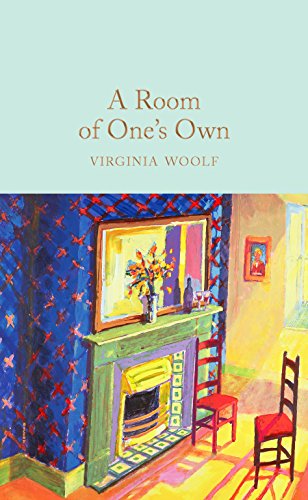
A Room of One's Own
by Virginia Woolf
- Author:
- Virginia Woolf
- Status:
- Done
- Format:
- eBook
- Reading Time:
- 5:28
- Genres:
- Classics , Nonfiction , Feminism , Essays , Philosophy , Writing , Literature
- Pages:
- 102
- Highlights:
- 45
Highlights
Page 60
‘One cannot think well, love well, sleep well, if one has not dined well. The lamp in the spine does not light on beef and prunes.’
Page 1
a woman must have money and a room of her own if she is to write fiction;
Page 1
At any rate, when a subject is highly controversial – and any question about sex is that – one cannot hope to tell the truth. One can only show how one came to hold whatever opinion one does hold. One can only give one’s audience the chance of drawing their own conclusions as they observe the limitations, the prejudices, the idiosyncrasies of the speaker.
Note: Pah unbelievable. One page in and I’m already floored.
Page 4
Lamb then came to Oxbridge perhaps a hundred years ago. Certainly he wrote an essay – the name escapes me – about the manuscript of one of Milton’s poems which he saw here.
Note: Was this a transcription of the speech or was this “escapes me” in the essay itself? If it’s the latter, it’s interesting that this is composed as a performance rather than an essay.
Page 7
Meanwhile the wine glasses had flushed yellow and flushed crimson; had been emptied; had been filled. And thus by degrees was lit, halfway down the spine, which is the seat of the soul, not that hard little electric light which we call brilliance, as it pops in and out upon our lips, but the more profound, subtle and subterranean glow which is the rich yellow flame of rational intercourse. No need to hurry. No need to sparkle. No need to be anybody but oneself. We are all going to heaven and Van Dyck is of the company – in other words, how good life seemed, how sweet its rewards, how trivial this grudge or that grievance, how admirable friendship and the society of one’s kind, as, lighting a good cigarette, one sank among the cushions in the window-seat.
Page 11
As I have said already that it was an October day, I dare not forfeit your respect and imperil the fair name of fiction by changing the season and describing lilacs hanging over garden walls, crocuses, tulips and other flowers of spring. Fiction must stick to facts, and the truer the facts the better the fiction
Note: That’s why handmaids tale works so well
Page 13
One cannot think well, love well, sleep well, if one has not dined well.
Note: Amen. Someone should have told her about keto though
Page 15
Now if she had gone into business; had become a manufacturer of artificial silk or a magnate on the Stock Exchange; if she had left two or three hundred thousand pounds to Fernham, we could have been sitting at our ease tonight and the subject of our talk might have been archaeology, botany, anthropology, physics, the nature of the atom, mathematics, astronomy, relativity, geography. If only Mrs Seton and her mother and her mother before her had learnt the great art of making money and had left their money, like their fathers and their grandfathers before them, to found fellowships and lectureships and prizes and scholarships appropriated to the use of their own sex, we might have dined very tolerably up here alone off a bird and a bottle of wine; we might have looked forward without undue confidence to a pleasant and honourable lifetime spent in the shelter of one of the liberally endowed professions.
Page 19
The inevitable sequel to lunching and dining at Oxbridge seemed, unfortunately, to be a visit to the British Museum. One must strain off what was personal and accidental in all these impressions and so reach the pure fluid, the essential oil of truth. For that visit to Oxbridge and the luncheon and the dinner had started a swarm of questions. Why did men drink wine and women water? Why was one sex so prosperous and the other so poor? What effect has poverty on fiction? What conditions are necessary for the creation of works of art? – a thousand questions at once suggested themselves. But one needed answers, not questions; and an answer was only to be had by consulting the learned and the unprejudiced, who have removed themselves above the strife of tongue and the confusion of body and issued the result of their reasoning and research in books which are to be found in the British Museum. If truth is not to be found on the shelves of the British Museum, where, I asked myself, picking up a notebook and a pencil, is truth?
Page 21
so I pondered until all such frivolous thoughts were ended by an avalanche of books sliding down on to the desk in front of me. Now the trouble began. The student who has been trained in research at Oxbridge has no doubt some method of shepherding his question past all distractions till it runs into his answer as a sheep runs into its pen. The student by my side, for instance, who was copying assiduously from a scientific manual, was, I felt sure, extracting pure nuggets of the essential ore every ten minutes or so. His little grunts of satisfaction indicated so much. But if, unfortunately, one has had no training in a university, the question far from being shepherded to its pen flies like a frightened flock hither and thither, helter-skelter, pursued by a whole pack of hounds.
Note: Studying next to Sabareesh
Page 23
Wherever one looked men thought about women and thought differently. It was impossible to make head or tail of it all, I decided, glancing with envy at the reader next door who was making the neatest abstracts, headed often with an A or a B or a C, while my own notebook rioted with the wildest scribble of contradictory jottings. It was distressing, it was bewildering, it was humiliating. Truth had run through my fingers. Every drop had escaped.
Note: I feel that feel lol
Page 25
Whatever the reason, all these books, I thought, surveying the pile on the desk, are worthless for my purposes. They were worthless scientifically, that is to say, though humanly they were full of instruction, interest, boredom, and very queer facts about the habits of the Fiji Islanders. They had been written in the red light of emotion and not in the white light of truth. Therefore they must be returned to the central desk and restored each to his own cell in the enormous honeycomb. All that I had retrieved from that morning’s work had been the one fact of anger. The professors – I lumped them together thus – were angry. But why, I asked myself, having returned the books, why, I repeated, standing under the colonnade among the pigeons and the prehistoric canoes, why are they angry? And, asking myself this question, I strolled off to find a place for luncheon.
Note: I don’t follow how she came to the conclusion that they’re emotional
Page 26
The most transient visitor to this planet, I thought, who picked up this paper could not fail to be aware, even from this scattered testimony, that England is under the rule of a patriarchy. Nobody in their senses could fail to detect the dominance of the professor. His was the power and the money and the influence. He was the proprietor of the paper and its editor and sub-editor. He was the Foreign Secretary and the judge. He was the cricketer; he owned the racehorses and the yachts. He was the director of the company that pays two hundred per cent to its shareholders. He left millions to charities and colleges that were ruled by himself. He suspended the film actress in midair. He will decide if the hair on the meat axe is human; he it is who will acquit or convict the murderer, and hang him, or let him go free. With the exception of the fog he seemed to control everything.
Page 26
Possibly when the professor insisted a little too emphatically upon the inferiority of women, he was concerned not with their inferiority, but with his own superiority. That was what he was protecting rather hot-headedly and with too much emphasis, because it was a jewel to him of the rarest price. Life for both sexes – and I looked at them, shouldering their way along the pavement – is arduous, difficult, a perpetual struggle. It calls for gigantic courage and strength. More than anything, perhaps, creatures of illusion as we are, it calls for confidence in oneself. Without self-confidence we are as babes in the cradle. And how can we generate this imponderable quality, which is yet so invaluable, most quickly? By thinking that other people are inferior to oneself. By feeling that one has some innate superiority – it may be wealth, or rank, a straight nose, or the portrait of a grandfather by Romney, for there is no end to the pathetic devices of the human imagination – over other people. Hence the enormous importance to a patriarch who has to conquer, who has to rule, of feeling that great numbers of people, half the human race indeed, are by nature inferior to himself. It must indeed be one of the chief sources of his power.
Note: Explains the White Man’s Burden as well
Page 27
Women have served all these centuries as looking-glasses possessing the magic and delicious power of reflecting the figure of man at twice its natural size.
Page 29
Of the two – the vote and the money – the money, I own, seemed infinitely the more important. Before that I had made my living by cadging odd jobs from newspapers, by reporting a donkey show here or a wedding there; I had earned a few pounds by addressing envelopes, reading to old ladies, making artificial flowers, teaching the alphabet to small children in a kindergarten. Such were the chief occupations that were open to women before 1918. I need not, I am afraid, describe in any detail the hardness of the work, for you know perhaps women who have done it; nor the difficulty of living on the money when it was earned, for you may have tried. But what still remains with me as a worse infliction than either was the poison of fear and bitterness which those days bred in me. To begin with, always to be doing work that one did not wish to do, and to do it like a slave, flattering and fawning, not always necessarily perhaps, but it seemed necessary and the stakes were too great to run risks; and then the thought of that one gift which it was death to hide – a small one but dear to the possessor – perishing and with it my self, my soul – all this became like a rust eating away the bloom of the spring, destroying the tree at its heart. However, as I say, my aunt died; and whenever I change a ten-shilling note a little of that rust and corrosion is rubbed off, fear and bitterness go. Indeed, I thought, slipping the silver into my purse, it is remarkable, remembering the bitterness of those days, what a change of temper a fixed income will bring about. No force in the world can take from me my five hundred pounds. Food, house and clothing are mine for ever. Therefore not merely do effort and labour cease, but also hatred and bitterness. I need not hate any man; he cannot hurt me. I need not flatter any man; he has nothing to give me. So imperceptibly I found myself adopting a new attitude towards the other half of the human race. It was absurd to blame any class or any sex, as a whole. Great bodies of people are never responsible for what they do. They are driven by instincts which are not within their control. They too, the patriarchs, the professors, had endless difficulties, terrible drawbacks to contend with. Their education had been in some ways as faulty as my own.
Note: Poverty poisons the mind. I might end up highlighting the whole essay
Page 31
Is it better to be a coal-heaver or a nursemaid; is the charwoman who has brought up eight children of less value to the world than the barrister who has made a hundred thousand pounds? It is useless to ask such questions for nobody can answer them. Not only do the comparative values of charwomen and lawyers rise and fall from decade to decade, but we have no rods with which to measure them even as they are at the moment. I had been foolish to ask my professor to furnish me with ‘indisputable proofs’ of this or that in his argument about women. Even if one could state the value of any one gift at the moment, those values will change; in a century’s time very possibly they will have changed completely. Moreover, in a hundred years, I thought, reaching my own doorstep, women will have ceased to be the protected sex. Logically they will take part in all the activities and exertions that were once denied them. The nursemaid will heave coal. The shopwoman will drive an engine. All assumptions founded on the facts observed when women were the protected sex will have disappeared – as, for example (here a squad of soldiers marched down the street), that women and clergymen and gardeners live longer than other people. Remove that protection, expose them to the same exertions and activities, make them soldiers and sailors and engine-drivers and dock labourers, and will not women die off so much younger, so much quicker, than men that one will say, ‘I saw a woman today’, as one used to say, ‘I saw an aeroplane’? Anything may happen when womanhood has ceased to be a protected occupation, I thought, opening the door. But what bearing has all this upon the subject of my paper, Women and Fiction? I asked, going indoors.
Note: Prescient, especially the part about changing values
Page 33
A very queer, composite being thus emerges. Imaginatively she is of the highest importance; practically she is completely insignificant. She pervades poetry from cover to cover; she is all but absent from history. She dominates the lives of kings and conquerors in fiction; in fact she was the slave of any boy whose parents forced a ring upon her finger. Some of the most inspired words, some of the most profound thoughts in literature fall from her lips; in real life she could hardly read, could scarcely spell, and was the property of her husband.
Note: JFC
Page 34
Occasionally an individual woman is mentioned, an Elizabeth, or a Mary; a queen or a great lady. But by no possible means could middle-class women with nothing but brains and character at their command have taken part in any one of the great movements which, brought together, constitute the historian’s view of the past. Nor shall we find her in any collection of anecdotes. Aubrey hardly mentions her. She never writes her own life and scarcely keeps a diary; there are only a handful of her letters in existence. She left no plays or poems by which we can judge her. What one wants, I thought – and why does not some brilliant student at Newnham or Girton supply it? – is a mass of information; at what age did she marry; how many children had she as a rule; what was her house like, had she a room to herself; did she do the cooking; would she be likely to have a servant? All these facts lie somewhere, presumably, in parish registers and account books; the life of the average Elizabethan woman must be scattered about somewhere, could one collect it and make a book of it. It would be ambitious beyond my daring,
Note: Very true points. Side note - it’s interesting that she is viewing this from the perspective of upper class (like herself) or middle class women. I say that based on the “servant” remark.
Page 36
I thought of that old gentleman, who is dead now, but was a bishop, I think, who declared that it was impossible for any woman, past, present, or to come, to have the genius of Shakespeare. He wrote to the papers about it. He also told a lady who applied to him for information that cats do not as a matter of fact go to heaven, though they have, he added, souls of a sort. How much thinking those old gentlemen used to save one! How the borders of ignorance shrank back at their approach! Cats do not go to heaven. Women cannot write the plays of Shakespeare.
Note: So sarcastic 😂
Page 39
To have lived a free life in London in the sixteenth century would have meant for a woman who was poet and playwright a nervous stress and dilemma which might well have killed her. Had she survived, whatever she had written would have been twisted and deformed, issuing from a strained and morbid imagination.
Note: i had not considered how her art would be warped by her experiences
Page 39
And undoubtedly, I thought, looking at the shelf where there are no plays by women, her work would have gone unsigned. That refuge she would have sought certainly. It was the relic of the sense of chastity that dictated anonymity to women even so late as the nineteenth century. Currer Bell, George Eliot, George Sand, all the victims of inner strife as their writings prove, sought ineffectively to veil themselves by using the name of a man. Thus they did homage to the convention, which if not implanted by the other sex was liberally encouraged by them (the chief glory of a woman is not to be talked of, said Pericles, himself a much-talked-of man), that publicity in women is detestable.
Page 42
Let us suppose that a father from the highest motives did not wish his daughter to leave home and become writer, painter or scholar. ‘See what Mr Oscar Browning says,’ he would say; and there was not only Mr Oscar Browning; there was the Saturday Review; there was Mr Greg – the ‘essentials of a woman’s being,’ said Mr Greg emphatically, ‘are that they are supported by, and they minister to, men’ – there was an enormous body of masculine opinion to the effect that nothing could be expected of women intellectually. Even if her father did not read out loud these opinions, any girl could read them for herself; and the reading, even in the nineteenth century, must have lowered her vitality, and told profoundly upon her work. There would always have been that assertion – you cannot do this, you are incapable of doing that – to protest against, to overcome.
Note: Difficult to succeed unless you can trick yourself into believing that you’re better than you are. Hard to succeed if everyone has convinced you that you’re worse than you are.
Page 44
For though we say that we know nothing about Shakespeare’s state of mind, even as we say that, we are saying something about Shakespeare’s state of mind. The reason perhaps why we know so little of Shakespeare – compared with Donne or Ben Jonson or Milton – is that his grudges and spites and antipathies are hidden from us. We are not held up by some ‘revelation’ which reminds us of the writer. All desire to protest, to preach, to proclaim an injury, to pay off a score, to make the world the witness of some hardship or grievance was fired out of him and consumed. Therefore his poetry flows from him free and unimpeded. If ever a human being got his work expressed completely, it was Shakespeare. If ever a mind was incandescent, unimpeded, I thought, turning again to the bookcase, it was Shakespeare’s mind.
Note: This harks back to her thesis that an artist who is stressed and wronged will have their art warped by the experience. Somewhat circularly, she argues that since his work is so perfect, he was not stressed or wronged. That sounds like conjecture to me.
Page 47
Alas! a woman that attempts the pen, Such a presumptuous creature is esteemed, The fault can by no virtue be redeemed. They tell us we mistake our sex and way; Good breeding, fashion, dancing, dressing, play, Are the accomplishments we should desire; To write, or read, or think, or to enquire, Would cloud our beauty, and exhaust our time, And interrupt the conquests of our prime. Whilst the dull manage of a servile house Is held by some our utmost art and use.
Page 52
The middle-class woman began to write. For if Pride and Prejudice matters, and Middlemarch and Villette and Wuthering Heights matter, then it matters far more than I can prove in an hour’s discourse that women generally, and not merely the lonely aristocrat shut up in her country house among her folios and her flatterers, took to writing. Without those forerunners, Jane Austen and the Brontës and George Eliot could no more have written than Shakespeare could have written without Marlowe, or Marlowe without Chaucer, or Chaucer without those forgotten poets who paved the ways and tamed the natural savagery of the tongue. For masterpieces are not single and solitary births; they are the outcome of many years of thinking in common, of thinking by the body of the people, so that the experience of the mass is behind the single voice. Jane Austen should have laid a wreath upon the grave of Fanny Burney, and George Eliot done homage to the robust shade of Eliza Carter – the valiant old woman who tied a bell to her bedstead in order that she might wake early and learn Greek. All women together ought to let flowers fall upon the tomb of Aphra Behn, which is, most scandalously but rather appropriately, in Westminster Abbey, for it was she who earned them the right to speak their minds. It is she – shady and amorous as she was – who makes it not quite fantastic for me to say to you tonight: Earn five hundred a year by your wits.
Note: She is strongest when citing historical examples
Page 56
She knew, no one better, how enormously her genius would have profited if it had not spent itself in solitary visions over distant fields; if experience and intercourse and travel had been granted her. But they were not granted; they were withheld; and we must accept the fact that all those good novels, Villette, Emma, Wuthering Heights, Middlemarch, were written by women without more experience of life than could enter the house of a respectable clergyman; written too in the common sitting-room of that respectable house and by women so poor that they could not afford to buy more than a few quires of paper at a time upon which to write Wuthering Heights or Jane Eyre. One of them, it is true, George Eliot, escaped after much tribulation, but only to a secluded villa in St John’s Wood. And there she settled down in the shadow of the world’s disapproval. ‘I wish it to be understood,’ she wrote, ‘that I should never invite anyone to come and see me who did not ask for the invitation’; for was she not living in sin with a married man and might not the sight of her damage the chastity of Mrs Smith or whoever it might be that chanced to call? One must submit to the social convention, and be ‘cut off from what is called the world’. At the same time, on the other side of Europe, there was a young man living freely with this gypsy or with that great lady; going to the wars; picking up unhindered and uncensored all that varied experience of human life which served him so splendidly later when he came to write his books. Had Tolstoy lived at the Priory in seclusion with a married lady, ‘cut off from what is called the world’, however edifying the moral lesson, he could scarcely, I thought, have written War and Peace.
Note: 100% agree. Without exposure to the world, your stories are likely to be mediocre. So whatever women wrote would likely be mediocre, reinforcing the perception that they weren’t good. If these women managed to write these books with such little experience I wonder what they would have written if they had £500 a year
Page 57
The whole structure, it is obvious, thinking back on any famous novel, is one of infinite complexity, because it is thus made up of so many different judgements, of so many different kinds of emotion. The wonder is that any book so composed holds together for more than a year or two, or can possibly mean to the English reader what it means for the Russian or the Chinese. But they do hold together occasionally very remarkably. And what holds them together in these rare instances of survival (I was thinking of War and Peace) is something that one calls integrity, though it has nothing to do with paying one’s bills or behaving honourably in an emergency. What one means by integrity, in the case of the novelist, is the conviction that he gives one that this is the truth. Yes, one feels, I should never have thought that this could be so; I have never known people behaving like that. But you have convinced me that so it is, so it happens.
Note: I sort of vaguely formulated this idea when talking about the “realism” of characters and plot. She puts it better than me.
Page 59
And since a novel has this correspondence to real life, its values are to some extent those of real life. But it is obvious that the values of women differ very often from the values which have been made by the other sex; naturally, this is so. Yet it is the masculine values that prevail. Speaking crudely, football and sport are ‘important’; the worship of fashion, the buying of clothes ‘trivial’. And these values are inevitably transferred from life to fiction. This is an important book, the critic assumes, because it deals with war. This is an insignificant book because it deals with the feelings of women in a drawing-room. A scene in a battlefield is more important than a scene in a shop – everywhere and much more subtly the difference of value persists.
Page 66
And I tried to remember any case in the course of my reading where two women are represented as friends. There is an attempt at it in Diana of the Crossways. They are confidantes, of course, in Racine and the Greek tragedies. They are now and then mothers and daughters. But almost without exception they are shown in their relation to men. It was strange to think that all the great women of fiction were, until Jane Austen’s day, not only seen by the other sex, but seen only in relation to the other sex. And how small a part of a woman’s life is that; and how little can a man know even of that when he observes it through the black or rosy spectacles which sex puts upon his nose. Hence, perhaps, the peculiar nature of woman in fiction; the astonishing extremes of her beauty and horror; her alternations between heavenly goodness and hellish depravity – for so a lover would see her as his love rose or sank, was prosperous or unhappy. This is not so true of the nineteenth-century novelists, of course. Woman becomes much more various and complicated there. Indeed it was the desire to write about women perhaps that led men by degrees to abandon the poetic drama which, with its violence, could make so little use of them, and to devise the novel as a more fitting receptacle. Even so it remains obvious, even in the writing of Proust, that a man is terribly hampered and partial in his knowledge of women, as a woman in her knowledge of men.
Note: The Bechdel test - the number of times two women in a movie have a conversation not about a man. This is something similar - everything revolves around men and their perspective.
Page 67
Suppose, for instance, that men were only represented in literature as the lovers of women, and were never the friends of men, soldiers, thinkers, dreamers; how few parts in the plays of Shakespeare could be allotted to them; how literature would suffer! We might perhaps have most of Othello; and a good deal of Antony; but no Caesar, no Brutus, no Hamlet, no Lear, no Jaques – literature would be incredibly impoverished, as indeed literature is impoverished beyond our counting by the doors that have been shut upon women. Married against their will, kept in one room, and to one occupation, how could a dramatist give a full or interesting or truthful account of them? Love was the only possible interpreter. The poet was forced to be passionate or bitter, unless indeed he chose to ‘hate women’, which meant more often than not that he was unattractive to them.
Page 71
With the eye of the imagination I saw a very ancient lady crossing the street on the arm of a middle-aged woman, her daughter, perhaps, both so respectably booted and furred that their dressing in the afternoon must be a ritual, and the clothes themselves put away in cupboards with camphor, year after year, throughout the summer months. They cross the road when the lamps are being lit (for the dusk is their favourite hour), as they must have done year after year. The elder is close on eighty; but if one asked her what her life has meant to her, she would say that she remembered the streets lit for the Battle of Balaclava, or had heard the guns fire in Hyde Park for the birth of King Edward VII. And if one asked her, longing to pin down the moment with date and season, but what were you doing on the fifth of April 1868, or the second of November 1875, she would look vague and say that she could remember nothing. For all the dinners are cooked; the plates and cups washed; the children sent to school and gone out into the world. Nothing remains of it all. All has vanished. No biography or history has a word to say about it. And the novels, without meaning to, inevitably lie.
Page 74
And thus she made it impossible for me to roll out my sonorous phrases about ‘elemental feelings’, the ‘common stuff of humanity’, ‘the depths of the human heart’, and all those other phrases which support us in our belief that, however clever we may be on top, we are very serious, very profound and very humane underneath.
Note: Very self aware
Page 74
But I read on, and noted certain other facts. She was no ‘genius’ that was evident. She had nothing like the love of nature, the fiery imagination, the wild poetry, the brilliant wit, the brooding wisdom of her great predecessors, Lady Winchilsea, Charlotte Brontë, Emily Brontë, Jane Austen and George Eliot; she could not write with the melody and the dignity of Dorothy Osborne – indeed she was no more than a clever girl whose books will no doubt be pulped by the publishers in ten years’ time. But, nevertheless, she had certain advantages which women of far greater gift lacked even half a century ago. Men were no longer to her ‘the opposing faction’; she need not waste her time railing against them; she need not climb on to the roof and ruin her peace of mind longing for travel, experience and a knowledge of the world and character that were denied her. Fear and hatred were almost gone, or traces of them showed only in a slight exaggeration of the joy of freedom, a tendency to the caustic and satirical, rather than to the romantic, in her treatment of the other sex.
Note: I think this thread about art being poisoned by hatred proves that she is as interested in the latter part of Women and Fiction as the former.
Page 79
And I went on amateurishly to sketch a plan of the soul so that in each of us two powers preside, one male, one female; and in the man’s brain the man predominates over the woman, and in the woman’s brain the woman predominates over the man. The normal and comfortable state of being is that when the two live in harmony together, spiritually co-operating. If one is a man, still the woman part of his brain must have effect; and a woman also must have intercourse with the man in her. Coleridge perhaps meant this when he said that a great mind is androgynous. It is when this fusion takes place that the mind is fully fertilised and uses all its faculties. Perhaps a mind that is purely masculine cannot create, any more than a mind that is purely feminine, I thought. But it would be well to test what one meant by man-womanly, and conversely by woman-manly, by pausing and looking at a book or two.
Note: This is some wacky shit. Clearly not everything she wrote was good.
Page 83
At any rate, according to the newspapers, there is a certain anxiety about fiction in Italy. There has been a meeting of academicians whose object it is ‘to develop the Italian novel’. ‘Men famous by birth, or in finance, industry or the Fascist corporations’ came together the other day and discussed the matter, and a telegram was sent to the Duce expressing the hope ‘that the Fascist era would soon give birth to a poet worthy of it’. We may all join in that pious hope, but it is doubtful whether poetry can come out of an incubator. Poetry ought to have a mother as well as a father. The Fascist poem, one may fear, will be a horrid little abortion such as one sees in a glass jar in the museum of some county town. Such monsters never live long, it is said; one has never seen a prodigy of that sort cropping grass in a field. Two heads on one body do not make for length of life.
Note: Lol what a story. And not a fan of fascism I take it
Page 83
All who have brought about a state of sex-consciousness are to blame, and it is they who drive me, when I want to stretch my faculties on a book, to seek it in that happy age, before Miss Davies and Miss Clough were born, when the writer used both sides of his mind equally. One must turn back to Shakespeare then, for Shakespeare was androgynous; and so were Keats and Sterne and Cowper and Lamb and Coleridge. Shelley perhaps was sexless. Milton and Ben Jonson had a dash too much of the male in them. So had Wordsworth and Tolstoy. In our time Proust was wholly androgynous, if not perhaps a little too much of a woman. But that failing is too rare for one to complain of it, since without some mixture of the kind the intellect seems to predominate and the other faculties of the mind harden and become barren.
Note: What the fuck
Page 84
Here, then, Mary Beton ceases to speak. She has told you how she reached the conclusion – the prosaic conclusion – that it is necessary to have five hundred a year and a room with a lock on the door if you are to write fiction or poetry. She has tried to lay bare the thoughts and impressions that led her to think this. She has asked you to follow her flying into the arms of a beadle, lunching here, dining there, drawing pictures in the British Museum, taking books from the shelf, looking out of the window. While she has been doing all these things, you no doubt have been observing her failings and foibles and deciding what effect they have had on her opinions. You have been contradicting her and making whatever additions and deductions seem good to you. That is all as it should be, for in a question like this truth is only to be had by laying together many varieties of error. And I will end now in my own person by anticipating two criticisms, so obvious that you can hardly fail to make them.
Note: She welcomes the readers thoughts
Page 85
No opinion has been expressed, you may say, upon the comparative merits of the sexes even as writers. That was done purposely, because, even if the time had come for such a valuation – and it is far more important at the moment to know how much money women have and how many rooms than to theorise about their capacities – even if the time had come I do not believe that gifts, whether of mind or character, can be weighed like sugar and butter, not even in Cambridge, where they are so adept at putting people into classes and fixing caps on their heads and letters after their names. I do not believe that even the Table of Precedency which you will find in Whitaker’s Almanack represents a final order of values, or that there is any sound reason to suppose that a Commander of the Bath will ultimately walk in to dinner behind a Master in Lunacy. All this pitting of sex against sex, of quality against quality; all this claiming of superiority and imputing of inferiority, belong to the private-school stage of human existence where there are ‘sides’, and it is necessary for one side to beat another side, and of the utmost importance to walk up to a platform and receive from the hands of the headmaster himself a highly ornamental pot. As people mature they cease to believe in sides or in headmasters or in highly ornamental pots.
Note: Extraordinary. Truly wonderful. I love it.
Page 85
At any rate, where books are concerned, it is notoriously difficult to fix labels of merit in such a way that they do not come off. Are not reviews of current literature a perpetual illustration of the difficulty of judgement? ‘This great book’, ‘this worthless book’, the same book is called by both names. Praise and blame alike mean nothing. No, delightful as the pastime of measuring may be, it is the most futile of all occupations, and to submit to the decrees of the measurers the most servile of attitudes. So long as you write what you wish to write, that is all that matters; and whether it matters for ages or only for hours, nobody can say. But to sacrifice a hair of the head of your vision, a shade of its colour, in deference to some headmaster with a silver pot in his hand or to some…
Note: I’m running out of superlatives. This is reminiscent of Anton Egos speech.
Page 86
Let me then quote to you the words of your own Professor of Literature, who knows better than I do what goes to the making of a poet. Sir Arthur Quiller-Couch writes: What are the great poetical names of the last hundred years or so? Coleridge, Wordsworth, Byron, Shelley, Landor, Keats, Tennyson, Browning, Arnold, Morris, Rossetti, Swinburne – we may stop there. Of these, all but Keats, Browning, Rossetti were University men, and of these three, Keats, who died young, cut off in his prime, was the only one not fairly well to do. It may seem a brutal thing to say, and it is a sad thing to say: but, as a matter of hard fact, the theory that poetical genius bloweth where it listeth, and equally in poor and rich, holds little truth. As a matter of hard fact, nine out of those twelve were University men: which means that somehow or other they procured the means to get the best education England can give. As a matter of hard fact, of the remaining three you know that Browning was well to do, and I challenge you that, if he had not been well to do, he would no more have attained to write Saul or The Ring and the Book than Ruskin would have attained to writing Modern Painters if his father had not dealt prosperously in business. Rossetti had a small private income; and, moreover, he painted. There remains but Keats; whom Atropos slew young, as she slew John Clare in a madhouse, and James Thomson by the laudanum he took to drug disappointment. These are dreadful facts, but let us face them. It is – however dishonouring to us as a nation – certain that, by some fault in our commonwealth, the poor…
Note: Holy shit on a crumpet. I don’t think truer words were ever spoken
Page 87
Nobody could put the point more plainly. ‘The poor poet has not in these days, nor has had for two hundred years, a dog’s chance … a poor child in England has little more hope than had the son of an Athenian slave to be emancipated into that intellectual freedom of which great writings are born.’ That is it. Intellectual freedom depends upon material things. Poetry depends upon intellectual freedom. And women have always been poor, not for two hundred years merely, but from the beginning of time. Women have had less intellectual freedom than the sons of Athenian slaves. Women, then, have not had a dog’s chance of writing poetry. That is why I have laid so much stress on money and a room of one’s own. However, thanks to the toils of those obscure women in the past, of whom I wish we knew more, thanks, curiously enough to two wars, the Crimean which let Florence Nightingale out of her drawin-groom, and the European War which opened the doors to the average…
Note: I had not realised how much the wars changed society for the better.
Page 88
Lately my diet has become a trifle monotonous: history is too much about wars; biography too much about great men; poetry has shown, I think, a tendency to sterility; and fiction – but I have sufficiently exposed my disabilities as a critic of modern fiction and will say no more about it. Therefore I would ask you to write all kinds of books, hesitating at no subject however trivial or however vast. By hook or by crook, I hope that you will possess yourselves of money enough to travel and to idle, to contemplate the future or the past of the world, to dream over books and loiter at street corners and let the line of thought dip deep into the stream. For I am by no means confining you to fiction. If you would please me – and there are thousands like me – you would write books of travel and adventure, and research and scholarship, and history and biography, and criticism and philosophy and science. By so doing you will certainly profit the art of fiction. For books have a way of influencing each other. Fiction will be much the better for standing cheek by jowl with poetry and philosophy. Moreover, if you consider any great figure of the past, like…
Note: Call to Arms!
Page 89
peroration.
Page 90
How can I further encourage you to go about the business of life? Young women, I would say, and please attend, for the peroration is beginning, you are, in my opinion, disgracefully ignorant. You have never made a discovery of any sort of importance. You have never shaken an empire or led an army into battle. The plays of Shakespeare are not by you, and you have never introduced a barbarous race to the blessings of civilisation. What is your excuse?